tow BUICK CENTURY 1996 User Guide
[x] Cancel search | Manufacturer: BUICK, Model Year: 1996, Model line: CENTURY, Model: BUICK CENTURY 1996Pages: 340, PDF Size: 17.61 MB
Page 78 of 340
NOTICE:
Driving with the parking brake on can cause
your rear brakes to overheat.
You may have to
replace them, and you could also damage other
parts
of vour vehicle.
If you are towing a trailer and are parking on any hill,
see “Towing a Trailer” in the Index. That section shows
what to do first to keep the trailer from moving.
Shifti 3 In’ PAnK (P)
4
It can be dangerous to get out of your vehicle if‘
the shift lever is not fully in PARK (P) with the
parking brake
firmly set. Your vehicle can roll.
If you have left the engine running, the vehicle
can move suddenly.
You or others could be
injured.
To be sure your vehicle won’t move, even
when you’re on fairly level ground, use the steps
that
follow. If you’re pulling a trailer, see
“Towing
a Trailer” in the Index.
~
1. Hold the brake pedal down with your right foot and
set the parking brake with
your left foot.
2-20
ProCarManuals.com
Page 79 of 340
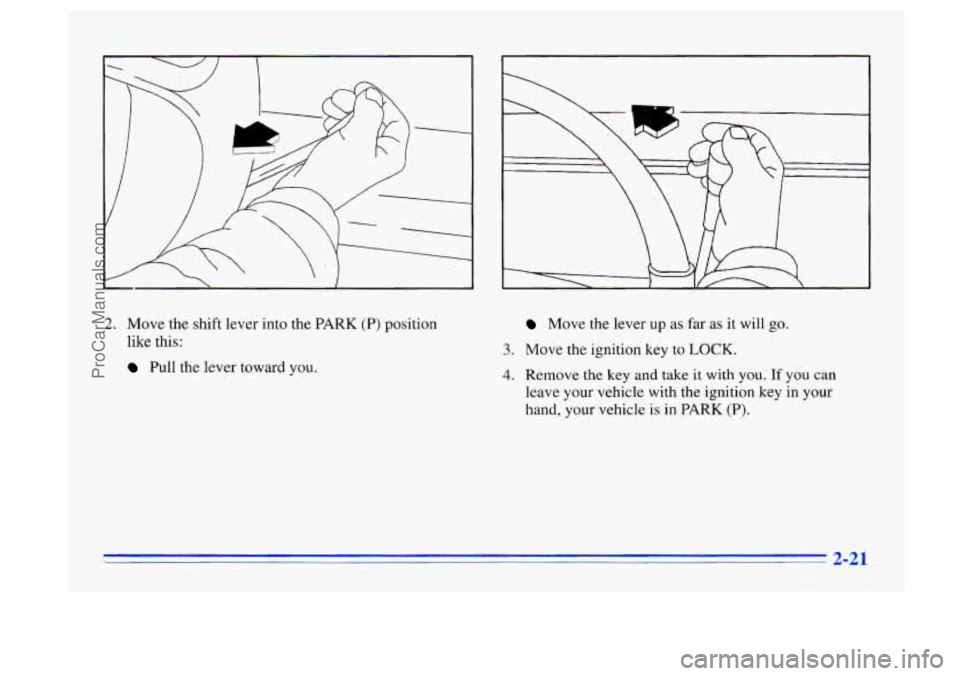
2. Move the shift lever into the PARK (P) position
like this:
Pull the lever toward you.
Move the lever up as far as it will go.
3. Move the ignition key to LOCK.
4. Remove the key and take it with you. If you can
leave your vehicle with the ignition key in your
hand, your vehicle is in
PARK (P).
2-21
ProCarManuals.com
Page 80 of 340
Leaving Your Vehicle With the
Engine
Running
A CAUTION
It can be dangerous to leave your vehicle with the
engine running. Your vehicle could move
suddenly if the shift lever
is not fully in PARK (P)
with the parking brake firmly set. And, if you
leave the vehicle with the engine running, it could
overheat and even catch fire. You or others could
be injured. Don’t leave your vehicle with the
engine running unless you have to.
If you have to leave your vehicle with the engine
running, be sure your vehicle is in PARK (P) and your
parking brake is firmly set before you leave it. After
you’ve moved the shift lever into the PARK (P)
position, hold the regular brake pedal down. Then, see if
you can move the shift lever away from PARK (P)
without first pulling it toward
you. If you can, it means
that the shift lever wasn’t fully locked into PARK
(P).
Note: If for some reason you leave your vehicle running
and
it is not in PARK (P) and the parking brake is
applied, your doors will automatically lock when you
close the door.
Torque Lock
If you are parking on a hill and you don’t shift your
transaxle into PARK (P) properly, the weight of the
vehicle may put too much force on the parking pawl in
the transaxle. You may find it difficult to pull the shift
lever
out of PARK (P). This is called “torque lock.” To
prevent torque lock, set the parking brake and then shift
into PARK (P) properly before
you leave the driver’s
seat.
To find out how, see “Shifting Into PARK (P)” in
the Index.
When you are ready
to drive, move the shift lever out of
PARK (P) before you release the parking brake.
If torque lock does occur, you may need to have another
vehicle push yours
a little uphill to take some of the
pressure from the transaxle,
so you can pull the shift
lever out of PARK (P).
2-22
ProCarManuals.com
Page 83 of 340
-
A CAUTION:
It can be dangerous to get out of your vehicle if
the shift lever is not fully in PARK (P) with the
parking brake firmly set. Your vehicle can roll.
Don’t leave your vehicle when the engine
is
running unless you have to. If you’ve left the
engine running, the vehicle can move suddenly.
You or others could be injured.
To be sure your
vehicle won’t move, even when you’re on
fairly
level ground, always set your parking brake and
move the shift lever to PARK
(P).
Follow the proper steps to be sure your vehicle won’t
move. See “Shifting Into
PARK (P)” in the Index.
If you are parking on
a hill and if you’re pulling a
trailer, also see “Towing a Trailer” in the Index.
Windows
Power Windows
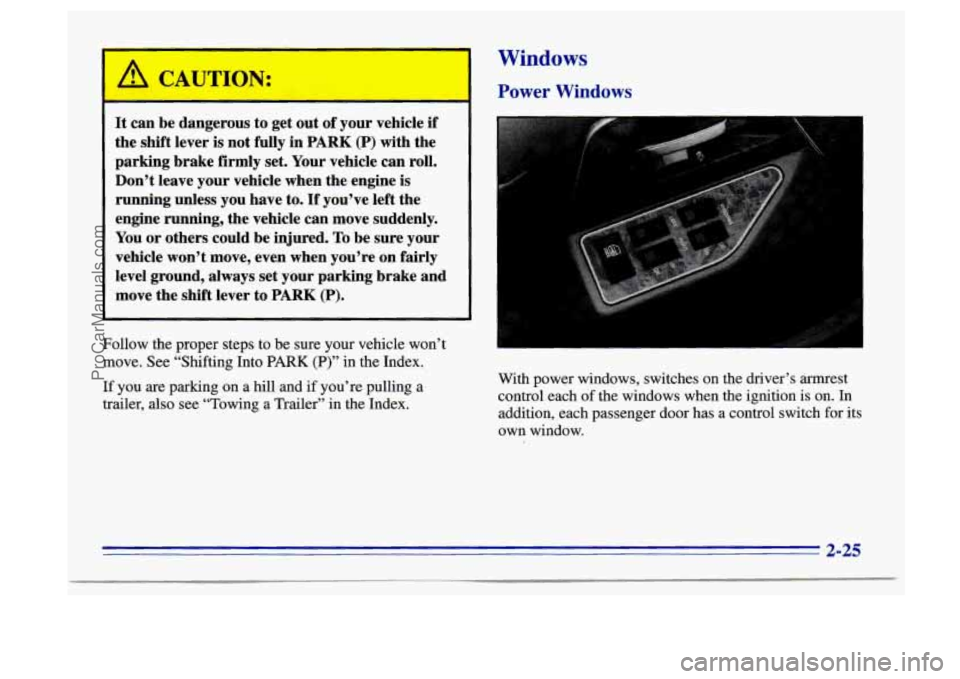
With power windows, switches on the driver’s armrest
control each of the windows when the ignition is on. In
addition, each passenger door has a control switch for its
own window.
2-25
ProCarManuals.com
Page 86 of 340
As you signal a turn or a lane change, if the arrows don’t
flash but just stay on,
a signal bulb may be burned out
and other drivers won’t
see your turn signal.
If a bulb is burned out, replace it to help avoid an
accident. If the arrows don’t go on at all when you
signal a turn, check for burned-out bulbs and check the
fuse
(see “Fuses and Circuit Breakers’’ in the Index).
Turn Signal Reminder
If your turn signal is left on for more than 3/4 of a mile
(1.2 km), a chime will sound. To turn off the chime,
move the turn signal lever
to the OFF position.
Headlamp High/Low Beam Changer Windshield Wipers
a _:::a::_
To change
the headlamps
from low beam
to high or
high
to low, pull the turn
signal lever all the way
toward you. Then release
it. When the high beams
are on, this light
on the
instrument panel also
will be on. You
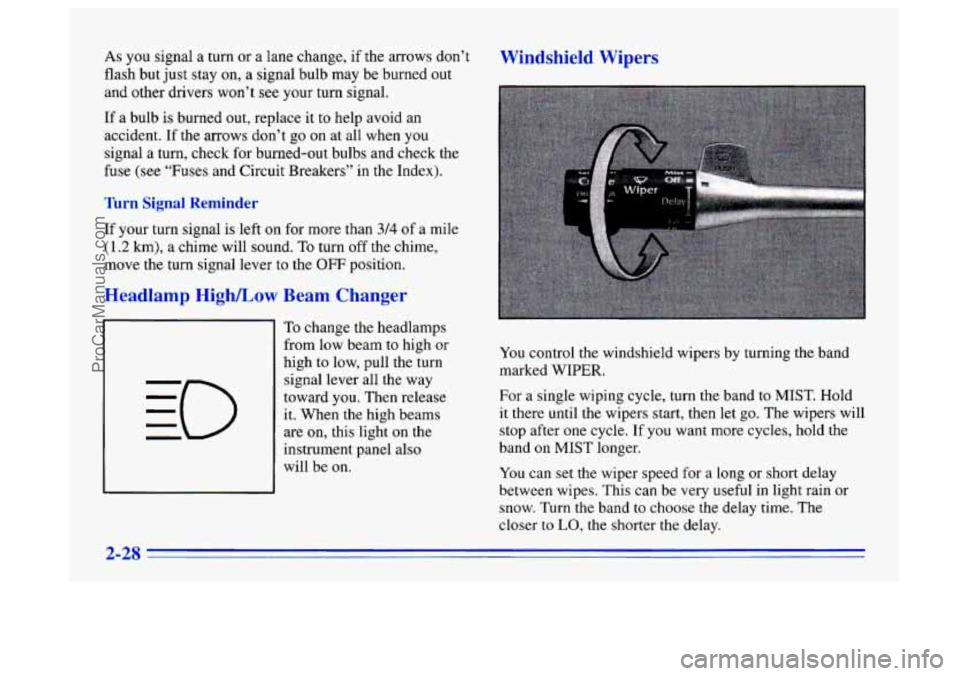
control the windshield wipers by turning the band
marked WIPER.
For a single wiping cycle, turn the band to MIST.
GoTd
it there until the wipers start, then let go. The wipers will
stop after
one cycle. If you want more cycles, hold the
band on MIST longer.
You can set the wiper speed for a long or short delay
between wipes. This can be very useful in light rain or
snow. Turn the band to choose the delay time. The
closer to
LO, the shorter the delay.
2-2s
ProCarManuals.com
Page 91 of 340
Passing Another Vehicle While Using Cruise Control
Use the accelerator pedal to increase your speed. When
you take your foot off the pedal, your vehicle will slow
down
to the cruise control speed you set earlier.
Using Cruise Control on Hills
How well your cruise control will work on hills depends
upon your speed, load and the steepness
of the hills.
When going up steep hills, you may have to step
on the
accelerator pedal to maintain your speed. When going
downhill, you may have to brake or shift
to a lower gear
to keep your speed down. Of course, applying the brake
takes you out
of cruise control. Many drivers find this to
be
too much trouble and don’t use cruise control on
steep hills.
Ending Cruise Control
There are two ways to turn off the cruise control:
Step lightly on the brake pedal; or
Move the cruise switch to OFF.
Erasing Cruise Speed Memory
When you turn off the cruise control or the ignition,
your cruise control set speed memory is erased.
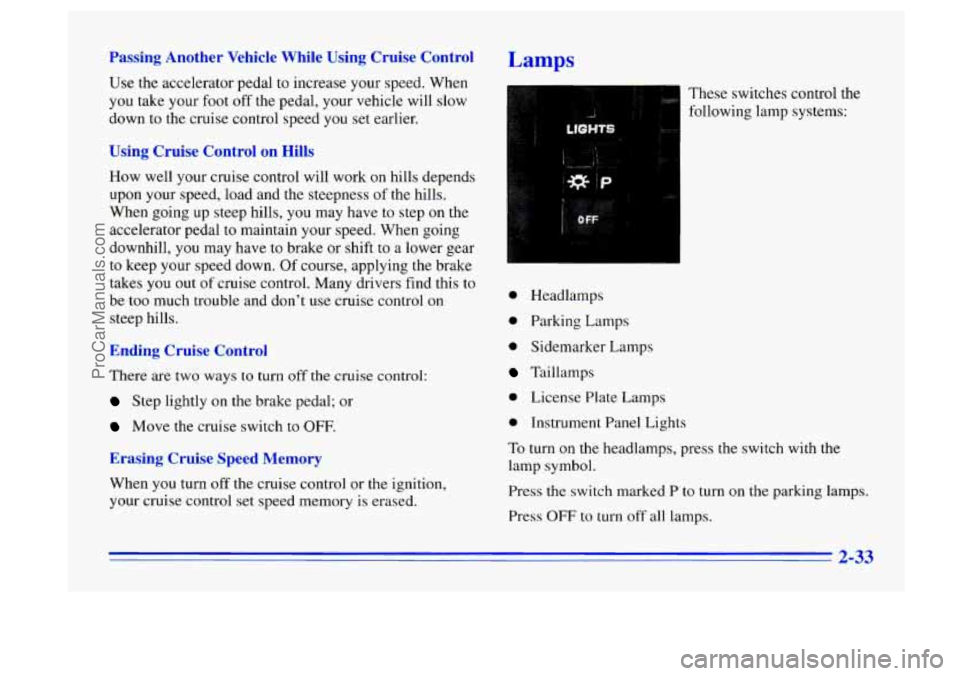
Lamps
..
li
LtOWtS
0 Headlamps
0 Parking Lamps
0 Sidemarker Lamps
Taillamps
0 License Plate Lamps
0 Instrument Panel Lights
To turn on the headlamps, press the switch with the
lamp symbol.
Press
the switch marked P to turn on the parking lamps.
Press
OFF to turn off all lamps.
2-33
ProCarManuals.com
Page 95 of 340
Mirrors
Inside Daymight Rearview M ror
When you are sitting in a comfortable driving position,
adjust the mirror
so you can see clearly behind your
vehicle. The dayhight adjustment allows you to reduce
glare from lights behind you.
To reduce glare pull the
lever toward
you to the night position.
Manual Remote Control Mirror
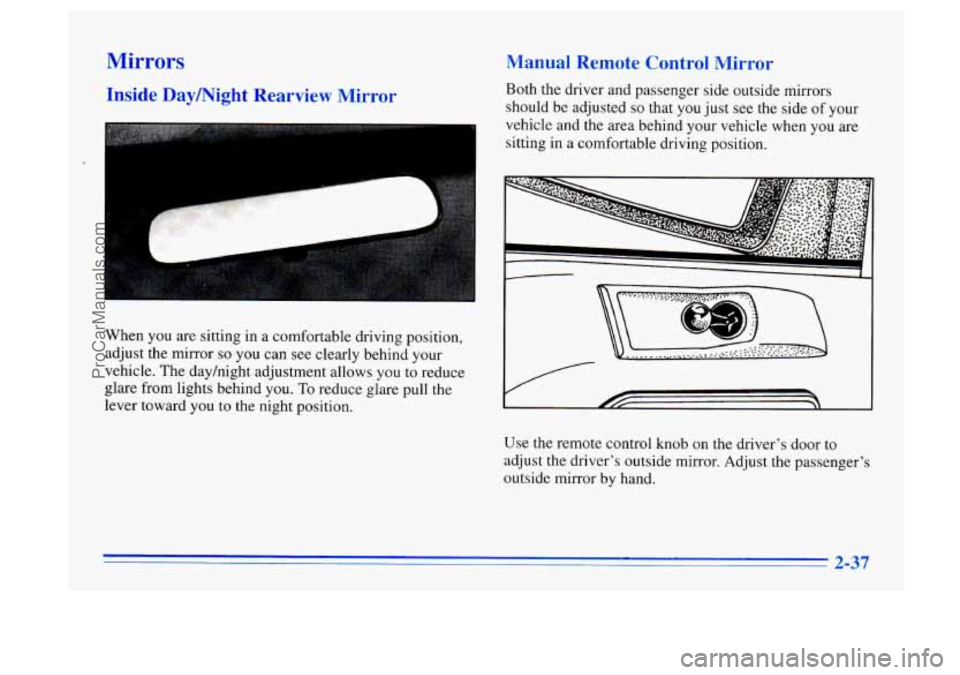
Both the driver and passenger side outside mirrors
should
be adjusted so that you just see the side of your
vehicle and the area behind your vehicle when you are
sitting
in a comfortable driving position.
Use the remote control knob on the driver's door to
adjust the driver's outside mirror. Adjust the passenger's
outside mirror by hand.
2-37
ProCarManuals.com
Page 108 of 340
Battery Light
I-+I
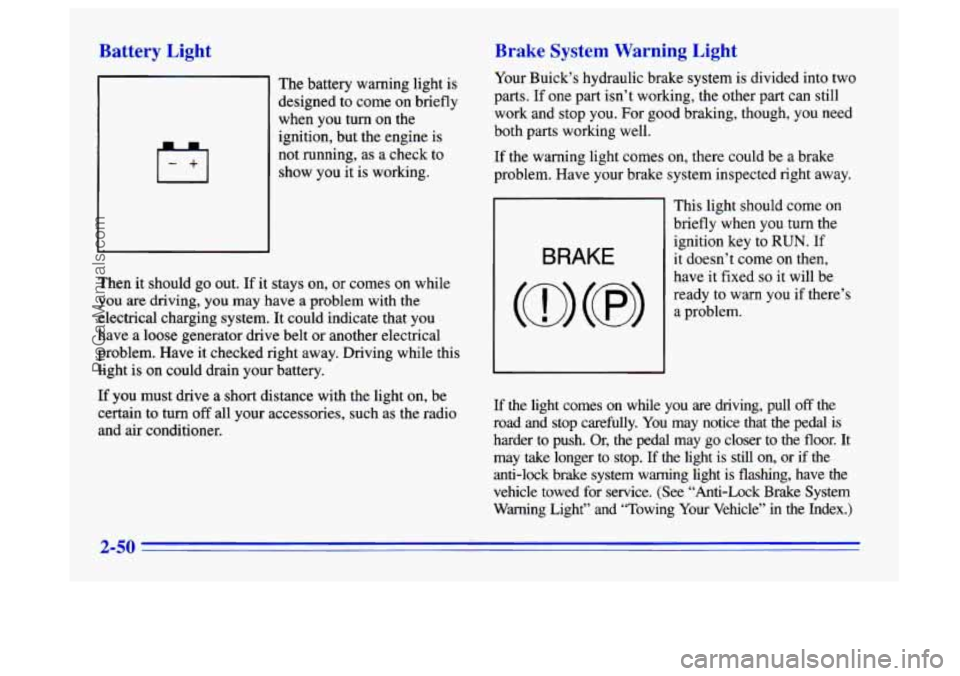
The battery warning light is
designed to come on briefly
when you turn on the
ignition, but the engine is
not running, as
a check to
show you it is working.
Then it should go out.
If it stays on, or comes on while
you
are driving, you may have a problem with the
electrical charging system. It could indicate that you
have a loose generator drive belt or another electrical
problem. Have it checked right away. Driving while this
light is on could drain your battery.
If
you must drive a short distance with the light on, be
certain to turn
off all your accessories, such as the radio
and air conditioner.
Brake System Warning Light
Your Buick’s hydraulic brake system is divided into two
parts.
If one part isn’t working, the other part can still
work and stop you. For good braking, though, you need
both parts working well.
If the warning light comes on, there could be a brake
problem. Have your brake system inspected right
away.
BRAKE
This light should come on
briefly when you turn the
ignition key to
RUN. If
it doesn’t come on then,
have it fixed
so it will be
ready to warn you if there’s
a problem.
If the light comes on while you
are driving, pull off the
road and stop carefully. You may notice that
the pedal is
harder to push. Or, the pedal may
go closer to the floor. It
may take longer to stop.
If the light is still on, or if the
anti-lock brake system warning light is flashing, have the
vehicle towed for service.
(See “Anti-Lock Brake System
Warning Light” and ‘Towing Your Vehicle” in the Index.)
2-50
ProCarManuals.com
Page 109 of 340
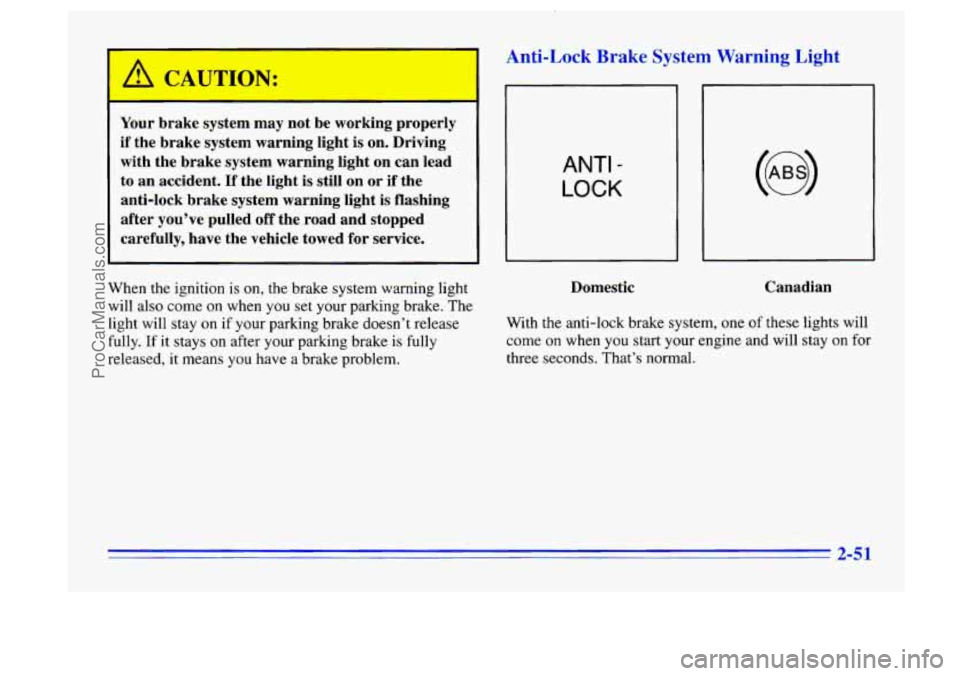
A CAUTION:
--
Your brake system may not be working properly
if the brake system warning light is on. Driving
with the brake system warning light on can lead
to an accident.
If the light is still on or if the
anti-lock brake system warning light
is flashing
after you’ve pulled off the road and stopped
carefully, have the vehicle towed for service.
When the ignition is on, the brake system warning light
will also come
on when you set your parking brake. The
light will stay
on if your parking brake doesn’t release
fully.
If it stays on after your parking brake is fully
released, it means you have
a brake problem.
Anti-Lock Brake System Warning Light
ANTI -
LOCK
Domestic
~~
Canadian
With the anti-lock brake system, one of these lights will
come on when you start your engine and will stay
on for
three seconds. That’s normal.
2-51
ProCarManuals.com
Page 110 of 340
If the light flashes when you’re driving, you don’t have
anti-lock brakes and there could be a problem with your
regular brakes. Pull
off the road and stop carefully. You
may notice that the pedal is harder to push. Or, the pedal
may go closer to the floor. It may take longer
to stop.
Have the vehicle towed for service. (See “Towing Your
Vehicle” in the Index.)
I
Your regular brake system may not be working
properly if the anti-lock brake system warning
light is flashing. Driving with the anti-lock
brake system warning light flashing can lead
to an accident. After you’ve pulled off the road
and stopped carefully, have the vehicle towed
for service.
If the anti-lock brake system warning light stays on
longer than normal after you’ve started your engine, turn
the ignition
off. Or, if the light comes on and stays on
when you’re driving, stop as soon as possible and turn
the ignition off. Then start the engine again to reset the
system. If the light still stays
on, or comes on again
while you’re driving, your Buick needs service.
If the
light is on
but not flashing and the regular brake system
warning light isn’t on, you still have brakes, but you
don’t have anti-lock brakes.
The anti-lock brake system warning light should come
on briefly when
you turn the ignition key to RUN. If the
light doesn’t come
on then, have it fixed so it will be
ready
to warn you if there is a problem.
2-52
ProCarManuals.com