fuel BUICK CENTURY 1996 Owner's Manual
[x] Cancel search | Manufacturer: BUICK, Model Year: 1996, Model line: CENTURY, Model: BUICK CENTURY 1996Pages: 340, PDF Size: 17.61 MB
Page 212 of 340
When you put the cap back on, turn it to the right until
you hear at least three clicks. Make sure
you fully install
the cap. The diagnostic system can determine
if the fuel
cap has been left
off or improperly installed. This would
allow fuel to evaporate into the atmosphere.
See
“Malfunction Indicator Lamp” in the Index.
I NOTICE:
If you need a new cap, be sure to get the right
type.
Your dealer can get one for you. If you get
the wrong type, it may not fit or have proper
venting, and your fuel tank and emissions system
might be damaged.
Checking Things Under the Hood
Hood Release
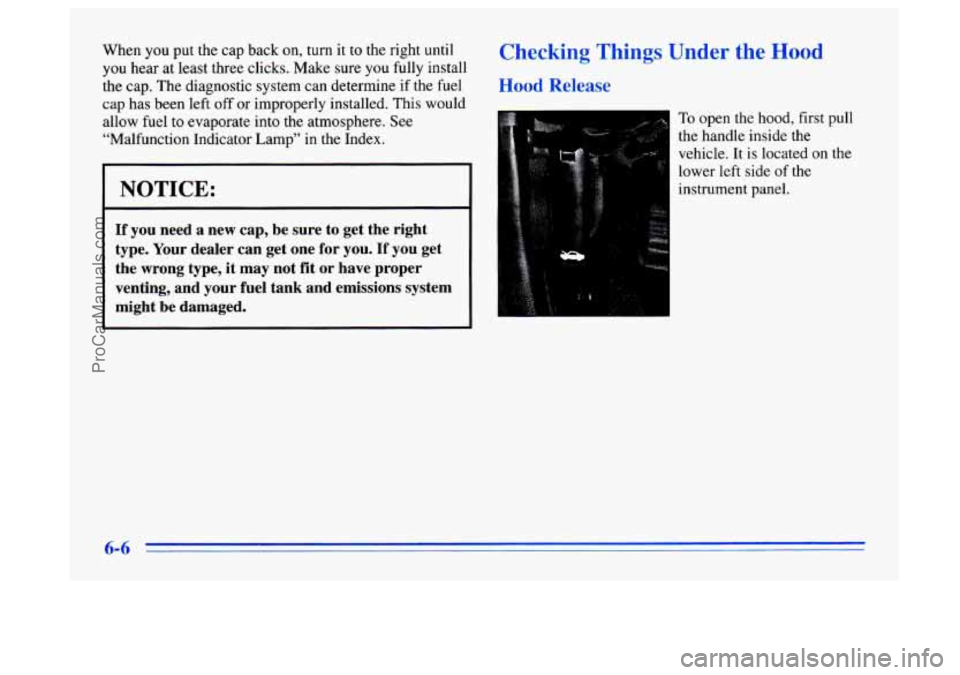
To open the hood, first pull
the handle inside
the
vehicle. It is located on the
lower left side of the
instrument panel.
6-6
ProCarManuals.com
Page 216 of 340
Things that burn can get on hot engine parts and
start a fire. These include liquids like gasoline,
oil, coolant, brake fluid, windshield washer and
other fluids, and plastic or rubber. You or others
could be burned. Be careful not
to drop or spill
Underhood Lamp
Your underhood lamp is designed to come on whenever
you raise the hood.
Engine Oil
It's a good idea to check your engine oil every time you
get fuel. In order
to get an accurate reading, the oil must
be warm and the vehicle must be on level ground.
things that will burn onto a hot engine. Turn off the engine and give the oil a few minutes to
drain back into the oil pan. If you don't, the oil dipstick
Before closing the hood, be sure all the filler caps
are on properly.
Then lift the hood
to relieve pressure on the hood prop.
Remove the hood prop from the slot in the hood and
return the prop
to its retainer. Then just let the hood
down and close
it firmly. might
not show the actual level.
Checking Engine Oil
Pull out the dipstick and clean it with a paper towel or
cloth, then push it back in all the way. Remove it again,
keeping the tip down, and check the level.
6-10
ProCarManuals.com
Page 219 of 340
RECOMMENDED SAE VISCOSITY GRADE ENGINE OILS
FOR BEST FUEL ECONOMY AND COLD STARTING, THE LOWEST
SAL VISCOSITY GRADE OIL
FOR THE EXPECTED ILL -AlURE RANGE.
HOT
WEATHER
WOK
FOR THIS
SYMBOL
17
+ 100-
+EO-
1
I
t 60“
t 40.
+ 20 ’
O! I
+ 16
c4
COLD
WEATHER
DO NOT USE SAE 2OW-50 OR ANY OTHER GRADE OIL NOT RECOMMENDED
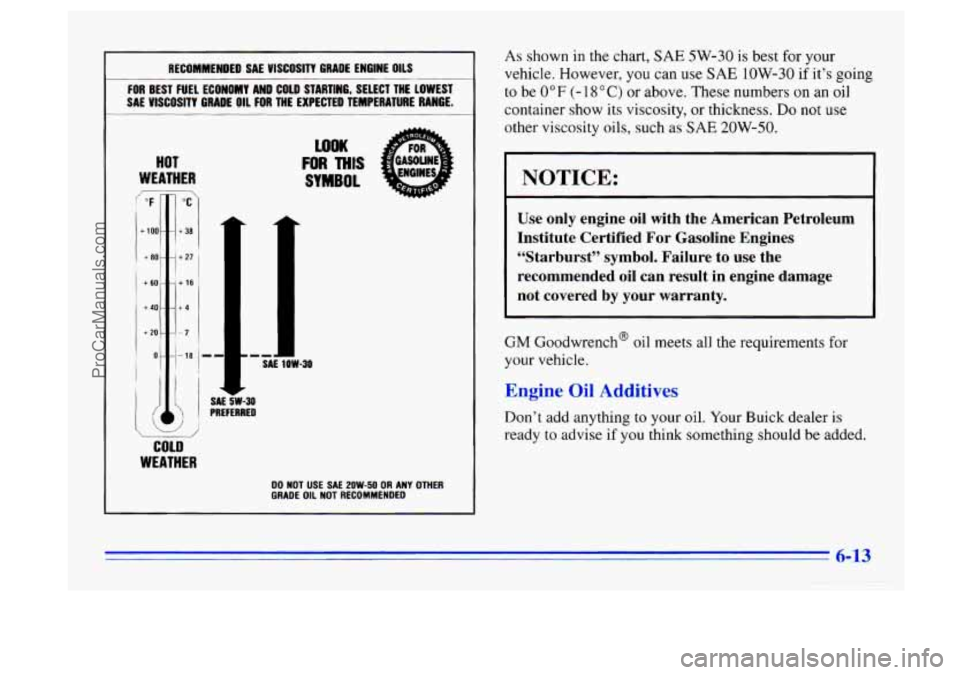
As shown in the chart, SAE 5W-30 is best for your
vehicle. However,
you can use SAE low-30 if it’s going
to be 0°F (- 18°C) or above. These numbers on an oil
container show its viscosity, or thickness.
Do not use
other viscosity oils, such as SAE 20W-50.
NOTICE:
Use only engine oil with the American Petroleum
Institute Certified For Gasoline Engines
“Starburst” symbol. Failure
to use the
recommended oil can result in engine damage not covered by your warranty.
GM Goodwrench@ oil meets all the requirements for
your vehicle.
Engine Oil Additives
Don’t add anything to your oil. Your Buick dealer is
ready to advise if you think something should be added.
ProCarManuals.com
Page 227 of 340
How to Add Fluid
Refer to the Maintenance Schedule to determine what
kind of transaxle fluid to
use. See “Recommended
Fluids and Lubricants” in the Index.
If the fluid level is low, add only enough of the proper
fluid to bring the level into the cross-hatched area
on
the dipstick.
1. Pull out the dipstick.
2. Using a long-neck funnel, add enough fluid at the
It doesn’t take much fluid, generally less than a pint
(0.5
L). Don’t overfiill. We recommend you use only
fluid labeled
DEXRON@-111, because fluid with that
label
is made especially for your automatic transaxle.
Damage caused by fluid other than
DEXRON-I11 is not
covered by your new vehicle warranty.
0 After adding fluid, recheck the fluid level as
dipstick hole
to bring it to the proper level.
described under “How to Check.”
0 When the correct fluid level is obtained, push the
dipstick back in all
the way.
Superlift Shock Absc :rs (Option)
If you have this option, you can level your vehicle for
different loads. As you need to, add air to the rear shock
absorbers through the air valve, located next to the fuel
filler cap behind the fuel filler door. Always keep
a
minimum pressure of 10- 15 psi (70- 105 kPa).
After you load your vehicle, you can add pressure until
the rear gets back to its normal riding height, but don’t
go above 90 psi (620 kPa).
NOTICE:
Do not use superlifts to raise your vehicle above
its normal riding height.
You can damage your
superlifts or other parts if you drive that way for
long periods.
ProCarManuals.com
Page 245 of 340
Inflation -- Tire Pressure
The Tire-Loading Information label, which is on the
rear edge of the driver’s door, shows the correct
inflation pressures for your tires when they’re cold.
“Cold” means your vehicle
has been sitting for at least
three hours or driven no more than 1 mile (1.6 km).
NOTICE:
Don’t let anyone tell you that, underinflation or
overinflation
is all right. It’s not. If your tires
don’t have enough air (underinflation), you can
get the following:
0 Too much flexing
Too much heat
0 Tire overloading
0 Bad wear
0. Bad handling
0 Bad fuel economy.
NOTICE: (Continued)
NOTICE: (Continued)
If your tires have too much air (overinflation),
you can get the following:
Unusual wear
Bad handling
Rough ride
Needless damage from road hazards.
When to Check
Check your tires once a month or more.
Don’t forget your compact spare tire.
It should be at
60 psi (420 Pa).
How to Check
Use a good quality pocket-type gage to check tire
pressure. You can’t
tell if your tires are properly inflated
simply by looking .at them. Radial tires may look
properly inflated even when they’re underinflated.
Be sure to put the valve caps back
on the valve stems.
They help prevent leaks by keeping out
dirt and moisture.
6-39
ProCarManuals.com
Page 259 of 340
Underbody Maintenance Chemical Paint SDotting
Chemicals used for ice and snow removal and dust
control can collect on the underbody. If these are not
removed, accelerated corrosion (rust) can occur on
the underbody parts such as
fuel lines, frame, floor
pan and exhaust system even though they have,
corrosion protection.
At least every spring, flush these materials from the
underbody with plain water. Clean any areas where mud
and other debris can collect. Dirt packed in closed areas
of the fi-ame should be loosened before being flushed.
Your dealer or an underbody vehicle washing system
can do this for you. Some
weather and atmospneric conditions can create a
I
chemical fallout. Airborne pollutants can fall upon and
attack painted surfaces on your vehicle.
This damage
can take two forms: blotchy, ringlet-shaped
discolorations, and small irregular dark spots etched into
the paint surface.
Although no defect in the paint
job causes this, Buick
will repair, at no charge to the owner, the. surfaces of
new vehicles damaged by this fallout condition within
12 months
or 12,000 ,miles (20 000 km) of purchase,
whichever occurs first.
6-53
ProCarManuals.com
Page 262 of 340
Electrical System
Add-on Electrical Equipment
I NOTICE:
Don’t add anything electrical to your Buick
unless you check with your dealer first. Some
electrical equipment can damage your vehicle
and the damage wouldn’t be covered by your
warranty. Some add-on electrical equipment
can keep other components from working as
they should.
Your vehicle has an air bag system. Before attempting to
add anything electrical to your Buick, see “Servicing
Your Air Bag-Equipped Buick” in the Index.
Headlamp Wiring
The headlamp wiring is protected by a circuit breaker in
the lamp switch. An electrical overload will cause the
lamps to
go on and off or, in some cases, to remain off.
If this happens, have your headlamp system checked
right away.
Windshield Wipers
The windshield wiper motor is protected by a circuit
breaker and a fuse.
If the motor overheats due to heavy
snow, etc., the wiper will stop until the motor cools. If
the overload is caused by some electrical problem, have
it fixed.
Power Windows and Other Power Options
Circuit breakers in the fuse panel protect the power
windows and other power accessories. When the current
load is too heavy, the circuit breaker opens and closes,
protecting the circuit until the problem is fixed.
Engine A/C, EGR, Relays, SIR Crank and
Safety Belt Fuses
These fuses are located behind the glove box. The fuse
holders are taped together with gray tape.
Other - uses
The Safety Belt/Chime (ICAM) Module fuse and the
Remote Keyless Entry fuse are located behind the fuse
block, above the hush panel.
The Fuel Pump, A/C CONT and the ECM fuses are
located under the hood.
6-56
ProCarManuals.com
Page 264 of 340
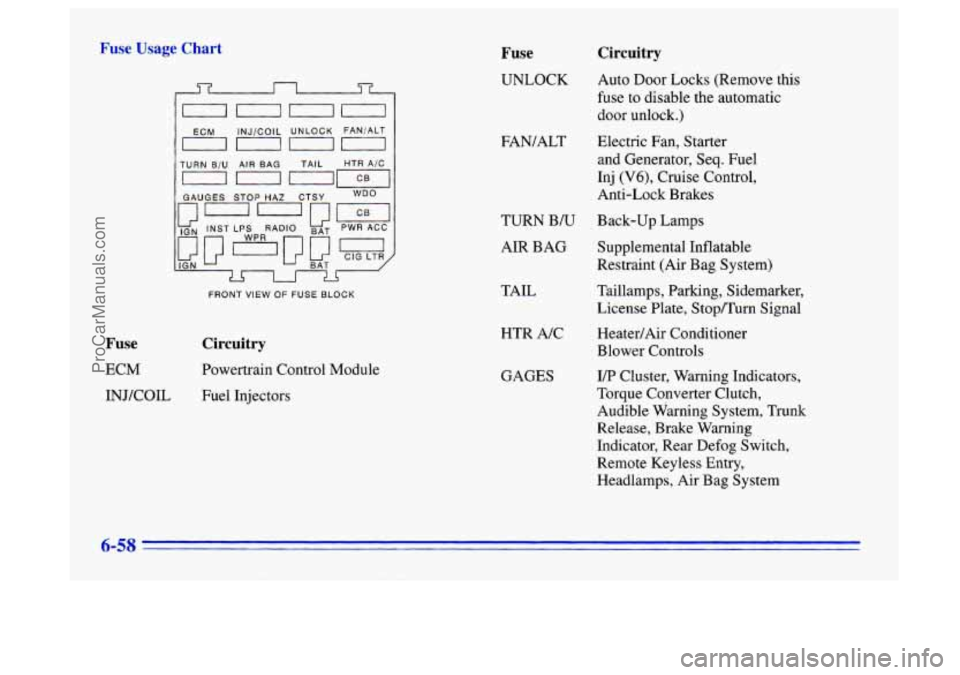
Fuse I qe Chart Fuse Circuitry
I----
ECM INJ/COIL UNLOCK FANiALT
GAUGES
STOP HAZ CTSY WDo
FRONT VIEW OF FUSE BLOCK
Fuse
ECM INJ/COIL
Circuitry
Powertrain Control Module Fuel Injectors UNLOCK Auto
Door Locks (Remove
this
fuse to disable the automatic
door unlock.)
FAN/ALT Electric Fan, Starter
and Generator, Seq. Fuel
Inj
(V6), Cruise Control,
Anti-Lock Brakes
TURN B/U Back-up Lamps
AIR BAG Supplemental Inflatable
Restraint (Air Bag System)
TAIL
HTR A/C
GAGES Taillamps,
Parking, Sidemarker,
License Plate, Stopflurn Signal
Heater/Air Conditioner
Blower Controls
IA? Cluster, Warning Indicators,
Torque Converter Clutch,
Audible Warning System, Trunk
Release, Brake Warning
Indicator, Rear Defog Switch,
Remote Keyless
Entry,
Headlamps, Air Bag System
6-58
ProCarManuals.com
Page 268 of 340
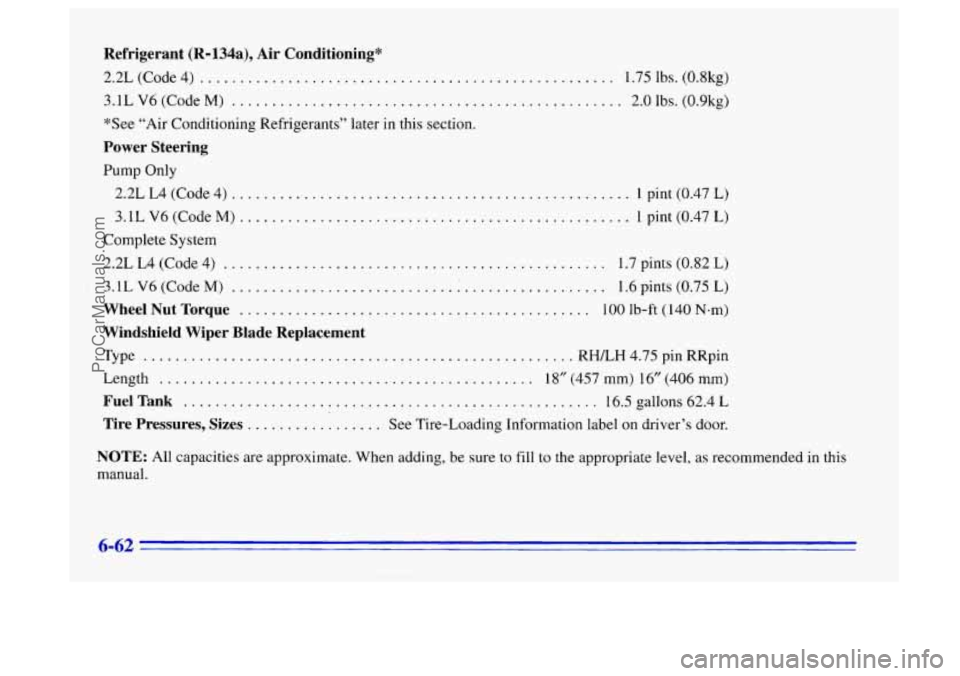
Refrigerant (R=l34a), Air Conditioning*
2.2L (Code 4) .................................................... 1.75 lbs. (0.8kg)
3.1L V6 (Code
M) ................................................. 2.0 Ibs. (0.9kg)
*See “Air Conditioning Refrigerants” later in this section.
Power Steering
Pump Only 2.2L
L4 (Code 4) .................................................. 1 pint (0.47 L)
3.1L V6 (Code M) ................................................. 1 pint (0.47 L)
2.2L L4 (Code 4) ................................................ 1.7 pints (0.82 L)
Wheel Nut Torque ............................................ 100 lb-ft (140 N-m)
Type
...................................................... RH/LH 4.75 pin RRpin
Length
............................................... 18” (457 mm) 16” (406 mm)
Complete System
3.1L V6
(Code M) ................................................ 1.6 pints (0.75 L)
Windshield Wiper Blade Replacement
Fuel Tank
................
Tire Pressures, Sizes ........
NOTE: All capacities are approx
manual. .i
................................... 16.5
gallons 62.4 L
........ See Tire-Loading Information label on driver’s door.
mate. When adding, be sure to fill to the appropriate level, as recommended in this
6-62
ProCarManuals.com
Page 272 of 340
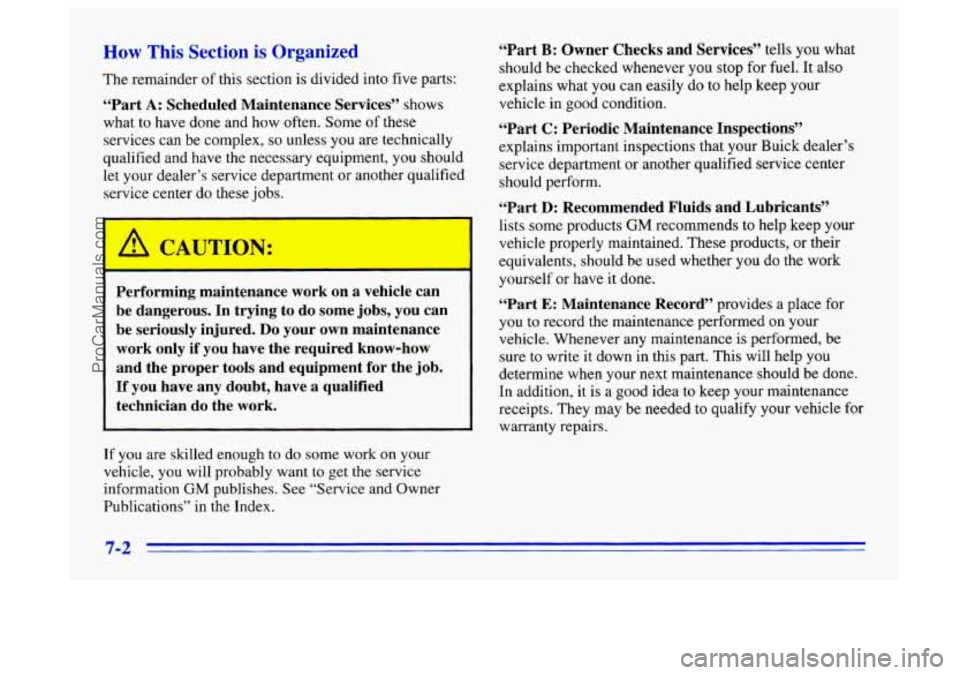
How This Section is Organized
The remainder of this section is divided into five parts:
“Part A: Scheduled Maintenance Services” shows
what to have done and
how often. Some of these
services can be complex,
so unless you are technically
qualified and have the necessary equipment,
you should
let your dealer’s service department or another qualified
service center do these jobs.
“Part B: Owner Checks and Services” tells you what
should be checked whenever you stop for fuel. It also
explains what
you can easily do to help keep your
vehicle in good condition.
“Part C: Periodic Maintenance Inspections”
explains important inspections that your Buick dealer’s
service department or another qualified service center
should perform.
L
Performing maintenance work on a vehicle can
be dangerous. In trying to
do some jobs, you can
be seriously injured.
Do your own maintenance
work only
if you have the required know-how
and the proper tools and equipment for the job.
If you have any doubt, have a qualified
technician do the work.
If you are skilled enough to do some work on your
vehicle,
you will probably want to get the service
information
GM publishes. See “Service and Owner
Publications” in the Index.
“Part D: Recommended Fluids and Lubricants”
lists some products GM recommends to help keep your
vehicle properly maintained. These products, or their
equivalents, should be used whether vou do the work
yourself or have it done.
“Part E: Maintenance Record” provides a place for
you to record the maintenance performed on your
vehicle. Whenever any maintenance is performed, be sure to write it down
in this part. This will help you
determine when your next maintenance should be done.
In addition, it is
a good idea to keep your maintenance
receipts. They may be needed to qualify your vehicle for
warranty repairs.
7-2
ProCarManuals.com