oil BUICK CENTURY 1996 Owner's Manual
[x] Cancel search | Manufacturer: BUICK, Model Year: 1996, Model line: CENTURY, Model: BUICK CENTURY 1996Pages: 340, PDF Size: 17.61 MB
Page 236 of 340
What to Add
When you do need brake fluid, use only DOT-3 brake
fluid -- such as Delco Supreme 11 @ (GM Part
No. 1052535). Use new brake fluid from a sealed
container only, and always clean the brake fluid
reservoir
cap before removing it.
I
I A CAUTION:
With the wrong kind of fluid in your brake
system, your brakes may not work well, or they
may not even work at all. This could cause
a
crash. Always use the proper brake fluid.
NOTICE:
0 Using the wrong fluid can badly damage
brake system parts. For example, just
a few
drops of mineral-based oil, such as engine
oil, in your brake system can damage brake
system parts
so badly that they’ll have to be
replaced. Don’t let someone put in the
wrong kind of fluid.
0 If you spill brake fluid on your vehicle’s
painted surfaces, the paint finish can be
damaged. Be careful not to spill brake fluid
on your vehicle.
If you do, wash it off
immediately. See “Appearance Care’’
in
the Index.
6-30
ProCarManuals.com
Page 253 of 340
If a ring forms after spot cleaning, clean the entire
area immediately or it will set.
Usin - lam-npe Cleanel- -In
1.
2.
3.
4.
5.
6.
7.
8.
9.
10.
11.
hcuum and brush the area to remove any loose
dirt.
Always clean a whole trim panel or section. Mask
surrounding trim along stitch or welt lines.
Mix Multi-Purpose Powdered Cleaner following
the directions on the container label.
Use suds only and apply with a clean sponge.
Don’t saturate the material.
Don’t rub it roughly.
As soon as you’ve cleaned the section, use a sponge
to remove the suds.
Rinse the section with
a clean, wet sponge.
Wipe off what’s left with a slightly damp paper
towel or cloth.
Then dry it immediately with a blow dryer.
Wipe with a clean cloth.
Using Solvent-Type Cleaner on Fabric
First, see if you have to use solvent-type cleaner at all.
Some spots and stains will clean off better with just
water and mild soap.
If
you need to use a solvent:
Gently scrape excess soil from the trim material with
a clean, dull knife or scraper.
Use very little cleaner,
light pressure and clean cloths (preferably
cheesecloth). Cleaning should start at the outside of
the stain, “feathering” toward the center. Keep
changing to a clean section
of the cloth.
When you clean a stain from fabric, immediately
dry the area with a blow dryer to help prevent a
cleaning ring.
ProCarManuals.com
Page 254 of 340
Special Cleaning Problems
Greasy or Oily Stains
Stains caused by grease, oil, butter, margarine, shoe
polish, coffee with cream, chewing gum, cosmetic
creams, vegetable oils, wax crayon, tar and asphalt can
be removed as follows:
1. Carefully scrape off excess stain.
2. Follow the solvent-type instructions described earlier.
3. Shoe polish, wax crayon, tar and asphalt will stain if
left on a vehicle’s seat fabric. They should be removed
as soon as possible. Be careful, because the cleaner
will dissolve them and may cause them to spread.
Non-Greasy Stains
Stains caused by catsup, coffee (black), egg, fruit, fruit
juice, milk, soft drinks, wine, vomit, urine and blood can
be removed as follows:
1. Carefully scrape off excess stain, then sponge the
soiled area with cool water.
2. If a stain remains, follow the foam-type instructions
described earlier.
3. If an odor lingers after cleaning vomit or urine,
treat the area with
a waterhaking soda solution:
1 teaspoon (5 ml) of baking soda to 1 cup (250 ml)
of lukewarm water.
4. If needed, clean lightly with solvent-type cleaner.
Combination Stains
Stains caused by candy, ice cream, mayonnaise, chili
sauce and unknown stains can be removed as follows:
0 Carefully scrape off excess stain, then clean with
cool water and allow to dry.
0 If a stain remains, clean it with solvent-type cleaner.
Cleaning Vinyl
Use warm water and a clean cloth.
0 Rub with a clean, damp cloth to remove dirt. You
may have to do it more than once.
0 Things like tar, asphalt and shoe polish will stain if
you don’t get them off quickly. Use a clean cloth and
a
GM Vinylkeather Cleaner or equivalent product.
ProCarManuals.com
Page 255 of 340
Cleaning Leather
Use a soft cloth with lukewarm water and a mild soap or
saddle soap.
0
0
0
For stubborn stains, use a GM VinyVLeather Cleaner
or equivalent product.
Never use oils, varnishes, solvent-based or abrasive
cleaners, furniture polish or shoe polish on leather.
Soiled leather should be cleaned immediately. If
dirt is allowed to work into the finish, it can harm
the leather.
ning the Top of tl Instrument Panel
Care of Safety Belts
Keep b-l+s clea Lnd dry.
bse only mild soap and water to clean the top surfaces
of the instrument panel. Sprays containing silicones or
waxes may cause annoying reflections
in the windshield
and even make it difficult to see through the windshield
under certain conditions.
Do not bleach or dye safety belts. If you do, it
may severely weaken them.
In a crash, they
might not be able to provide adequate protection.
Clean safety belts only with mild soap and
lukewarm water.
Glass
Glass should be cleaned often. GM Glass Cleaner
(GM Part No. 1050427) or a liquid household glass
cleaner will remove normal tobacco smoke and dust
films.
Don't use abrasive cleaners on glass, because they may
cause scratches. Avoid placing decals on the inside rear
window, since they may have
to be scraped off later. If
abrasive cleaners are used on the inside of the rear
window, an electric defogger element may be damaged.
Any temporary license should not be attached across the
defogger grid.
6-49
ProCarManuals.com
Page 257 of 340
Finish Care
Occasional waxing or mild polishing of your Buick by
hand may be necessary to remove residue from the paint
finish. You can get GM-approved cleaning products
from your dealer. (See “Appearance Care and Materials”
in the Index,)
Your Buick has a “basecoatklearcoat” paint finish.
The clearcoat gives more depth and gloss
to the colored
basecoat. Always use waxes and polishes that are
non-abrasive and made for a basecoatklearcoat
paint finish.
1 NOTICE:
Machine compounding or aggressive polishing on
a basecoatklearcoat paint finish may dull the
finish or leave swirl marks.
Foreign materials such as calcium chloride and other
salts, ice melting agents, road oil and tar, tree sap, bird
droppings, chemicals from industrial chimneys, etc.,
can damage your vehicle’s finish
if they remain on
painted surfaces. Wash the vehicle as soon as possible. If
necessary, use non-abrasive cleaners that are marked
safe for painted surfaces
to remove foreign matter.
Exterior painted surfaces are subject to aging, weather
and chemical fallout that can take their toll over a period
of years. You can help to keep the paint finish looking
new by keeping your Buick garaged or covered
whenever possible.
Aluminum Wheels (If So Equipped)
Keep your wheels clean using a soft clean cloth with
mild soap and water. Rinse with clean water. After
rinsing thoroughly, dry with
a soft clean towel. A wax
may then
be applied.
The surface of these wheels is similar to the painted
surface of your car. Don’t use strong soaps, chemicals,
abrasive polishes, abrasive cleaners or abrasive cleaning
brushes on them because you could damage the surface.
Don’t take your vehicle through an automatic car wash
that has silicon carbide tire cleaning brushes. These
brushes can also damage the surface of these wheels.
6-51
ProCarManuals.com
Page 264 of 340
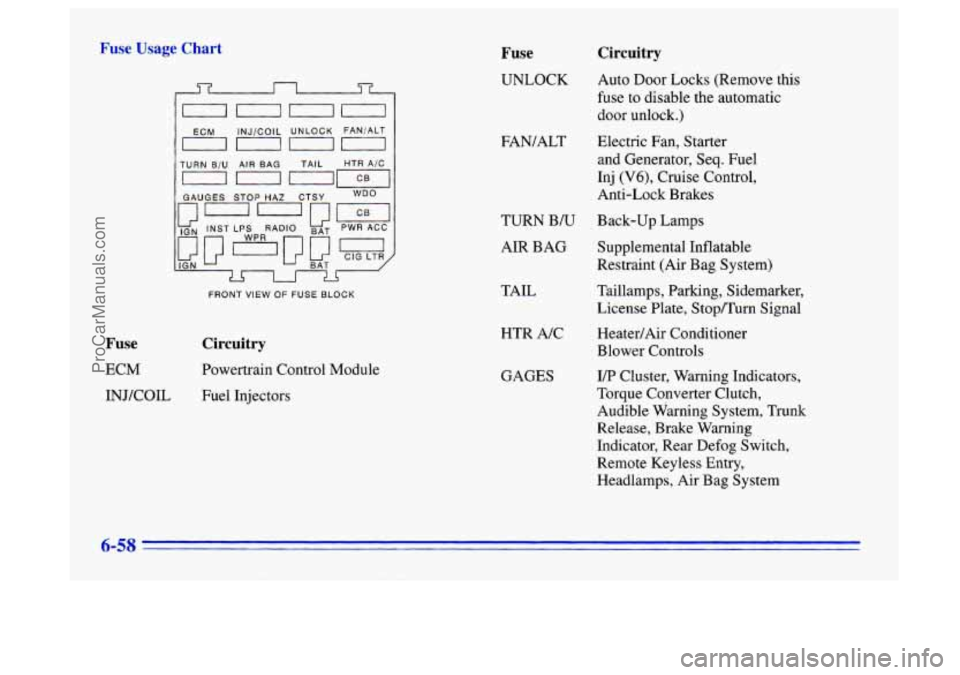
Fuse I qe Chart Fuse Circuitry
I----
ECM INJ/COIL UNLOCK FANiALT
GAUGES
STOP HAZ CTSY WDo
FRONT VIEW OF FUSE BLOCK
Fuse
ECM INJ/COIL
Circuitry
Powertrain Control Module Fuel Injectors UNLOCK Auto
Door Locks (Remove
this
fuse to disable the automatic
door unlock.)
FAN/ALT Electric Fan, Starter
and Generator, Seq. Fuel
Inj
(V6), Cruise Control,
Anti-Lock Brakes
TURN B/U Back-up Lamps
AIR BAG Supplemental Inflatable
Restraint (Air Bag System)
TAIL
HTR A/C
GAGES Taillamps,
Parking, Sidemarker,
License Plate, Stopflurn Signal
Heater/Air Conditioner
Blower Controls
IA? Cluster, Warning Indicators,
Torque Converter Clutch,
Audible Warning System, Trunk
Release, Brake Warning
Indicator, Rear Defog Switch,
Remote Keyless
Entry,
Headlamps, Air Bag System
6-58
ProCarManuals.com
Page 270 of 340
Normal Maintenance Replacement Parts
Air Cleaner Element
2.2L L4 .................... AC Type A-905C
3.1L
V6 .................... AC Qpe A-925C
All Engines
................... AC Type PF-47
2.2L L4 ................... AC Type CV-900C
3.1L
V6 ................... AC Type CV-892C
2.2LL4
.......................... 24574912
Gap:
0.060 inch (1.50 mm)
3.1L V6 .................... AC Type 041-940
Gap:
0.060 inch (1 SO mm)
Batteries
Remote Keyless Duracell Type
Entry Transmitter ........ DL2016 (2) or equivalent
Engine Oil Filter
PCV Valve
Spark Plugs
8 .................
Air Conditioning Refrigerants
Not all air conditioning refrigerants are the same.
If the air conditioning system in your vehicle needs
refrigerant, be sure the proper refrigerant is used.
If you’re not sure, ask your Buick dealer.
6-64
__
ProCarManuals.com
Page 271 of 340
Section 7 Maintenance Schedule
I
LE
IMPORTANT:
KEEP ENGINE OIL
AT THE PROPER
,VEL AND CHANGE
RECOMMENDED
AS
This section covers the maintenance required for your
Buick. Your vehicle needs these services to retain its
safety, dependability and emission control performance.
Protectiob.
Plan
Have you purchased the GM Protection Plan? The Plan
supplements
your new vehicle warranties. See your
Warranty and Owner Assistance booklet, or your Buick
dealer
for details.
Introduction
Your Vehicle and the Environment
Proper vehicle maintenance not only helps to keep your
vehicle in good working condition, but also helps the
environment. All recommended maintenance procedures
are important. Improper vehicle maintenance can even
affect the quality
of the air we breathe. Improper fluid
levels or the wrong tire inflation can increase the level
of emissions from your vehicle.
To help protect our
environment, and to keep your vehicle
in good
condition, please maintain your vehicle properly.
7-1
ProCarManuals.com
Page 274 of 340
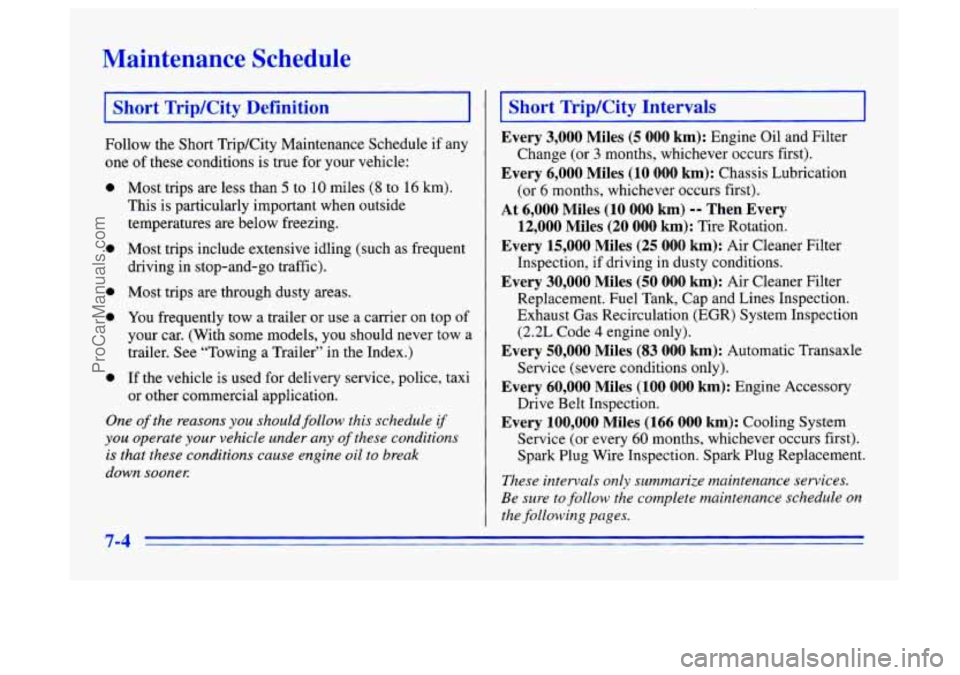
Maintenance Scl aule
1 Short Trip/City Definition 1
Follow the Short Trip/City Maintenance Schedule if any
one
of these conditions is true for your vehicle:
a
a
a
a
0
Most trips are less than 5 to 10 miles (8 to 16 km).
This is particularly important when outside
temperatures
are below freezing.
Most trips include extensive idling (such as frequent
driving
in stop-and-go traffic).
Most trips are through dusty
areas.
You frequently tow a trailer or use a carrier on top of
your car. (With some models, you should never tow a
trailer. See “Towing a Trailer” in the Index.)
If the vehicle is used for delivery service, police, taxi
or other commercial application.
One
of the reasons you should follow this schedule if
you operate your vehicle under any of these conditions
is that these conditions cause engine oil to break
down sooneE
Short Trip/City Intervals -
Every 3,000 Miles (5 000 km): Engine Oil and Filter
Change (or
3 months, whichever occurs first).
Every 6,000 Miles (10 000 km): Chassis Lubrication
(or
6 months, whichever occurs first).
At 6,000 Miles (10 000 km) -- Then Every
12,000 Miles (20 000 km): Tire Rotation.
Every 15,000 Miles (25 000 km): Air Cleaner Filter
Inspection, if driving in dusty conditions.
Every 30,000 Miles (50 000 km): Air Cleaner Filter
Replacement. Fuel Tank, Cap and Lines Inspection.
Exhaust Gas Recirculation (EGR) System Inspection
(2.2L Code 4 engine only).
Every 50,000 Miles (83 000 km): Automatic Transaxle
Service (severe conditions only).
Every 60,000 Miles (100 000 km): Engine Accessory
Drive Belt Inspection.
Every 100,000 Miles (166 000 km): Cooling System
Service
(or every 60 months, whichever occurs first).
Spark Plug Wire Inspection. Spark Plug Replacement.
These intervals only summarize maintenance services.
Be sure to follow the complete maintenance schedule on
the following pages.
7-4
ProCarManuals.com
Page 275 of 340
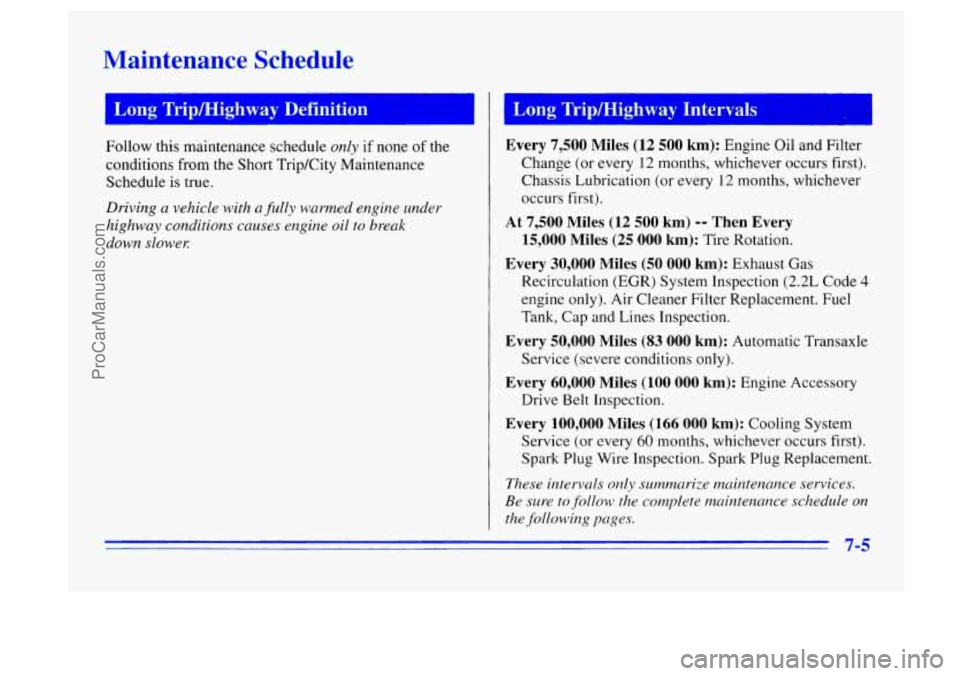
Maintenance Schedule
LOI- - Tripmighway Definition Long Tripmighway Intervals
Follow this maintenance schedule only if none of the
conditions from the Short TripKity Maintenance
Schedule is true.
Driving a vehicle with a fully warmed engine under
highway conditions causes engine
oil to break
down
slowel:
gvery -1,500 Miles (12 5UV km): Engine Oil and Filter
Change (or every
12 months, whichever occurs first).
Chassis Lubrication (or every
12 months, whichever
occurs first).
At 7,500 Miles (12 500 km) -- Then Every
15,000 Miles
(25 000 km): Tire Rotation.
Every 30,000 Miles (50 000 km): Exhaust Gas
Recirculation
(EGR) System Inspection (2.2L Code 4
engine only). Air Cleaner Filter Replacement. Fuel
Tank, Cap and Lines Inspection.
Every 50,000 Miles (83 000 km): Automatic Transaxle
Service (severe conditions only).
Every 60,000 Miles (100 000 km): Engine Accessory
Drive Belt Inspection.
Every 100,000 Miles (166 000 km): Cooling System
Service
(or every 60 months, whichever occurs first).
Spark Plug Wire Inspection. Spark Plug Replacement.
Tlzese interwls
ordv summarize maintenance services.
Be sure to~follow the complete maintenance schedule on.
the-following pages.
7-5
ProCarManuals.com