child restraint BUICK CENTURY 1997 Owner's Manual
[x] Cancel search | Manufacturer: BUICK, Model Year: 1997, Model line: CENTURY, Model: BUICK CENTURY 1997Pages: 406, PDF Size: 20.64 MB
Page 69 of 406
A child in a rear-facing child restraint can be
seriously injured if the right front passenger’s air
bag inflates. This
is because the back of a
rear-facing child restraint would be very close to
the inflating air bag. Always secure a rear-facing
child restraint in the rear seat.
You’ll be using the lap-shoulder belt. See the earlier part
about the top strap if the child restraint has
one.
1.
2.
3.
Because your vehicle has a right front passenger air
bag, always move the seat as far back as it will
go
before securing a forward-facing child restraint. (See
“Seats” in the Index.)
Put the restraint on the seat. Follow the instructions
for the child restraint.
Secure the child in the child restraint as the
instructions say.
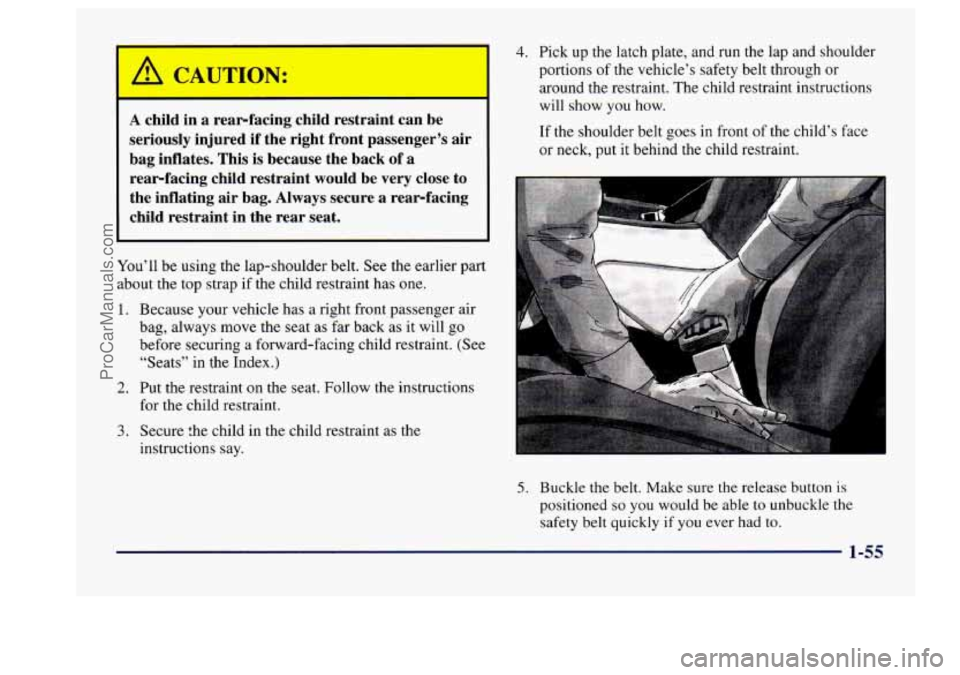
4. Pick up the latch plate, and run the lap and shoulder
portions
of the vehicle’s safety belt through or
around the restraint. The child restraint instructions
will show
you how.
If the shoulder belt goes in front of the child’s face
or neck, put it behind the child restraint.
5. Buckle the belt. Make sure the release button is
positioned so you would be able to unbuckle the
safety belt quickly if you ever had to.
1-55
ProCarManuals.com
Page 70 of 406
r I
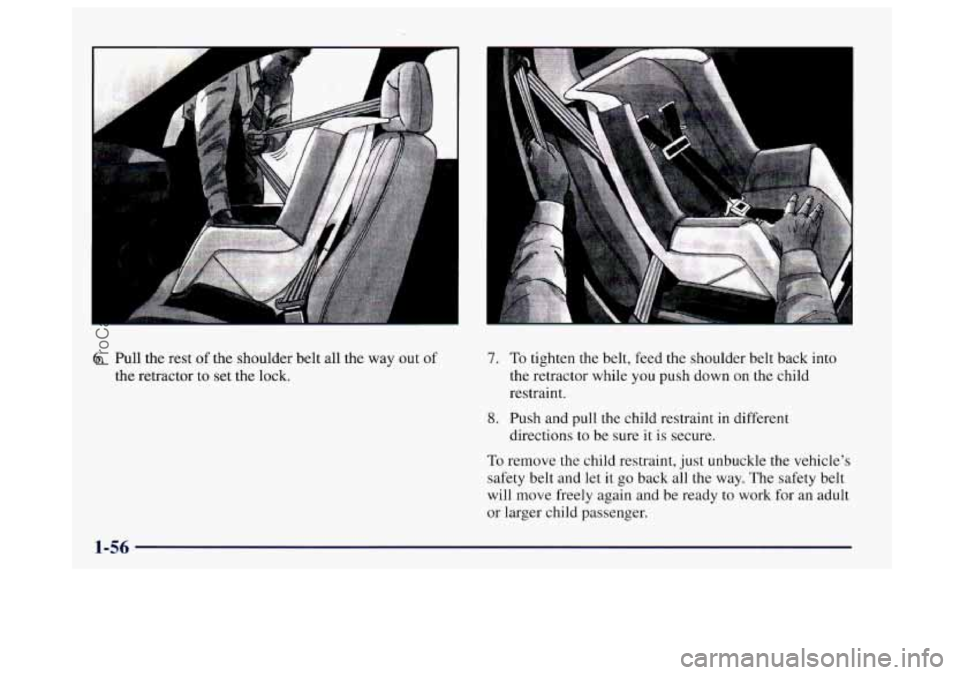
6. Pull the rest of the shoulder belt all the way out of
the retractor to set the lock.
7. To tighten the belt, feed the shoulder belt back into
the retractor while you push down on the child
restraint.
8. Push and pull the child restraint in different
directions to be sure it is secure.
To remove the child restraint, just unbuckle the vehicle's
safety belt and let
it go back all the way. The safety belt
will move freely again and be ready to work for an adult
or larger child passenger.
1-56
ProCarManuals.com
Page 71 of 406
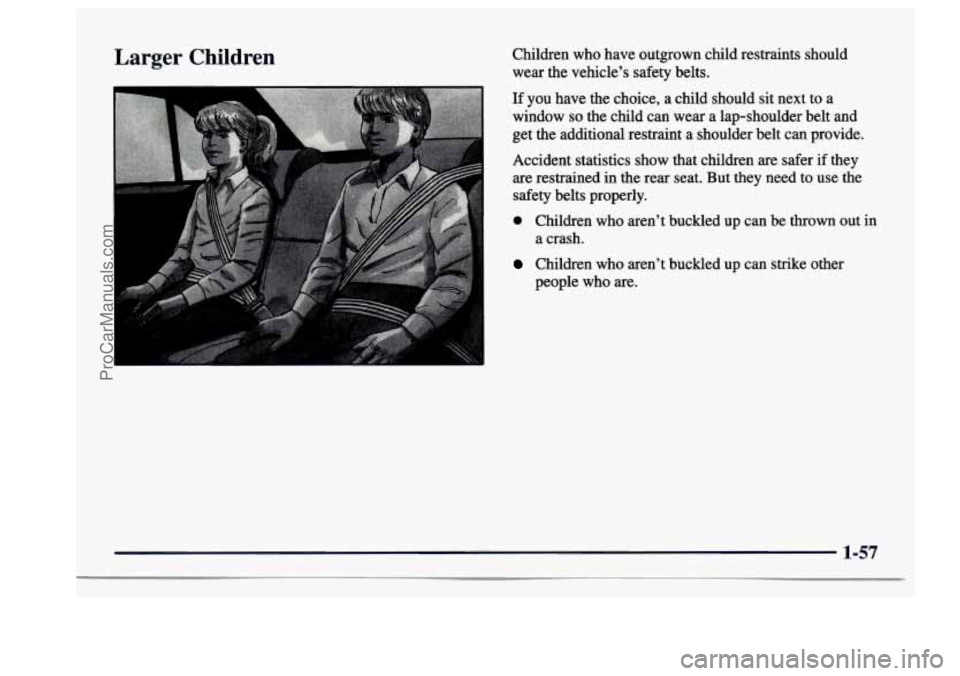
Larger Children Children who have outgrown child restraints should
wear the vehicle’s safety belts.
If you have the choice, a child should sit next to a
window
so the child can wear a lap-shoulder belt and
get the additional restraint a shoulder belt can provide.
Accident statistics show that children are safer if they
are restrained in the rear seat.
But they need to use the
safety belts properly.
0 Children who aren’t buckled up can be thrown out in
Children who aren’t buckled up can strike other
a crash.
people who are.
1-57
ProCarManuals.com
Page 72 of 406
I
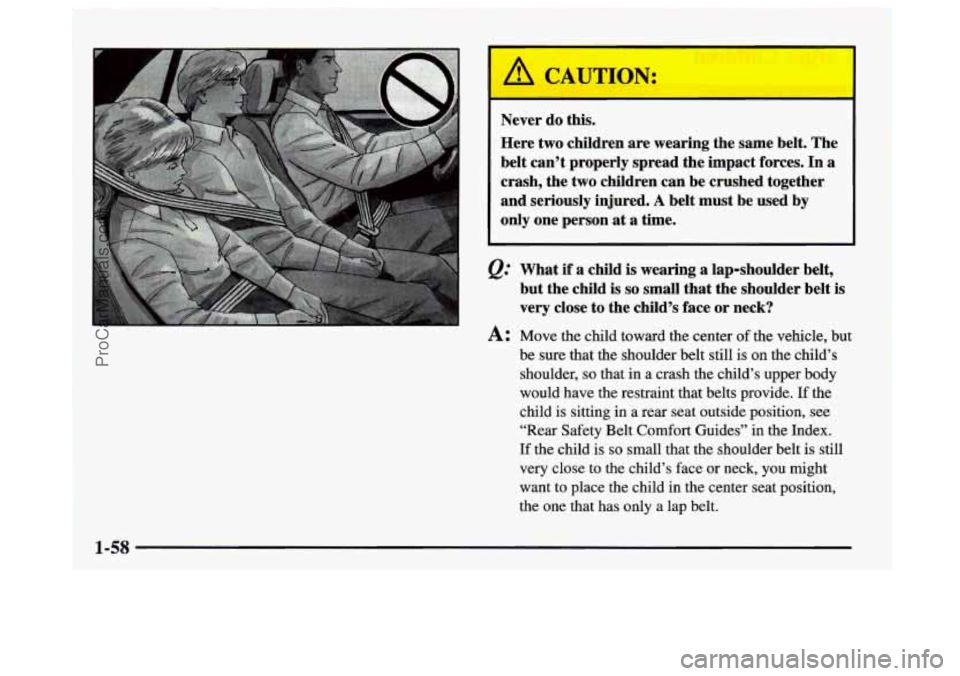
Never do this.
Here two children are wearing the same belt. The
belt can’t properly spread the impact forces.
In a
crash, the two children can be crushed together
and seriously injured.
A belt must be used by
only one person at a time.
Q: What if a child is wearing a lap-shoulder belt,
but the child
is so small that the shoulder belt is
very close to the child’s face or neck?
A: Move the child toward the center of the vehicle, but
be sure that the shoulder belt still is on the child’s
shoulder,
so that in a crash the child’s upper body
would have the restraint that belts provide. If the
child is sitting in a rear seat outside position, see
“Rear Safety Belt
Comfort Guides’’ in the Index.
If the child is so small that the shoulder belt is still
very close to the child’s face or neck, you might
want to place the child in the center seat position,
the one that has only a lap belt.
1-58
ProCarManuals.com
Page 74 of 406
Safety Belt Extender
If the vehicle’s safety belt will fasten around you, you
should use it.
But if a safety belt isn’t long enough to fasten, your
dealer will order you an extender. It’s free. When you go
in to order it, take the heaviest coat you will wear,
so the
extender will be long enough for you. The extender will
be just for you, and just for the seat in your vehicle that
you choose. Don’t let someone else use it, and use it
only for the seat it is made to fit.
To wear it, just attach
it to the regular safety belt.
Checking Your Restraint Systems
Now and then, make sure the safety belt reminder light
and all your belts, buckles, latch plates, retractors and
anchorages
are working properly. If your vehicle has a
built-in child restraint, also periodically make sure the
harness straps, latch plates, buckle, clip, retractors and
anchorages
are working properly. Look for any other
loose or damaged safety belt and built-in child restraint
system parts. If you see anything that might keep a
safety belt or built-in child restraint system from doing
its job, have it repaired.
Torn or frayed safety belts may not protect you in a
crash. They can rip apart under impact forces. If a belt is
torn or frayed, get a new one right away.
If your vehicle has the built-in child restraint, torn or
frayed harness straps can rip apart under impact forces
just like torn or frayed safety belts can. They may
not
protect a child in a crash. If a harness strap is torn or
frayed, get a new harness right away.
Also look for any opened or broken air bag covers, and
have them repaired or replaced. (The air bag system
does not need regular maintenance.)
1-60
ProCarManuals.com
Page 75 of 406
Replacing Restraint System Parts
After
a Crash
If you’ve had a crash, do you need new safety belts or
built-in child restraint parts?
After
a very minor collision, nothing may be necessary.
But if the safety belts or built-in child restraint harness
straps were stretched, as they would be
if worn during a
more severe crash, then you need new safety belts or
harness straps.
If safety belts or built-in child restraint harness straps
are cut or damaged, replace them. Collision damage also
may mean
you will need to have safety belt, built-in
child restraint or seat parts repaired or replaced. New
parts and repairs may be necessary even if the safety
belt or built-in child restraint wasn’t being used at the
time
of the collision.
If an air bag inflates, you’ll need to replace air bag
system parts. See the part on the air bag system earlier
in this section.
1-61
ProCarManuals.com
Page 216 of 406
If you put things inside your vehicle -- like suitcases,
tools, packages or anything else
-- they will go as fast as
the vehicle goes. If you have to stop or turn quickly, or
if there
is a crash, they’ll keep going.
Things you put inside your vehicle can strike
and injure people in
a sudden stop or turn, or in
a crash.
Put things in the trunk of your vehicle. In a
trunk, put them
as far forward as you can.
Try to spread the weight evenly.
inside the vehicle
so that some of them are
above the tops of the seats.
Don’t leave an unsecured child restraint in
your vehicle.
When you carry something inside the
vehicle, secure it whenever you can.
Never stack heavier things, like suitcases,
Towing a Trailer
If you don’t use the correct equipment and drive
properly, you can lose control when you pull
a
trailer. For example, if the trailer is too heavy, the
brakes may not work well
-- or even at all. You
and your passengers could be seriously injured.
Pull a trailer only if you have followed all the
steps in this section. Ask your Buick dealer
for
advice and information about towing a trailer
with your vehicle.
NOTICE:
Pulling a trailer improperly can damage your
vehicle and result in costly repairs not covered by
your warranty.
To pull a trailer correctly, follow
the advice in this part, and see your Buick dealer
for important information about towing a trailer
with your vehicle.
ProCarManuals.com
Page 267 of 406
Section 6 Service and Appearance Care
Here you will find information about the care of your Buick. This section begins with service and fuel information,
and then
it shows how to check important fluid and lubricant levels. There is also technical information about your
vehicle, and a part devoted
to its appearance care.
6-2
6-3
6-5
6-
5
6-7
6- 10
6-15
6-17
6-20
6-24
6-25
6-26
6-29
6-30
6-37 6-45
6-45
6-48
6-49 Service
Fuel
Fuels in Foreign Countries
Filling Your Tank
Checking Things Under the Hood
Engine Oil
Air Cleaner
Automatic Transaxle Fluid
Engine Coolant
Power Steering Fluid
Windshield Washer Fluid
Brakes
Battery
Bulb Replacement
Tires
Appearance Care
Cleaning the Inside of Your Buick
Cleaning the Built-in Child Restraint
Care
of Safety Belts and Built-in Child
Restraint Harness 6-49
6-49
6-50
6-50
6-5 1
6-52
6-52 6-52
6-5
3
6-53
6-54
6-55
6-55
6-56 6-62
6-62
6-63
6-63
6-63 Cleaning
Glass Surfaces
Cleaning the Outside
of the Windshield and
Wiper Blades
Weatherstrips
Cleaning the Outside of Your Buick
Cleaning Aluminum Wheels
Cleaning Tires
Sheet Metal Damage
Finish Damage
Underbody Maintenance
Chemical Paint Spotting
Appearance Care Materials Chart
Vehicle Identification Number
(VIN)
Service Parts Identification Label
Electrical System Replacement Bulbs
Capacities and Specifications
Vehicle Dimensions
Normal Maintenance Replacement Parts
Air Conditioning Refrigerants
6-1
ProCarManuals.com
Page 314 of 406
Cleaning Leather
Use a soft cloth with lukewarm water and a mild soap or
saddle soap and wipe dry with
a soft cloth. Then, let the
leather dry naturally.
Do not use heat to dry.
0 For stubborn stains, use a leather cleaner. See your
dealer for
this product.
0 Never use oils, varnishes, solvent-based or abrasive
cleaners, furniture polish or shoe polish
on leather.
Soiled or stained leather should be cleaned
immediately.
If dirt is allowed to work into the
finish, it can harm the leather.
Cleaning the Top of the Instrument Panel
Use only mild soap and water to clean the top surfaces
of the instrument panel. Sprays containing silicones or
waxes may cause annoying reflections in the windshield
and even make
it difficult to see through the windshield
under certain conditions.
Cleaning the Built-in Child Restraint
Your built-in child restraint may be cleaned with mild
soap
and lukewarm water. Don’t use household cleaners.
They may weaken the harness or damage plastic parts.
The built-in child restraint pad is attached to the child
restraint cushion and seatback with fastener strips. You
can remove the pad, machine wash it in cold water
on a
gentle cycle and tumble dry it
on a low heat setting.
Never bleach or iron the pad, and don’t dry clean it.
6-48
ProCarManuals.com
Page 315 of 406
Care of Safety Belts and Built-in
Child Restraint Harness
Keep the safety belts and the built-in child restraint
harness clean and dry.
Do not bleach or dye safety belts or the built-in
child restraint harness. If you do, they may be
severely weakened. In
a crash, they might not be
able to provide adequate protection. Clean the
safety belts and the child restraint harness only with mild soap and lukewarm water.
Cleaning Glass Surfaces
Glass should be cleaned often. GM Glass Cleaner (GM
Part No. 1050427) or a liquid household glass cleaner
will remove normal tobacco smoke and dust films on
interior glass. Don’t use
abrasive cleaners on glass, because they may
cause scratches. Avoid placing decals on
the inside rear
window, since they
may have to be scraped off later. If
abrasive cleaners are used on the inside of
the rear
window, an electric defogger element
may be damaged.
Any temporary license should not be attached across the
defogger grid.
Cleaning the Outside of the
Windshield and Wiper Blades
If the windshield is not clear after using the windshield
washer, or if the wiper blade chatters when running, wax,
sap or other material may be
on the blade or windshield.
Clean the outside of the windshield with
GM
Windshield Cleaner, Bon Ami@ Powder (non-scratching
glass cleaning powder),
GM Part No. 10500 1 1. The
windshield is clean
if beads do not form when you rinse
it with water.
Grime from the windshield will stick
to the wiper blades
and affect
their performance. Clean the blade by wiping
vigorously with
a cloth soaked in full-strength windshield
washer solvent. Then rinse the blade with water.
Check
the wiper blades and clean them as necessary;
replace blades that look worn.
6-49
ProCarManuals.com