child seat BUICK CENTURY 1997 Owners Manual
[x] Cancel search | Manufacturer: BUICK, Model Year: 1997, Model line: CENTURY, Model: BUICK CENTURY 1997Pages: 406, PDF Size: 20.64 MB
Page 15 of 406
Section 1 Seats and Restraint Systems
Here you’ll find information about the seats in your Buick and how to use your safety belts properly. You can also
learn about some things
you should not do with air bags and safety belts.
1-2
1-5
1-9
1-10
1- 10
1-18
1-19
1-19
1-25 Seats
and Seat Controls
Safety Belts: They’re for Everyone
Here Are Questions Many People Ask About
Safety Belts
-- and the Answers
How to Wear Safety Belts Properly
Driver Position Safety Belt Use During Pregnancy
Right Front Passenger Position
Air Bag System
Center Passenger Position 1-26
1-29 1-32
1-34
1-49
1-57
1-60
1-60
1-61 Rear
Seat Passengers
Rear Safety Belt Comfort Guides for
Children and Small Adults
Children Built-in Child Restramt
Child Restraints
Larger Children
Safety Belt Extender
Checking Your Restraint Systems
Replacing Restraint System Parts After
a Crash
1-1
ProCarManuals.com
Page 43 of 406
Rear Safety Belt Comfort Guides for Children and Small Adults
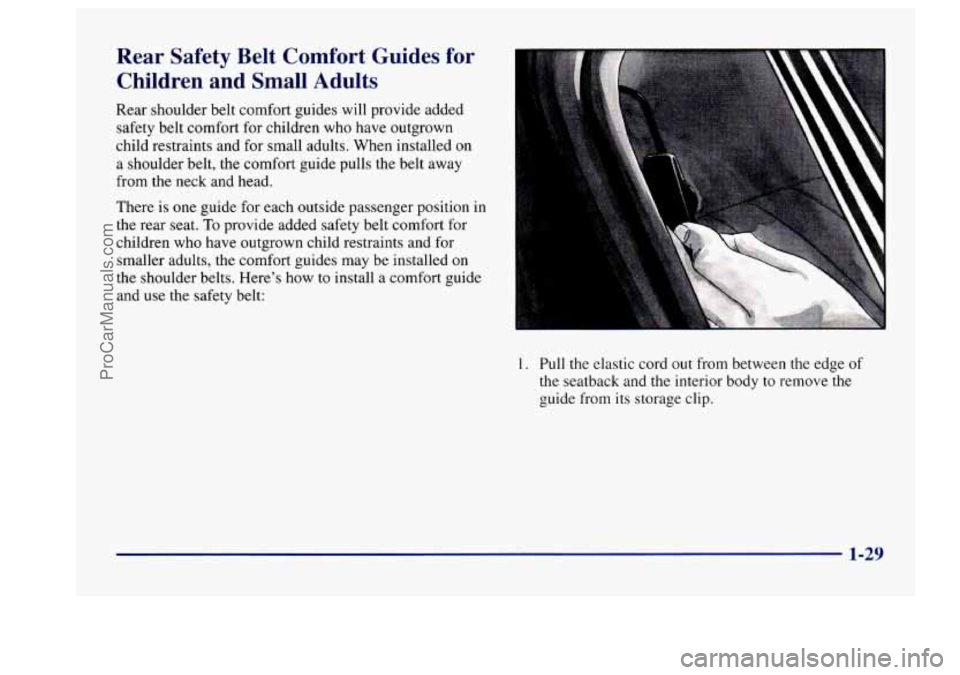
Rear shoulder belt comfort guides will provide added
safety belt comfort for children who have outgrown
child restraints and for small adults. When installed
on
a shoulder belt, the comfort guide pulls the belt away
from the neck and head.
There is one guide for each outside passenger position in
the rear seat.
To provide added safety belt comfort for
children who have outgrown child restraints and for
smaller adults, the comfort guides may be installed
on
the shoulder belts. Here’s how to install a comfort guide
and use the safety belt:
1. Pull the elastic cord out from between the edge of
the seatback and the interior body to remove
the
guide from its storage clip.
1-29
ProCarManuals.com
Page 48 of 406
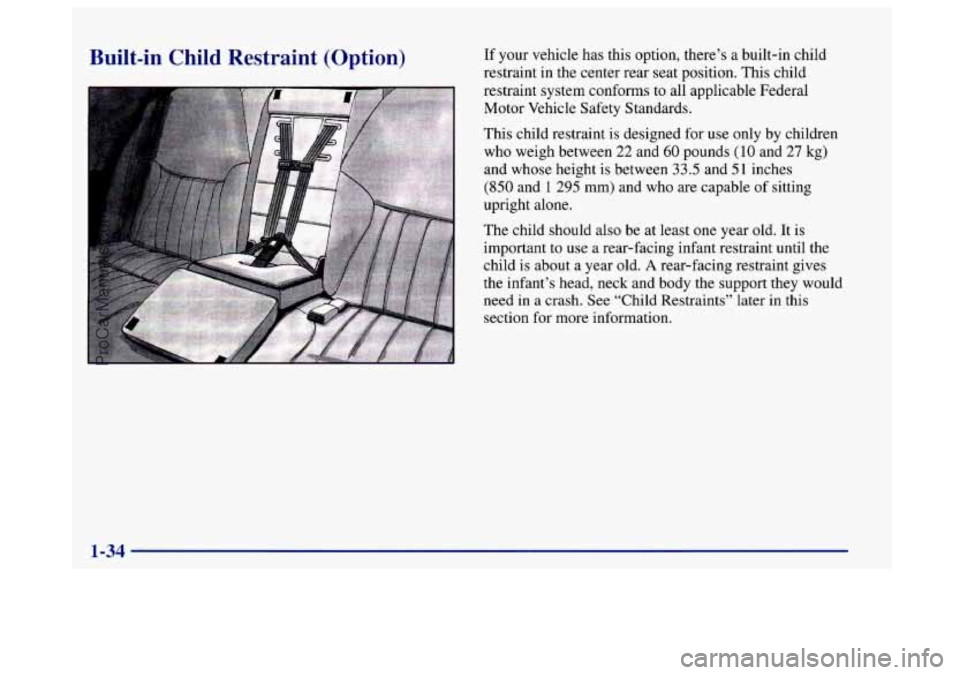
Built-in Child Restraint (Option) If your vehicle has this option, there’s a built-in child
restraint in the center rear seat position. This chld
restraint system conforms
to all applicable Federal
Motor Vehicle Safety Standards.
This child restraint is designed for use only by children
who weigh between
22 and 60 pounds (10 and 27 kg)
and whose height is between 33.5 and 5 1 inches
(850 and 1 295 mm) and who are capable of sitting
upright alone.
The child should also be at least one year old. It is
important
to use a rear-facing infant restraint until the
child is
about a year old. A rear-facing restraint gives
the infant’s head, neck and body the support they would
need in
a crash. See “Child Restraints’’ later in this
section for more information.
1-34
ProCarManuals.com
Page 49 of 406
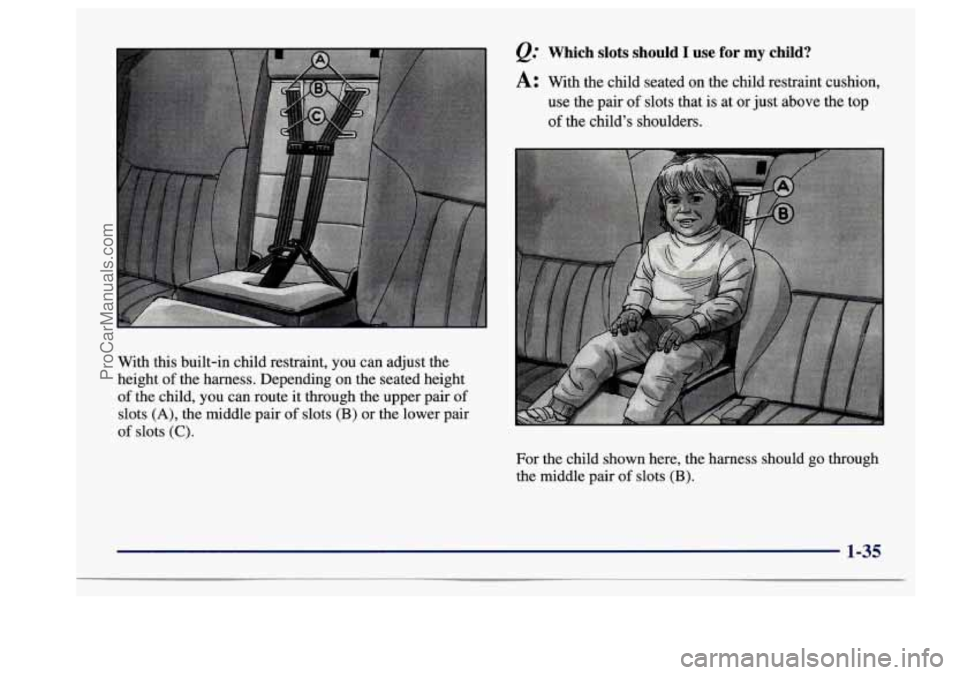
e.' Which slots should I use for my child?
A: With the child seated on the child restraint cushion,
use the pair
of slots that is at or just above the top
of the child's shoulders.
With this built-in child restraint, you can adjust the
height
of the harness. Depending on the seated height
of the child, you can route it through the upper pair of
slots (A), the middle pair of slots (B) or the lower pair
of slots (C).
For the child shown here, the harness should go through
the middle pair
of slots (B).
1-35
ProCarManuals.com
Page 50 of 406
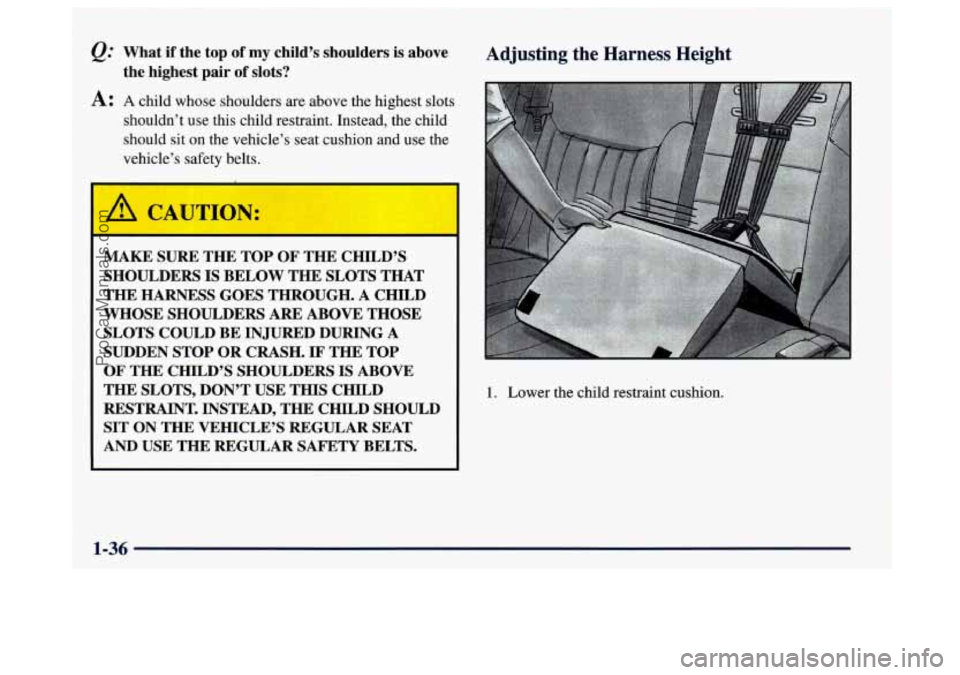
@ What if the top of my child’s shoulders is above
A: A child whose shoulders are above the highest slots
the highest pair of slots?
shouldn’t use this child restraint. Instead, the child
should sit on the vehicle’s seat cushion and use the
vehicle’s safety belts.
MAKE SURE THE TOP OF THE CHILD’S
SHOULDERS
IS BELOW THE SLOTS THAT
THE HARNESS GOES THROUGH.
A CHILD
WHOSE SHOULDERS ARE ABOVE THOSE
SLOTS COULD BE INJURED DURING
A
SUDDEN STOP OR CRASH.’IF THE TOP
OF THE CHILD’S SHOULDERS IS ABOVE
THE SLOTS, DON’T
USE THIS CHILD
RESTRAINT. INSTEAD, THE CHILD SHOULD
SIT
ON THE VEHICLE’S REGULAR SEAT
AND USE THE REGULAR SAFETY BELTS.
Adjusting the Harness Height
1. Lower the child restraint cushion.
1-36
ProCarManuals.com
Page 54 of 406
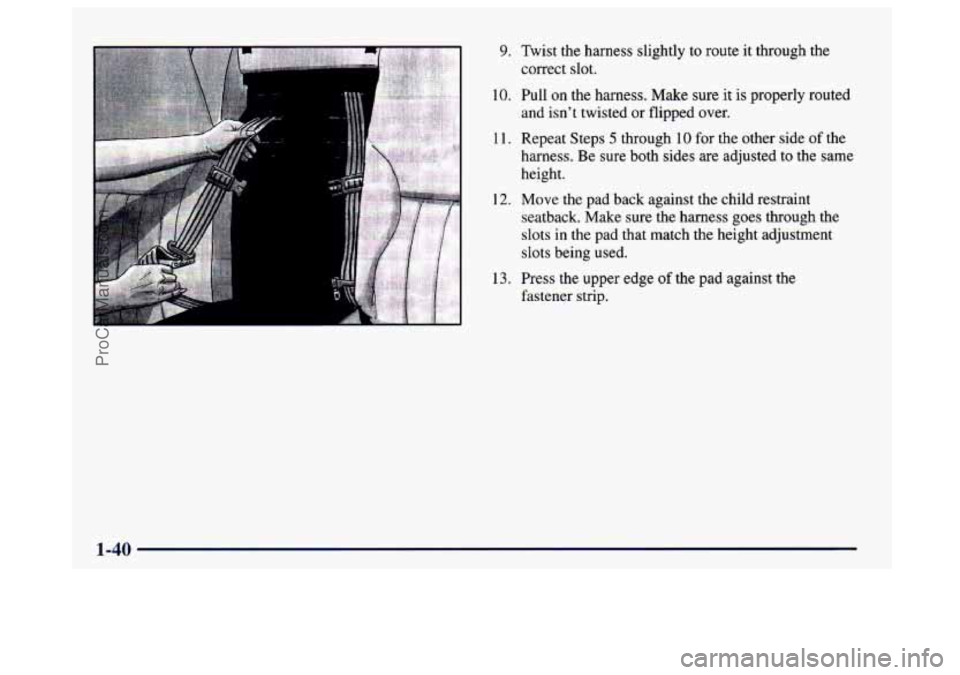
9. Twist the harness slightly to route it through the correct slot.
10. Pull on the harness. Make sure it is properly routed
and isn’t twisted or flipped over.
1 1. Repeat Steps 5 through 10 for the other side of the
harness. Be sure both sides are adjusted to the same
height.
seatback. Make sure the harness goes through the
slots
in the pad that match the height adjustment
slots being used.
12. Move the pad back against the child restraint
13. Press the upper edge of the pad against the
fastener strip.
1-40
ProCarManuals.com
Page 55 of 406
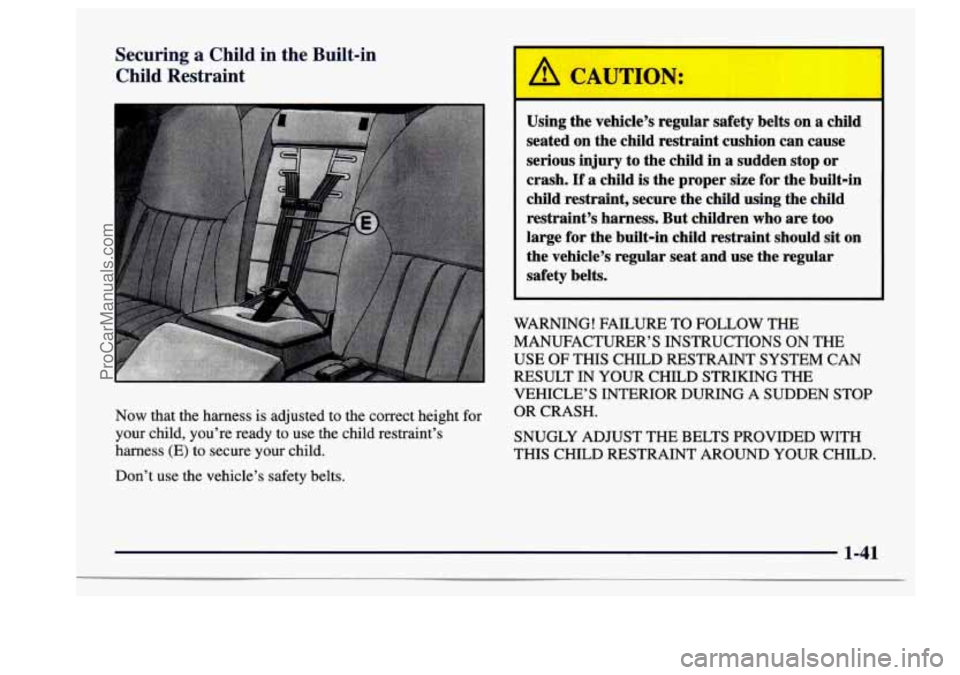
Securing a Child in the Built-in
Child Restraint
Now that the harness is adjusted to the correct height for
your child, you’re ready to use the child restraint’s
harness (E) to secure your child.
Don’t use the vehicle’s safety belts.
Using the vehicle’s regular safety belts on a child
seated on the child restraint cushion can cause
serious injury to the child in
a sudden stop or
crash.
If a child is the proper size for the built-in
child restraint, secure the child using the child
restraint’s harness. But children who are too
large for the built-in child restraint should sit on
the vehicle’s regular seat and use the regular
safety belts.
WARNING! FAILURE TO FOLLOW THE
MANUFACTURER’S INSTRUCTIONS
ON THE
USE
OF THIS CHILD RESTRAINT SYSTEM CAN
RESULT IN YOUR CHILD STRIKING THE
VEHICLE’S INTERIOR DURING
A SUDDEN STOP
OR CRASH.
SNUGLY ADJUST THE BELTS PROVIDED WITH
THIS CHILD RESTRAINT AROUND YOUR CHILD.
1-41
ProCarManuals.com
Page 62 of 406
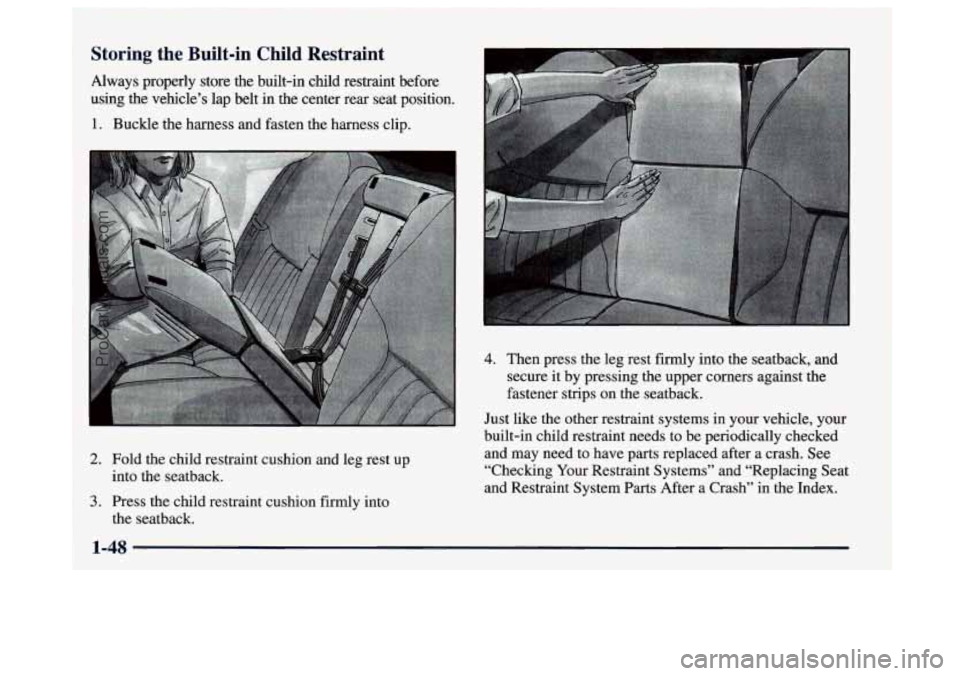
Storing the Built-in Child Restraint
Always properly store the built-in child restraint before
using the vehicle’s lap belt in the center rear seat position.
1. Buckle the harness and fasten the harness clip.
2. Fold the child restraint cushion and leg rest up
3. Press the child restraint cushion firmly into into the seatback.
the seatback.
I
4. Then
press the leg rest firmly into the seatback, and
secure it by pressing the upper corners against the
fastener strips on the seatback.
Just like the other restraint systems in your’vehicle, your
built-in child restraint needs to be periodically checked
and may need to have parts replaced after a crash. See
“Checking Your Restraint Systems” and “Replacing Seat
and Restraint System
Parts After a Crash” in the Index.
ProCarManuals.com
Page 63 of 406
Child Restraints
Be sure the child restraint is designed to be used in a
vehicle. If it is, it will have a label saying that it meets
Federal Motor Vehicle Safety Standards.
Then follow the instructions for the restraint. You may
find these instructions on the restraint itself or in a
booklet, or both. These restraints
use the belt system in
your vehicle, but the child also has to be secured within
the restraint to help reduce the chance
of personal injury.
The instructions that come with the infant
or child
restraint will show you how
to do that.
Where to Put the Restraint
Accident statistics show that children are safer if they
are restrained in the rear rather than the front seat. We at
General Motors therefore recommend that you put your
child restraint
in the rear seat. Never put a rear-facing
child restraint in the front passenger seat. Here’s why:
A child in a rear-facing child restraint can be
seriously injured
if the right front passenger’s
air bag inflates. This is because the back of
a
rear-facing child restraint would be very close to
the inflating air bag. Always secure a rearfacing
child restraint in the rear seat.
You may, however, secure a forward-facing child
restraint
in the right front seat. Before you secure
a forward-facing child restraint, always move the
front passenger seat as far back as it will go. Or,
secure the child restraint in the rear seat.
1-49
ProCarManuals.com
Page 64 of 406
A child in a child restraint in the center front seat
can be badly injured by the right front passenger
air bag if it inflates. Never secure a child restraint
in the center front seat.
It’s always better to
secure a child restraint in the rear seat.
You may,
however, secure
a forward-facing child restraint
in the right front passenger seat, but only with
the seat moved all the
way back.
Wherever you install it, be sure to secure the child
restraint properly.
Keep in mind that
an unsecured child restraint can move
around in a collision or sudden stop and injure people in
the vehicle. Be sure to properly secure any child
restraint in your vehicle
-- even when no child is in it.
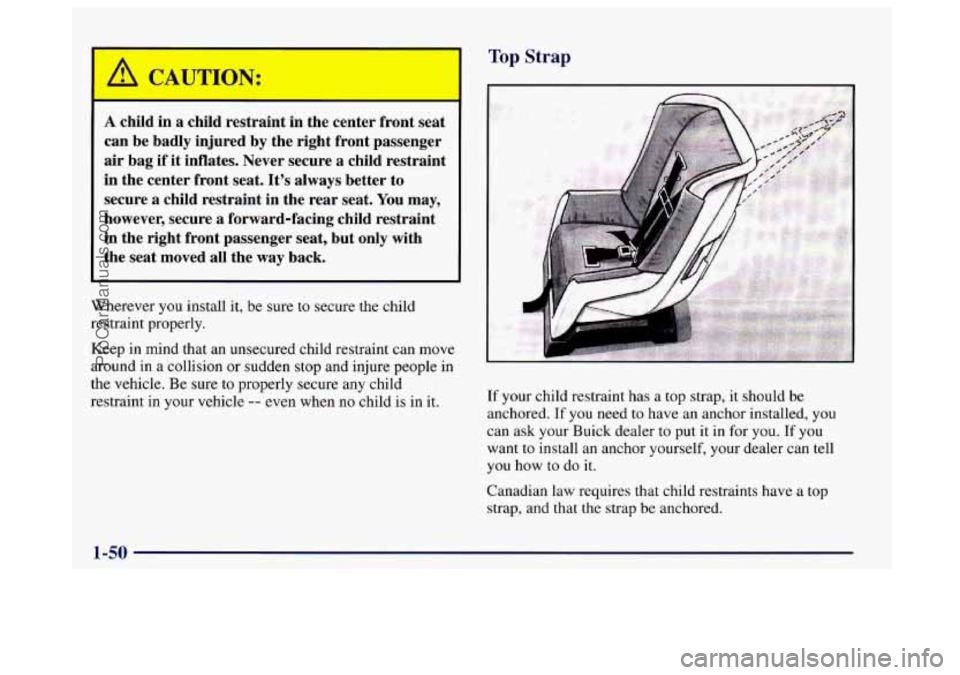
Top Strap
If your child restraint has a top strap, it should be
anchored. If you need to have an anchor installed, you
can ask your Buick dealer to put
it in for you. If you
want to install an anchor yourself, your dealer can tell
you how to do it.
Canadian law requires that child restraints have
a top
strap, and that the strap be anchored.
1-50
ProCarManuals.com