maintenance schedule BUICK CENTURY 1997 Owners Manual
[x] Cancel search | Manufacturer: BUICK, Model Year: 1997, Model line: CENTURY, Model: BUICK CENTURY 1997Pages: 406, PDF Size: 20.64 MB
Page 3 of 406

The 1997 Buick Century Owner’s Manual
1-1
2- 1
3-1
4-1
5-1
6-1
Seats and Restraint Systems
This section tells you how to use your seats and safety belts\
properly. It also explains the “air bag” system.
Features and Controls
This section explains how to start and operate your Buick.
Comfort Controls and Audio Systems
This section tells you how to adjust the ventilation and comfo\
rt controls and how to operate your audio system.
Your Driving and the Road
Here you’ll find helpful information and tips about the road\
and how to drive under different conditions.
Problems on the Road
This section tells what to do if you have a problem while driving,\
such as a flat tire or overheated engine, etc.
Service and Appearance Care
Here the manual tells you how to keep your Buick running prop\
erly and looking good.
7-1 Maintenance Schedule
This section tells you when to perform vehicle maintenance and what \
fluids and lubricants to use.
8- 1
9-1
Customer Assistance Information
This section tells you how to contact Buick for assistance and how \
to get service and owner publications.
It also gives you information on “Reporting Safety Defects”\
on page 8-8.
Index
Here’s an alphabetical listing of almost every subject in this manual. You can use it to quickly find
something you want to read.
i
ProCarManuals.com
Page 146 of 406
Comfort Controls
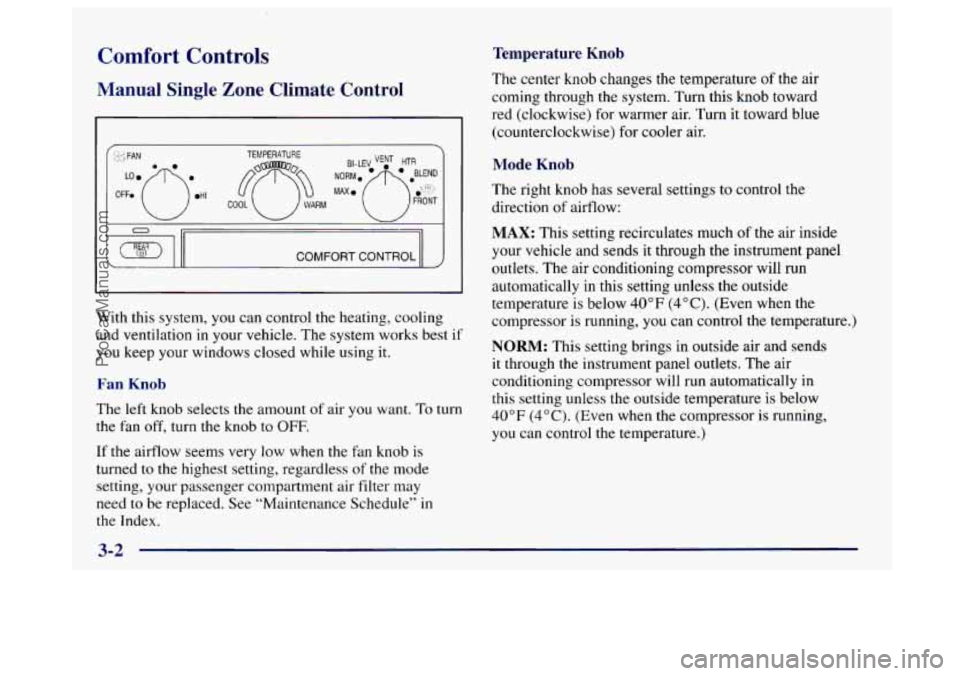
Manual Single Zone Climate Control
- .
0 IIl
COMFORT CONTROL II
With this system, you can control the heating, cooling
and ventilation in your vehicle. The system works best
if
you keep your windows closed while using it.
Fan Knob
The left knob selects the amount of air you want. To turn
the fan
off, turn the knob to OFF.
If the airflow seems very low when
the fm knob is
turned
to the highest setting, regardless of the mode
setting, your passenger compartment air filter may
need
to be replaced. See "Maintenance Schedule" in
the Index.
Temperature Knob
The center knob changes the temperature of the air
coming through the system. Turn this knob toward
red (clockwise) for warmer air. Turn it toward blue
(counterclockwise) for cooler air.
Mode Knob
The right knob has several settings to control the
direction of airflow:
MAX: This setting recirculates much of the air inside
your vehicle and sends it through the instrument panel
outlets. The air conditioning compressor will run
automatically in this setting unless the outside
temperature is below 40°F
(4°C). (Even when the
compressor is running, you can control the temperature.)
NORM: This setting brings in outside air and sends
it through the instrument panel outlets. The air
conditioning compressor will run automatically in
this setting unless the outside temperature is below
40°F (4°C). (Even when the compressor is running,
you can control the temperature.)
3-2
ProCarManuals.com
Page 148 of 406
Heating
On cold days, use HTR with the temperature knob all
the way in the red area. The system will bring in outside
air, heat it and send it to the floor ducts.
If your vehicle has an engine coolant heater, you can use
it to help your system provide warm air faster when it’s
cold outside
(OOF (- 18°C) or lower). An engine coolant
heater warms the coolant your engine and heating
system use to provide heat. See “Engine Coolant
Heater” in the Index.
Ventilation
For mild outside temperatures when little heating or
cooling is needed,
use VENT to direct outside air
through your vehicle. Your vehicle also has the
flow-through ventilation system described later in
this section.
Defogging and Defrosting
Your system has two settings for clearing the front and
side windows.
To defrost the windows quickly, use
FRONT with the temperature knob all the way in the red
area.
To warm passengers while keeping the windows
clear, use
BLEND.
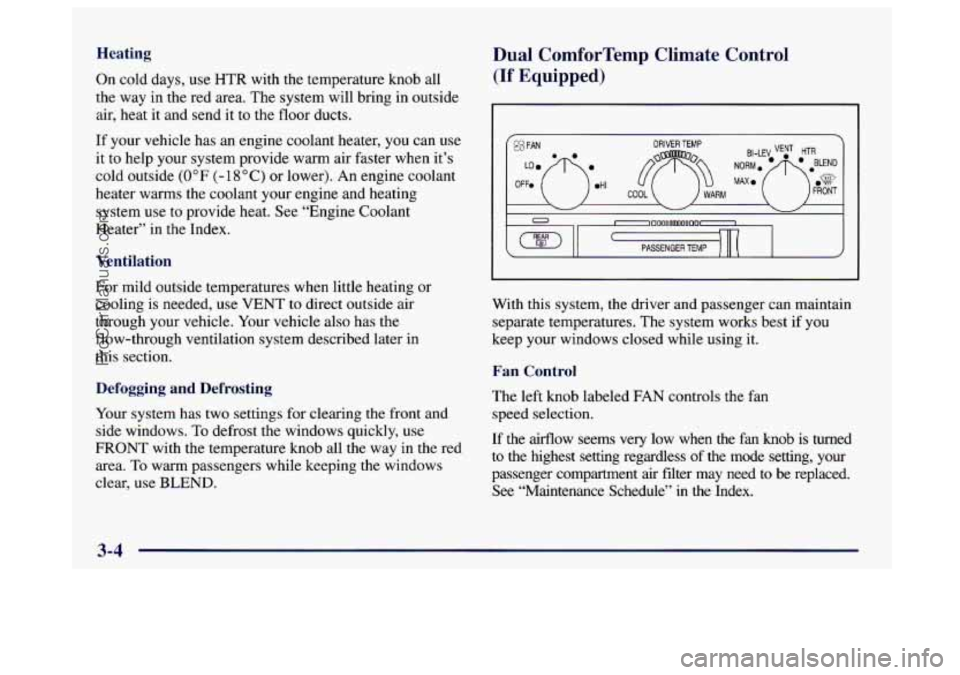
Dual ComforTemp Climate Control
(If Equipped)
With this system, the driver and passenger can maintain
separate temperatures. The system works best
if you
keep your windows closed while using it.
Fan Control
The left knob labeled FAN controls the fan
speed selection.
If the airflow seems very low when the fan knob is turned
to the highest setting regardless of the mode setting, your
passenger compartment
air filter may need to be replaced.
See “Maintenance Schedule’’ in
the Index.
3-4
ProCarManuals.com
Page 154 of 406
Heating Ventilation System
On cold days, use HTR with the temperature knob all
the way in the red area. The system will bring in outside
air, heat it and send it to the floor ducts.
If your vehicle has an engine coolant heater, you can
use
it to help your system provide warm air faster when it’s
cold outside
(0°F (-18°C) or lower). An engine coolant
heater warms the coolant your engine and heating
system use to provide heat. See “Engine Coolant
Heater” in the Index.
Defogging and Defrosting
Your system has two settings for clearing the front and
side windows.
To defrost the windows quickly, use
FRONT and full hot (90°F (32°C)). Driver sets
temperature and selects high fan speed.
To warm
passengers while keeping the windows clear, push the
AIR FLOW button until WINDSHIELD/FLOOR
appears in the display. Select fan speed for comfort and
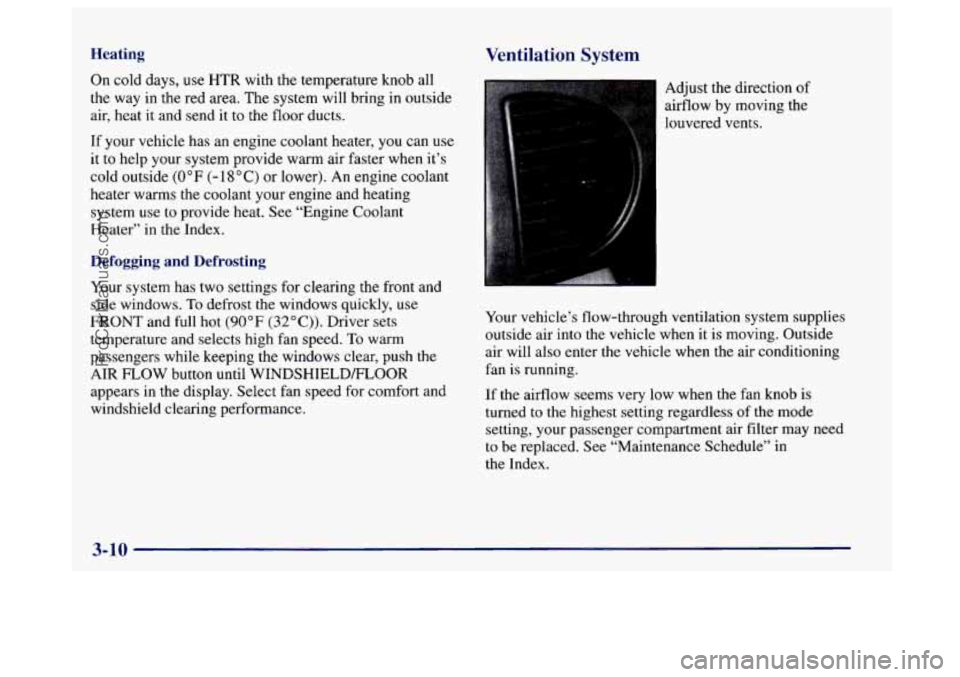
windshield clearing performance. Adjust the direction
of
airflow
by moving the
louvered vents.
Your vehicle’s flow-through ventilation system supplies
outside air into the vehicle when it is moving. Outside
air will also enter the vehicle when the air conditioning
fan is running.
If the airflow seems very low when the fan knob is
turned to the highest setting regardless of the mode
setting, your passenger compartment air filter may need
to be replaced. See “Maintenance Schedule” in
the Index.
3-10
ProCarManuals.com
Page 223 of 406
When You Are Ready to Leave After
Parking on a Hill
1. Apply your regular brakes and hold the pedal down
while you:
Start your engine;
Shift into a gear; and
Release the parking brake.
2. Let up on the brake pedal.
3. Drive slowly until the trailer is clear of the chocks.
4. Stop and have someone pick up and store the chocks.
Maintenance When Trailer Towing
Your vehicle will need service more often when you’re
pulling a trailer. See the Maintenance Schedule for more
on this. Things that are especially important
in trailer
operation are automatic transaxle fluid (don’t overfill),
engine oil, belt, cooling system and brake adjustment.
Each of these
is covered in this manual, and the Index
will help you find them quickly.
If you’re trailering, it’s
a good idea to review these sections before you start
your trip.
Check periodically to see that all hitch nuts and bolts
are tight.
4-37
ProCarManuals.com
Page 280 of 406
When to Chang( Cngine Oil
If any one of these is true for you, use the short tripkity
maintenance schedule:
Most trips are less than 5 to 10 miles (8 to 16 km).
This is particularly important when outside
temperatures are below freezing.
Most trips include extensive idling (such as frequent
driving in stop-and-go traffic).
Most trips are through dusty areas.
You frequently tow a trailer or use a carrier on top of
your vehicle.
The vehicle is used for delivery service, police, taxi
or other commercial application.
Driving under these conditions causes engine
oil to break
down sooner.
If any one of these is true for your vehicle,
then you need to change your oil and filter every
3,000 miles (5 000 km) or 3 months -- whichever occurs
first. (See “Change Oil Soon” Light in the Index.)
If none
of them is true, use the long triphighway
maintenance schedule. Change the oil and filter every
7,500 miles (12 500 km) or 12 months -- whichever
occurs first. Driving a vehicle with a fully warmed
engine under highway conditions causes engine oil to
break down slower. (See
“Change Oil
Soon” Light in the Index.)
What to Do with Used Oil
Did you know that used engine oil contains certain
elements that may be unhealthy for your skin and could
even cause cancer? Don’t let used oil stay on your skin
for very long. Clean your skin and nails with soap and
water, or a good hand cleaner. Wash or properly throw
away clothing or rags containing used engine oil. (See
the manufacturer’s warnings about the use and disposal
of oil products.)
Used oil can be a real threat to the environment. If you
change your own oil, be sure to drain all free-flowing oil
from the filter before disposal. Don’t ever dispose of oil
by putting it in the trash, pouring it on the ground, into
sewers, or into streams or bodies
of water. Instead,
recycle it by taking it to a place that collects used oil.
If
you have a problem properly disposing of your used oil,
ask your dealer, a service station or a local recycling
center for help.
ProCarManuals.com
Page 281 of 406
Air Cleaner
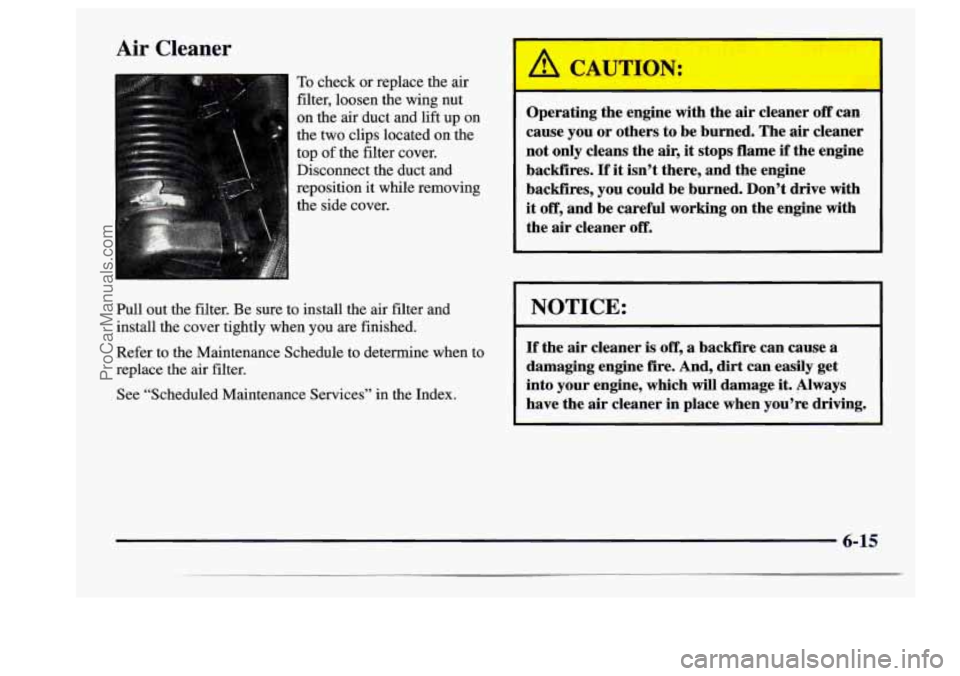
To check or replace the air
filter, loosen the wing nut
on the air duct and lift up on
the two clips located on the
top of the filter cover.
Disconnect the duct and
reposition it while removing
the side cover.
Pull out the filter. Be sure to install the air filter and
install the cover tightly when you are finished.
Refer to the Maintenance Schedule to determine when to
replace the air filter.
See “Scheduled Maintenance Services” in the Index. Operating the engine with the air cleaner off can-
cause you or others to be burned. The air cleaner
not only cleans the air,
it stops flame if the engine
backfires.
If it isn’t there, and the engine
backfires, you could be burned. Don’t drive with
it
off, and be careful working on the engine with
the air cleaner
off.
NOTICE:
If the air cleaner is off, a backfire can cause a
damaging engine fire. And, dirt can easily get
into your engine, which will damage it.
Always
have the air cleaner in place when you’re driving.
6-15
ProCarManuals.com
Page 282 of 406
Passenger Compartment Air Filter
-------
To change the passenger compartment air filter, use the
following steps:
1.
2.
3.
4.
5.
6.
7.
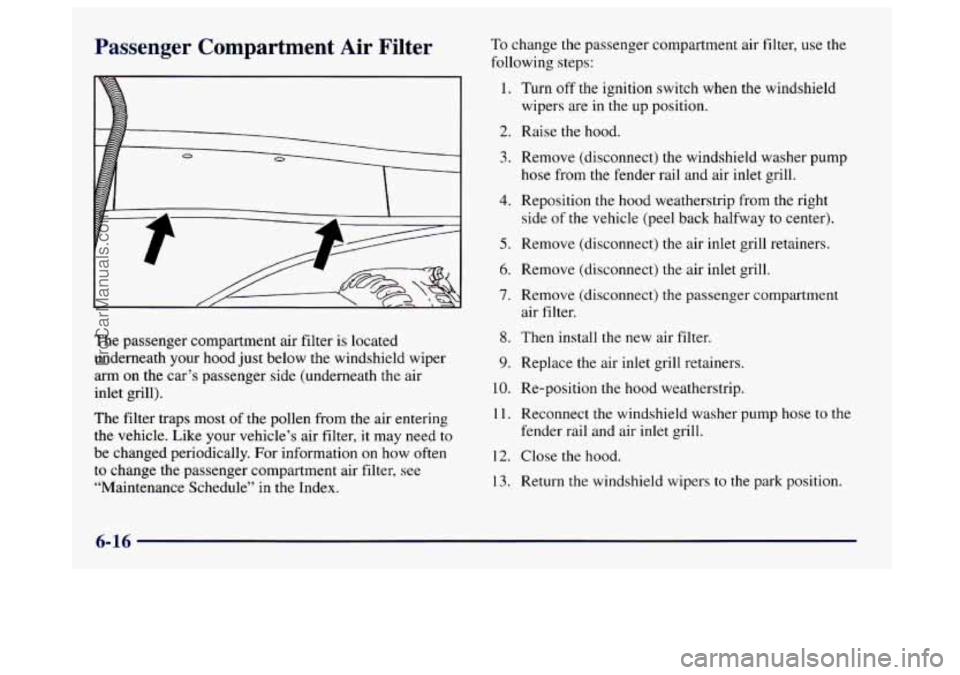
The passenger compartment air filter is located
underneath your hood just below the windshield wiper
arm on the car’s passenger side (underneath the air
inlet grill).
The filter traps most
of the pollen from the air entering
the vehicle. Like your vehicle’s air filter, it may need to
be changed periodically. For information
on how often
to change the passenger compartment air filter, see
“Maintenance Schedule” in the Index.
8.
9.
10.
11.
12.
13.
Turn off the ignition switch when the windshield
wipers are in the
up position.
Raise the hood.
Remove (disconnect) the windshield washer pump
hose from the fender rail and air inlet grill.
Reposition the hood weatherstrip from the right
side of the vehicle (peel back halfway to center).
Remove (disconnect) the air inlet grill retainers.
Remove (disconnect) the air inlet grill.
Remove (disconnect.) the passenger compartment
air filter.
Then install the new air filter.
Replace the air inlet grill retainers.
Re-position the hood weatherstrip.
Reconnect the windshield washer pump hose to the
fender rail and
air inlet grill.
Close the hood.
Return the windshield wipers to the park position.
6-16
ProCarManuals.com
Page 283 of 406
Automatic Transaxle Fluid
When to Check and Change
A good time to check your automatic transaxle fluid
level
is when the engine oil is changed.
Change both the fluid and filter every
50,000 miles
(83
000 km) if the vehicle is mainly driven under one or
more of these conditions:
In heavy city traffic where the outside temperature
regularly reaches
90°F (32°C) or higher.
In hilly or mountainous terrain.
When doing frequent trailer towing.
Uses such as found in taxi, police or delivery service.
If you do not use your vehicle under any
of these
conditions, the fluid and filter do not require changing.
See "Scheduled Maintenance Services"
in the Index.
How to Check
Because this operation can be a little difficult, you may
choose
to have this done at your Buick dealership
Service Department.
If you do it yourself, be sure to follow all the instructions
here, or you could get a false reading on
the dipstick.
NOTICE:
Too much or too little fluid can damage your
transaxle.
Too much can mean that some of the
fluid could come out and fall on
hot engine parts
or exhaust system parts, starting a fire. Be sure to get an accurate reading if you check your
transaxle fluid.
Wait at least 30 minutes before checking the transaxle
fluid level
if you have been driving:
When outside temperatures are above 90°F (32°C).
At high speed for quite a while.
In heavy traffic -- especially in hot weather.
While pulling a trailer.
To get the right reading, the fluid should be at normal
operating temperature, which
is 180°F to 200°F (82°C
to 93 " C).
Get the vehicle warmed up by driving about
15 miles
(24 km) when outside temperatures are above 50°F
(10°C). If it's colder than 50°F (lO"C), you may have
to drive longer.
6-17
ProCarManuals.com
Page 285 of 406
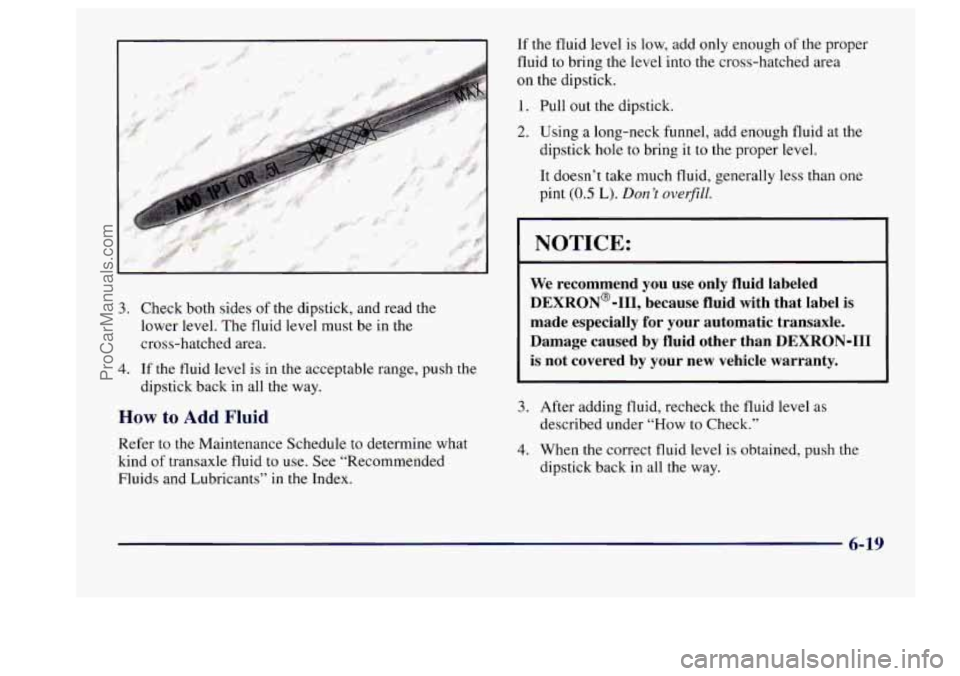
3. Check both sides of the dipstick, and read the
lower level. The fluid
level must be in the
cross-hatched area.
4. If the fluid level is in the acceptable range, push the
dipstick back
in all the way.
How to Add Fluid
Refer to the Maintenance Schedule to determine what
kind
of transaxle fluid to use. See “Recommended
Fluids and Lubricants”
in the Index. If
the fluid level is low, add only enough
of the proper
fluid to bring the level into the cross-hatched area
on the dipstick.
1. Pull out the dipstick.
2. Using a long-neck funnel, add enough fluid at the
dipstick hole to bring it to the proper
level.
It doesn’t take much fluid, generally less than one
pint
(0.5 L). Dun ’t overfill.
I NOTICE: I
We recommend you use only fluid labeled
DEXRON@-111, because fluid with that label
is
made especially for your automatic transaxle.
Damage caused by fluid other than DEXRON-I11
is not covered by your new vehicle warranty.
3. After adding fluid, recheck the fluid level as
described under
“How to Check.”
4. When the correct fluid level is obtained, push the
dipstick back in all the way.
6-19
ProCarManuals.com