spare wheel BUICK CENTURY 1997 Owners Manual
[x] Cancel search | Manufacturer: BUICK, Model Year: 1997, Model line: CENTURY, Model: BUICK CENTURY 1997Pages: 406, PDF Size: 20.64 MB
Page 255 of 406
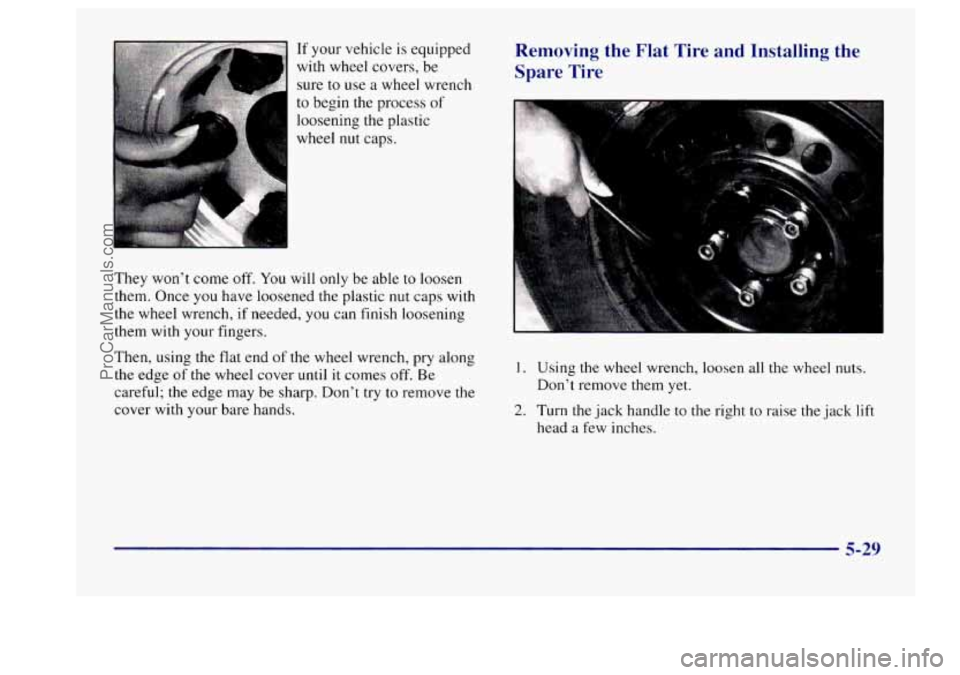
If your vehicle is equipped
with wheel covers, be
sure
to use a wheel wrench
to begin the process of
loosening the plastic
wheel
nut caps.
They won’t come off.
You will only be able to loosen
them. Once you have loosened the plastic
nut caps with
the wheel wrench, if needed,
you can finish loosening
them with your fingers.
Then, using the flat end of
the wheel wrench, pry along
the edge of
the wheel cover until it comes off. Be
careful; the edge may be sharp. Don’t try to remove the
cover with your bare hands.
Removing the Flat Tire and Installing the
Spare Tire
1. Using the wheel wrench, loosen all the wheel nuts.
Don’t remove them yet.
2. Turn the jack handle to the right to raise the jack lift
head a few inches.
5-29
ProCarManuals.com
Page 256 of 406
Getting under a vehicle when it is jacked up is
dangerous.
If the vehicle slips off the jack, you
could be badly injured or killed. Never get under
a vehicle when it is supported only
by a jack.
FRONT
VEHICLE
I L 1-14 I
- REAR EDGE OF FRONT
WHEEL OPENING
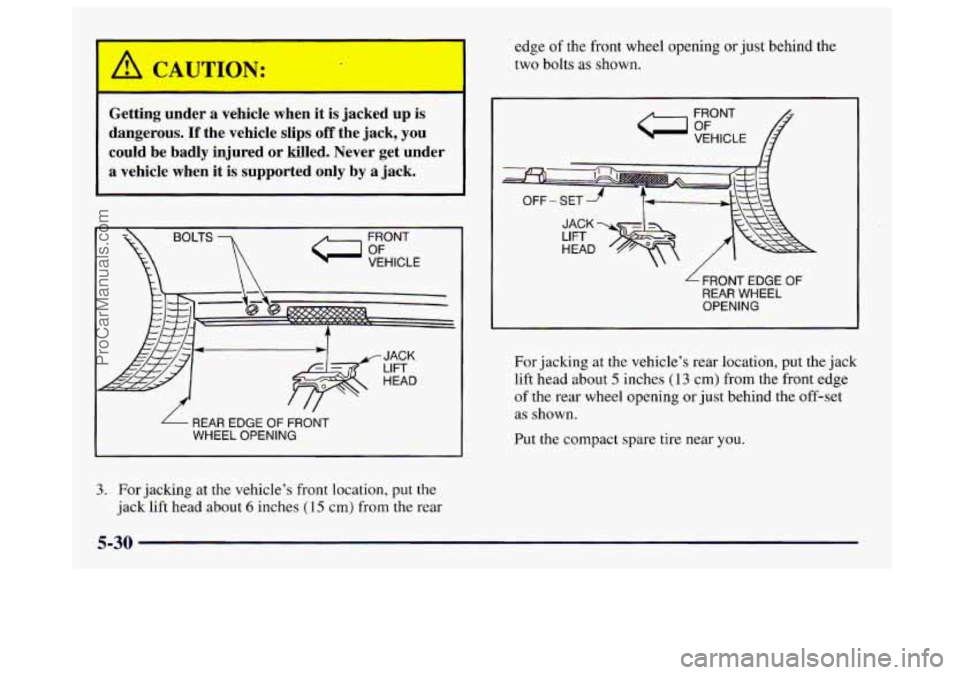
edge of the front wheel opening or just behind the
two bolts
as shown.
FRONT EDGE OF
REAR WHEEL OPENING
For jacking at the vehicle’s rear location, put the jack
lift head about
5 inches (13 cm) from the front edge
of the rear wheel opening or just behind the off-set
as shown.
Put the compact spare tire near you.
3. For jacking at the vehicle’s front location, put the
jack lift head about
6 inches (15 cm) from the rear
ProCarManuals.com
Page 257 of 406
c
CAUTION:
I
Raising your vehicle with the jack improperly
positioned can damage the vehicle and even
make the vehicle fall.
To help avoid personal
injury and vehicle damage, be sure to fit the jack
lift head into the proper location before raising
the vehicle.
1
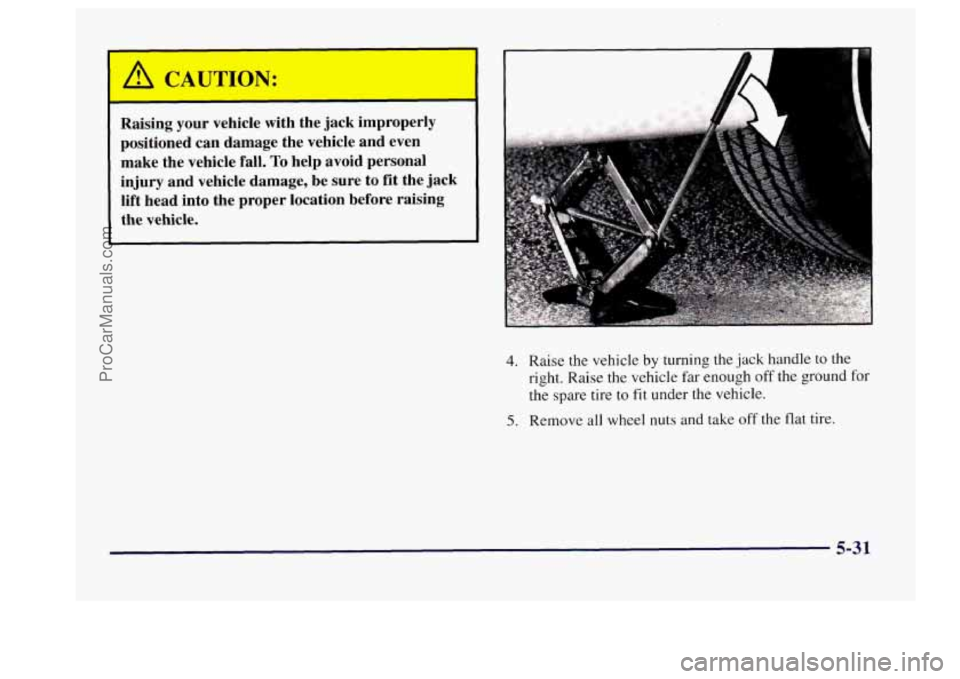
4. Raise the vehicle by turning the jack handle to the
right. Raise
the vehicle far enough off the ground for
the spare tire to
fit under the vehicle.
5. Remove all wheel nuts and take off the flat tire.
5-31
ProCarManuals.com
Page 258 of 406
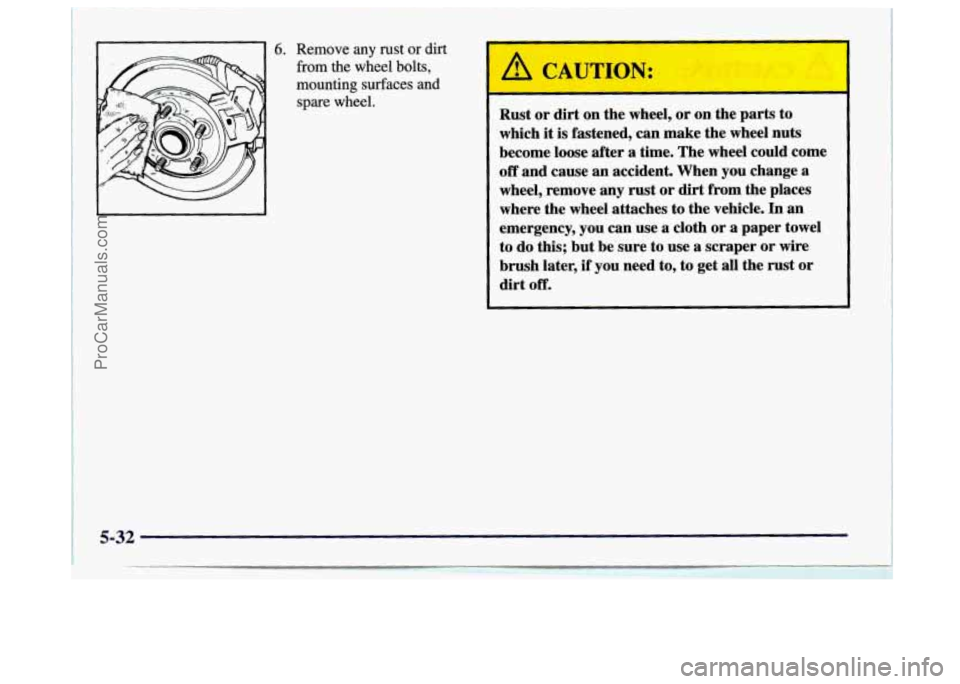
from the wheel bolts,
mounting surfaces and
spare wheel.
Rust or dirt on the wheel, or on the parts to
which it is fastened, can make the wheel nuts
become loose after a time. The wheel could come
off and cause an accident. When you change a
wheel, remove any rust or dirt from the places
where the wheel attaches to the vehicle.
In an
emergency, you can use a cloth or
a paper towel
to do this; but be sure to use
a scraper or wire
brush later, if you need to, to get all the rust or
dirt off.
ProCarManuals.com
Page 260 of 406
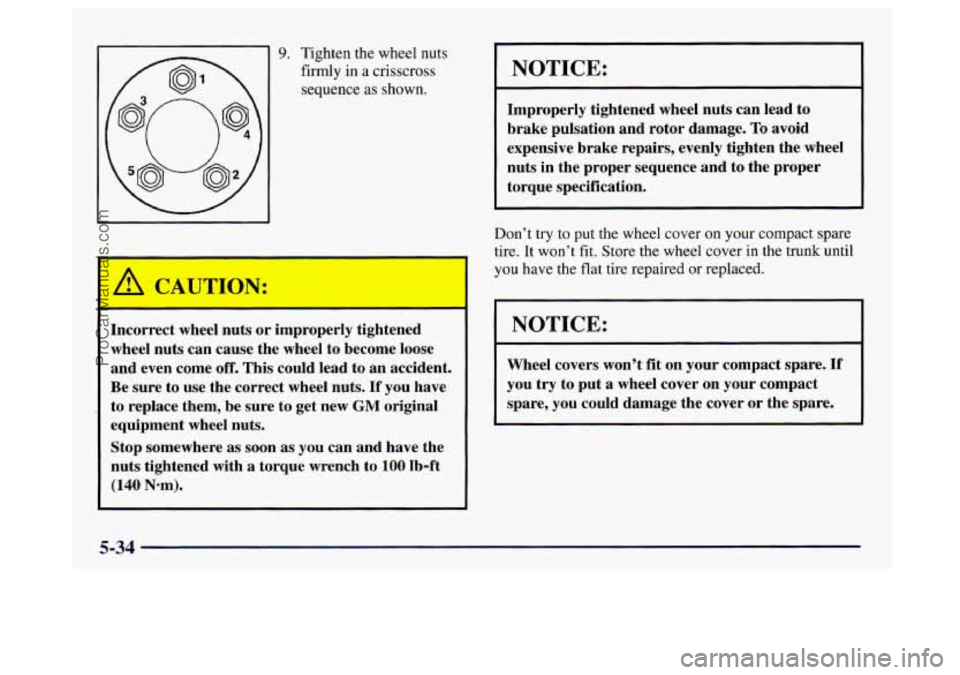
9. Tighten the wheel nuts
firmly
in a crisscross
sequence
as shown.
A CAUT’ON:
Inca xt wheel nuts or improperly tightened
wheel nuts can cause the wheel to become loose
and even come off. This could lead to an accident.
Be sure to use the correct wheel nuts.
If you have
to replace them, be sure to get new
GM original
equipment wheel nuts.
Stop somewhere
as soon as you can and have the
nuts tightened with a torque wrench to
100 Ib-ft
(140 N-m).
NOTICE:
Improperly tightened wheel nuts can lead to
brake pulsation and rotor damage.
To avoid
expensive brake repairs, evenly tighten the wheel
nuts in the proper sequence and to the proper
torque specification.
Don’t try to put the wheel cover on your compact spare
tire. It won’t fit. Store the wheel cover in the trunk until
you have the flat tire repaired or replaced.
NOTICE:
Wheel covers won’t fit on your compact spare. If
you try to put a wheel cover on your compact
spare, you could damage the cover or the spare.
5-34
ProCarManuals.com
Page 261 of 406
Storing the Flat Tire and Tools
Storing a jack, a tire or other equipment in the
passenger compartment
of the vehicle could
cause injury. In a sudden stop or collision, loose
equipment could strike someone. Store all these
in the proper place.
After you’ve put the compact spare tire on your vehicle,
you’ll need to store the flat tire
in your trunk. Use the
following procedure to secure the flat tire in the trunk.
When storing a full-size
tire you must use the extension
with the protector/guide to help avoid wheel surface
damage.
Use the extension and protector/guide located
in the foam holder.
To store a full-size tire, place the
tire valve stem facing down and then remove the
protector/guide and attach the retainer securely. When
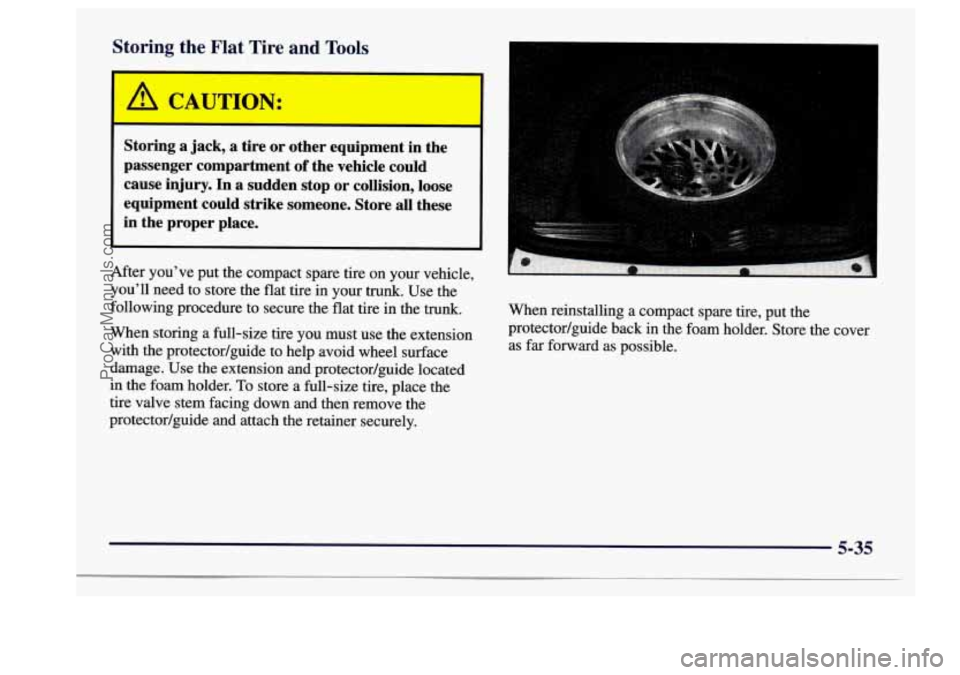
reinstalling a compact spare tire, put the
protector/guide back in the foam holder. Store the cover
as far forward as possible.
5-35
ProCarManuals.com
Page 263 of 406
Compact Spare Tire
Although the compact spare tire was fully inflated when
your vehicle was new, it can
lose air after a time. Check
the inflation pressure regularly. It should be
60 psi
(420 kPa).
After installing the compact spare on your vehicle, you
should stop as soon as possible and make sure your
spare tire is correctly inflated. The compact spare
is
made to perform well at speeds up to 65 mph
(105 km/h) for distances up to 3,000 miles (5 000 km),
so you can finish your trip and have your full-size tire
repaired or replaced where you want. Of course, it’s best
to replace your spare with a full-size tire as soon as you
can. Your spare will last longer and be in good shape
in
case you need it again.
NOTICE:
When the compact spare is installed, don’t take
your vehicle through an automatic car wash with
guide rails. The compact spare can get caught on
the rails. That can damage the tire and wheel,
and maybe other parts
of your vehicle.
Don’t use your compact spare on other vehicles.
And don’t mix your compact spare tire or wheel with
other wheels or tires. They won’t
fit. Keep your spare
tire and its wheel together.
I NOTICE:
Tire chains won’t fit your compact spare. Using
them can damage your vehicle and can damage
the chains too. Don’t use tire chains
on your
compact spare.
5-37
ProCarManuals.com
Page 305 of 406
Tire Inspection and Rotation
Tires should be rotated every 6,000 to 8,000 miles
(10 O00 to 13 OOO km). Any time you notice unusual wear,
rotate your tires as soon as possible and check wheel
alignment.
Also check for damaged tires or wheels.
See “When It’s Time for New Tires” and ‘Wheel
Replacement” later
in this section for more information.
The purpose of regular rotation is to achieve more
uniform wear for all tires on the vehicle. The first
rotation is the most important. See “Scheduled
Maintenance Services” in the Index for scheduled
rotation intervals. Don’t include the compact spare tire
in your tire rotation.
After the tires have been rotated, adjust the front and
rear inflation pressures as shown
on the Tire-Loading
Information label. Make certain that all wheel nuts
are properly tightened. See “Wheel Nut Torque”
in the Index.
Rust or dirt on a wheel, or on the parts to which
it is fastened, can make wheel nuts become loose
after a time. The wheel could come
off and cause
an accident. When you change a wheel, remove
any rust or dirt from places where the wheel
attaches to the vehicle. In an emergency, you can
use a cloth or a paper towel to do this; but be
sure to use
a scraper or wire brush later, if you
need to, to get all the rust or dirt off. (See
“Changing
a Flat Tire” in the Index.)
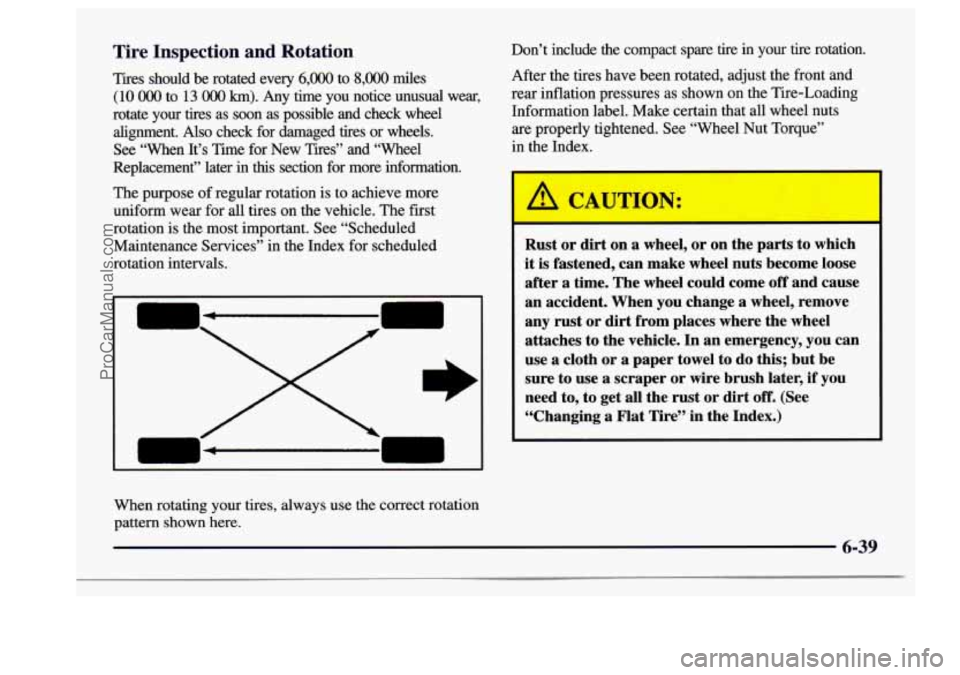
When rotating your tires, always use the correct rotation
pattern shown here.
.. ~ 6-39
ProCarManuals.com
Page 307 of 406
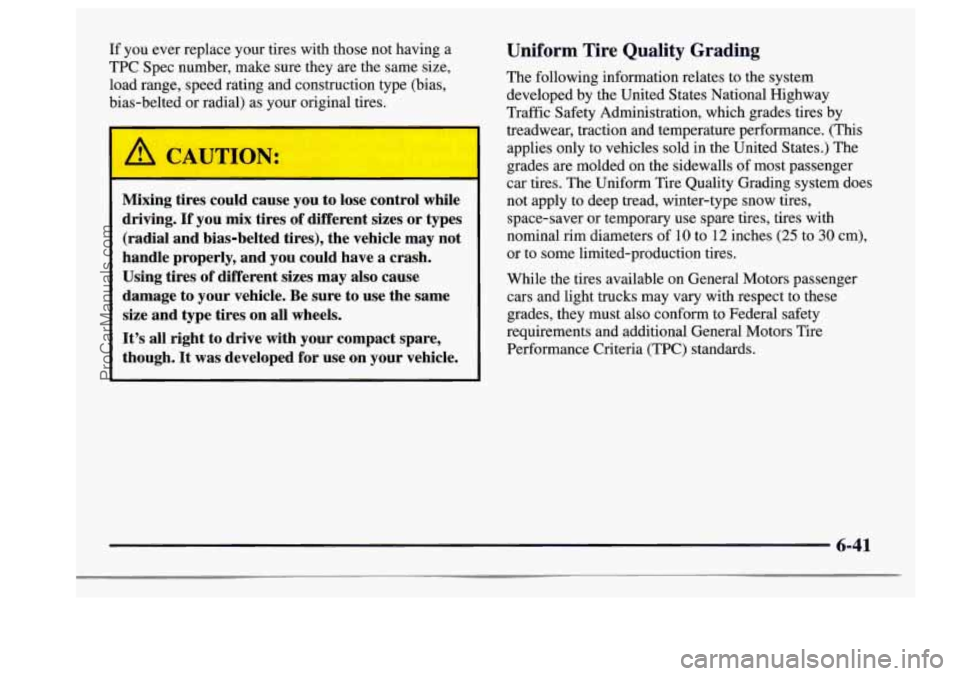
If you ever replace your tires with those not having a
TPC Spec number, make sure they are the same size,
load range, speed rating and construction type (bias,
bias-belted or radial) as your original tires.
A CAUTJN:
Mixing tires could cause you to lose control while
driving.
If you mix tires of different sizes or types
(radial and bias-belted tires), the vehicle may not
handle properly, and you could have a crash.
Using tires
of different sizes may also cause
damage to your vehicle. Be sure to use the same
size and type tires on all wheels.
It’s all right to drive with your compact spare,
though.
It was developed for use on your vehicle.
Uniform Tire Quality Grading
The following information relates to the system
developed by the United States National Highway
Traffic Safety Administration, which grades tires by
treadwear, traction and temperature performance.
(This
applies only to vehicles sold in the United States.) The
grades are molded on the sidewalls of most passenger
car tires. The Uniform Tire Quality Grading system does
not apply to deep tread, winter-type snow tires,
space-saver or temporary use spare tires, tires with
nominal rim diameters of
10 to 12 inches (25 to 30 cm),
or to some limited-production tires.
While the tires available on General Motors passenger cars and light trucks may vary with respect to these
grades, they must also conform to Federal safety
requirements and additional General Motors Tire Performance Criteria (TPC) standards.
6-41
ProCarManuals.com
Page 395 of 406
Inside of Your Buick .......................... 6-45
Instrument Panel
............................. 6-48
Leather
..................................... 6-48
Outside of Your Buick
......................... 6-50
Special Problems
............................. 6-47
Stains
...................................... 6-46
Tires
....................................... 6-52
Vinyl ....................................... 6-47
Wheels
..................................... 6-51
Windshield and Wiper Blades
.................... 6-50
Clock. Setting the
............................... 3- 12
Comfort Controls
............................ 3- 1. 3.2
Compact Disc Care ............................. 3-36
Compact Disc Player
....................... 3.24. 3.30
Compact Disc Player Errors .................. 3.24. 3.30
Control. Lossof
................................ 4-13
Control
of a Vehicle .............................. 4-6
Convenience
Net ............................... 2-49
Convex Outside Mirror
.......................... 2-48
Coolant
....................................... 6-20
Bleedvalves
................................. 5-22
RecoveryTank
............................... 5719
Coolant Heater. Engine
.......................... 2-20
Cooling System
................................ 5-17
Courtesy Lamps
................................ 2-44
Courtesy Transportation
........................... 8-6
Cruise Control
................................. 2-37
Cruise Light
................................... 2-67
Compact Spare
Tire
............................. 5-37
Cupholders
.................................... 2-49
Customer Assistance for Text Telephone Users
......... 8-4
Customer Assistance Information
................... 8- 1
Customer Satisfaction Procedure .................... 8-2 Damage.
Finish
............................... 6-52
Damage. Sheet Metal
............................ 6-52
Daytime Running Lamps
......................... 2-42
Dead Battery
................................... 5-3
Defects. Reporting Safety
......................... 8-8
Defensive Driving
............................... 4-2
Defogger. Rear Window
......................... 3-11
Defogging ............................ 3-4.3.6. 3- 10
Defrosting ............................ 3.4.3.6. 3.10
Delayed Exit Lighting ........................... 2-45
Dimensions. Vehicle
............................ 6-63
Dolby@
B Noise Reduction ............. 3.18.3.21. 3.29
Dome Lamp Bulb Replacement
.................... 6-35
DoorLocks ..................................... 2-4
Door/Trunk Ajar Warning Light
................... 2-68
Driver Position
................................. 1 . IO
Driving
City
........................................ 4-19
Defensive
.................................... 4-2
Drunken
..................................... 4-3
Freeway
.................................... 4-20
InaBlizzard
................................. 4-26
In Foreign Countries
........................... 6-5
IntheRain
.................................. 4-16
Night
...................................... 4-14
OnCurves
................................... 4-9
On Grades While Towing
a Trailer ............... 4-36
On Hill and Mountain Roads
.................... 4-22
On Snow or Ice
.............................. 4-25
WetRoads
.................................. 4-16
Winter
...................................... 4-24
With
a Trailer ................................ 4-34
Delayed Entry Lighting
.......................... 2-44
Through Deep Standing Water
................... 4-18
9-3
ProCarManuals.com