wheel BUICK CENTURY 2000 Service Manual
[x] Cancel search | Manufacturer: BUICK, Model Year: 2000, Model line: CENTURY, Model: BUICK CENTURY 2000Pages: 344, PDF Size: 2.56 MB
Page 235 of 344
5-27
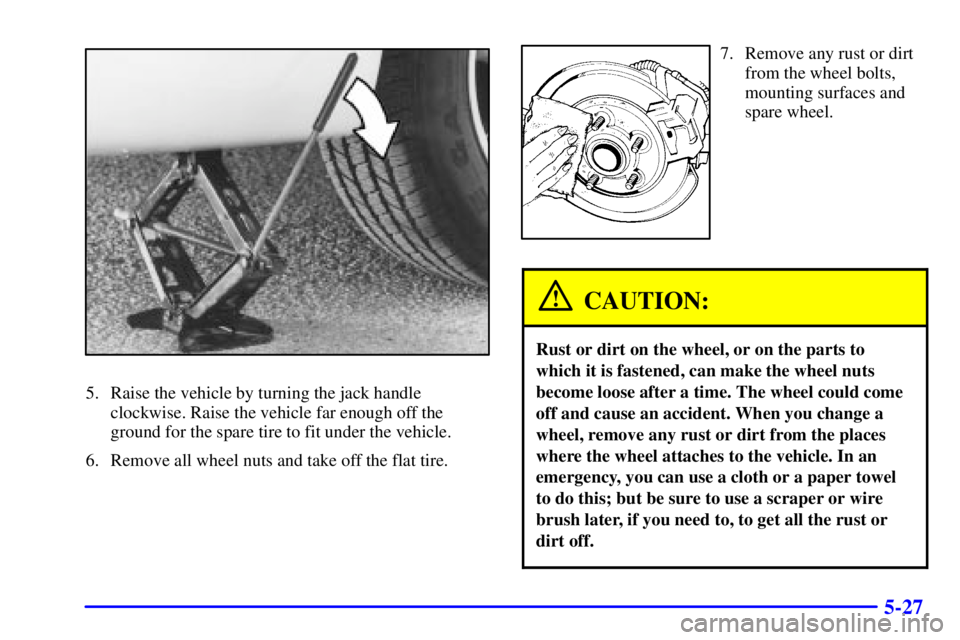
5. Raise the vehicle by turning the jack handle
clockwise. Raise the vehicle far enough off the
ground for the spare tire to fit under the vehicle.
6. Remove all wheel nuts and take off the flat tire.
7. Remove any rust or dirt
from the wheel bolts,
mounting surfaces and
spare wheel.
CAUTION:
Rust or dirt on the wheel, or on the parts to
which it is fastened, can make the wheel nuts
become loose after a time. The wheel could come
off and cause an accident. When you change a
wheel, remove any rust or dirt from the places
where the wheel attaches to the vehicle. In an
emergency, you can use a cloth or a paper towel
to do this; but be sure to use a scraper or wire
brush later, if you need to, to get all the rust or
dirt off.
Page 236 of 344
5-28
CAUTION:
Never use oil or grease on studs or nuts. If you
do, the nuts might come loose. Your wheel could
fall off, causing a serious accident.
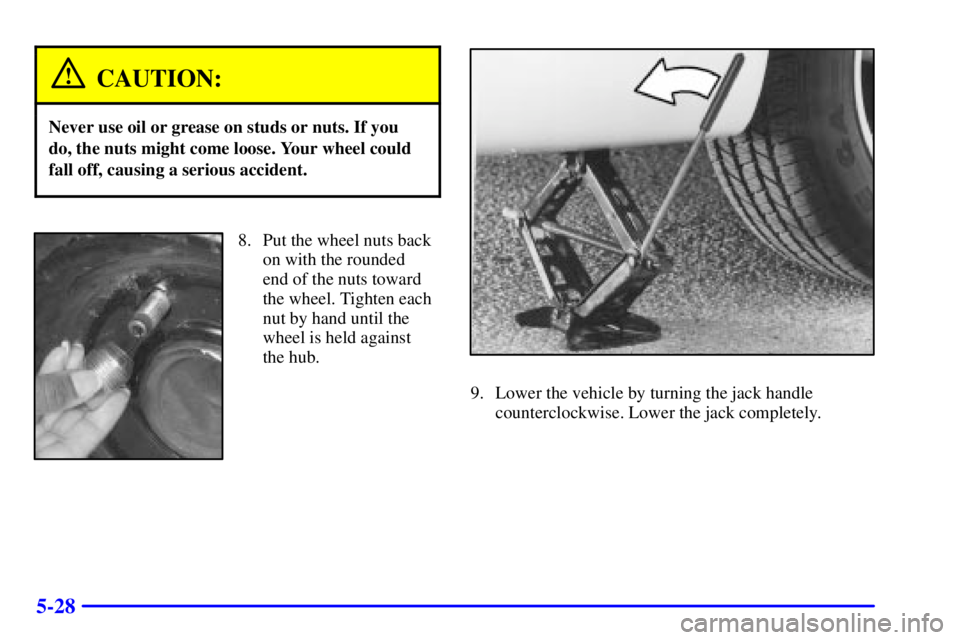
8. Put the wheel nuts back
on with the rounded
end of the nuts toward
the wheel. Tighten each
nut by hand until the
wheel is held against
the hub.
9. Lower the vehicle by turning the jack handle
counterclockwise. Lower the jack completely.
Page 237 of 344
5-29
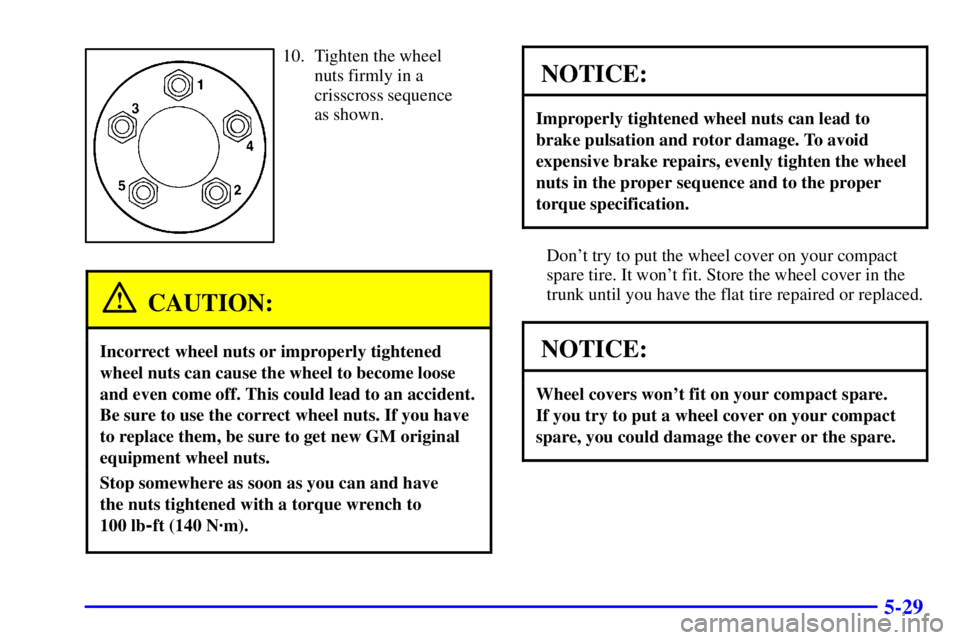
10. Tighten the wheel
nuts firmly in a
crisscross sequence
as shown.
CAUTION:
Incorrect wheel nuts or improperly tightened
wheel nuts can cause the wheel to become loose
and even come off. This could lead to an accident.
Be sure to use the correct wheel nuts. If you have
to replace them, be sure to get new GM original
equipment wheel nuts.
Stop somewhere as soon as you can and have
the nuts tightened with a torque wrench to
100 lb
-ft (140 N´m).
NOTICE:
Improperly tightened wheel nuts can lead to
brake pulsation and rotor damage. To avoid
expensive brake repairs, evenly tighten the wheel
nuts in the proper sequence and to the proper
torque specification.
Don't try to put the wheel cover on your compact
spare tire. It won't fit. Store the wheel cover in the
trunk until you have the flat tire repaired or replaced.
NOTICE:
Wheel covers won't fit on your compact spare.
If you try to put a wheel cover on your compact
spare, you could damage the cover or the spare.
Page 238 of 344
5-30 Storing the Flat Tire and Tools
CAUTION:
Storing a jack, a tire or other equipment in the
passenger compartment of the vehicle could
cause injury. In a sudden stop or collision, loose
equipment could strike someone. Store all these
in the proper place.
After you've put the compact tire on your vehicle, you'll
put the compact spare tire on your vehicle, you'll need
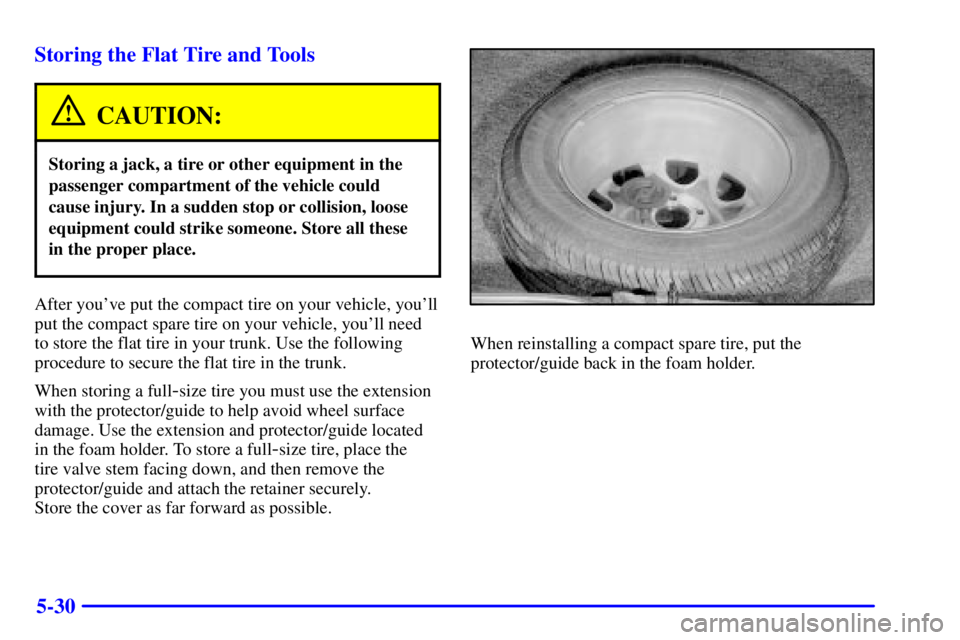
to store the flat tire in your trunk. Use the following
procedure to secure the flat tire in the trunk.
When storing a full
-size tire you must use the extension
with the protector/guide to help avoid wheel surface
damage. Use the extension and protector/guide located
in the foam holder. To store a full
-size tire, place the
tire valve stem facing down, and then remove the
protector/guide and attach the retainer securely.
Store the cover as far forward as possible.
When reinstalling a compact spare tire, put the
protector/guide back in the foam holder.
Page 240 of 344
5-32
Compact Spare Tire
Although the compact spare tire was fully inflated
when your vehicle was new, it can lose air after a time.
Check the inflation pressure regularly. It should be
60 psi (420 kPa).
After installing the compact spare on your vehicle, you
should stop as soon as possible and make sure your
spare tire is correctly inflated. The compact spare is
made to perform well at speeds up to 65 mph
(105 km/h) for distances up to 3,000 miles (5 000 km),
so you can finish your trip and have your full
-size tire
repaired or replaced where you want. You must calibrate
the tire pressure monitor system after installing or
removing the compact spare. See ªTire Pressure
Monitorº in the Index. The system may not work
correctly when the compact spare is installed on the
vehicle. You must calibrate the tire inflation monitor
system after installing or removing the compact spare.
See ªTire Inflation Monitorº in the Index. The system may not work correctly when the compact
spare is installed on the vehicle. Of course, it's best to
replace your spare with a full
-size tire as soon as you
can. Your spare will last longer and be in good shape in
case you need it again.
NOTICE:
When the compact spare is installed, don't take
your vehicle through an automatic car wash with
guide rails. The compact spare can get caught on
the rails. That can damage the tire and wheel,
and maybe other parts of your vehicle.
Don't use your compact spare on other vehicles.
And don't mix your compact spare tire or wheel with
other wheels or tires. They won't fit. Keep your spare
tire and its wheel together.
Page 241 of 344
5-33
NOTICE:
Tire chains won't fit your compact spare. Using
them can damage your vehicle and can damage
the chains too. Don't use tire chains on your
compact spare.
If You're Stuck: In Sand, Mud,
Ice or Snow
In order to free your vehicle when it is stuck, you
will need to spin the wheels, but you don't want to spin
your wheels too fast. The method known as ªrockingº
can help you get out when you're stuck, but you must
use caution.
CAUTION:
If you let your tires spin at high speed, they can
explode, and you or others could be injured. And,
the transaxle or other parts of the vehicle can
overheat. That could cause an engine
compartment fire or other damage. When you're
stuck, spin the wheels as little as possible. Don't
spin the wheels above 35 mph (55 km/h) as shown
on the speedometer.
Page 242 of 344
5-34
NOTICE:
Spinning your wheels can destroy parts of your
vehicle as well as the tires. If you spin the wheels
too fast while shifting your transaxle back and
forth, you can destroy your transaxle.
For information about using tire chains on your vehicle,
see ªTire Chainsº in the Index.
Rocking Your Vehicle To Get It Out
First, turn your steering wheel left and right. That will
clear the area around your front wheels. You should turn
the Enhanced Traction System off. (See ªEnhanced
Traction Systemº in the Index.) Then shift back and
forth between REVERSE (R) and a forward gear,
spinning the wheels as little as possible. REVERSE (R)
and FIRST (1) or SECOND (2) gear. The Enhanced
Traction System will be turned off in FIRST (1) or
SECOND (2) gear. Spin the wheels as little as possible.
Release the accelerator pedal while you shift, and press
lightly on the accelerator pedal when the transaxle is in
gear. By slowly spinning your wheels in the forward and
reverse directions, you will cause a rocking motion that
may free your vehicle. If that doesn't get you out after a
few tries, you may need to be towed out. If you do
need to be towed out, see ªTowing Your Vehicleº in
the Index.
Page 243 of 344
6-
6-1
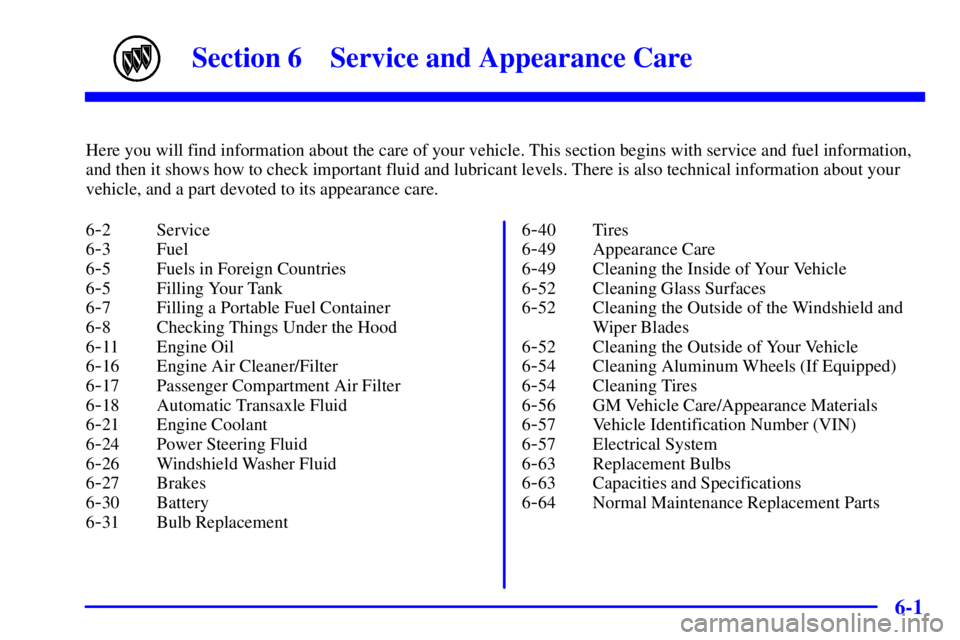
Section 6 Service and Appearance Care
Here you will find information about the care of your vehicle. This section begins with service and fuel information,
and then it shows how to check important fluid and lubricant levels. There is also technical information about your
vehicle, and a part devoted to its appearance care.
6
-2 Service
6
-3 Fuel
6
-5 Fuels in Foreign Countries
6
-5 Filling Your Tank
6
-7 Filling a Portable Fuel Container
6
-8 Checking Things Under the Hood
6
-11 Engine Oil
6
-16 Engine Air Cleaner/Filter
6
-17 Passenger Compartment Air Filter
6
-18 Automatic Transaxle Fluid
6
-21 Engine Coolant
6
-24 Power Steering Fluid
6
-26 Windshield Washer Fluid
6
-27 Brakes
6
-30 Battery
6
-31 Bulb Replacement6
-40 Tires
6
-49 Appearance Care
6
-49 Cleaning the Inside of Your Vehicle
6
-52 Cleaning Glass Surfaces
6
-52 Cleaning the Outside of the Windshield and
Wiper Blades
6
-52 Cleaning the Outside of Your Vehicle
6
-54 Cleaning Aluminum Wheels (If Equipped)
6
-54 Cleaning Tires
6
-56 GM Vehicle Care/Appearance Materials
6
-57 Vehicle Identification Number (VIN)
6
-57 Electrical System
6
-63 Replacement Bulbs
6
-63 Capacities and Specifications
6
-64 Normal Maintenance Replacement Parts
Page 271 of 344
6-29 Brake Wear
Your vehicle has front disc brakes and rear drum brakes.
Disc brake pads have built
-in wear indicators that
make a high
-pitched warning sound when the brake
pads are worn and new pads are needed. The sound
may come and go or be heard all the time your vehicle
is moving (except when you are pushing on the brake
pedal firmly).
CAUTION:
The brake wear warning sound means that soon
your brakes won't work well. That could lead to
an accident. When you hear the brake wear
warning sound, have your vehicle serviced.
NOTICE:
Continuing to drive with worn-out brake pads
could result in costly brake repair.
Some driving conditions or climates may cause a brake
squeal when the brakes are first applied or lightly
applied. This does not mean something is wrong with
your brakes.
Properly torqued wheel nuts are necessary to help
prevent brake pulsation. When tires are rotated, inspect
brake pads for wear and evenly torque wheel nuts in the
proper sequence to GM specifications.
Brake linings should always be replaced as complete
axle sets.
See ªBrake System Inspectionº in Section 7
of this manual under Part C ªPeriodic
Maintenance Inspections.º
Brake Pedal Travel
See your dealer if the brake pedal does not return to
normal height, or if there is a rapid increase in pedal
travel. This could be a sign of brake trouble.
Brake Adjustment
Every time you apply the brakes, with or without the
vehicle moving, your brakes adjust for wear.
Page 285 of 344

6-43
To reset (calibrate) the system: turn the ignition switch
to RUN. Then press and hold the RESET button for
about five seconds. The red RESET button is located
inside your instrument panel fuse block. The fuse block
is located under the cover labeled FUSES, which is at
the end of the instrument panel on the passenger's side
of the vehicle. The RESET button is the first button in
the top row of the fuse block. The LOW TIRE light will
come on and flash three times. Then it will go off. If the
light doesn't go off, see your dealer for service.
The system completes the calibration process
during driving.
The system normally takes 15 to 20 minutes of driving
in each of three speed ranges to ªlearnº tire pressures.
The speed ranges are 15 to 40 mph (25 to 65 km/h),
40 to 65 mph (65 to 105 km/h) and above 65 mph
(105 km/h). When learning is complete, the system will
alert you after 2
-8 minutes if a tire is 12 psi (83 kPa)
different from the other three tires. Detection thresholds
may be higher and detection times may be longer on
rough roads, curves and at high speeds. The system
is not capable of detection at speeds greater than
70 mph (110 km/h).
Tire Inspection and Rotation
Tires should be rotated every 6,000 to 8,000 miles
(10 000 to 13 000 km). Any time you notice unusual wear,
rotate your tires as soon as possible and check wheel
alignment. Also check for damaged tires or wheels. See
ªWhen It's Time for New Tiresº and ªWheel
Replacementº later in this section for more information.
The purpose of regular rotation is to achieve more
uniform wear for all tires on the vehicle. The first
rotation is the most important. See ªScheduled
Maintenance Servicesº in the Index for scheduled
rotation intervals.
When rotating your tires, always use the correct rotation
pattern shown here.