ECU BUICK CENTURY 2003 User Guide
[x] Cancel search | Manufacturer: BUICK, Model Year: 2003, Model line: CENTURY, Model: BUICK CENTURY 2003Pages: 344, PDF Size: 2.57 MB
Page 48 of 344
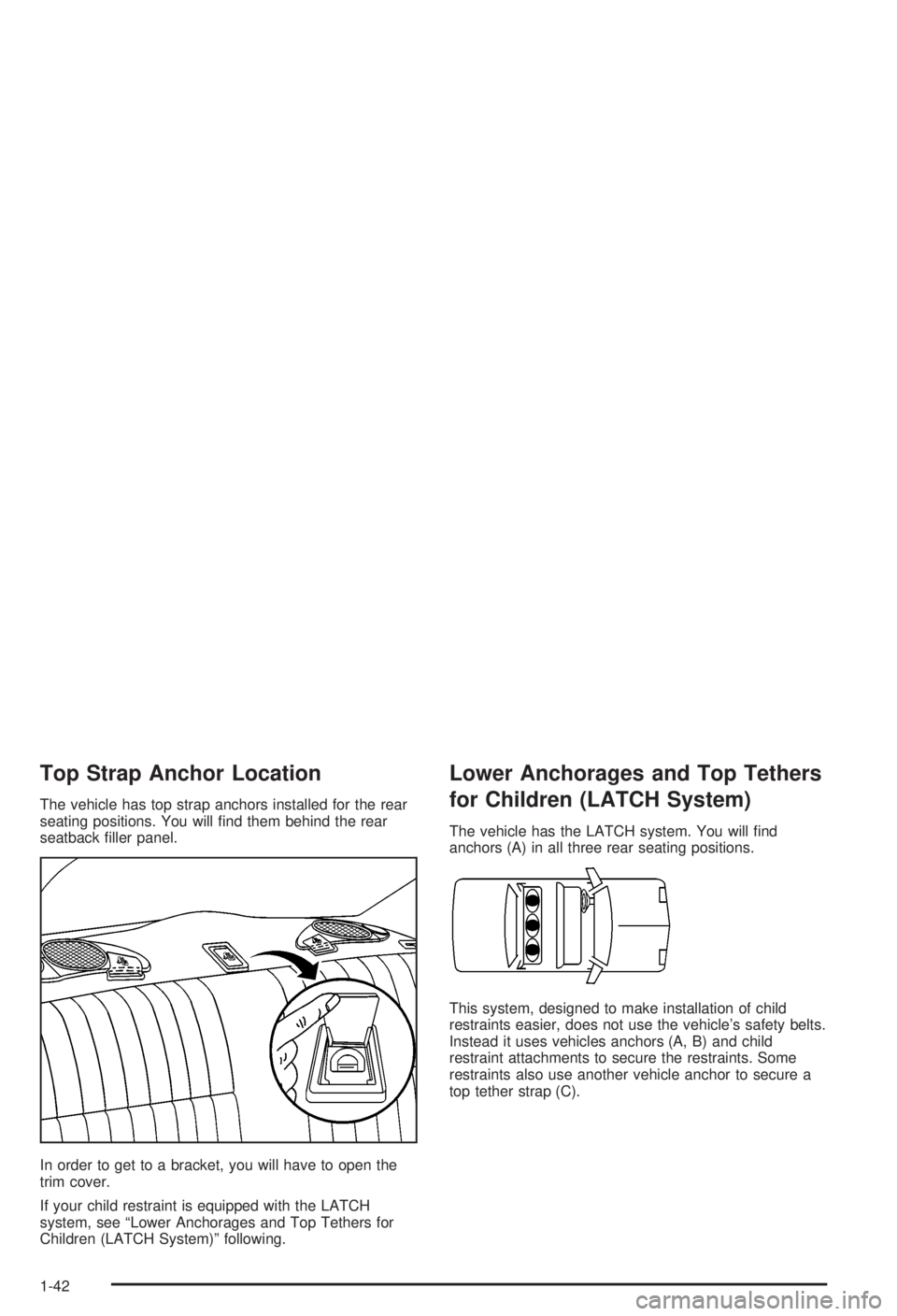
Top Strap Anchor Location
The vehicle has top strap anchors installed for the rear
seating positions. You will ®nd them behind the rear
seatback ®ller panel.
In order to get to a bracket, you will have to open the
trim cover.
If your child restraint is equipped with the LATCH
system, see ªLower Anchorages and Top Tethers for
Children (LATCH System)º following.
Lower Anchorages and Top Tethers
for Children (LATCH System)
The vehicle has the LATCH system. You will ®nd
anchors (A) in all three rear seating positions.
This system, designed to make installation of child
restraints easier, does not use the vehicle's safety belts.
Instead it uses vehicles anchors (A, B) and child
restraint attachments to secure the restraints. Some
restraints also use another vehicle anchor to secure a
top tether strap (C).
1-42
Page 50 of 344
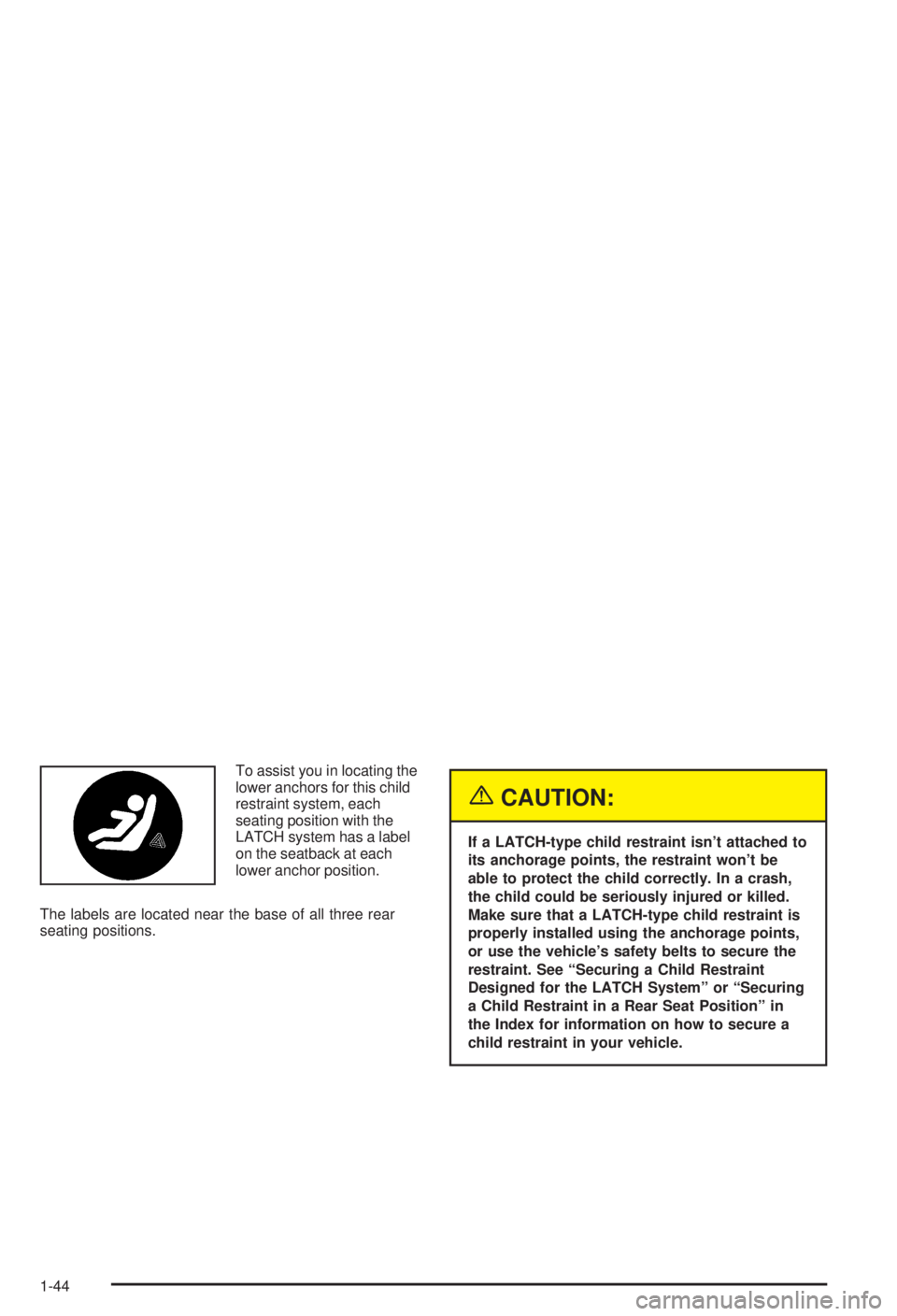
To assist you in locating the
lower anchors for this child
restraint system, each
seating position with the
LATCH system has a label
on the seatback at each
lower anchor position.
The labels are located near the base of all three rear
seating positions.
{CAUTION:
If a LATCH-type child restraint isn't attached to
its anchorage points, the restraint won't be
able to protect the child correctly. In a crash,
the child could be seriously injured or killed.
Make sure that a LATCH-type child restraint is
properly installed using the anchorage points,
or use the vehicle's safety belts to secure the
restraint. See ªSecuring a Child Restraint
Designed for the LATCH Systemº or ªSecuring
a Child Restraint in a Rear Seat Positionº in
the Index for information on how to secure a
child restraint in your vehicle.
1-44
Page 51 of 344
Securing a Child Restraint Designed
for the LATCH System
1. Find the anchors for the seating position you want
to use, where the bottom of the seatback meets the
back of the seat cushion.
2. Put the child restraint on the seat.
3. Attach the anchor points on the child restraint to the
anchors in the vehicle. The child restraint
instructions will show you how.
4. If the child restraint is forward-facing, attach the top
strap to the top strap anchor. See
Top Strap on
page 1-40. Tighten the top strap according to
the child restraint instructions.
5. Push and pull the child restraint in different
directions to be sure it is secure.
To remove the child restraint, simply unhook the top
strap from the top tether anchor and then disconnect the
anchor points.
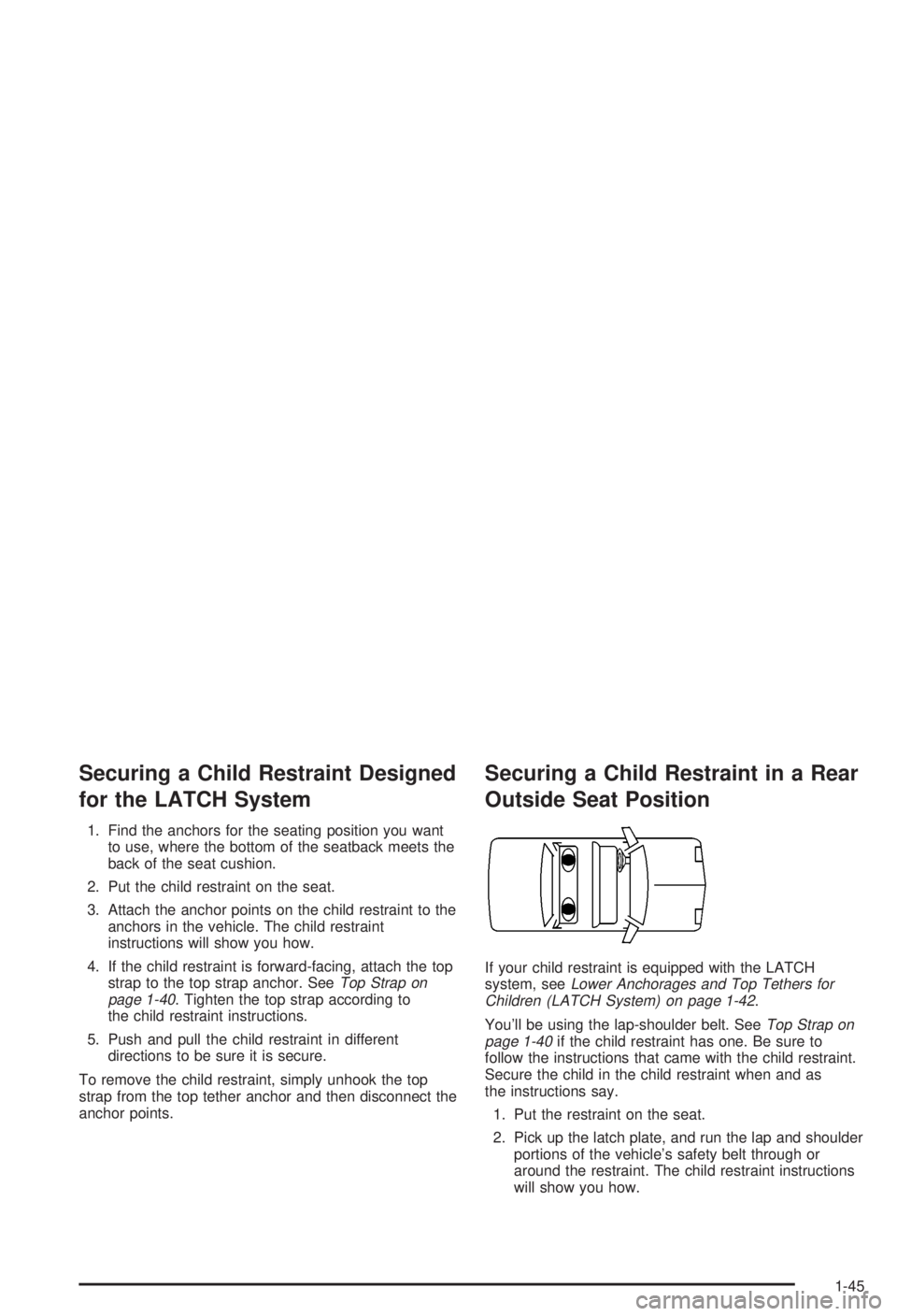
Securing a Child Restraint in a Rear
Outside Seat Position
If your child restraint is equipped with the LATCH
system, seeLower Anchorages and Top Tethers for
Children (LATCH System) on page 1-42.
You'll be using the lap-shoulder belt. See
Top Strap on
page 1-40if the child restraint has one. Be sure to
follow the instructions that came with the child restraint.
Secure the child in the child restraint when and as
the instructions say.
1. Put the restraint on the seat.
2. Pick up the latch plate, and run the lap and shoulder
portions of the vehicle's safety belt through or
around the restraint. The child restraint instructions
will show you how.
1-45
Page 53 of 344
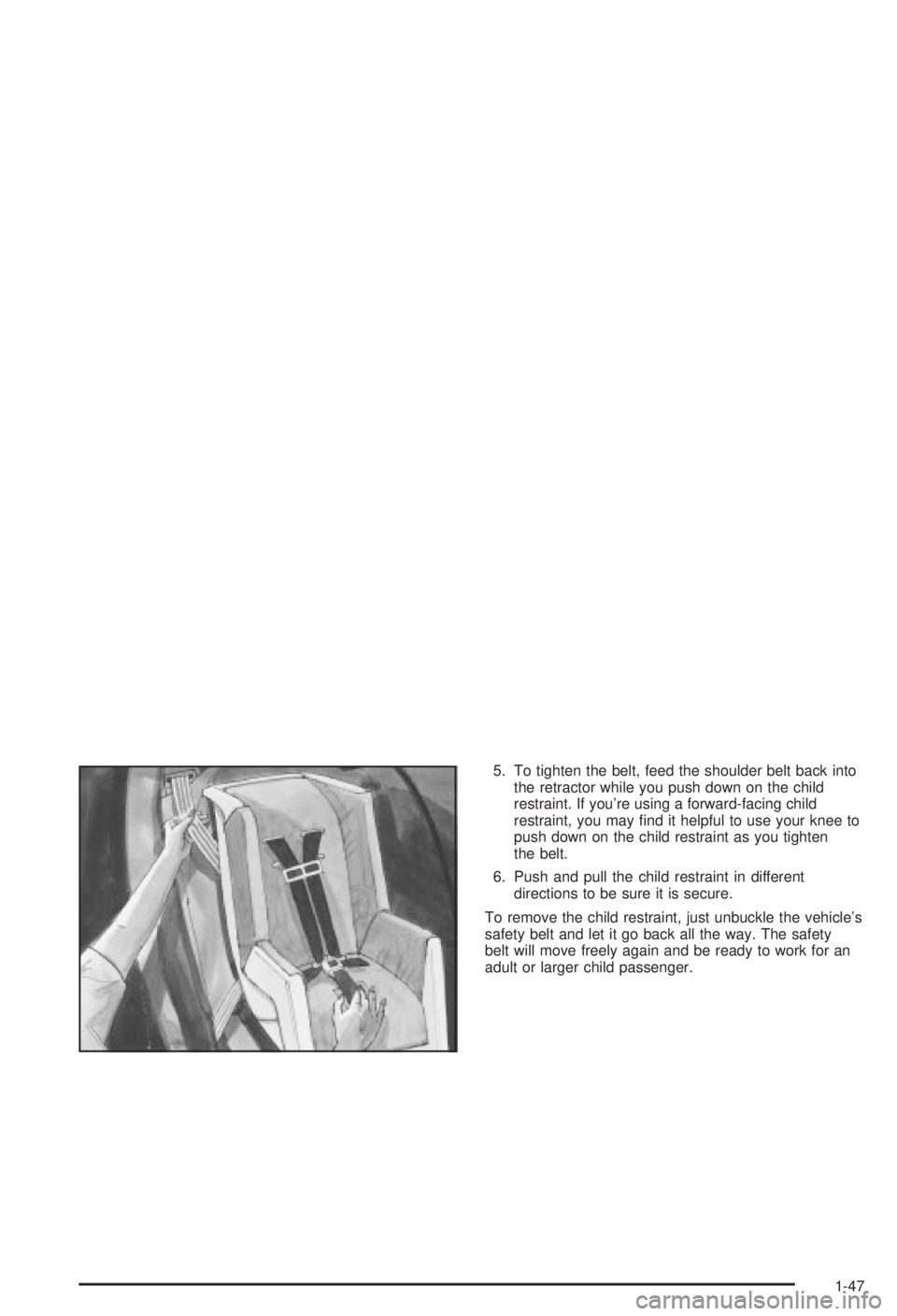
5. To tighten the belt, feed the shoulder belt back into
the retractor while you push down on the child
restraint. If you're using a forward-facing child
restraint, you may ®nd it helpful to use your knee to
push down on the child restraint as you tighten
the belt.
6. Push and pull the child restraint in different
directions to be sure it is secure.
To remove the child restraint, just unbuckle the vehicle's
safety belt and let it go back all the way. The safety
belt will move freely again and be ready to work for an
adult or larger child passenger.
1-47
Page 54 of 344
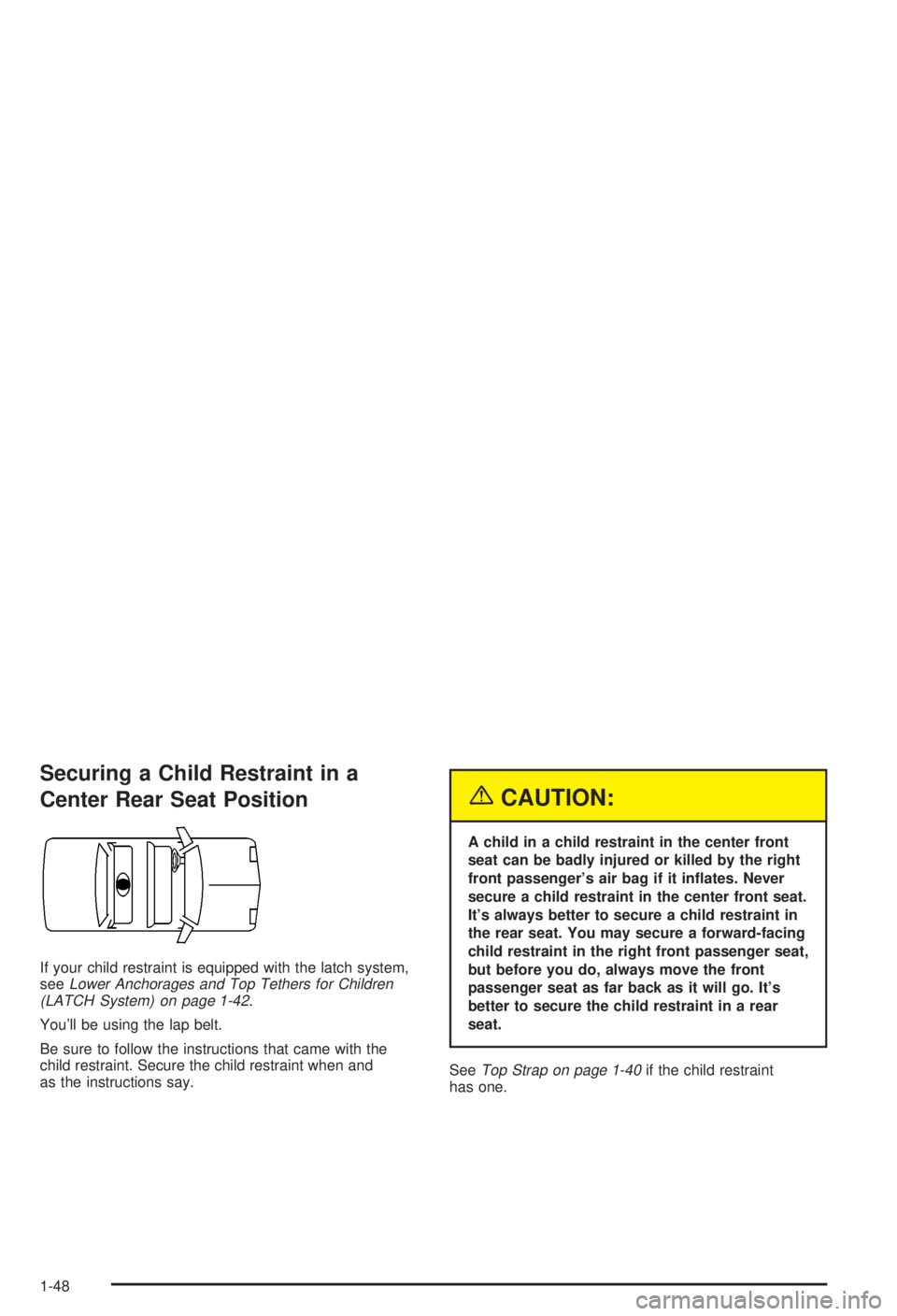
Securing a Child Restraint in a
Center Rear Seat Position
If your child restraint is equipped with the latch system,
seeLower Anchorages and Top Tethers for Children
(LATCH System) on page 1-42.
You'll be using the lap belt.
Be sure to follow the instructions that came with the
child restraint. Secure the child restraint when and
as the instructions say.
{CAUTION:
A child in a child restraint in the center front
seat can be badly injured or killed by the right
front passenger's air bag if it in¯ates. Never
secure a child restraint in the center front seat.
It's always better to secure a child restraint in
the rear seat. You may secure a forward-facing
child restraint in the right front passenger seat,
but before you do, always move the front
passenger seat as far back as it will go. It's
better to secure the child restraint in a rear
seat.
See
Top Strap on page 1-40if the child restraint
has one.
1-48
Page 56 of 344
6. Push and pull the child restraint in different
directions to be sure it is secure.
To remove the child restraint, just unbuckle the vehicle's
safety belt. It will be ready to work for an adult or
larger child passenger.
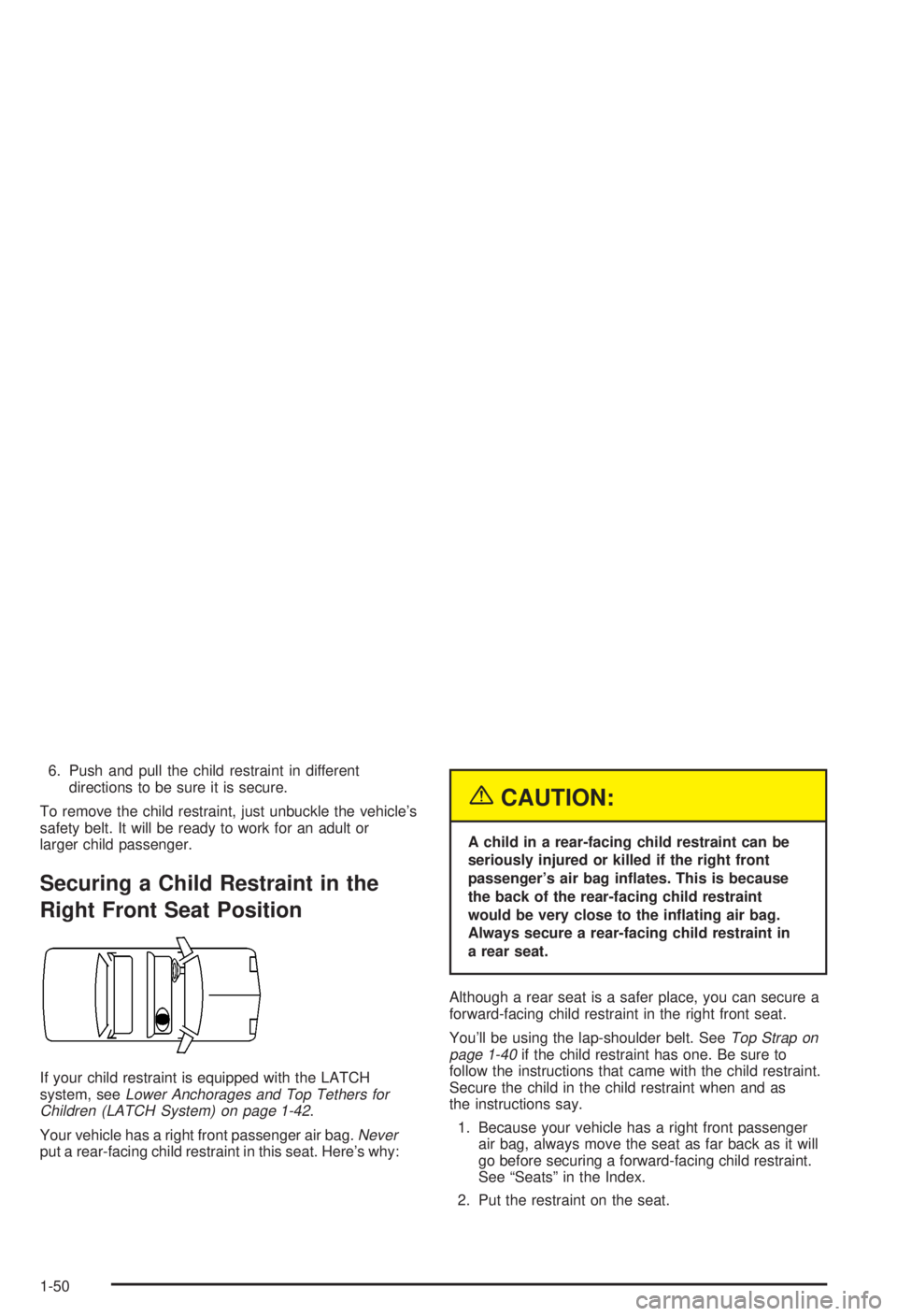
Securing a Child Restraint in the
Right Front Seat Position
If your child restraint is equipped with the LATCH
system, seeLower Anchorages and Top Tethers for
Children (LATCH System) on page 1-42.
Your vehicle has a right front passenger air bag.
Neverput a rear-facing child restraint in this seat. Here's why:
{CAUTION:
A child in a rear-facing child restraint can be
seriously injured or killed if the right front
passenger's air bag in¯ates. This is because
the back of the rear-facing child restraint
would be very close to the in¯ating air bag.
Always secure a rear-facing child restraint in
a rear seat.
Although a rear seat is a safer place, you can secure a
forward-facing child restraint in the right front seat.
You'll be using the lap-shoulder belt. See
Top Strap on
page 1-40if the child restraint has one. Be sure to
follow the instructions that came with the child restraint.
Secure the child in the child restraint when and as
the instructions say.
1. Because your vehicle has a right front passenger
air bag, always move the seat as far back as it will
go before securing a forward-facing child restraint.
See ªSeatsº in the Index.
2. Put the restraint on the seat.
1-50
Page 58 of 344
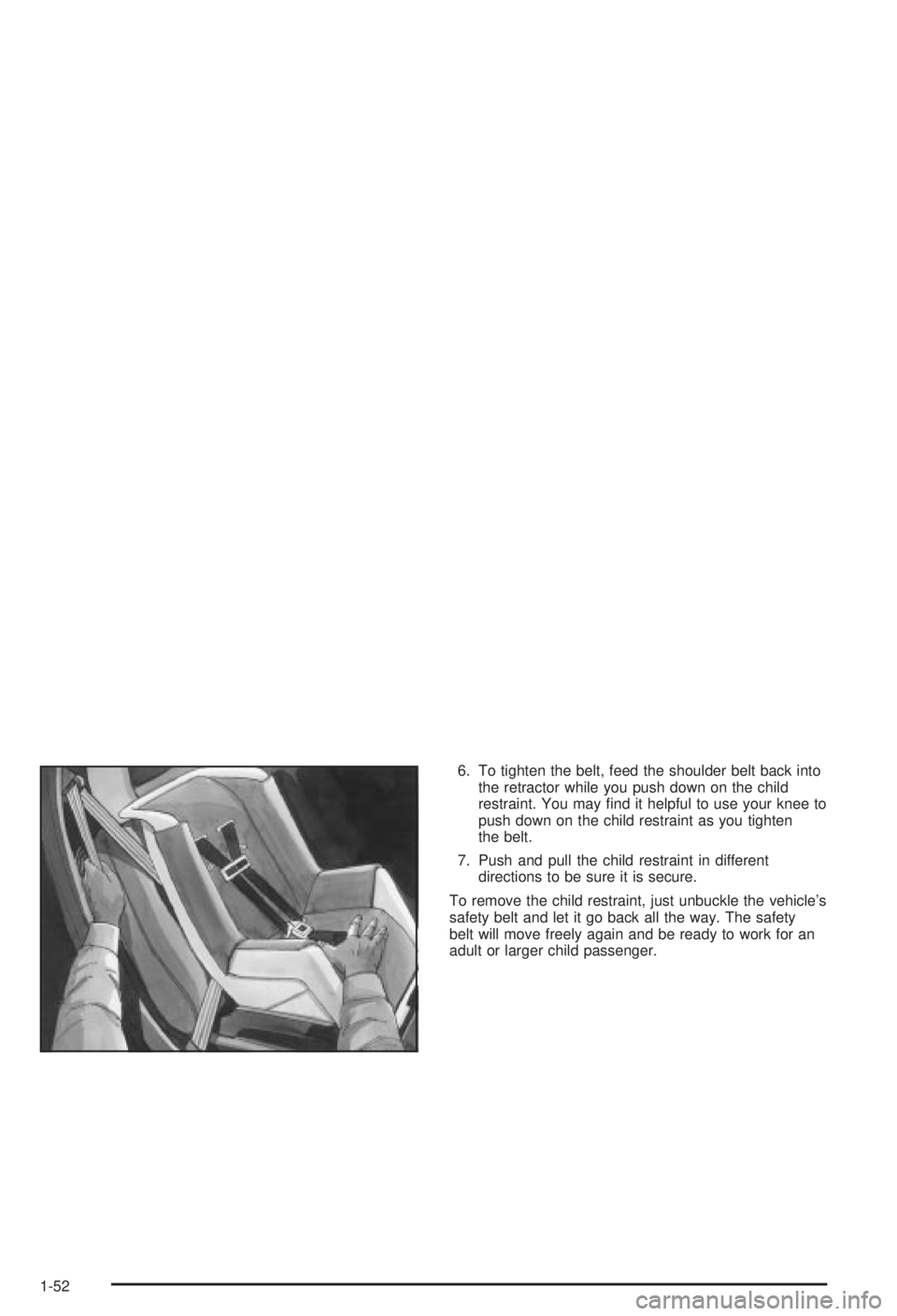
6. To tighten the belt, feed the shoulder belt back into
the retractor while you push down on the child
restraint. You may ®nd it helpful to use your knee to
push down on the child restraint as you tighten
the belt.
7. Push and pull the child restraint in different
directions to be sure it is secure.
To remove the child restraint, just unbuckle the vehicle's
safety belt and let it go back all the way. The safety
belt will move freely again and be ready to work for an
adult or larger child passenger.
1-52
Page 61 of 344
{CAUTION:
Anyone who is up against, or very close to,
any air bag when it in¯ates can be seriously
injured or killed. Air bags plus lap-shoulder
belts offer the best protection for adults, but
not for young children and infants. Neither the
vehicle's safety belt system nor its air bag
system is designed for them. Young children
and infants need the protection that a child
restraint system can provide. Always secure
children properly in your vehicle. To read how,
see the part of this manual called ªOlder
Childrenº or ªInfants and Young Children.ºThere is an air bag
readiness light on the
instrument panel, which
shows the air bag symbol.
The system checks the air bag electrical system for
malfunctions. The light tells you if there is an electrical
problem. See
Air Bag Readiness Light on page 3-25for more information.
1-55
Page 75 of 344
Remote Keyless Entry System
Operation
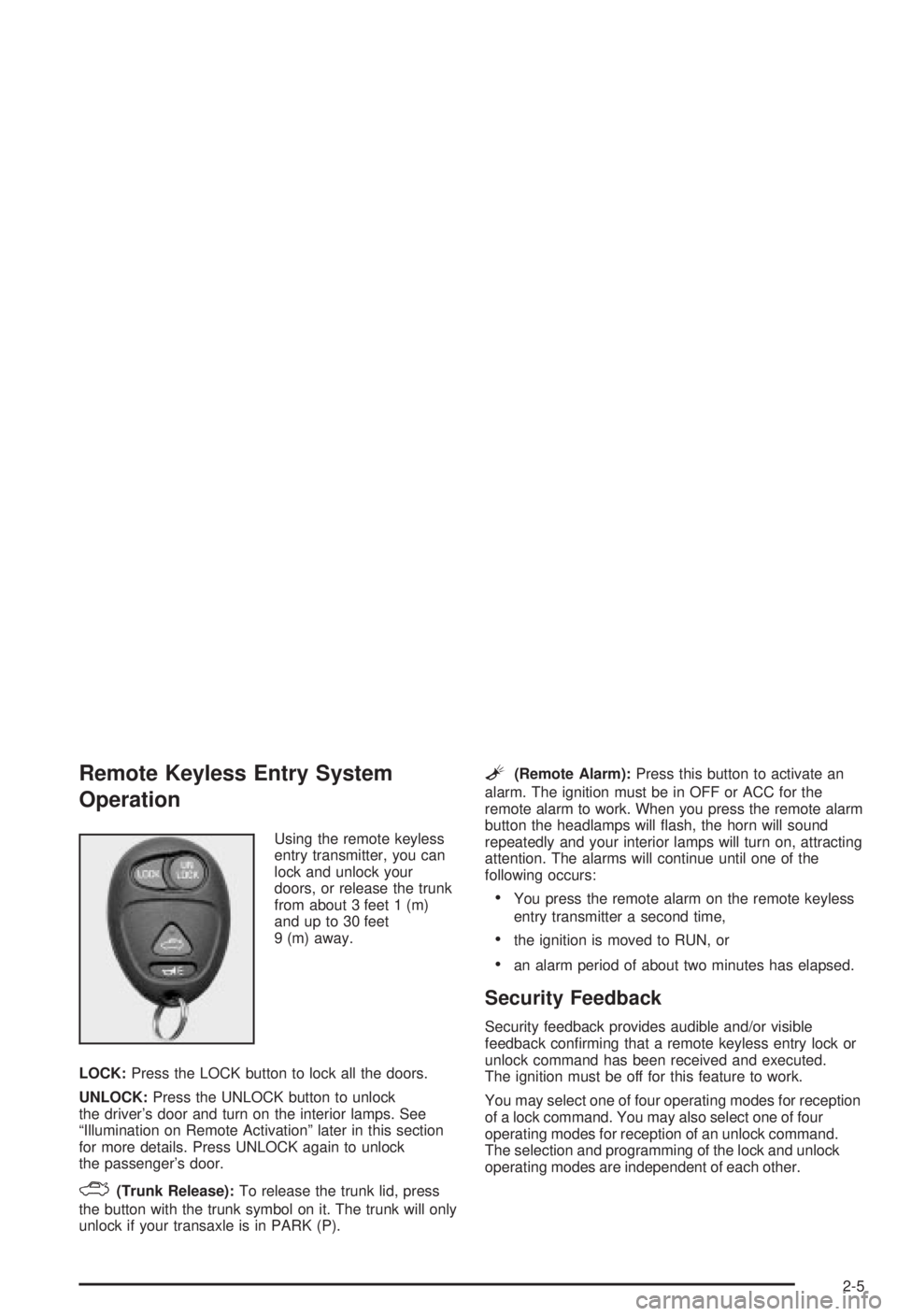
Using the remote keyless
entry transmitter, you can
lock and unlock your
doors, or release the trunk
from about 3 feet 1 (m)
and up to 30 feet
9 (m) away.
LOCK:Press the LOCK button to lock all the doors.
UNLOCK:Press the UNLOCK button to unlock
the driver's door and turn on the interior lamps. See
ªIllumination on Remote Activationº later in this section
for more details. Press UNLOCK again to unlock
the passenger's door.
F(Trunk Release):To release the trunk lid, press
the button with the trunk symbol on it. The trunk will only
unlock if your transaxle is in PARK (P).
L(Remote Alarm):Press this button to activate an
alarm. The ignition must be in OFF or ACC for the
remote alarm to work. When you press the remote alarm
button the headlamps will ¯ash, the horn will sound
repeatedly and your interior lamps will turn on, attracting
attention. The alarms will continue until one of the
following occurs:
·You press the remote alarm on the remote keyless
entry transmitter a second time,
·the ignition is moved to RUN, or
·an alarm period of about two minutes has elapsed.
Security Feedback
Security feedback provides audible and/or visible
feedback con®rming that a remote keyless entry lock or
unlock command has been received and executed.
The ignition must be off for this feature to work.
You may select one of four operating modes for reception
of a lock command. You may also select one of four
operating modes for reception of an unlock command.
The selection and programming of the lock and unlock
operating modes are independent of each other.
2-5
Page 76 of 344
Programmable Modes
Your vehicle can be programmed to one of the following
modes.
Mode 1:No Veri®cation
Mode 2:Horn Chirp only
Mode 3:Headlamps Flash only
Mode 4:Horn Chirp and Headlamps Flash
The vehicle was originally programmed to Mode 3. The
mode may have been changed since then. To
determine the current mode, or to change the mode, do
the following:
1. Close all doors and turn the ignition key to RUN.
2. Press and hold the power door lock switch in
the lock position.
3. While holding the door lock switch in the lock
position, press and release the remote keyless entry
transmitter LOCK button. This will start the
customization mode. While in the customizationmode, the feature will sound the number of chimes
corresponding to the current lock mode. If you
do not wish to change the current mode, you can
either exit the programming mode by following
the instructions listed here or program the
next feature available on your vehicle.
4. Each additional press of the remote keyless entry
transmitter LOCK button will cause your vehicle to
advance the lock mode by one, starting from
the current lock mode.
5. If cycled beyond Mode 4, the vehicle will enter
Mode 1. When the door lock switch is released,
the vehicle will remain in the most recent lock mode.
The mode you selected is now set. You can either exit
the programming mode by following the previous
instructions or program the next feature available on
your vehicle.
Disconnecting the vehicle's battery for up to a year will
not change the programmed mode for the lock and
unlock security feedback features.
2-6