ECU BUICK CENTURY 2005 Owner's Guide
[x] Cancel search | Manufacturer: BUICK, Model Year: 2005, Model line: CENTURY, Model: BUICK CENTURY 2005Pages: 348, PDF Size: 2.32 MB
Page 202 of 348
If things like suitcases, tools, packages, or anything else
are put inside the vehicle, they will go as fast as the
vehicle goes. If you have to stop or turn quickly,
or if there is a crash, they will keep going.
{CAUTION:
Things you put inside your vehicle can strike
and injure people in a sudden stop or turn, or
in a crash.
Put things in the trunk of your vehicle. In a
trunk, put them as far forward as you can.
Try to spread the weight evenly.
Never stack heavier things, like suitcases,
inside the vehicle so that some of them
are above the tops of the seats.
Do not leave an unsecured child restraint
in your vehicle.
When you carry something inside the
vehicle, secure it whenever you can.
Do not leave a seat folded down unless
you need to.
Towing
Towing Your Vehicle
Consult your dealer or a professional towing service
if you need to have your disabled vehicle towed.
SeeRoadside Assistance Program on page 7-6.
If you want to tow your vehicle behind another vehicle
for recreational purposes (such as behind a motorhome),
see “Recreational Vehicle Towing” following.
Recreational Vehicle Towing
Recreational vehicle towing means towing your vehicle
behind another vehicle – such as behind a motorhome.
The two most common types of recreational vehicle
towing are known as dinghy towing, towing the vehicle
with all four wheels on the ground, and dolly towing,
towing the vehicle with two wheels on the ground and
two wheels up on a device known as a dolly.
With the proper preparation and equipment, many
vehicles can be towed in these ways. See “Dinghy
Towing” and “Dolly Towing,” following.
4-36
Page 208 of 348
Driving with a Trailer
Towing a trailer requires a certain amount of experience.
Before setting out for the open road, get to know the
rig. Acquaint yourself with the feel of handling and
braking with the added weight of the trailer. And always
keep in mind that the vehicle is now a good deal
longer and not nearly as responsive as the vehicle is
by itself.
Before starting, check all trailer hitch parts and
attachments, safety chains, electrical connector, lamps,
tires, and mirror adjustment. If the trailer has electric
brakes, start the vehicle and trailer moving and then
apply the trailer brake controller by hand to be sure the
brakes are working. This lets you check the electrical
connection at the same time.
During your trip, check occasionally to be sure that the
load is secure, and that the lamps and any trailer
brakes are still working.
Following Distance
Stay at least twice as far behind the vehicle ahead as
when driving the vehicle without a trailer. This can
help avoid situations that require heavy braking
and sudden turns.
Passing
More passing distance is needed up ahead when
towing a trailer. And, because the vehicle is a good deal
longer with the trailer, you will need to go much farther
beyond the vehicle you have passed before you
can return to the proper lane.
Backing Up
Hold the bottom of the steering wheel with one hand.
Then, to move the trailer to the left, move that hand
to the left. To move the trailer to the right, move your
hand to the right. Always back up slowly and, if possible,
have someone guide you.
Making Turns
Notice:Making very sharp turns while trailering
could cause the trailer to come in contact with the
vehicle. Your vehicle could be damaged. Avoid
making very sharp turns while trailering.
When turning with a trailer, make wider turns than
normal. Do this so the trailer will not strike soft shoulders,
curbs, road signs, trees, or other objects. Avoid jerky or
sudden maneuvers. Signal well in advance.
4-42
Page 221 of 348

Hood Release
To open the hood, do the following:
1. Pull the interior hood
release handle located
below the instrument
panel, to the left of the
steering column.
2. Push the secondary hood release, located under
the hood, to the right to disengage it.
3. Lift the hood.
Before closing the hood, make sure all of the ller caps
are properly secured. Pull the hood down and close
it rmly.
5-11
Page 262 of 348
Windshield Wiper Blade
Replacement
Windshield wiper blades should be inspected for wear
or cracking each time maintenance is performed.
SeeScheduled Maintenance on page 6-4.
1. Turn on the wipers to LO.
2. Turn off the ignition while the wipers are at the
outer positions of the wiper pattern. The blades
are more accessible for removal or replacement
while in this position.
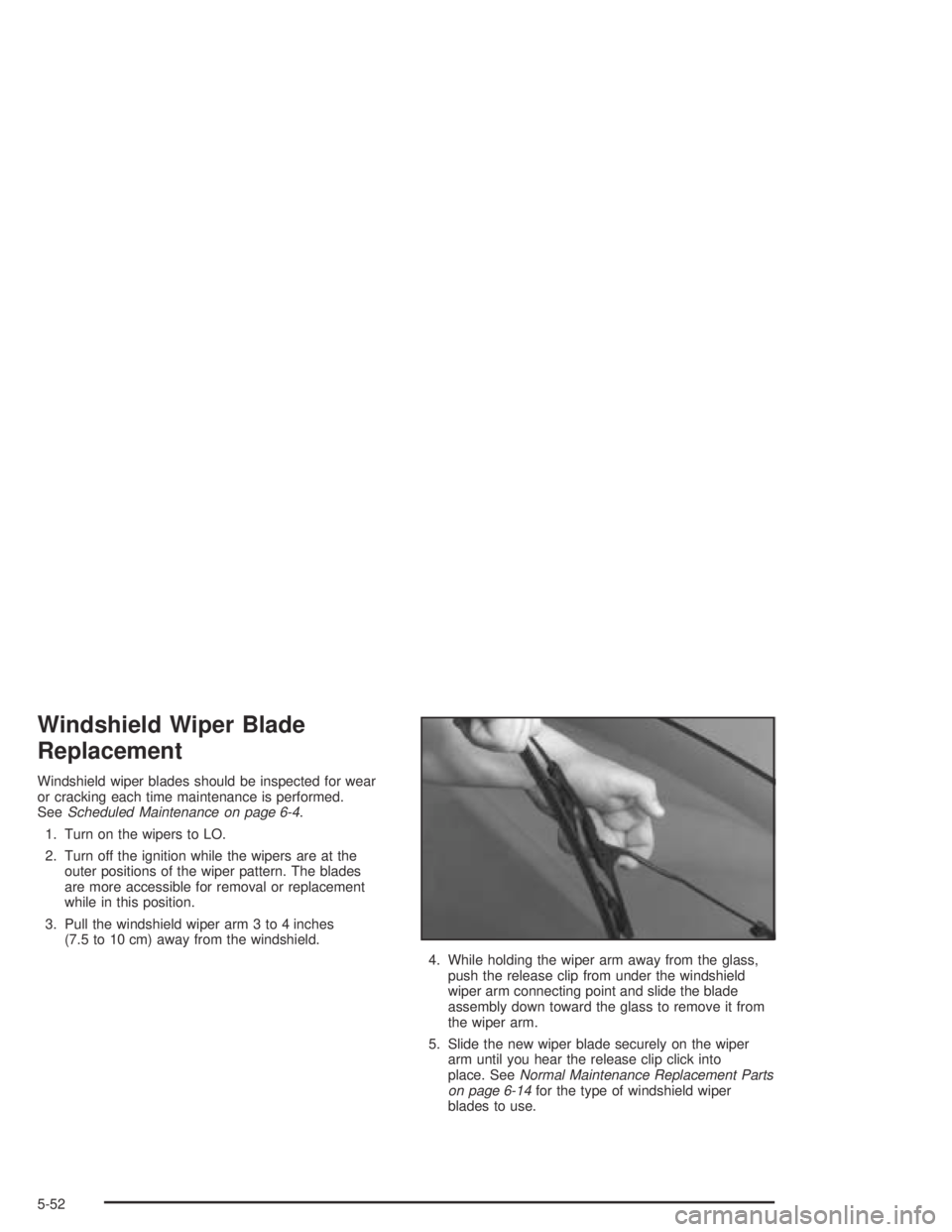
3. Pull the windshield wiper arm 3 to 4 inches
(7.5 to 10 cm) away from the windshield.
4. While holding the wiper arm away from the glass,
push the release clip from under the windshield
wiper arm connecting point and slide the blade
assembly down toward the glass to remove it from
the wiper arm.
5. Slide the new wiper blade securely on the wiper
arm until you hear the release clip click into
place. SeeNormal Maintenance Replacement Parts
on page 6-14for the type of windshield wiper
blades to use.
5-52
Page 278 of 348
Used Replacement Wheels
{CAUTION:
Putting a used wheel on your vehicle is
dangerous. You can’t know how it’s been used
or how far it’s been driven. It could fail suddenly
and cause a crash. If you have to replace a
wheel, use a new GM original equipment wheel.
Tire Chains
{CAUTION:
If your vehicle has P225/60R16 size tires, don’t
use tire chains, there’s not enough clearance.
Tire chains used on a vehicle without the
proper amount of clearance can cause damage
to the brakes, suspension or other vehicle
parts. The area damaged by the tire chains
could cause you to lose control of your vehicle
and you or others may be injured in a crash.
CAUTION: (Continued)
CAUTION: (Continued)
Use another type of traction device only if its
manufacturer recommends it for use on your
vehicle and tire size combination and road
conditions. Follow that manufacturer’s
instructions. To help avoid damage to your
vehicle, drive slowly, readjust or remove the
device if it’s contacting your vehicle, and don’t
spin your wheels.
If you do nd traction devices that will t,
install them on the front tires.
Notice:If your vehicle has a tire size other than
P225/60R16 size tires, use tire chains only where
legal and only when you must. Use only SAE Class
‘‘S’’ type chains that are the proper size for your
tires. Install them on the front tires and tighten them
as tightly as possible with the ends securely
fastened. Drive slowly and follow the chain
manufacturer’s instructions. If you can hear the
chains contacting your vehicle, stop and retighten
them. If the contact continues, slow down until
it stops. Driving too fast or spinning the wheels with
chains on will damage your vehicle.
5-68
Page 289 of 348
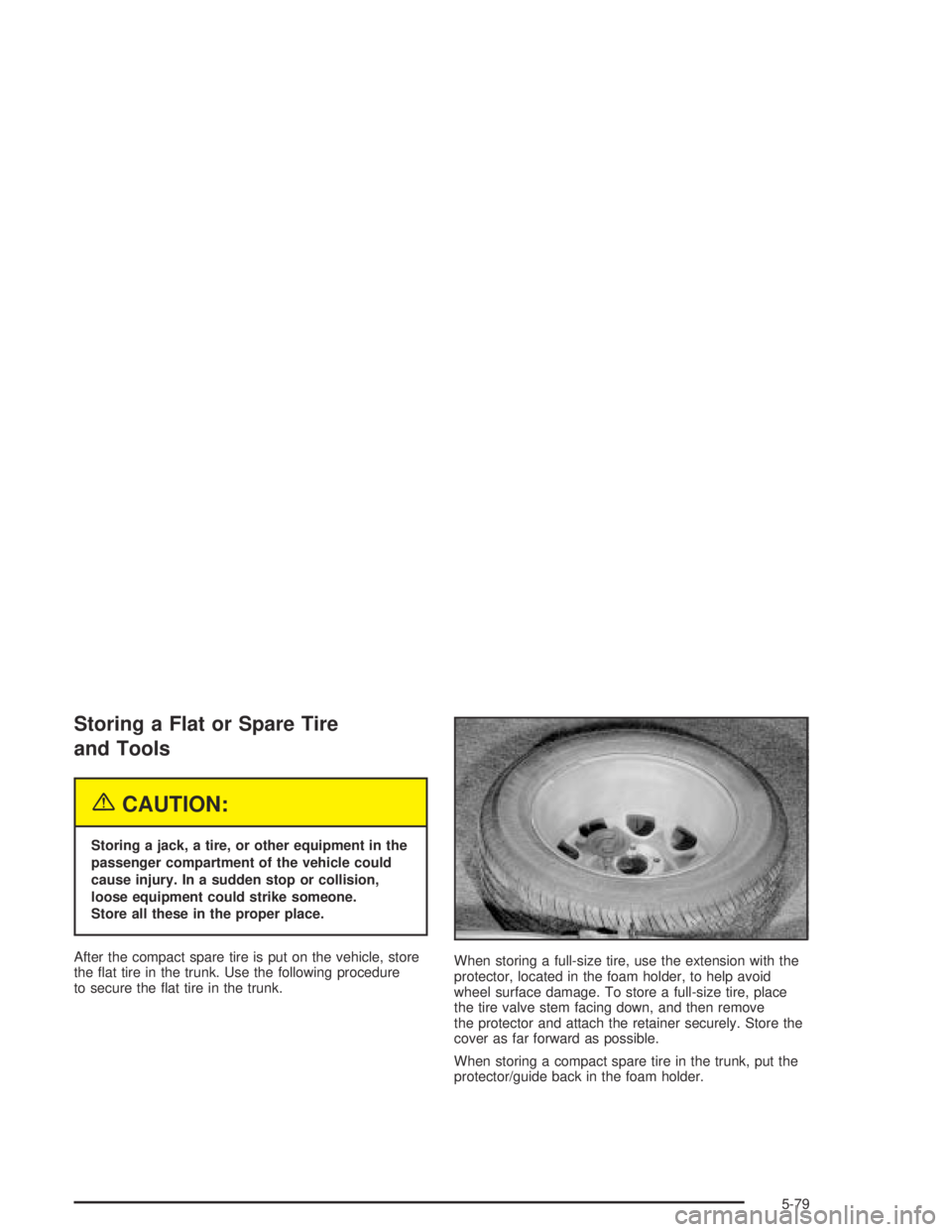
Storing a Flat or Spare Tire
and Tools
{CAUTION:
Storing a jack, a tire, or other equipment in the
passenger compartment of the vehicle could
cause injury. In a sudden stop or collision,
loose equipment could strike someone.
Store all these in the proper place.
After the compact spare tire is put on the vehicle, store
the at tire in the trunk. Use the following procedure
to secure the at tire in the trunk.When storing a full-size tire, use the extension with the
protector, located in the foam holder, to help avoid
wheel surface damage. To store a full-size tire, place
the tire valve stem facing down, and then remove
the protector and attach the retainer securely. Store the
cover as far forward as possible.
When storing a compact spare tire in the trunk, put the
protector/guide back in the foam holder.
5-79
Page 316 of 348
Engine Coolant Level Check
Check the engine coolant level and add DEX-COOL®
coolant mixture if necessary. SeeEngine Coolant
on page 5-22for further details.
Windshield Washer Fluid Level Check
Check the windshield washer uid level in the windshield
washer tank and add the proper uid if necessary.
At Least Once a Month
Tire Ination Check
Visually inspect your tires and make sure tires are
inated to the correct pressures. Do not forget to check
your spare tire. SeeTires on page 5-53for further
details. Check to make sure the spare tire is stored
securely. Push, pull and then try to rotate or turn
the spare tire. If it moves, tighten it. SeeChanging a
Flat Tire on page 5-70.
At Least Once a Year
Starter Switch Check
{CAUTION:
When you are doing this inspection, the
vehicle could move suddenly. If the vehicle
moves, you or others could be injured.
1. Before you start, be sure you have enough room
around the vehicle.
2. Firmly apply both the parking brake and the regular
brake. SeeParking Brake on page 2-24if necessary.
Do not use the accelerator pedal, and be ready to
turn off the engine immediately if it starts.
3. Try to start the engine in each gear. The starter
should work only in PARK (P) or NEUTRAL (N).
If the starter works in any other position, contact
your GM Goodwrench dealer for service.
6-10
Page 331 of 348
Flat Tire Change:Installation of a spare tire will be
covered at no charge. The customer is responsible
for the repair or replacement of the tire if not covered
by a warrantable failure.
Jump Start:No-start occurrences which require a
battery jump start will be covered at no charge.
Dealer Locator Service
In many instances, mechanical failures are covered
under Buick’s Bumper-to-Bumper warranty. However,
when other services are utilized, our Roadside
Assistance Representatives will explain any payment
obligations you might incur.
For prompt and efficient assistance when calling,
please provide the following to the Roadside
Assistance Representative:
Your name, home address, and home
telephone number.
Telephone number of your location.
Location of the vehicle.
Model, year, color, and license plate number.
Mileage, Vehicle Identication Number, and delivery
date of the vehicle.
Description of the problem.While we hope you never have the occasion to use our
service, it is added security while traveling for you
and your family. Remember, we are only a phone call
away. Buick Roadside Assistance: 1-800-252-1112,
text telephone (TTY) users, call 1-888-889-2438.
Buick reserves the right to limit services or
reimbursement to an owner or driver when, in Buick’s
judgement, the claims become excessive in frequency or
type of occurrence.
Roadside Assistance is not part of or included in the
coverage provided by the New Vehicle Limited Warranty.
Buick reserves the right to make any changes or
discontinue the Roadside Assistance program at any
time without notication.
Canadian Roadside Assistance
Vehicles purchased in Canada have an extensive
roadside assistance program accessible from anywhere
in Canada or the United States. Please refer to the
Warranty and Owner Assistance Information book.
7-7
Page 338 of 348
B
Battery..........................................................5-39
Run-Down Protection...................................3-17
Before Leaving on a Long Trip.........................4-22
Brake
Anti-Lock Brake System (ABS)........................ 4-7
Emergencies................................................ 4-9
Parking......................................................2-24
System Warning Light..................................3-32
Brakes..........................................................5-36
Braking........................................................... 4-6
Braking in Emergencies..................................... 4-9
Break-In, New Vehicle.....................................2-17
Bulb Replacement...........................................5-47
Back-Up Lamps...........................................5-51
Center High-Mounted Stoplamp (CHMSL)........5-49
Front Turn Signal and Parking Lamps.............5-48
Halogen Bulbs............................................5-47
Headlamp Aiming........................................5-45
Headlamps.................................................5-47
Replacement Bulbs......................................5-51
Taillamps, Turn Signal, and Stoplamps............5-50
Buying New Tires...........................................5-64
C
California Fuel.................................................. 5-6
Canadian Owners................................................ ii
Capacities and Specications............................5-96Carbon Monoxide...................2-12, 2-27, 4-26, 4-38
Care of
Safety Belts................................................5-85
Your Cassette Tape Player............................3-65
Your CD Player...........................................3-66
Your CDs ...................................................3-66
Center High-Mounted Stoplamp (CHMSL)...........5-49
Center Passenger Position, Safety Belts.............1-20
Chains, Tire...................................................5-68
Charging System Light....................................3-32
Check
Engine Light...............................................3-36
Checking Things Under the Hood......................5-10
Chemical Paint Spotting...................................5-88
Child Restraints
Child Restraint Systems...............................1-33
Infants and Young Children...........................1-30
Lower Anchorages and Top Tethers for
Children (LATCH System)..........................1-40
Older Children.............................................1-27
Securing a Child Restraint Designed for
the LATCH System...................................1-42
Securing a Child Restraint in a Center
Rear Seat Position...................................1-44
Securing a Child Restraint in a Rear
Outside Seat Position...............................1-42
Securing a Child Restraint in the Right
Front Seat Position...................................1-46
Top Strap...................................................1-37
2
Page 343 of 348
LATCH System
Child Restraints...........................................1-40
Securing a Child Restraint Designed for
the LATCH System...................................1-42
Leaving Your Vehicle.......................................2-12
Light
Airbag Readiness........................................3-31
Anti-Lock Brake System Warning...................3-33
Brake System Warning.................................3-32
Change Engine Oil......................................3-40
Charging System.........................................3-32
Cruise Control.............................................3-41
Door/Trunk Ajar Warning...............................3-42
Engine Coolant Temperature Warning.............3-35
Enhanced Traction System (ETS)
Warning Light..........................................3-34
Low Fuel Warning.......................................3-43
Low Traction...............................................3-34
Low Washer Fluid Warning...........................3-41
Malfunction Indicator....................................3-36
Oil Pressure...............................................3-40
Safety Belt Reminder...................................3-30
Security.....................................................3-41
Service Vehicle Soon...................................3-42
Tire Pressure..............................................3-36
Lighting
Delayed Entry.............................................3-16
Delayed Exit...............................................3-17
Entry.........................................................3-16Lockout Protection..........................................2-12
Locks
Door..........................................................2-10
Leaving Your Vehicle....................................2-12
Lockout Protection.......................................2-12
Power Door................................................2-11
Programmable Automatic Door Locks.............2-11
Loss of Control...............................................4-15
Low Fuel Warning Light...................................3-43
Low Traction Light..........................................3-34
Low Washer Fluid Warning Light.......................3-41
M
Maintenance Schedule
Additional Required Services........................... 6-6
At Each Fuel Fill........................................... 6-9
At Least Once a Month................................6-10
At Least Once a Year..................................6-10
Introduction.................................................. 6-2
Maintenance Footnotes.................................. 6-8
Maintenance Record....................................6-16
Maintenance Requirements............................. 6-2
Normal Maintenance Replacement Parts.........6-14
Owner Checks and Services........................... 6-9
Recommended Fluids and Lubricants.............6-13
Scheduled Maintenance................................. 6-4
Using Your................................................... 6-2
Your Vehicle and the Environment................... 6-2
7