instrument panel BUICK CENTURY 2005 Owner's Guide
[x] Cancel search | Manufacturer: BUICK, Model Year: 2005, Model line: CENTURY, Model: BUICK CENTURY 2005Pages: 348, PDF Size: 2.32 MB
Page 131 of 348

Airbag Readiness Light
There is an air bag readiness light on the instrument
panel, which shows the air bag symbol. The system
checks the air bag’s electrical system for malfunctions.
The system check includes the air bag modules, the
wiring and the crash sensing and diagnostic module.
For more information on the air bag system, seeAirbag
System on page 1-49.
This light will come on
when the vehicle is
started, and it will ash for
a few seconds. Then
the light should go out.
This means the system is
functioning properly.
If the air bag readiness light stays on after the vehicle is
started, or comes on as the vehicle is being driven,
there may be an electrical problem and the air
bag system may not work properly. Have the vehicle
serviced right away.{CAUTION:
If the airbag readiness light stays on after you
start your vehicle, it means the airbag system
may not be working properly. The airbags in
your vehicle may not inate in a crash, or they
could even inate without a crash. To help
avoid injury to yourself or others, have your
vehicle serviced right away if the airbag
readiness light stays on after you start
your vehicle.
The air bag readiness light should ash for a few
seconds when you turn the ignition key to RUN. If the
light does not come on then, have it xed so it will
be ready to warn you if there is a problem.
3-31
Page 143 of 348
Here are four things that some owners ask about.
All these things are normal and do not indicate that
anything is wrong with the fuel gage:
At the gas station, the pump shuts off before the
gage reads full.
It takes more, or less, fuel to ll up than the gage
reads. For example, the gage reads half full, but
it took more, or less, than half of the tank’s capacity
to ll it.
The gage pointer may move while cornering,
braking or accelerating.
The gage may not indicate empty when the ignition
is turned off.
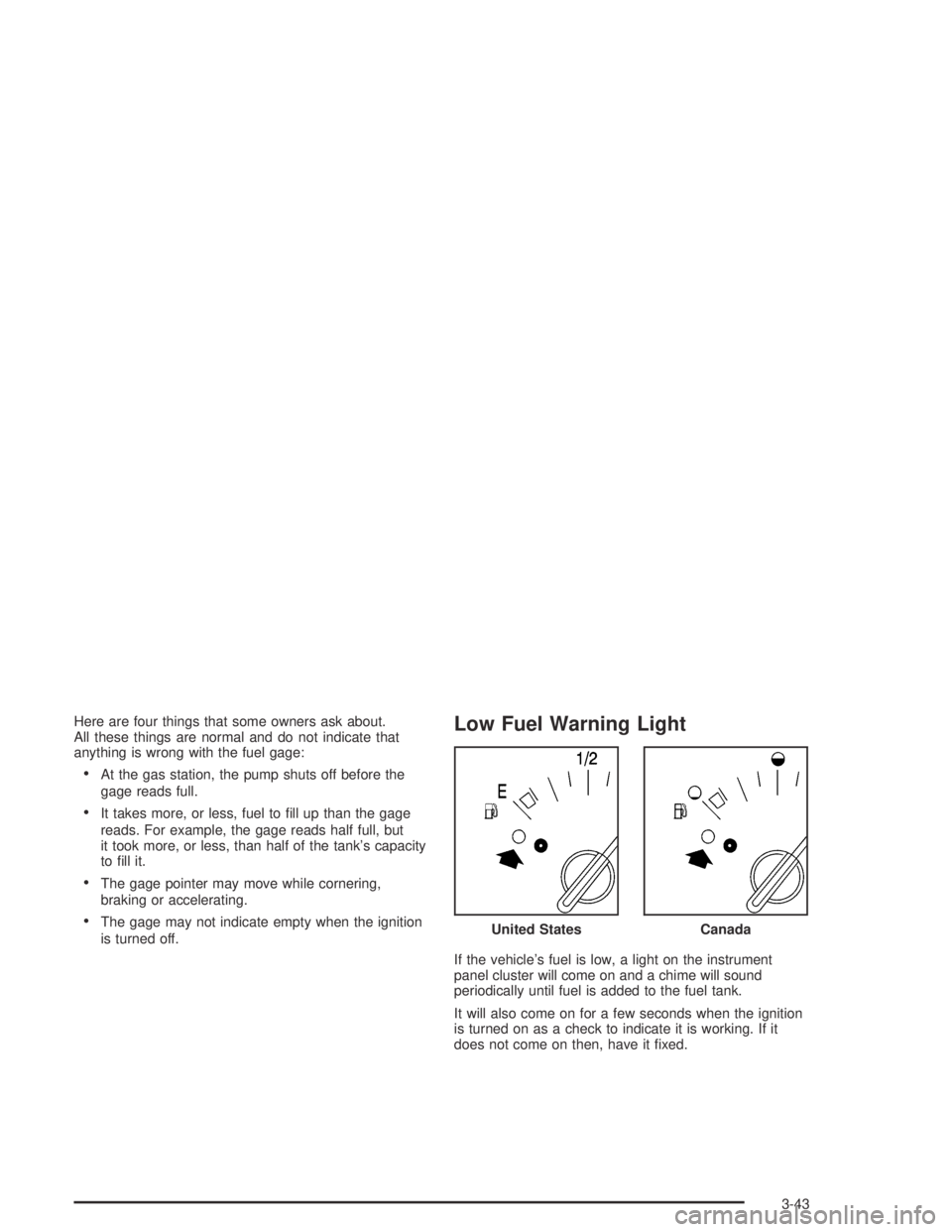
Low Fuel Warning Light
If the vehicle’s fuel is low, a light on the instrument
panel cluster will come on and a chime will sound
periodically until fuel is added to the fuel tank.
It will also come on for a few seconds when the ignition
is turned on as a check to indicate it is working. If it
does not come on then, have it xed.United States
Canada
3-43
Page 173 of 348
Anti-Lock Brake System (ABS)
Your vehicle may have anti-lock brakes. ABS is an
advanced electronic braking system that will help
prevent a braking skid.
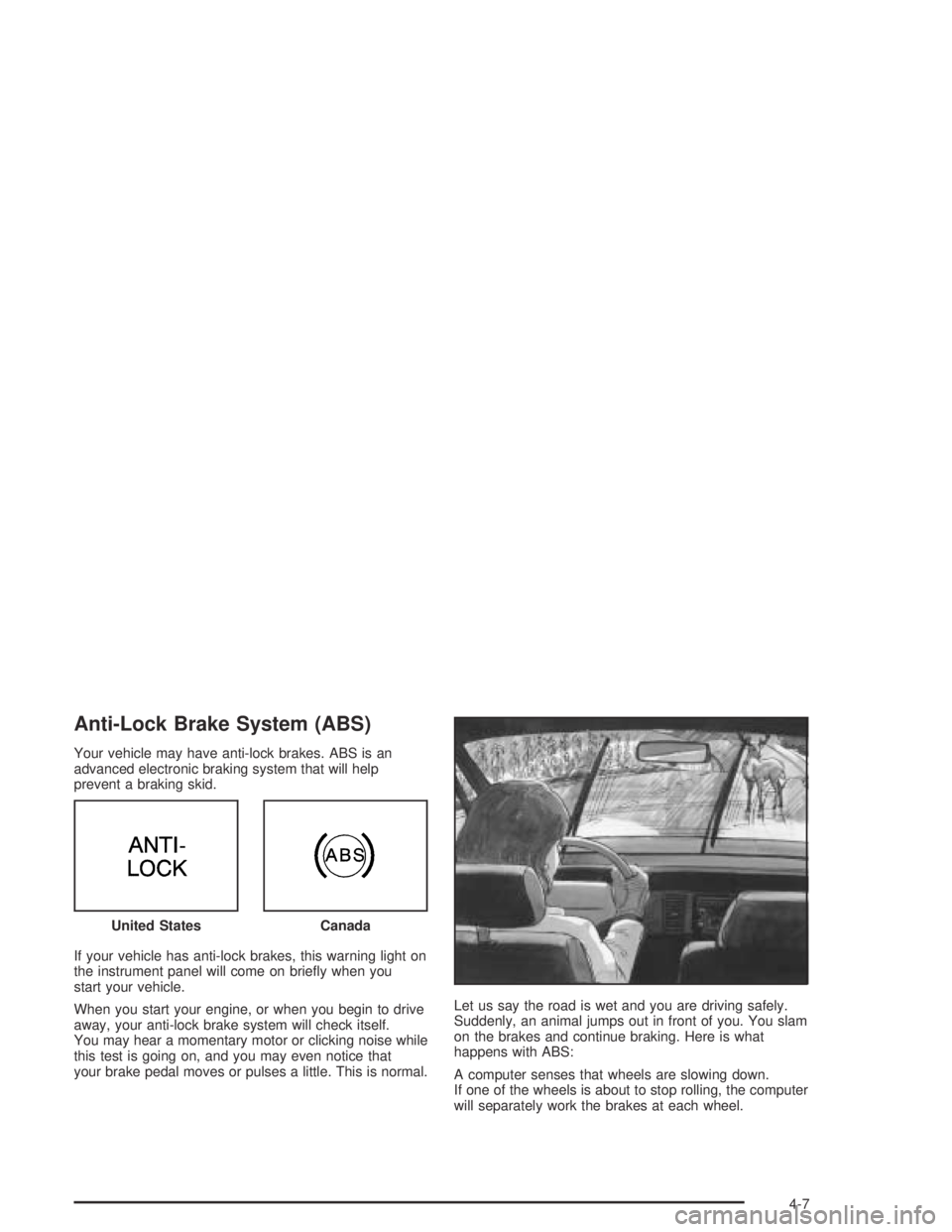
If your vehicle has anti-lock brakes, this warning light on
the instrument panel will come on briey when you
start your vehicle.
When you start your engine, or when you begin to drive
away, your anti-lock brake system will check itself.
You may hear a momentary motor or clicking noise while
this test is going on, and you may even notice that
your brake pedal moves or pulses a little. This is normal.Let us say the road is wet and you are driving safely.
Suddenly, an animal jumps out in front of you. You slam
on the brakes and continue braking. Here is what
happens with ABS:
A computer senses that wheels are slowing down.
If one of the wheels is about to stop rolling, the computer
will separately work the brakes at each wheel. United States
Canada
4-7
Page 175 of 348
Braking in Emergencies
At some time, nearly every driver gets into a situation
that requires hard braking.
If you have anti-lock, you can steer and brake at the
same time. However, if you do not have anti-lock, your
rst reaction — to hit the brake pedal hard and hold
it down — may be the wrong thing to do. Your wheels
can stop rolling. Once they do, the vehicle can not
respond to your steering. Momentum will carry it
in whatever direction it was headed when the wheels
stopped rolling. That could be off the road, into the very
thing you were trying to avoid, or into traffic.
If you do not have anti-lock, use a “squeeze” braking
technique. This will give you maximum braking while
maintaining steering control. You can do this by pushing
on the brake pedal with steadily increasing pressure.
In an emergency, you will probably want to squeeze the
brakes hard without locking the wheels. If you hear or
feel the wheels sliding, ease off the brake pedal.
This will help you retain steering control. If youdohave
anti-lock, it is different. SeeAnti-Lock Brake System
(ABS) on page 4-7
In many emergencies, steering can help you more than
even the very best braking.
Enhanced Traction System (ETS)
If the vehicle has an Enhanced Traction System (ETS)
it will limit wheel spin. This is especially useful in
slippery road conditions. The system operates only if
it senses that one or both of the front wheels are
spinning or beginning to lose traction. When this
happens, the system reduces engine power and may
also upshift the transaxle to limit wheel spin.
This light will come on the
instrument panel cluster
while the ETS is limiting
wheel spin. SeeEnhanced
Traction System Warning
Light on page 3-34.
You may feel or hear the system working, but this
is normal.
If the vehicle is in cruise control when the enhanced
traction system begins to limit wheel spin, the cruise
control will automatically disengage. The cruise control
can be used again when road conditions allow safe
use of it. See “Cruise Control” underTurn
Signal/Multifunction Lever on page 3-7.
4-9
Page 176 of 348
The ETS operates in THIRD (3) and AUTOMATIC
OVERDRIVE (
X). If the vehicle is in THIRD (3),
the system can upshift the transaxle to AUTOMATIC
OVERDRIVE (
X). The ETS is turned off in
SECOND (2) or FIRST (1) gear, and when the parking
brake is set. SeeAutomatic Transaxle Operation on
page 2-21.
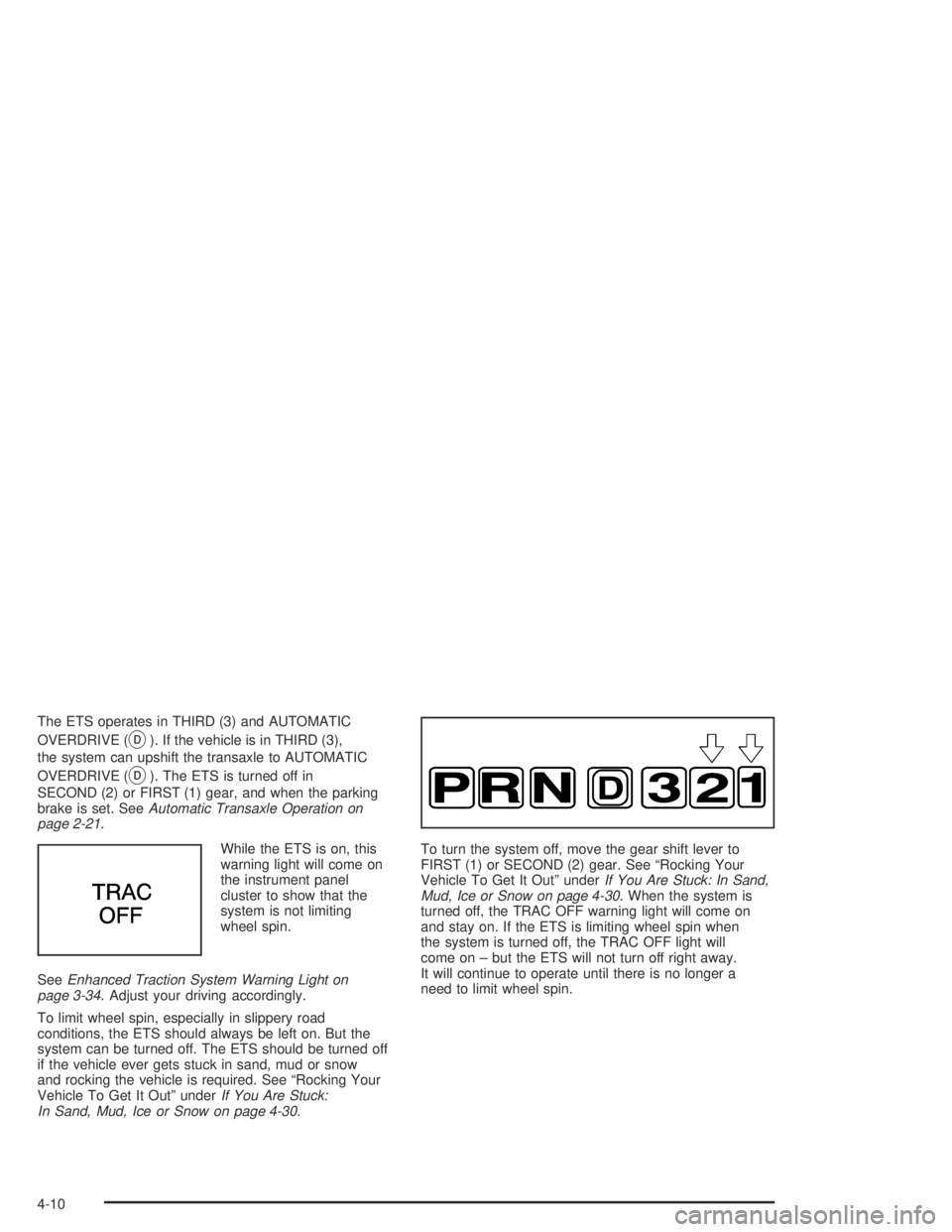
While the ETS is on, this
warning light will come on
the instrument panel
cluster to show that the
system is not limiting
wheel spin.
SeeEnhanced Traction System Warning Light on
page 3-34. Adjust your driving accordingly.
To limit wheel spin, especially in slippery road
conditions, the ETS should always be left on. But the
system can be turned off. The ETS should be turned off
if the vehicle ever gets stuck in sand, mud or snow
and rocking the vehicle is required. See “Rocking Your
Vehicle To Get It Out” underIf You Are Stuck:
In Sand, Mud, Ice or Snow on page 4-30.To turn the system off, move the gear shift lever to
FIRST (1) or SECOND (2) gear. See “Rocking Your
Vehicle To Get It Out” underIf You Are Stuck: In Sand,
Mud, Ice or Snow on page 4-30. When the system is
turned off, the TRAC OFF warning light will come on
and stay on. If the ETS is limiting wheel spin when
the system is turned off, the TRAC OFF light will
come on – but the ETS will not turn off right away.
It will continue to operate until there is no longer a
need to limit wheel spin.
4-10
Page 209 of 348
Turn Signals When Towing a Trailer
When towing a trailer, the vehicle may need a different
turn signal asher and/or extra wiring. Check with your
dealer. The arrows on the instrument panel will ash
whenever signaling a turn or lane change. Properly
hooked up, the trailer lamps will also ash, telling other
drivers you are about to turn, change lanes or stop.
When towing a trailer, the arrows on the instrument
panel will ash for turns even if the bulbs on the trailer
are burned out. You may think drivers behind you
are seeing your signal when they are not. It is important
to check occasionally to be sure the trailer bulbs are
still working.
Driving On Grades
Reduce speed and shift to a lower gearbeforestarting
down a long hill or steep downgrade. If the vehicle is not
shifted down, the brakes might have to be used so much
that they would get hot and no longer work well.
On a long uphill grade, shift down and reduce the
vehicle’s speed to around 45 mph (70 km/h) to reduce
the possibility of engine and transaxle overheating.
If towing a trailer, you may want to drive in THIRD (3)
instead of AUTOMATIC OVERDRIVE (
X). Shift to
a lower gear as needed.
Parking on Hills
{CAUTION:
You really should not park your vehicle, with a
trailer attached, on a hill. If something goes
wrong, your rig could start to move. People
can be injured, and both your vehicle and the
trailer can be damaged.
But if the rig ever has to be parked on a hill, here is
how to do it:
1. Apply the regular brakes, but do not shift into
PARK (P) yet.
2. Have someone place chocks under the
trailer’s wheels.
3. When the wheel chocks are in place, release the
regular brakes until the chocks absorb the load.
4. Reapply the regular brakes. Then apply the parking
brake, and shift to PARK (P).
5. Release the regular brakes.
4-43
Page 212 of 348
Wheel Replacement......................................5-67
Tire Chains..................................................5-68
If a Tire Goes Flat........................................5-69
Changing a Flat Tire.....................................5-70
Removing the Spare Tire and Tools................5-71
Removing the Flat Tire and Installing the
Spare Tire................................................5-73
Storing a Flat or Spare Tire and Tools............5-79
Compact Spare Tire......................................5-81
Appearance Care............................................5-82
Fabric/Carpet...............................................5-82
Vinyl...........................................................5-84
Leather.......................................................5-84
Instrument Panel..........................................5-85
Interior Plastic Components............................5-85
Glass Surfaces.............................................5-85
Care of Safety Belts......................................5-85
Weatherstrips...............................................5-85
Washing Your Vehicle...................................5-86
Cleaning Exterior Lamps/Lenses.....................5-86
Finish Care..................................................5-86Windshield and Wiper Blades.........................5-87
Aluminum Wheels.........................................5-87
Tires...........................................................5-87
Sheet Metal Damage.....................................5-88
Finish Damage.............................................5-88
Underbody Maintenance................................5-88
Chemical Paint Spotting.................................5-88
Vehicle Care/Appearance Materials..................5-89
Vehicle Identication......................................5-90
Vehicle Identication Number (VIN).................5-90
Service Parts Identication Label.....................5-90
Electrical System............................................5-90
Add-On Electrical Equipment..........................5-90
Headlamp Wiring..........................................5-91
Windshield Wiper Fuses................................5-91
Power Windows and Other Power Options.......5-91
Fuses and Circuit Breakers............................5-91
Instrument Panel Fuse Block..........................5-91
Underhood Fuse Block..................................5-94
Capacities and Specications..........................5-96
Section 5 Service and Appearance Care
5-2
Page 221 of 348

Hood Release
To open the hood, do the following:
1. Pull the interior hood
release handle located
below the instrument
panel, to the left of the
steering column.
2. Push the secondary hood release, located under
the hood, to the right to disengage it.
3. Lift the hood.
Before closing the hood, make sure all of the ller caps
are properly secured. Pull the hood down and close
it rmly.
5-11
Page 235 of 348
Engine Overheating
The coolant temperature gage and the engine coolant
temperature warning light on the instrument panel
can indicate an overheated engine condition.
SeeEngine Coolant Temperature Gage on page 3-35
andEngine Coolant Temperature Warning Light on
page 3-35.
If Steam Is Coming From Your Engine
{CAUTION:
Steam from an overheated engine can burn
you badly, even if you just open the hood.
Stay away from the engine if you see or hear
steam coming from it. Just turn it off and get
everyone away from the vehicle until it cools
down. Wait until there is no sign of steam or
coolant before you open the hood.
CAUTION: (Continued)
CAUTION: (Continued)
If you keep driving when your engine is
overheated, the liquids in it can catch re.
You or others could be badly burned. Stop
your engine if it overheats, and get out of the
vehicle until the engine is cool.
See “Overheated Engine Protection Operating
Mode” underEngine Overheating on page 5-25
for information on driving to a safe place in
an emergency.
Notice:If your engine catches re because you
keep driving with no coolant, your vehicle can
be badly damaged. The costly repairs would not
be covered by your warranty. See “Overheated
Engine Protection Operating Mode” underEngine
Overheating on page 5-25for information on driving
to a safe place in an emergency.
5-25
Page 271 of 348
How to Check
Use a good quality pocket-type gage to check tire
pressure. You can’t tell if your tires are properly inated
simply by looking at them. Radial tires may look
properly inated even when they’re underinated. Check
the tire’s ination pressure when the tires are cold.
Cold means your vehicle has been sitting for at least
three hours or driven no more than 1 mile (1.6 km).
Remove the valve cap from the tire valve stem. Press
the tire gage rmly onto the valve to get a pressure
measurement. If the cold tire ination pressure matches
the recommended pressure on the Tire and Loading
Information label, no further adjustment is necessary.
If the ination pressure is low, add air until you reach the
recommended amount.
If you overll the tire, release air by pushing on the
metal stem in the center of the tire valve. Recheck the
tire pressure with the tire gage.
Be sure to put the valve caps back on the valve stems.
They help prevent leaks by keeping out dirt and moisture.
Tire Pressure Monitor System
If your vehicle has the tire ination monitor system,
it detects differences in tire rotation speeds that
are caused by changes in tire pressure. The system
can alert you if a tire is low – but it does not replace
normal tire maintenance. SeeTires on page 5-53.
When the LOW TIRE light comes on the instrument
panel, stop as soon as you can and check all the tires
for damage. If a tire is at, seeIf a Tire Goes Flat
on page 5-69. Also, check the tire pressure in all four
tires as soon as possible. SeeInation - Tire Pressure
on page 5-60.
In order for the tire ination system to function properly,
the vehicle must be driven between 45 and 90 minutes
before the system determines the tire pressure in
each tire. The driving time may be longer depending on
an individual’s driving habits. The data does not have
to be accumulated during a single trip. Once determined,
the system will store the tire pressures until the system
is reset.
5-61