power steering BUICK ENCLAVE 2009 User Guide
[x] Cancel search | Manufacturer: BUICK, Model Year: 2009, Model line: ENCLAVE, Model: BUICK ENCLAVE 2009Pages: 412
Page 239 of 412

As the brakes are applied, the
computer keeps receiving updates
on wheel speed and controls braking
pressure accordingly.
Remember: ABS does not change
the time needed to get a foot
up to the brake pedal or always
decrease stopping distance. If you
get too close to the vehicle in
front of you, there will not be enough
time to apply the brakes if that
vehicle suddenly slows or stops.
Always leave enough room up
ahead to stop, even with ABS.
Using ABS
Do not pump the brakes. Just hold
the brake pedal down rmly and
let antilock work. The antilock pump
or motor operating might be
heard and the brake pedal might be
felt to pulsate, but this is normal.
Braking in Emergencies
ABS allows the driver to steer and
brake at the same time. In many
emergencies, steering can help more
than even the very best braking.
Brake Assist
This vehicle has a Brake Assist
feature designed to assist the driver
in stopping or decreasing vehicle
speed in emergency driving
conditions. This feature uses the
stability system hydraulic brake
control module to supplement the
power brake system under
conditions where the driver has
quickly and forcefully applied
the brake pedal in an attempt to
quickly stop or slow down the
vehicle. The stability system
hydraulic brake control module
increases brake pressure at each
corner of the vehicle until the
ABS activates. Minor brake pedal
pulsations or pedal movement
during this time is normal and the
driver should continue to apply
the brake pedal as the drivingsituation dictates The Brake Assist
feature will automatically disengage
when the brake pedal is released
or brake pedal pressure is quickly
decreased.
StabiliTrak®System
The vehicle has the StabiliTrak
system which combines antilock
brake, traction and stability control
systems and helps the driver
maintain directional control of the
vehicle in most driving conditions.
When you rst start the vehicle and
begin to drive away, the system
performs several diagnostic checks
to ensure there are no problems.
The system may be heard or
felt while it is working. This is normal
and does not mean there is a
problem with the vehicle. The
system should initialize before the
vehicle reaches 20 mph (32 km/h).
In some cases, it may take
approximately two miles of driving
before the system initializes.
Driving Your Vehicle 4-5
Page 242 of 412

When using a compact spare tire on
the AWD equipped vehicle, the
AWD system automatically detects
the presence of the compact
spare and the AWD is disabled. To
restore the AWD operation and
prevent excessive wear on
the clutch in the AWD system,
replace the compact spare with a
full-size tire as soon as possible.
SeeCompact Spare Tire on
page 5-83for more information.
Steering
Power Steering
If power steering assist is lost
because the engine stops or the
system is not functioning, the vehicle
can be steered but it will take
more effort.
Variable Effort Steering
The vehicle has a steering system
that continuously adjusts the
effort felt when steering at all vehicle
speeds. It provides ease when
parking, yet a rm, solid feel
at highway speeds.
Steering Tips
It is important to take curves at a
reasonable speed.
Traction in a curve depends on the
condition of the tires and the
road surface, the angle at which the
curve is banked, and vehicle
speed. While in a curve, speed is
the one factor that can be controlled.
If there is a need to reduce speed,
do it before entering the curve,
while the front wheels are straight.
Try to adjust the speed so you
can drive through the curve.
Maintain a reasonable, steady
speed. Wait to accelerate until out
of the curve, and then accelerate
gently into the straightaway.
Steering in Emergencies
There are times when steering can
be more effective than braking.
For example, you come over a hill
and nd a truck stopped in your
lane, or a car suddenly pulls
out from nowhere, or a child darts
out from between parked cars
and stops right in front of you. These
problems can be avoided by
braking — if you can stop in time.
But sometimes you cannot stop
in time because there is no room.
That is the time for evasive
action — steering around the
problem.
The vehicle can perform very well in
emergencies like these. First,
apply the brakes. SeeBraking on
page 4-3. It is better to remove
as much speed as possible from a
collision. Then steer around the
problem, to the left or right
depending on the space available.
4-8 Driving Your Vehicle
Page 269 of 412

Service and
Appearance Care
Service
Service...............................5-3
Accessories and
Modications.....................5-3
California Proposition 65
Warning............................5-3
California Perchlorate
Materials Requirements.....5-4
Doing Your Own
Service Work....................5-4
Adding Equipment to the
Outside of the Vehicle......5-4
Fuel
Fuel....................................5-5
Gasoline Octane.................5-5
Gasoline Specications.......5-5
California Fuel....................5-5
Additives.............................5-5
Fuels in Foreign
Countries..........................5-6
Filling the Tank...................5-7
Filling a Portable Fuel
Container..........................5-8
Checking Things Under
the Hood
Checking Things Under
the Hood..........................5-9
Hood Release.....................5-9
Engine Compartment
Overview.........................5-10
Engine Oil.........................5-11
Engine Oil Life System.....5-13
Engine Air Cleaner/Filter. . . .5-14
Automatic Transmission
Fluid................................5-15
Cooling System.................5-16
Engine Coolant.................5-17
Engine Overheating...........5-20
Overheated Engine
Protection
Operating Mode
..............5-22
Power Steering Fluid.........5-22
Windshield Washer
Fluid................................5-23
Brakes..............................5-24
Battery..............................5-27
Jump Starting...................5-28
All-Wheel Drive
All-Wheel Drive.................5-32
Headlamp Aiming
Headlamp Aiming..............5-33
Bulb Replacement
Bulb Replacement.............5-33
High Intensity Discharge
(HID) Lighting..................5-33
Halogen Bulbs..................5-34
Taillamps, Turn Signal,
Stoplamps and
Sidemarker Lamps
..........5-34
License Plate Lamp..........5-35
Replacement Bulbs...........5-35
Windshield Replacement
Windshield
Replacement...................5-35
Windshield Wiper Blade
Replacement
Windshield Wiper Blade
Replacement...................5-36
Tires
Tires.................................5-36
Tire Sidewall Labeling.......5-37
Service and Appearance Care 5-1
Page 279 of 412
A. Radiator Pressure Cap. See
Cooling System on page 5-16.
B. Engine Coolant Recovery Cap.
SeeCooling System on
page 5-16.
C. Remote Negative (−) Terminal.
SeeJump Starting on page 5-28.
D.Underhood Fuse Block on
page 5-94.
E. Remote Positive (+) Terminal.
SeeJump Starting on page 5-28.
F.Power Steering Fluid on
page 5-22.
G. Engine Oil Fill Cap. See “When
to Add Engine Oil” underEngine
Oil on page 5-11.
H. Engine Oil Dipstick. See
“Checking Engine Oil” under
Engine Oil on page 5-11.
I. Automatic Transmission Fluid
Dipstick. See “Checking the
Fluid Level” underAutomatic
Transmission Fluid on page 5-15.
J. Brake Master Cylinder Reservoir.
See “Brake Fluid” underBrakes
on page 5-24.K.Engine Air Cleaner/Filter on
page 5-14.
L. Windshield Washer Fluid
Reservoir. See “Adding Washer
Fluid” underWindshield
Washer Fluid on page 5-23.
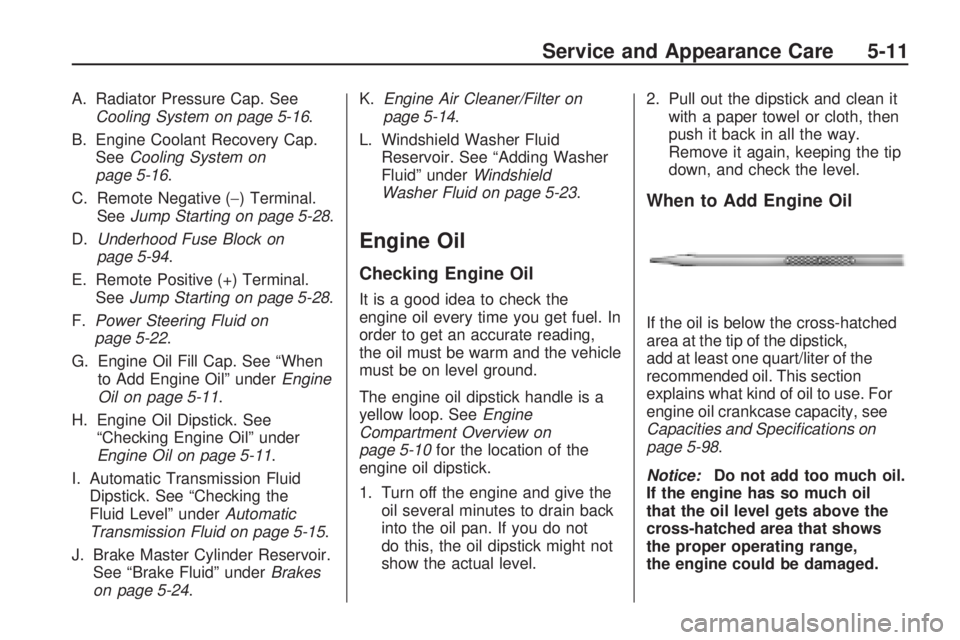
Engine Oil
Checking Engine Oil
It is a good idea to check the
engine oil every time you get fuel. In
order to get an accurate reading,
the oil must be warm and the vehicle
must be on level ground.
The engine oil dipstick handle is a
yellow loop. SeeEngine
Compartment Overview on
page 5-10for the location of the
engine oil dipstick.
1. Turn off the engine and give the
oil several minutes to drain back
into the oil pan. If you do not
do this, the oil dipstick might not
show the actual level.2. Pull out the dipstick and clean it
with a paper towel or cloth, then
push it back in all the way.
Remove it again, keeping the tip
down, and check the level.
When to Add Engine Oil
If the oil is below the cross-hatched
area at the tip of the dipstick,
add at least one quart/liter of the
recommended oil. This section
explains what kind of oil to use. For
engine oil crankcase capacity, see
Capacities and Specifications on
page 5-98.
Notice:Do not add too much oil.
If the engine has so much oil
that the oil level gets above the
cross-hatched area that shows
the proper operating range,
the engine could be damaged.
Service and Appearance Care 5-11
Page 290 of 412

If the temperature overheat gage is
no longer in the overheat zone or an
overheat warning no longer displays,
the vehicle can be driven. Continue
to drive the vehicle slow for about
10 minutes. Keep a safe vehicle
distance from the car in front of you.
If the warning does not come back
on, continue to drive normally.
If the warning continues, pull over,
stop, and park the vehicle right away.
If there is no sign of steam, idle the
engine for three minutes while
parked. If the warning is still
displayed, turn off the engine until it
cools down. Also, see “Overheated
Engine Protection Operating
Mode” next in this section.Overheated Engine
Protection
Operating Mode
This emergency operating mode lets
the vehicle be driven to a safe place
in an emergency situation. If an
overheated engine condition exists,
an overheat protection mode which
alternates ring groups of cylinders
helps prevent engine damage. In this
mode, there is a signicant loss in
power and engine performance. The
temperature gage indicates an
overheat condition exists. Driving
extended distances and/or towing a
trailer in the overheat protection
mode should be avoided.Notice:After driving in the
overheated engine protection
operating mode, to avoid engine
damage, allow the engine to
cool before attempting any repair.
The engine oil will be severely
degraded. Repair the cause
of coolant loss, change the oil
and reset the oil life system. See
Engine Oil on page 5-11.
Power Steering Fluid
The power steering uid reservoir is
located toward the front of the engine
compartment on the passenger
side of the vehicle. SeeEngine
Compartment Overview on
page 5-10for reservoir location.
5-22 Service and Appearance Care
Page 291 of 412

When to Check Power
Steering Fluid
It is not necessary to regularly
check power steering uid unless
you suspect there is a leak in
the system or you hear an unusual
noise. A uid loss in this system
could indicate a problem. Have the
system inspected and repaired.
How to Check Power Steering
Fluid
To check the power steering uid:
1. Turn the key off and let the
engine compartment cool down.
2. Remove engine oil ll cap.
3. Slide engine cover rearward and
lift to remove.
4. Wipe the cap and the top of the
reservoir clean.
5. Unscrew the cap and wipe the
dipstick with a clean rag.6. Replace the cap and completely
tighten it.
7. Remove the cap again and look
at the uid level on the dipstick.
The uid level should be somewhere
between MAX and MIN line on the
dipstick in room temperature. If the
uid is on or below MIN line, you
should add uid close to MAX Line.
What to Use
To determine what kind of uid to
use, seeRecommended Fluids and
Lubricants on page 6-12. Always
use the proper uid.
Notice:Use of the incorrect uid
may damage the vehicle and
the damages may not be covered
by the vehicle’s warranty.
Always use the correct uid
listed inRecommended Fluids
and Lubricants on page 6-12.
Windshield Washer Fluid
What to Use
When adding windshield washer
uid, be sure to read the
manufacturer’s instructions before
use. If the vehicle will be operating in
an area where the temperature may
fall below freezing, use a uid that
has sufficient protection against
freezing.
Service and Appearance Care 5-23
Page 308 of 412

Tire Terminology and
Denitions
Air Pressure:The amount of air
inside the tire pressing outward
on each square inch of the tire.
Air pressure is expressed in
pounds per square inch (psi) or
kilopascal (kPa).
Accessory Weight
:This means
the combined weight of optional
accessories. Some examples
of optional accessories are,
automatic transmission, power
steering, power brakes, power
windows, power seats, and air
conditioning.
Aspect Ratio
:The relationship
of a tire’s height to its width.
Belt
:A rubber coated layer of
cords that is located between the
plies and the tread. Cords
may be made from steel or other
reinforcing materials.Bead
:The tire bead contains
steel wires wrapped by steel
cords that hold the tire onto
the rim.
Bias Ply Tire
:A pneumatic tire
in which the plies are laid at
alternate angles less than
90 degrees to the centerline
of the tread.
Cold Tire Pressure
:The
amount of air pressure in a tire,
measured in pounds per square
inch (psi) or kilopascals (kPa)
before a tire has built up heat
from driving. SeeInflation - Tire
Pressure on page 5-42.
Curb Weight
:The weight of a
motor vehicle with standard
and optional equipment including
the maximum capacity of fuel,
oil, and coolant, but without
passengers and cargo.
DOT Markings
:A code molded
into the sidewall of a tire
signifying that the tire is in
compliance with the U.S.Department of Transportation
(DOT) motor vehicle safety
standards. The DOT code
includes the Tire Identication
Number (TIN), an alphanumeric
designator which can also
identify the tire manufacturer,
production plant, brand, and date
of production.
GVWR
:Gross Vehicle Weight
Rating. SeeLoading the Vehicle
on page 4-16.
GAWR FRT
:Gross Axle Weight
Rating for the front axle. See
Loading the Vehicle on
page 4-16.
GAWR RR
:Gross Axle Weight
Rating for the rear axle. See
Loading the Vehicle on
page 4-16.
Intended Outboard Sidewall
:The side of an asymmetrical tire,
that must always face outward
when mounted on a vehicle.
Kilopascal (kPa)
:The metric
unit for air pressure.
5-40 Service and Appearance Care
Page 361 of 412

Fuses Usage
AIRBAG Airbag
AMP Amplier
BCK/UP/
STOPBack-up
Lamp/Stoplamp
BCMBody Control
Module
CNSTR/
VENTCanister Vent
CTSY Courtesy
DR/LCK Door Locks
DRLDaytime Running
Lamps
DSPLY Display
FRT/WSWFront Windshield
Washer
HTD/COOL
SEATHeated/Cooling
Seats
HVACHeating, Ventilation
and Air ConditioningFuses Usage
IADV/
PWR/LEDInadvertent
Power LED
INFOTMNT Infotainment
LT/TRN/SIGDriver Side Turn
Signal
MSMMemory Seat
Module
PWR
MODEPower Mode
PWR/MIR Power Mirrors
RDO Radio
REAR WPR Rear Wiper
RT/TRN/SIGPassenger Side
Turn Signal
SPARE Spare
SPARE Spare
STR/WHL/
ILLUMSteering Wheel
Illumination
Fuse Side
Service and Appearance Care 5-93
Page 362 of 412
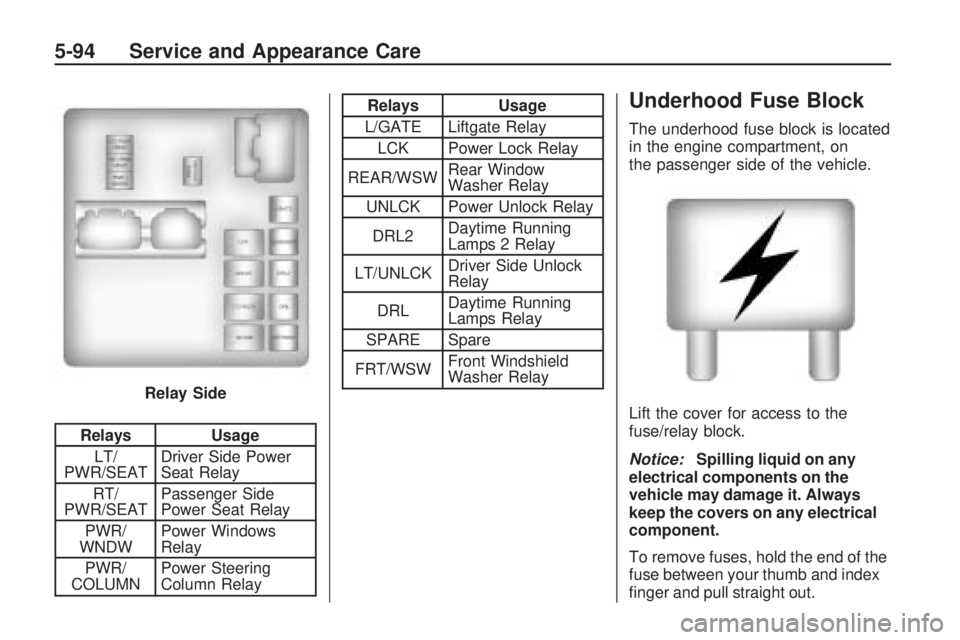
Relays Usage
LT/
PWR/SEATDriver Side Power
Seat Relay
RT/
PWR/SEATPassenger Side
Power Seat Relay
PWR/
WNDWPower Windows
Relay
PWR/
COLUMNPower Steering
Column Relay
Relays Usage
L/GATE Liftgate Relay
LCK Power Lock Relay
REAR/WSWRear Window
Washer Relay
UNLCK Power Unlock Relay
DRL2Daytime Running
Lamps 2 Relay
LT/UNLCKDriver Side Unlock
Relay
DRLDaytime Running
Lamps Relay
SPARE Spare
FRT/WSWFront Windshield
Washer RelayUnderhood Fuse Block
The underhood fuse block is located
in the engine compartment, on
the passenger side of the vehicle.
Lift the cover for access to the
fuse/relay block.
Notice:Spilling liquid on any
electrical components on the
vehicle may damage it. Always
keep the covers on any electrical
component.
To remove fuses, hold the end of the
fuse between your thumb and index
nger and pull straight out. Relay Side
5-94 Service and Appearance Care
Page 373 of 412

Additional Required Services (cont’d)
Service and Miles (Kilometers)25,000
(40 000) 50,000
(80 000) 75,000
(120 000) 100,000
(160 000) 125,000
(200 000) 150,000
(240 000)
Engine cooling system service
(or every ve years, whichever occurs
rst). An Emission Control Service.
See footnote (i). •
Inspect engine accessory drive belt.
An Emission Control Service.
See footnote (k). •
Maintenance Footnotes
(a)
Visually inspect brake lines
and hoses for proper hook-up,
binding, leaks, cracks, chafing, etc.
Inspect disc brake pads for wear
and rotors for surface condition.
Inspect other brake parts, including
calipers, parking brake, etc.
Check parking brake adjustment.
(b) Visually inspect front and
rear suspension and steering
system for damaged, loose, or
missing parts or signs of wear. Inspect power steering lines and
hoses for proper hook-up, binding,
leaks, cracks, chafing, etc.
(c)
Visually inspect hoses and have
them replaced if they are cracked,
swollen, or deteriorated. Inspect all
pipes, fittings and clamps; replace
with genuine parts as needed. To
help ensure proper operation, a
pressure test of the cooling system
and pressure cap and cleaning the
outside of the radiator and air
conditioning condenser is
recommended at least once a year. (d)
Inspect wiper blades for wear,
cracking, or contamination. Clean the
windshield and wiper blades, if
contaminated. Replace wiper blades
that are worn or damaged. See
Windshield Wiper Blade
Replacement on page 5-36 and
Windshield, Backglass, and Wiper
Blades on page 5-88 for more
information.
(e) Make sure the safety belt
reminder light and safety belt
assemblies are working properly.
Look for any other loose or
damaged safety belt system parts.
Maintenance Schedule 6-7