instrument panel BUICK ENCLAVE 2009 Owner's Guide
[x] Cancel search | Manufacturer: BUICK, Model Year: 2009, Model line: ENCLAVE, Model: BUICK ENCLAVE 2009Pages: 412
Page 133 of 412

Instrument Panel
Brightness
D
(Instrument Panel
Brightness):The knob with this
symbol on it is located next to
the exterior lamps control to the left
of the steering wheel. Push the
knob in all the way until it extends
out and then turn the knob clockwise
or counterclockwise to brighten or
dim the lights. Push the knob
back in when nished.
Dome Lamps
The dome lamps automatically
come on when a door is opened,
unless the dome lamp override
button is pressed in.
The lamps can also be turned on
and off by turning the instrument
panel brightness control clockwise to
the farthest position.
Dome Lamp Override
The dome lamp override button
is located next to the exterior lamps
control.
The dome lamp override sets the
dome lamps to remain off or
come on automatically when a door
is opened.
E(Dome Lamp Override):Press
the button in and the dome lamps
remain off when a door is opened.
Press the button again to return it to
the extended position so that the
dome lamps come on when a door
is opened.
Entry Lighting
For vehicles with courtesy lamps,
they come on and stay on for a set
time whenever the unlock symbol
is pressed on the Remote Keyless
Entry (RKE) Transmitter, if the
vehicle has one.If a door is opened, the lamps stay
on while it is open and then turn
off automatically about 25 seconds
after the door is closed. If the
unlock symbol is pressed and no
door is opened, the lamps turn
off after about 20 seconds.
Entry lighting includes a feature
called theater dimming. With theater
dimming, the lamps do not turn off at
the end of the delay time. Instead,
they slowly dim after the delay time
until they go out. The delay time is
canceled if the ignition key is turned
to ON/RUN or the power door lock
switch is pressed. The lamps will dim
right away.
When the ignition is on, illuminated
entry is inactive, which means
the courtesy lamps will not come on
unless a door is opened.
Instrument Panel 3-15
Page 134 of 412

Delayed Entry Lighting
Delayed entry lighting illuminates the
interior for a period of time after
all the doors have been closed.
The ignition must be off for delayed
entry lighting to work. Immediately
after all the doors have been closed,
the delayed entry lighting feature
will continue to work until one of the
following occurs:
The ignition is in ON/RUN.
The doors are locked.
An illumination period of
25 seconds has elapsed.
If during the illumination period a
door is opened, the timed
illumination period will be canceled
and the interior lamps will remain
on because a door is open.
Delayed Exit Lighting
This feature illuminates the interior
for a period of time after the key
is removed from the ignition.The ignition must be off for delayed
exit lighting to work. When the
key is removed, interior illumination
will activate and remain on until
one of the following occurs:
The ignition is in ON/RUN.
The power door locks are
activated.
An illumination period of
20 seconds has elapsed.
If during the illumination period a
door is opened, the timed
illumination period will be canceled
and the interior lamps will remain
on because a door is open.
Parade Dimming
Parade mode automatically prohibits
the dimming of the instrument panel
displays during the daylight while the
headlamps are on so that the
displays are still able to be seen.
Reading Lamps
The vehicle has reading lamps that
also act as the dome lamp. Press
the button to turn them on and off.
Electric Power
Management
The vehicle has Electric Power
Management (EPM) that estimates
the battery’s temperature and
state of charge. It then adjusts the
voltage for best performance
and extended life of the battery.
When the battery’s state of charge
is low, the voltage is raised
slightly to quickly bring the charge
back up. When the state of charge is
high, the voltage is lowered
slightly to prevent overcharging. If
the vehicle has a voltmeter gage or
a voltage display on the Driver
Information Center (DIC), you may
see the voltage move up or
down. This is normal. If there is a
problem, an alert will be displayed.
3-16 Instrument Panel
Page 135 of 412

The battery can be discharged at
idle if the electrical loads are
very high. This is true for all
vehicles. This is because the
generator (alternator) may not be
spinning fast enough at idle to
produce all the power that is needed
for very high electrical loads.
A high electrical load occurs when
several of the following are on, such
as: headlamps, high beams, fog
lamps, rear window defogger,
climate control fan at high speed,
heated seats, engine cooling fans,
trailer loads, and loads plugged into
accessory power outlets.
EPM works to prevent excessive
discharge of the battery. It does this
by balancing the generator’s
output and the vehicle’s electrical
needs. It can increase engine
idle speed to generate more power,
whenever needed. It can temporarily
reduce the power demands of
some accessories.Normally, these actions occur in
steps or levels, without being
noticeable. In rare cases at the
highest levels of corrective action,
this action may be noticeable
to the driver. If so, a Driver
Information Center (DIC) message
might be displayed, such as
BATTERY SAVER ACTIVE,
BATTERY VOLTAGE LOW, or LOW
BATTERY. If this message is
displayed, it is recommended that
the driver reduce the electrical loads
as much as possible. SeeDIC
Warnings and Messages on
page 3-48.Battery Run-Down
Protection
This feature helps prevent the
battery from being drained, if the
interior courtesy lamps, reading/map
lamps, visor vanity lamps or trunk
lamp are accidentally left on. If
any of these lamps are left on,
they automatically turn off after
10 minutes, if the ignition is off. The
lamps will not come back on
again until one of the following
occurs:
The ignition is turned on.
The exterior lamps control is
turned off, then on again.
The headlamps will timeout after
10 minutes, if they are manually
turned on before the ignition is off.
Instrument Panel 3-17
Page 136 of 412
Accessory Power
Outlet(s)
The vehicle has three 12-volt outlets
which can be used to plug in
electrical equipment, such as a
cellular telephone, a compact disc
player, etc.
The power outlets are located on
the instrument panel below the
climate controls, at the rear of the
center console, and in the rear cargo
area. Lift the cover to access the
outlet. Close the cover when
not using the outlet.
Notice:Leaving electrical
equipment plugged in for an
extended period of time while the
vehicle is off will drain the
battery. Power is always supplied
to the outlets. Always unplug
electrical equipment when not in
use and do not plug in equipment
that exceeds the maximum
20 ampere rating.Certain accessory plugs may not be
compatible to the accessory power
outlet and could result in blown
vehicle and adapter fuses. If a
problem is experienced, see your
dealer/retailer for additional
information on the power accessory
outlets.
Notice:Adding any electrical
equipment to the vehicle can
damage it or keep other
components from working as
they should. The repairs would
not be covered by the vehicle
warranty. Do not use equipment
exceeding maximum amperage
rating of 20 amperes. Check with
your dealer/retailer before
adding electrical equipment.
When adding electrical equipment,
be sure to follow the proper
installation instructions included
with the equipment.
Notice:Improper use of the
power outlet can cause damage
not covered by the warranty.
Do not hang any type ofaccessory or accessory bracket
from the plug because the
power outlets are designed for
accessory power plugs only.
Power Outlet 115 Volt
Alternating Current
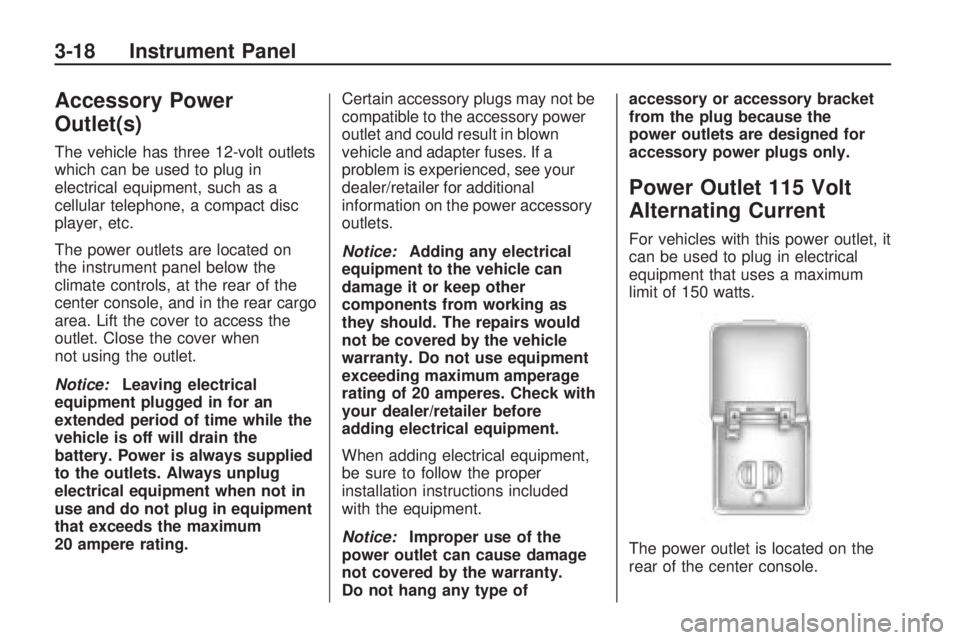
For vehicles with this power outlet, it
can be used to plug in electrical
equipment that uses a maximum
limit of 150 watts.
The power outlet is located on the
rear of the center console.
3-18 Instrument Panel
Page 137 of 412
An indicator light on the outlet turns
on to show it is in use. The light
comes on when the ignition is
in ON/RUN and equipment requiring
less than 150 watts is plugged
into the outlet, and no system fault
is detected.
The indicator light does not come
on when the ignition is in LOCK/OFF
or if no equipment is plugged into
the outlet.
If equipment is connected using
more than 150 watts or a system
fault is detected, a protection circuit
shuts off the power supply and
the indicator light turns off. To reset
the circuit, unplug the item and
plug it back in or turn the Remote
Accessory Power (RAP) off and then
back on. SeeRetained Accessory
Power (RAP) on page 2-22.
The power restarts when equipment
using 150 watts or less is plugged
into the outlet and a system
fault is not detected.The power outlet is not designed for
the following electrical equipment
and may not work properly if
these items are plugged into the
power outlet:
Equipment with high initial
peak wattage such as:
compressor-driven refrigerators
and electric power tools.
Other equipment requiring
an extremely stable power
supply such as:
microcomputer-controlled electric
blankets, touch sensor lamps, etc.
SeeHigh Voltage Devices and
Wiring on page 5-91.
Analog Clock
The analog clock is located on the
instrument panel above the
radio. The clock is not connected
with any other vehicle system
and runs by itself. To change the
clock, do the following:
1. Push and hold the button located
directly above the clock to
advance the clock hands.
Holding the button down will
cause the clock to advance
faster. Release the button before
you get to the desired time.
2. Push and release the button to
increase the time by one minute
increments until the desired
time is reached.
Instrument Panel 3-19
Page 138 of 412

Climate Controls
Dual Automatic Climate Control System
The heating, cooling, and ventilation in the vehicle can be controlled with this
system.
A. Fan Control
B. AUTO
C. Defrost
D. Recirculation
E. REAR
F. Air Delivery Mode Control
G. Driver Side Temperature ControlH. Display
I. Power
J. Rear Window Defogger
K. Air Conditioning
L. PASS (Passenger)
M. Passenger Side Temperature
Control Display Function
Each time the temperature, mode,
or fan control buttons are pressed,
the climate control display shows
that function along with the
inside temperature setting. The
outside temperature is displayed on
the instrument panel cluster.
O(On/Off):
Press to turn the
climate control system on or
off. While the system is off, outside
air still enters through the oor
outlets, but the air delivery mode
can be adjusted.
The climate control system will also
turn on if either the fan control,
defrost, AUTO, or air conditioning
buttons are pressed.
3-20 Instrument Panel
Page 139 of 412

Automatic Operation
AUTO (Automatic):The system
automatically controls the inside
temperature, the air delivery,
and the fan speed.
To use automatic mode:
1. Press the AUTO button.
When AUTO is selected,
the current temperature(s)
selected and AUTO is shown on
the display. The current air
delivery mode and fan speed
also appear for approximately
ve seconds.
When AUTO is selected, the air
conditioning and air inlet are
automatically controlled. The air
conditioning runs when the
outside temperature is over 40°F
(4°C). The system is
automatically set to outside air,
unless it is hot outside and
then the air inlet changes
to recirculation mode to helpquickly cool the vehicle. The
recirculation indicator light
will come on.
2. Set the temperature for the driver
and passenger.
To nd a comfortable setting,
start with a 73°F (22°C)
temperature setting and allow
about 20 minutes for the system
to regulate. Use the driver’s side
or passenger side temperature
buttons to adjust the temperature
setting as necessary. The system
will remain at the selected setting.
Choosing the warmest or coolest
temperatures will not cause the
vehicle to heat or cool any faster.
To avoid blowing cold air in cold
weather, the system delays
turning on the fan until warm air
is available. Press the fan
control to override this delay and
select the fan speed.Temperature Control
The driver and passenger side
temperature buttons are used to
adjust the temperature of the
air coming through the system. The
temperature can be adjusted
even if the system is turned off since
outside air still enters the vehicle,
unless the recirculation mode
is selected. See “Recirculation” later
in this section.
Driver’s Side Temperature
Control:Press the + or−buttons
to increase or decrease the
driver’s side temperature. The
driver’s side temperature display will
show the temperature setting.
Passenger Side Temperature
Control:Press the + or−buttons
to increase or decrease the
passenger side temperature. The
passenger side display will show the
temperature setting.
PASS (Passenger):Press to set
the passenger temperature to match
the driver temperature setting.
Instrument Panel 3-21
Page 140 of 412
The PASS indicator will turn off.
When the passenger temperature
setting is different than the
driver setting, the PASS indicator
comes on.
Manual Operation
The air delivery mode or fan speed
can be manually adjusted.
D/C(Fan Control):Press to
increase or decrease the fan speed.
Pressing
DorCwhile in automatic
control places the fan speed
under manual control.
The air delivery mode remains in
automatic control. The fan setting still
displays, but the word AUTO
no longer displays, and the AUTO
button indicator light turns off.
H/G(Air Delivery Mode
Control):Press to change the
direction of the airow in the vehicle.
Repeatedly press
HorGuntil the
desired mode appears on the
display. Pressing a mode buttonwhile the system is off changes the
air delivery mode without turning
the system on. Press a mode button
while in automatic control to place
the system into manual control.
The air delivery mode setting still
displays, but the word AUTO no
longer displays, and the AUTO
button indicator light turns off.
H(Vent):Air is directed to the
instrument panel outlets.
)(Bi-Level):Air is divided
between the instrument panel and
oor outlets. Some air is directed
towards the windshield and
side window outlets. Cooler air is
directed to the upper outlets
and warmer air to the oor outlets.
6(Floor):Air is directed to
the oor outlets, with some of the
air directed to the windshield,
side window, and second row oor
outlets. In this mode, the system
uses outside air.
-(Defog):This mode clears the
windows of fog or moisture. Air
is directed to the windshield, oor
outlets, and side window vents.
When this mode is selected,
the system turns off recirculation
and runs the air conditioning
compressor unless the outside
temperature is less than 40°F (4°C).
Do not drive the vehicle until all
the windows are clear.
0(Defrost):Press to turn the
defrost on or off. This mode quickly
clears the windshield of fog or frost.
Air is directed to the windshield, side
window, and oor vents. In this
mode, outside air is pulled inside the
vehicle. The air conditioning system
runs automatically in this setting,
unless the outside temperature is
less than 40°F (4°C).
Do not drive the vehicle until all the
windows are clear.
While in defrost mode, if the PASS
button is pressed, the PASS button
indicator ashes three times to show
3-22 Instrument Panel
Page 141 of 412

that the passenger climate control
system cannot be activated. If the
passenger temperature buttons are
adjusted while in defrost mode, the
driver temperature indicator will
change. The passenger temperature
will not be displayed.
@(Recirculation):Press to turn
the recirculation mode on or off.
An indicator light comes on
when recirculation is on. When the
engine is turned off, the recirculation
mode automatically turns off and
must be re-selected when the
engine is turned on again.
This mode recirculates and helps to
quickly cool the air inside the
vehicle. It can be used to prevent
outside air and odors from entering
the vehicle.
The recirculation mode cannot be
used with oor, defog, or defrosting
modes. If recirculation is selected
in these modes, the indicator ashes
three times and turns off. The air
conditioning compressor also comeson when this mode is activated.
While in recirculation mode
the windows can fog when the
weather is cold and damp. To clear
the fog, select either the defog
or defrost mode and increase the
fan speed.Air Conditioning
#(Air Conditioning):Press to
turn the air conditioning (A/C)
on and off. An indicator light comes
on when A/C is on.
The A/C does not work when the
outside temperature is below
40°F (4°C). If
#is pressed the
indicator ashes three times
and turns off to show that the
A/C mode is not available. If the
A/C is on and the outside
temperature drops below a
temperature which is too cool for air
conditioning to be effective, the
A/C indicator turns off to show that
the A/C mode has been canceled.On hot days, open the windows
briey to let hot inside air escape.
This helps reduce the time it
takes for the interior of the vehicle
to cool down.
The air conditioning system removes
moisture from the air, so a small
amount of water might drip under the
vehicle while idling or after turning off
the engine. This is normal.
Rear Window Defogger
The rear window defogger uses a
warming grid to remove fog from the
rear window.
<(Rear Window Defogger):
Press to turn the rear window
defogger on or off. The rear window
defogger stays on for about
10 minutes, before turning off. The
defogger also turns off when the
engine is turned off. Do not drive
the vehicle until all the windows
are clear.
Instrument Panel 3-23
Page 142 of 412
For vehicles with heated outside
rearview mirrors, fog or frost
is cleared from the surface of the
mirror when the rear window
defog button is pressed.
Notice:Do not use a razor blade
or sharp object to clear the
inside rear window. Do not adhere
anything to the defogger grid
lines in the rear glass. These
actions may damage the rear
defogger. Repairs would not be
covered by your warranty.
REAR:Press to turn the rear
heating and air conditioning on or
off. SeeRear Air Conditioning
and Heating System on page 3-26
orRear Air Conditioning and
Heating System and Electronic
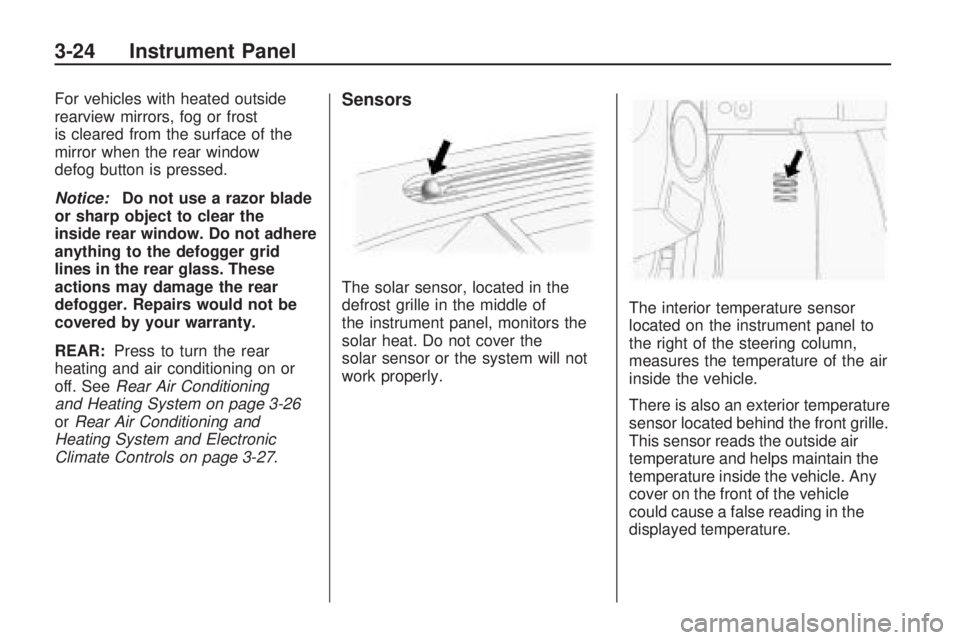
Climate Controls on page 3-27.Sensors
The solar sensor, located in the
defrost grille in the middle of
the instrument panel, monitors the
solar heat. Do not cover the
solar sensor or the system will not
work properly.The interior temperature sensor
located on the instrument panel to
the right of the steering column,
measures the temperature of the air
inside the vehicle.
There is also an exterior temperature
sensor located behind the front grille.
This sensor reads the outside air
temperature and helps maintain the
temperature inside the vehicle. Any
cover on the front of the vehicle
could cause a false reading in the
displayed temperature.
3-24 Instrument Panel