seats BUICK ENCLAVE 2009 Repair Manual
[x] Cancel search | Manufacturer: BUICK, Model Year: 2009, Model line: ENCLAVE, Model: BUICK ENCLAVE 2009Pages: 412
Page 64 of 412

✍NOTES
1-60 Seats and Restraint System
Page 69 of 412
Programming Transmitters to
the Vehicle
Only RKE transmitters programmed
to this vehicle will work. If a
transmitter is lost or stolen, a
replacement can be purchased and
programmed through your dealer/
retailer. When the replacement
transmitter is programmed to this
vehicle using the DIC, all remaining
transmitters must also be
reprogrammed. Any lost or stolen
transmitters will no longer work once
the new transmitter is programmed.
Each vehicle can have up to
eight transmitters programmed to it.
See “Relearn Remote Key” under
DIC Operation and Displays on
page 3-41for instructions on how to
program transmitters to this vehicle.
Battery Replacement
Replace the battery if the REPLACE
BATTERY IN REMOTE KEY
message displays in the DIC.Notice:When replacing the
battery, do not touch any of the
circuitry on the transmitter. Static
from your body could damage
the transmitter.
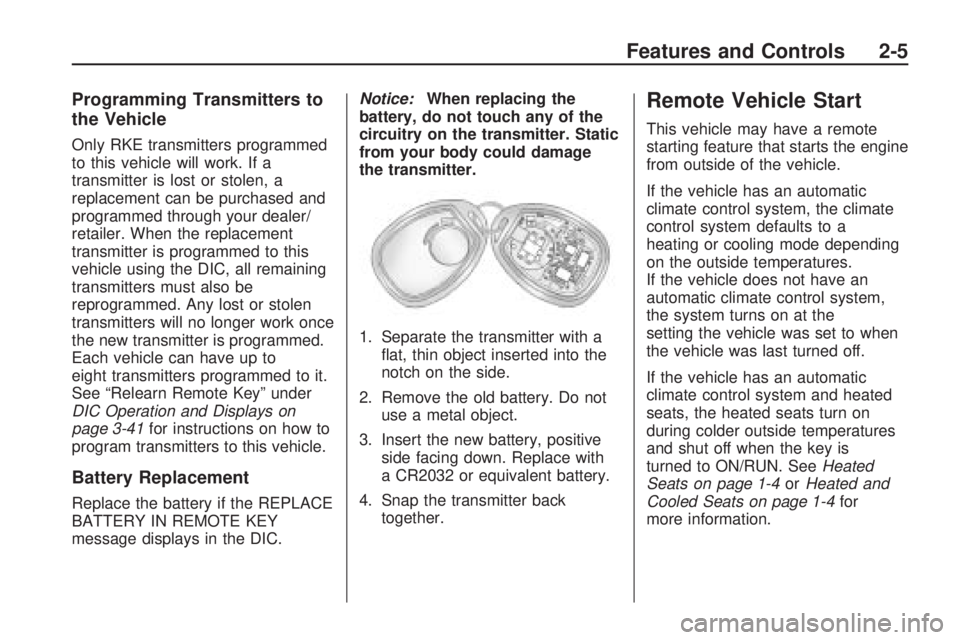
1. Separate the transmitter with a
at, thin object inserted into the
notch on the side.
2. Remove the old battery. Do not
use a metal object.
3. Insert the new battery, positive
side facing down. Replace with
a CR2032 or equivalent battery.
4. Snap the transmitter back
together.
Remote Vehicle Start
This vehicle may have a remote
starting feature that starts the engine
from outside of the vehicle.
If the vehicle has an automatic
climate control system, the climate
control system defaults to a
heating or cooling mode depending
on the outside temperatures.
If the vehicle does not have an
automatic climate control system,
the system turns on at the
setting the vehicle was set to when
the vehicle was last turned off.
If the vehicle has an automatic
climate control system and heated
seats, the heated seats turn on
during colder outside temperatures
and shut off when the key is
turned to ON/RUN. SeeHeated
Seats on page 1-4orHeated and
Cooled Seats on page 1-4for
more information.
Features and Controls 2-5
Page 88 of 412

4. Before starting the engine, be
sure to unplug and store the
cord as it was before to keep it
away from moving engine
parts. If you do not, it could be
damaged.
The length of time the heater should
remain plugged in depends on
several factors. Ask a dealer/retailer
in the area where you will be
parking the vehicle for the best
advice on this.Automatic Transmission
Operation
The automatic transmission has a
shift lever located on the console
between the seats.
P (Park):This position locks the
front wheels. It is the best position
to use when starting the engine
because the vehicle cannot
move easily.
{CAUTION
It is dangerous to get out of the
vehicle if the shift lever is not fully
in P (Park) with the parking brake
rmly set. The vehicle can roll.
Do not leave the vehicle when the
engine is running unless you have
to. If you have left the engine
running, the vehicle can move
suddenly. You or others could be
injured. To be sure the vehicle will
not move, even when you are on
fairly level ground, always set the
parking brake and move the shift
lever to P (Park). SeeShifting Into
Park on page 2-28. If you are
pulling a trailer, seeTowing a
Trailer on page 4-24.
Make sure the shift lever is fully in
P (Park) before starting the engine.
The vehicle has an automatic
transmission shift lock control
system. You must fully apply the
regular brake rst and then press the
2-24 Features and Controls
Page 117 of 412

Sunroof
The vehicle may have a sunroof
over the front seats and a rear
sunroof over the second row seats.
The rear sunroof does not open.
The switches to operate the
front sunroof and rear sunshade are
located on the headliner above
the rearview mirror. The ignition
must be in ON or ACCESSORY to
operate the sunroof. SeeIgnition
Positions on page 2-21.
Vent:From the closed position,
press and hold the front of the driver
side switch to vent the sunroof.
Press and hold the rear of the driver
side switch to close the sunroof.
Express-open/Express-close:
From the closed position, press and
release the rear of the driver side
switch to express-open the sunroof.
Press and release the front of
the driver side switch to
express-close the sunroof.The front sunshade must be opened
and closed manually. Push up on
the sunshade handle to open
the sunshade.
Notice:The rear sunshade could
be damaged if you attempt to
open or close it manually. Do not
manually open or close the rear
sunshade.
To open the rear sunshade,
located over the second row seats,
press and release the rear of the
passenger side switch. Press and
release the front of the switch
to close the sunshade.
Features and Controls 2-53
Page 123 of 412

The main components of your
instrument panel are listed here:
A.Outlet Adjustment on page 3-25.
B.Turn Signal/Multifunction
Lever on page 3-6.Windshield
Wipers on page 3-8.
C.Instrument Panel Cluster on
page 3-29.
D.Driver Information Center (DIC)
on page 3-41.
E.Analog Clock on page 3-19.
F.Audio System(s) on page 3-64.
Navigation/Radio System on
page 3-92(If Equipped).
G.Exterior Lamps on page 3-12.
Fog Lamps on page 3-14.
H.Hood Release on page 5-9.
I.Dome Lamp Override on
page 3-15.Instrument Panel
Brightness on page 3-15. Heated
Windshield Washer Button
(If Equipped). SeeWindshield
Washer on page 3-8.J.Cruise Control on page 3-10.
K.Tilt and Telescopic Steering
Wheel on page 3-6.
L.Horn on page 3-5.
M.Audio Steering Wheel Controls
on page 3-113.
N.Hazard Warning Flashers on
page 3-5.
O.Dual Automatic Climate Control
System on page 3-20.
P. Center Console Shift Lever. See
“Console Shift Lever” under
Shifting Into Park on page 2-28.
Q.Rear Window Wiper/Washer on
page 3-9. Traction Control
System (TCS) Disable Button
(If Equipped). SeeStabiliTrak
®
System on page 4-5.Tow/Haul
Mode on page 2-26(If
Equipped).Power Liftgate on
page 2-10(If Equipped).
R.Accessory Power Outlet(s) on
page 3-18.
S.Heated Seats on page 1-4.T. Passenger Air Bag Status
Indicator. SeePassenger
Sensing System on page 1-52.
U.Glove Box on page 2-49.
Hazard Warning Flashers
|
Hazard Warning
Flasher:Press this button located
on the instrument panel below
the audio system, to make the front
and rear turn signal lamps ash
on and off. This warns others that
you are having trouble. Press
again to turn the ashers off.
The turn signals do not work while
the hazard warning ashers are on.
Horn
Press near or on the horn symbols
on the steering wheel pad to
sound the horn.
Instrument Panel 3-5
Page 135 of 412

The battery can be discharged at
idle if the electrical loads are
very high. This is true for all
vehicles. This is because the
generator (alternator) may not be
spinning fast enough at idle to
produce all the power that is needed
for very high electrical loads.
A high electrical load occurs when
several of the following are on, such
as: headlamps, high beams, fog
lamps, rear window defogger,
climate control fan at high speed,
heated seats, engine cooling fans,
trailer loads, and loads plugged into
accessory power outlets.
EPM works to prevent excessive
discharge of the battery. It does this
by balancing the generator’s
output and the vehicle’s electrical
needs. It can increase engine
idle speed to generate more power,
whenever needed. It can temporarily
reduce the power demands of
some accessories.Normally, these actions occur in
steps or levels, without being
noticeable. In rare cases at the
highest levels of corrective action,
this action may be noticeable
to the driver. If so, a Driver
Information Center (DIC) message
might be displayed, such as
BATTERY SAVER ACTIVE,
BATTERY VOLTAGE LOW, or LOW
BATTERY. If this message is
displayed, it is recommended that
the driver reduce the electrical loads
as much as possible. SeeDIC
Warnings and Messages on
page 3-48.Battery Run-Down
Protection
This feature helps prevent the
battery from being drained, if the
interior courtesy lamps, reading/map
lamps, visor vanity lamps or trunk
lamp are accidentally left on. If
any of these lamps are left on,
they automatically turn off after
10 minutes, if the ignition is off. The
lamps will not come back on
again until one of the following
occurs:
The ignition is turned on.
The exterior lamps control is
turned off, then on again.
The headlamps will timeout after
10 minutes, if they are manually
turned on before the ignition is off.
Instrument Panel 3-17
Page 143 of 412

The climate control system uses the
information from these sensors to
maintain comfort settings by
adjusting the temperature, fan
speed, and the air delivery mode.
The system may also supply cooler
air to the side of the vehicle
facing the sun. The recirculation
mode will also be used as needed
to maintain cool outlet temperatures.
Outlet Adjustment
Use the slider switch in the center
of the outlet, to change the direction
of the air ow. Use the thumbwheel
near the outlet to control the
amount of air ow or to shut off the
airow completely.
Keep all outlets open whenever
possible for best system
performance.
Operation Tips
Clear away any ice, snow, or
leaves from the air inlets at
the base of the windshield that
can block the ow of air into
the vehicle.
Use of non-GM approved hood
deectors can adversely affect
the performance of the system.
Keep the path under all seats
clear of objects to help circulate
the air inside the vehicle
more effectively.
If fogging reoccurs while in vent
or bi-level modes with mild
temperature throughout the
vehicle, turn on the air conditioner
to reduce windshield fogging.
Instrument Panel 3-25
Page 144 of 412

Rear Air Conditioning and Heating System
A. Fan Control
B. Temperature Control
C. Air Delivery Mode Control
For vehicles with the rear climate
control system, the controls
are located on the rear of the center
console. The system can also be
controlled with the front controls.
Press the REAR button on the front
climate control system to turn the
rear climate control system on or off.An indicator comes on when the
rear system is on. The system also
turns on if any of the rear controls
are adjusted.
Mimic Mode:
This mode matches
the rear climate control to the
front climate control settings. It
comes on when REAR is pressed.
Independent Mode: This mode
directs rear seating airow according
to the settings of the rear controls. It comes on when any rear control
is adjusted.
Fan Control:
Turn clockwise or
counterclockwise to increase
or decrease the fan speed. Turn the
knob to
9to turn the fan off.
Temperature Control: Turn
clockwise or counterclockwise to
increase or decrease the airow
temperature.
Air Delivery Mode Control: Turn
to the desired mode to change
the airow direction.
H(Vent): Air is directed through
the overhead outlets.
)(Bi-Level): Air is directed
through the rear oor outlets, as
well as the overhead outlets.
6(Floor): Air is directed through
the oor outlets. The rear system
oor outlets are located under
the third row seats.
3-26 Instrument Panel
Page 146 of 412
N(Air Delivery Mode
Control):Press to manually
change the direction of the airow.
Repeatedly press the button
until the desired mode appears on
the display.
H(Vent):Air is directed through
the overhead outlets.
)(Bi-Level):Air is directed
through the rear oor outlets, as
well as the overhead outlets.
6(Floor):Air is directed through
the oor outlets. The rear system
oor outlets are located under
the third row seats.
Warning Lights,
Gages, and Indicators
Warning lights and gages can
signal that something is wrong
before it becomes serious enough
to cause an expensive repair or
replacement. Paying attention to the
warning lights and gages could
prevent injury.
Warning lights come on when there
may be or is a problem with one
of the vehicle’s functions. Some
warning lights come on briey when
the engine is started to indicate
they are working.Gages can indicate when there may
be or is a problem with one of the
vehicle’s functions. Often gages and
warning lights work together to
indicate a problem with the vehicle.
When one of the warning lights
comes on and stays on while
driving, or when one of the gages
shows there may be a problem,
check the section that explains what
to do. Follow this manual’s advice.
Waiting to do repairs can be
costly and even dangerous.
3-28 Instrument Panel
Page 162 of 412

If the tire pressure display shows
dashes instead of a value, there
may be a problem with your vehicle.
If this consistently occurs, see
your dealer/retailer for service.
RELEARN REMOTE KEY
This display allows you to match
Remote Keyless Entry (RKE)
transmitters to your vehicle. To
match an RKE transmitter to your
vehicle:
1. Press the vehicle information
button until PRESS
VTO
RELEARN REMOTE KEY
displays.
2. Press the set/reset button until
REMOTE KEY LEARNING
ACTIVE is displayed.
3. Press and hold the lock and
unlock buttons on the rst
transmitter at the same time for
about 15 seconds.
On vehicles with memory recall
seats, the rst transmitter
learned will match driver 1 and
the second will match driver 2.A chime will sound indicating
that the transmitter is matched.
4. To match additional transmitters
at this time, repeat Step 3.
Each vehicle can have a
maximum of eight transmitters
matched to it.
5. To exit the programming mode,
you must cycle the key to
LOCK/OFF.
COMPASS ZONE SETTING
This display will be available if the
vehicle has a compass. See
DIC Compass on page 3-46for
more information.
COMPASS RECALIBRATION
This display will be available if the
vehicle has a compass. See
DIC Compass on page 3-46for
more information.
Blank Display
This display shows no information.
Trip/Fuel Menu Items
3(Trip/Fuel):Press this button
to scroll through the following
menu items:
ODOMETER
Press the trip/fuel button until
ODOMETER displays. This display
shows the distance the vehicle
has been driven in either miles (mi)
or kilometers (km).
To switch between English and
metric measurements, see “UNITS”
earlier in this section.
TRIP A and TRIP B
Press the trip/fuel button until TRIP A
or TRIP B displays. This display
shows the current distance traveled
in either miles (mi) or kilometers (km)
since the last reset for each trip
odometer. Both trip odometers can
be used at the same time.
3-44 Instrument Panel