Latch BUICK LACROSSE 2006 User Guide
[x] Cancel search | Manufacturer: BUICK, Model Year: 2006, Model line: LACROSSE, Model: BUICK LACROSSE 2006Pages: 444, PDF Size: 2.66 MB
Page 48 of 444
In order to use the LATCH system in your vehicle, you
need a child restraint equipped with LATCH attachments.
The child restraint manufacturer will provide you with
instructions on how to use the child restraint and its
attachments. The following explains how to attach a
child restraint with these attachments in your vehicle.
Your vehicle has lower anchors and top tether anchors.
Your child restraint may have lower attachments and
a top tether.
Not all vehicle seating positions or child restraints have
lower anchors and attachments or top tether anchors
and attachments.Lower Anchors
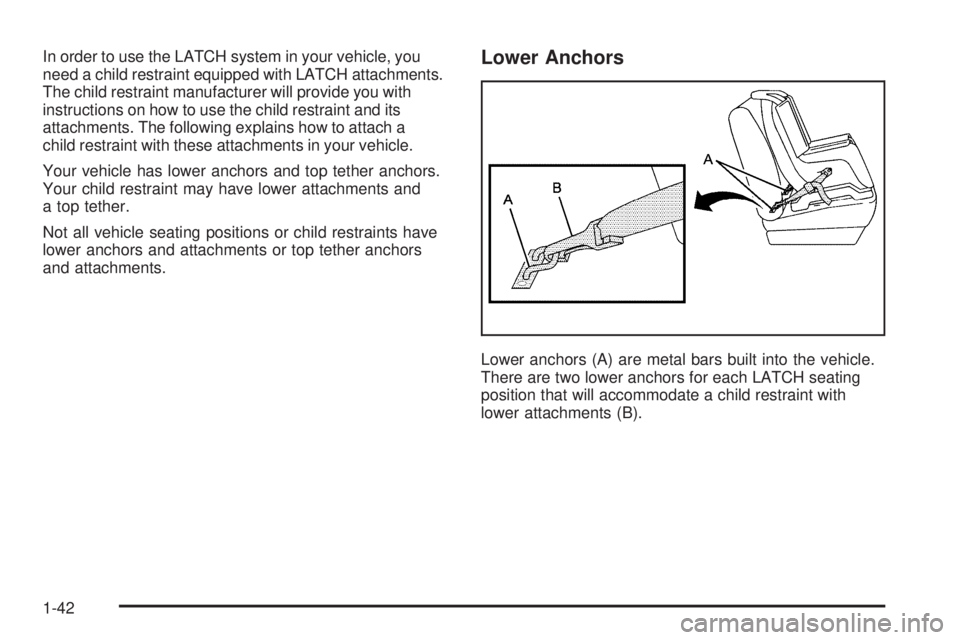
Lower anchors (A) are metal bars built into the vehicle.
There are two lower anchors for each LATCH seating
position that will accommodate a child restraint with
lower attachments (B).
1-42
Page 52 of 444
Securing a Child Restraint Designed for
the LATCH System
{CAUTION:
If a LATCH-type child restraint is not attached to
anchors, the restraint will not be able to protect
the child correctly. In a crash, the child could be
seriously injured or killed. Make sure that a
LATCH-type child restraint is properly installed
using the anchors, or use the vehicle’s safety
belts to secure the restraint, following the
instructions that came with that restraint, and
also the instructions in this manual.
{CAUTION:
Each top tether anchor and lower anchor in
the vehicle is designed to hold only one child
restraint. Attaching more than one child
restraint to a single anchor could cause the
anchor or attachment to come loose or even
break during a crash. A child or others could be
injured if this happens. To help prevent injury to
people and damage to your vehicle, attach only
one child restraint per anchor.
1-46
Page 53 of 444
{CAUTION:
Children can be seriously injured or strangled
if a shoulder belt is wrapped around their neck
and the safety belt continues to tighten.
Secure any unused safety belts behind the
child restraint so children cannot reach them.
Pull the shoulder belt all the way out of the
retractor to set the lock, if your vehicle has
one, after the child restraint has been installed.
Be sure to follow the instructions of the child
restraint manufacturer.
Notice:Contact between the child restraint or the
LATCH attachment parts and the vehicle’s safety
belt assembly may cause damage to these parts.
Make sure when securing unused safety belts
behind the child restraint that there is no contact
between the child restraint or the LATCH attachment
parts and the vehicle’s safety belt assembly.
Folding an empty rear seat with the safety belts
secured, may cause damage to the safety belt or the
seat. When removing the child restraint, always
remember to return the safety belts to their normal,
stowed position before folding the rear seat.1. Attach and tighten the lower attachments to the
lower anchors. If the child restraint does not have
lower attachments or the desired seating position
does not have lower anchors, secure the child
restraint with the top tether and the safety belts.
Refer to your child restraint manufacturer
instructions and the instructions in this manual.
1.1. Find the lower anchors for the desired
seating position.
1.2. Put the child restraint on the seat.
1.3. Attach and tighten the lower attachments on
the child restraint to the lower anchors.
1-47
Page 55 of 444
Securing a Child Restraint in a
Rear Seat Position
If your child restraint is equipped with the LATCH
system, seeLower Anchors and Tethers for Children
(LATCH) on page 1-41.
If your child restraint does not have the LATCH system,
you will be using the lap-shoulder belt to secure the
child restraint in this position. Be sure to follow the
instructions that came with the child restraint. Secure
the child in the child restraint when and as the
instructions say.
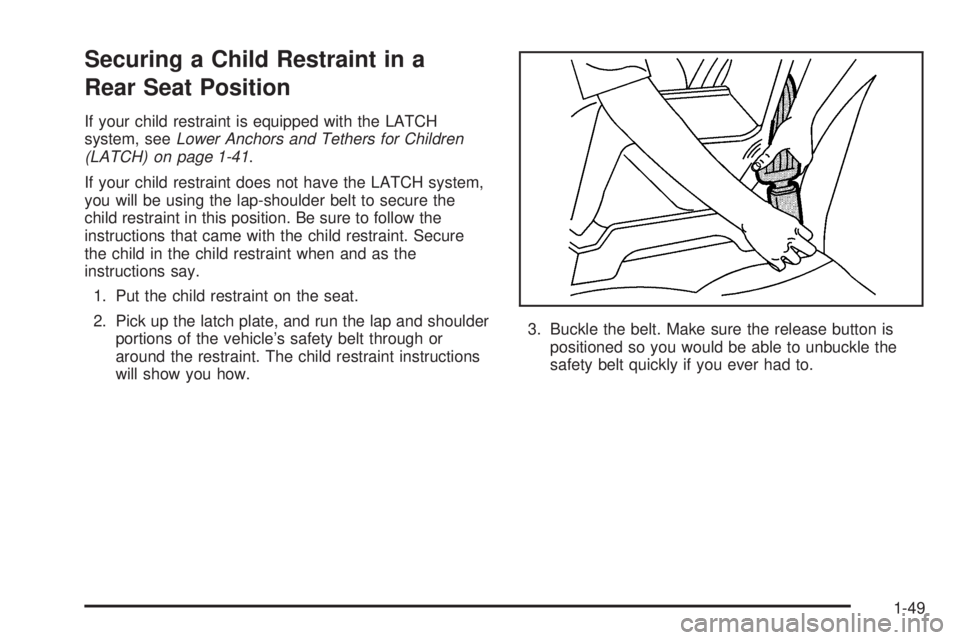
1. Put the child restraint on the seat.
2. Pick up the latch plate, and run the lap and shoulder
portions of the vehicle’s safety belt through or
around the restraint. The child restraint instructions
will show you how.3. Buckle the belt. Make sure the release button is
positioned so you would be able to unbuckle the
safety belt quickly if you ever had to.
1-49
Page 57 of 444
6. If your child restraint manufacturer recommends
using a top tether, attach and tighten the top
tether to the top tether anchor. Refer to the
instructions that came with the child restraint
and seeLower Anchors and Tethers for
Children (LATCH) on page 1-41.
7. Push and pull the child restraint in different
directions to be sure it is secure.
To remove the child restraint, if the top tether is attached
to the top tether anchor, disconnect it. Unbuckle the
vehicle’s safety belt and let it go back all the way.
The safety belt will move freely again and be ready
to work for an adult or larger child passenger.Securing a Child Restraint in the
Center Front Seat Position
{CAUTION:
A child in a child restraint in the center front
seat can be badly injured or killed by the right
front passenger’s airbag if it inates. Never
secure a child restraint in the center front seat.
It is always better to secure a child restraint in
the rear seat.
Do not secure a child restraint in the center front seat
position.
1-51
Page 59 of 444
If you need to secure a forward-facing child restraint
in the right front seat position, move the seat as far back
as it will go before securing the forward-facing child
restraint. SeeManual Seats on page 1-2orSix-Way
Power Seats on page 1-3.
If your child restraint is equipped with the LATCH
system, seeLower Anchors and Tethers for Children
(LATCH) on page 1-41.
There is no top tether anchor at the right front seating
position. Do not secure a child restraint in this position
if a national or local law requires that the top tether
be anchored or if the instructions that come with
the child restraint say that the top tether must be
anchored. SeeLower Anchors and Tethers for
Children (LATCH) on page 1-41if your child
restraint has a top tether.
You will be using the lap-shoulder belt to secure the
child restraint in this position. Be sure to follow the
instructions that came with the child restraint. Secure
the child in the child restraint when and as the
instructions say.1. Your vehicle has a right front passenger’s frontal
airbag. SeePassenger Sensing System on
page 1-65. General Motors recommends that
rear-facing child restraints be secured in a rear seat,
even if the airbag is off. If your child restraint is
forward-facing, move the seat as far back as it will
go before securing the child restraint in this seat.
SeeManual Seats on page 1-2orSix-Way Power
Seats on page 1-3.
When the passenger sensing system has turned
off the right front passenger’s frontal airbag, the off
indicator in the passenger airbag status indicator
should light and stay lit when you turn the ignition
to RUN or START. SeePassenger Airbag
Status Indicator on page 3-35.
2. Put the child restraint on the seat.
3. Pick up the latch plate, and run the lap and shoulder
portions of the vehicle’s safety belt through or
around the restraint. The child restraint instructions
will show you how.
1-53
Page 77 of 444
Restraint System Check
Checking the Restraint Systems
Now and then, make sure the safety belt reminder light
and all your belts, buckles, latch plates, retractors
and anchorages are working properly. Look for any other
loose or damaged safety belt system parts. If you see
anything that might keep a safety belt system from doing
its job, have it repaired. SeeCare of Safety Belts on
page 5-87for more information.
Torn or frayed safety belts may not protect you in a
crash. They can rip apart under impact forces. If a belt
is torn or frayed, get a new one right away.Also look for any opened or broken airbag covers, and
have them repaired or replaced. The airbag system
does not need regular maintenance.
Notice:If you damage the covering for the driver’s
or the right front passenger’s airbag, or the side
impact airbag covering (if equipped) on the ceiling
near the side windows, the airbag may not work
properly. You may have to replace the airbag
module in the steering wheel, both the airbag
module and the instrument panel for the right front
passenger’s airbag, or side impact airbag module
and ceiling covering for roof-mounted side impact
airbags (if equipped.) Do not open or break the
airbag coverings.
1-71
Page 78 of 444
Replacing Restraint System Parts
After a Crash
{CAUTION:
A crash can damage the restraint systems in
your vehicle. A damaged restraint system may
not properly protect the person using it,
resulting in serious injury or even death in
a crash. To help make sure your restraint
systems are working properly after a crash,
have them inspected and any necessary
replacements made as soon as possible.
If you have had a crash, do you need new belts or
LATCH system parts?
After a very minor collision, nothing may be necessary.
But if the belts were stretched, as they would be if
worn during a more severe crash, then you need
new parts.
If the LATCH system was being used during a more
severe crash, you may need new LATCH system parts.If belts are cut or damaged, replace them. Collision
damage also may mean you will need to have LATCH
system, safety belt or seat parts repaired or replaced.
New parts and repairs may be necessary even if the belt
or LATCH system was not being used at the time of
the collision.
If an airbag inates, you will need to replace airbag
system parts. See the part on the airbag system earlier
in this section.
If the frontal airbags inate, you will also need to
replace the driver’s and right front passenger’s safety
belt buckle assembly. Be sure to do so. Then the
new buckle assembly will be there to help protect you
in a collision.
After a crash you may need to replace the driver and
front passenger’s safety belt buckle assemblies, even
if the frontal airbags have not deployed. The driver and
front passenger’s safety belt buckle assemblies
contain the safety belt pretensioners. Have your safety
belt pretensioners checked if your vehicle has been
in a collision, or if your airbag readiness light stays on
after you start your vehicle or while you are driving.
SeeAirbag Readiness Light on page 3-34.
1-72
Page 93 of 444
Emergency Trunk Release Handle
Notice:Do not use the emergency trunk release
handle as a tie-down or anchor point when securing
items in the trunk as it could damage the handle. The
emergency trunk release handle is only intended to
aid a person trapped in a latched trunk, enabling
them to open the trunk from the inside.
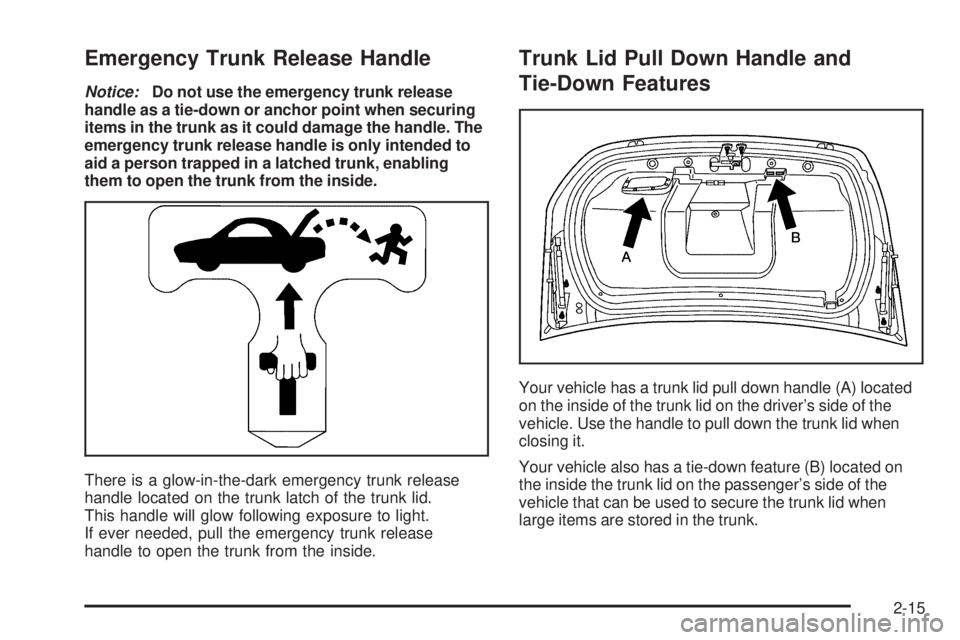
There is a glow-in-the-dark emergency trunk release
handle located on the trunk latch of the trunk lid.
This handle will glow following exposure to light.
If ever needed, pull the emergency trunk release
handle to open the trunk from the inside.
Trunk Lid Pull Down Handle and
Tie-Down Features
Your vehicle has a trunk lid pull down handle (A) located
on the inside of the trunk lid on the driver’s side of the
vehicle. Use the handle to pull down the trunk lid when
closing it.
Your vehicle also has a tie-down feature (B) located on
the inside the trunk lid on the passenger’s side of the
vehicle that can be used to secure the trunk lid when
large items are stored in the trunk.
2-15
Page 173 of 444
Highbeam On Light
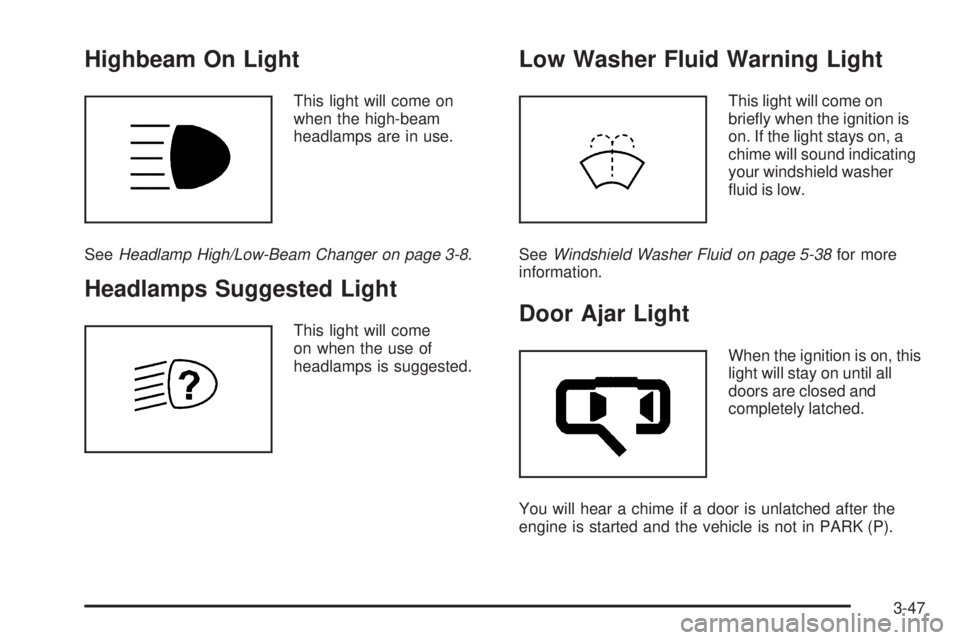
This light will come on
when the high-beam
headlamps are in use.
SeeHeadlamp High/Low-Beam Changer on page 3-8.
Headlamps Suggested Light
This light will come
on when the use of
headlamps is suggested.
Low Washer Fluid Warning Light
This light will come on
briey when the ignition is
on. If the light stays on, a
chime will sound indicating
your windshield washer
uid is low.
SeeWindshield Washer Fluid on page 5-38for more
information.
Door Ajar Light
When the ignition is on, this
light will stay on until all
doors are closed and
completely latched.
You will hear a chime if a door is unlatched after the
engine is started and the vehicle is not in PARK (P).
3-47