engine oil BUICK LACROSSE 2007 User Guide
[x] Cancel search | Manufacturer: BUICK, Model Year: 2007, Model line: LACROSSE, Model: BUICK LACROSSE 2007Pages: 512
Page 221 of 512
REMOTE START DISABLED
If your vehicle has the remote start feature, this
message displays if a remote start attempt is
unsuccessful. This may be caused if any of the
following conditions are true when a remote
start attempt is made:
The remote start system is disabled through
the DIC.
The key is in the ignition.
The hood or the doors are not closed.
There is an emission control system
malfunction.
The engine coolant temperature is too high.
The oil pressure is low.
The hazard warning ashers are turned on.
The maximum number of remote starts
or remote start attempts between ignition
cycles has been reached.
The content theft-deterrent alarm is on while
attempting to remote start the vehicle.
See “REMOTE START” underDIC Vehicle
Personalization on page 229and “Remote Vehicle
Start” underRemote Keyless Entry (RKE)
System Operation on page 90for more
information.
RIGHT FRONT TURN LAMP OUT
This message displays when the right front turn
signal bulb needs to be replaced. SeeFront Turn
Signal and Parking Lamps on page 397.
This message displays while the ignition is in RUN.
Press any of the DIC buttons to acknowledge this
message and to clear it from the screen.
This message continues to display for two seconds
if it has not been acknowledged when the engine is
turned off. It also re-displays for two seconds if the
message has been acknowledged, but the
condition still exists when the engine is turned off.
If the condition still exists, the message re-appears
when the engine is turned on.
221
Page 310 of 512
Once you are moving on the freeway, make
certain you allow a reasonable following distance.
Expect to move slightly slower at night.
When you want to leave the freeway, move to the
proper lane well in advance. If you miss your
exit, do not, under any circumstances, stop and
back up. Drive on to the next exit.
The exit ramp can be curved, sometimes quite
sharply. The exit speed is usually posted. Reduce
your speed according to your speedometer, not
to your sense of motion. After driving for any
distance at higher speeds, you may tend to think
you are going slower than you actually are.
Before Leaving on a Long Trip
Make sure you are ready. Try to be well rested. If
you must start when you are not fresh — such
as after a day’s work — do not plan to make too
many miles that rst part of the journey. Wear
comfortable clothing and shoes you can easily
drive in.Is your vehicle ready for a long trip? If you keep it
serviced and maintained, it is ready to go. If it needs
service, have it done before starting out. Of course,
you will nd experienced and able service experts
in GM dealerships all across North America. They
will be ready and willing to help if you need it.
Here are some things you can check before a trip:
Windshield Washer Fluid:Is the reservoir
full? Are all windows clean inside and outside?
Wiper Blades:Are they in good shape?
Fuel, Engine Oil, Other Fluids:Have you
checked all levels?
Lamps:Are they all working? Are the lenses
clean?
Tires:They are vitally important to a safe,
trouble-free trip. Is the tread good enough
for long-distance driving? Are the tires
all inated to the recommended pressure?
Weather Forecasts:What is the weather
outlook along your route? Should you
delay your trip a short time to avoid a major
storm system?
Maps:Do you have up-to-date maps?
310
Page 335 of 512
When You Are Ready to Leave After
Parking on a Hill
1. Apply the regular brakes and hold the pedal
down while you:
Start the engine.
Shift into a gear.
Release the parking brake.
2. Let up on the brake pedal.
3. Drive slowly until the trailer is clear of the
chocks.
4. Stop and have someone pick up and store the
chocks.
Maintenance When Trailer Towing
The vehicle will need service more often when it
pulls a trailer. SeeScheduled Maintenance
on page 462for more information. Things that are
especially important in trailer operation are
automatic transaxle uid; which should not be
overlled; engine oil, drive belt(s), and cooling and
brake systems. Each of these is covered in this
manual, and the Index will help you nd them
quickly. If trailering, it is a good idea to review this
information before starting on a trip.
Check periodically to see that all hitch nuts and
bolts are tight.
Engine Cooling When Trailer Towing
The cooling system may temporarily overheat
during severe operating conditions. SeeEngine
Overheating on page 367.
335
Page 337 of 512
Service........................................................ 340
Accessories and Modications................... 341
California Proposition 65 Warning.............. 341
Doing Your Own Service Work.................. 342
Adding Equipment to the Outside
of Your Vehicle...................................... 343
Fuel............................................................. 343
Gasoline Octane........................................ 343
Gasoline Specications.............................. 344
California Fuel........................................... 344
Additives................................................... 344
Fuels in Foreign Countries........................ 345
Filling the Tank......................................... 346
Filling a Portable Fuel Container............... 348
Checking Things Under the Hood.............. 348
Hood Release........................................... 349
Engine Compartment Overview.................. 350
Engine Oil................................................. 353
Engine Oil Life System.............................. 356
Engine Air Cleaner/Filter............................ 358
Automatic Transaxle Fluid......................... 360Engine Coolant.......................................... 363
Radiator Pressure Cap.............................. 367
Engine Overheating................................... 367
Overheated Engine Protection
Operating Mode..................................... 370
Cooling System......................................... 370
Power Steering Fluid ................................. 378
Windshield Washer Fluid........................... 380
Brakes...................................................... 381
Battery...................................................... 384
Jump Starting............................................ 385
Headlamp Aiming........................................ 391
Bulb Replacement....................................... 394
Halogen Bulbs........................................... 394
Headlamps and Sidemarker Lamps........... 395
Front Turn Signal and Parking Lamps....... 397
Taillamps, Turn Signal, Sidemarker,
Stoplamps and Back-up Lamps.............. 398
License Plate Lamp................................... 400
Replacement Bulbs................................... 400
Windshield Replacement............................ 401
Section 5 Service and Appearance Care
337
Page 348 of 512
Filling a Portable Fuel Container
{CAUTION:
Never ll a portable fuel container while
it is in your vehicle. Static electricity
discharge from the container can ignite the
gasoline vapor. You can be badly burned
and your vehicle damaged if this occurs.
To help avoid injury to you and others:
Dispense gasoline only into approved
containers.
Do not ll a container while it is inside
a vehicle, in a vehicle’s trunk, pickup
bed, or on any surface other than the
ground.
Bring the ll nozzle in contact with
the inside of the ll opening before
operating the nozzle. Contact should
be maintained until the lling is
complete.
Do not smoke while pumping gasoline.
Checking Things Under
the Hood
{CAUTION:
An electric fan under the hood can start up
and injure you even when the engine is not
running. Keep hands, clothing, and tools
away from any underhood electric fan.
{CAUTION:
Things that burn can get on hot engine
parts and start a re. These include
liquids like fuel, oil, coolant, brake uid,
windshield washer and other uids, and
plastic or rubber. You or others could be
burned. Be careful not to drop or spill
things that will burn onto a hot engine.
348
Page 351 of 512
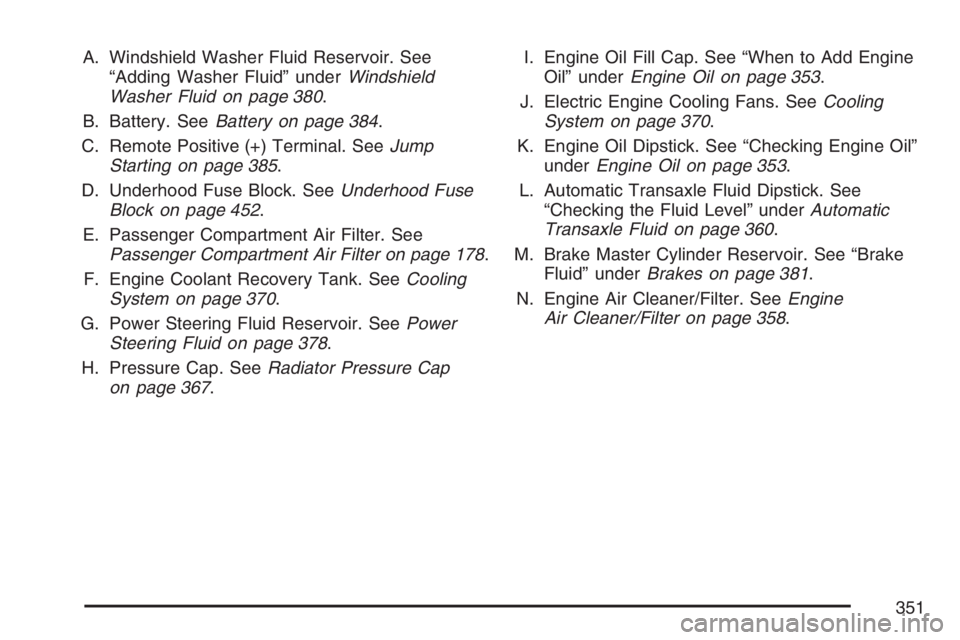
A. Windshield Washer Fluid Reservoir. See
“Adding Washer Fluid” underWindshield
Washer Fluid on page 380.
B. Battery. SeeBattery on page 384.
C. Remote Positive (+) Terminal. SeeJump
Starting on page 385.
D. Underhood Fuse Block. SeeUnderhood Fuse
Block on page 452.
E. Passenger Compartment Air Filter. See
Passenger Compartment Air Filter on page 178.
F. Engine Coolant Recovery Tank. SeeCooling
System on page 370.
G. Power Steering Fluid Reservoir. SeePower
Steering Fluid on page 378.
H. Pressure Cap. SeeRadiator Pressure Cap
on page 367.I. Engine Oil Fill Cap. See “When to Add Engine
Oil” underEngine Oil on page 353.
J. Electric Engine Cooling Fans. SeeCooling
System on page 370.
K. Engine Oil Dipstick. See “Checking Engine Oil”
underEngine Oil on page 353.
L. Automatic Transaxle Fluid Dipstick. See
“Checking the Fluid Level” underAutomatic
Transaxle Fluid on page 360.
M. Brake Master Cylinder Reservoir. See “Brake
Fluid” underBrakes on page 381.
N. Engine Air Cleaner/Filter. SeeEngine
Air Cleaner/Filter on page 358.
351
Page 353 of 512
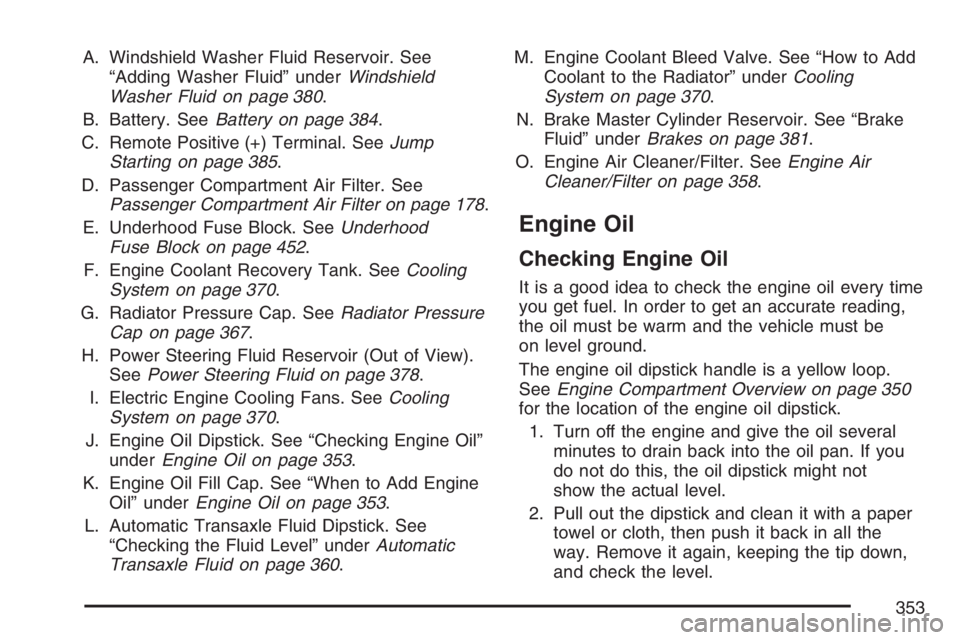
A. Windshield Washer Fluid Reservoir. See
“Adding Washer Fluid” underWindshield
Washer Fluid on page 380.
B. Battery. SeeBattery on page 384.
C. Remote Positive (+) Terminal. SeeJump
Starting on page 385.
D. Passenger Compartment Air Filter. See
Passenger Compartment Air Filter on page 178.
E. Underhood Fuse Block. SeeUnderhood
Fuse Block on page 452.
F. Engine Coolant Recovery Tank. SeeCooling
System on page 370.
G. Radiator Pressure Cap. SeeRadiator Pressure
Cap on page 367.
H. Power Steering Fluid Reservoir (Out of View).
SeePower Steering Fluid on page 378.
I. Electric Engine Cooling Fans. SeeCooling
System on page 370.
J. Engine Oil Dipstick. See “Checking Engine Oil”
underEngine Oil on page 353.
K. Engine Oil Fill Cap. See “When to Add Engine
Oil” underEngine Oil on page 353.
L. Automatic Transaxle Fluid Dipstick. See
“Checking the Fluid Level” underAutomatic
Transaxle Fluid on page 360.M. Engine Coolant Bleed Valve. See “How to Add
Coolant to the Radiator” underCooling
System on page 370.
N. Brake Master Cylinder Reservoir. See “Brake
Fluid” underBrakes on page 381.
O. Engine Air Cleaner/Filter. SeeEngine Air
Cleaner/Filter on page 358.
Engine Oil
Checking Engine Oil
It is a good idea to check the engine oil every time
you get fuel. In order to get an accurate reading,
the oil must be warm and the vehicle must be
on level ground.
The engine oil dipstick handle is a yellow loop.
SeeEngine Compartment Overview on page 350
for the location of the engine oil dipstick.
1. Turn off the engine and give the oil several
minutes to drain back into the oil pan. If you
do not do this, the oil dipstick might not
show the actual level.
2. Pull out the dipstick and clean it with a paper
towel or cloth, then push it back in all the
way. Remove it again, keeping the tip down,
and check the level.
353
Page 354 of 512
When to Add Engine Oil
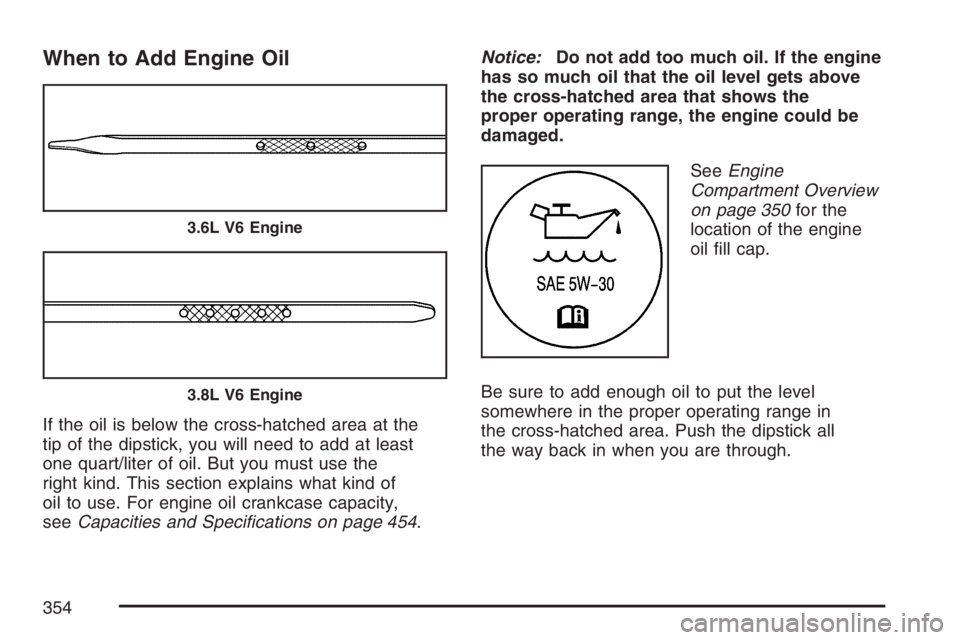
If the oil is below the cross-hatched area at the
tip of the dipstick, you will need to add at least
one quart/liter of oil. But you must use the
right kind. This section explains what kind of
oil to use. For engine oil crankcase capacity,
seeCapacities and Specications on page 454.Notice:Do not add too much oil. If the engine
has so much oil that the oil level gets above
the cross-hatched area that shows the
proper operating range, the engine could be
damaged.
SeeEngine
Compartment Overview
on page 350for the
location of the engine
oil ll cap.
Be sure to add enough oil to put the level
somewhere in the proper operating range in
the cross-hatched area. Push the dipstick all
the way back in when you are through.
3.6L V6 Engine
3.8L V6 Engine
354
Page 355 of 512
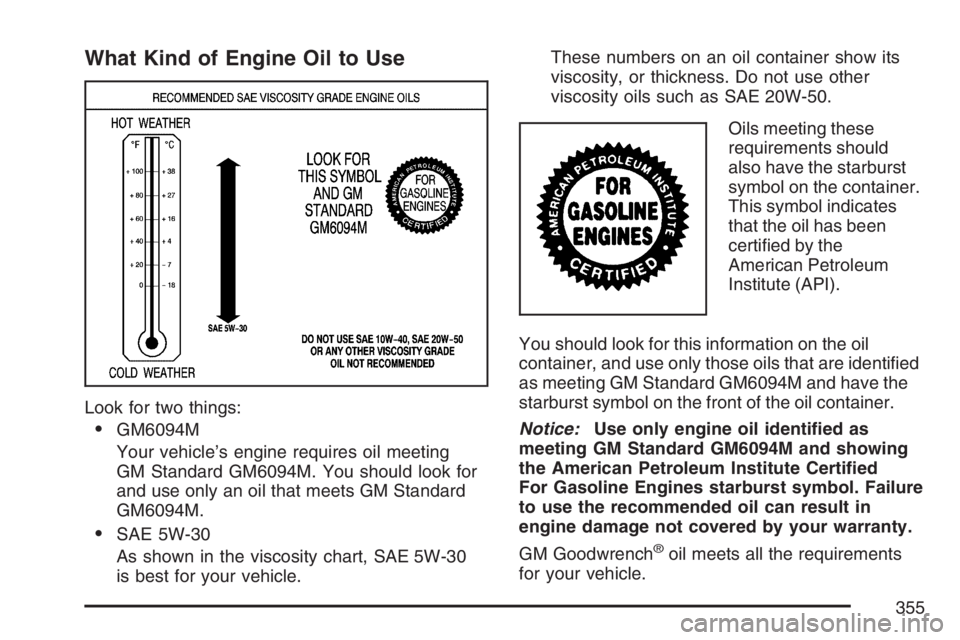
What Kind of Engine Oil to Use
Look for two things:
GM6094M
Your vehicle’s engine requires oil meeting
GM Standard GM6094M. You should look for
and use only an oil that meets GM Standard
GM6094M.
SAE 5W-30
As shown in the viscosity chart, SAE 5W-30
is best for your vehicle.These numbers on an oil container show its
viscosity, or thickness. Do not use other
viscosity oils such as SAE 20W-50.
Oils meeting these
requirements should
also have the starburst
symbol on the container.
This symbol indicates
that the oil has been
certied by the
American Petroleum
Institute (API).
You should look for this information on the oil
container, and use only those oils that are identied
as meeting GM Standard GM6094M and have the
starburst symbol on the front of the oil container.
Notice:Use only engine oil identied as
meeting GM Standard GM6094M and showing
the American Petroleum Institute Certied
For Gasoline Engines starburst symbol. Failure
to use the recommended oil can result in
engine damage not covered by your warranty.
GM Goodwrench®oil meets all the requirements
for your vehicle.
355
Page 356 of 512
If you are in an area of extreme cold, where the
temperature falls below−20°F (−29°C), it is
recommended that you use either an SAE 5W-30
synthetic oil or an SAE 0W-30 oil. Both will
provide easier cold starting and better protection
for the engine at extremely low temperatures.
Engine Oil Additives
Do not add anything to the oil. The recommended
oils with the starburst symbol that meet GM
Standard GM6094M are all you will need for
good performance and engine protection.
Engine Oil Life System
When to Change Engine Oil
Your vehicle has a computer system that lets you
know when to change the engine oil and lter.
This is based on engine revolutions and engine
temperature, and not on mileage. Based on driving
conditions, the mileage at which an oil change
will be indicated can vary considerably. For the oil
life system to work properly, you must reset the
system every time the oil is changed.When the system has calculated that oil life has
been diminished, it will indicate that an oil change
is necessary. A change engine oil light or, if
your vehicle has the Driver Information Center
(DIC), a CHANGE OIL SOON message will come
on. SeeChange Engine Oil Light on page 195
orDIC Warnings and Messages on page 208.
Change the oil as soon as possible within the next
600 miles (1 000 km). It is possible that, if you
are driving under the best conditions, the oil
life system may not indicate that an oil change is
necessary for over a year. However, the engine
oil and lter must be changed at least once a
year and at this time the system must be reset.
Your dealer has GM-trained service people
who will perform this work using genuine GM parts
and reset the system. It is also important to
check your oil regularly and keep it at the
proper level.
If the system is ever reset accidentally, you must
change the oil at 3,000 miles (5 000 km) since
the last oil change. Remember to reset the oil life
system whenever the oil is changed.
356