air condition BUICK LACROSSE 2007 Owner's Guide
[x] Cancel search | Manufacturer: BUICK, Model Year: 2007, Model line: LACROSSE, Model: BUICK LACROSSE 2007Pages: 512
Page 406 of 512
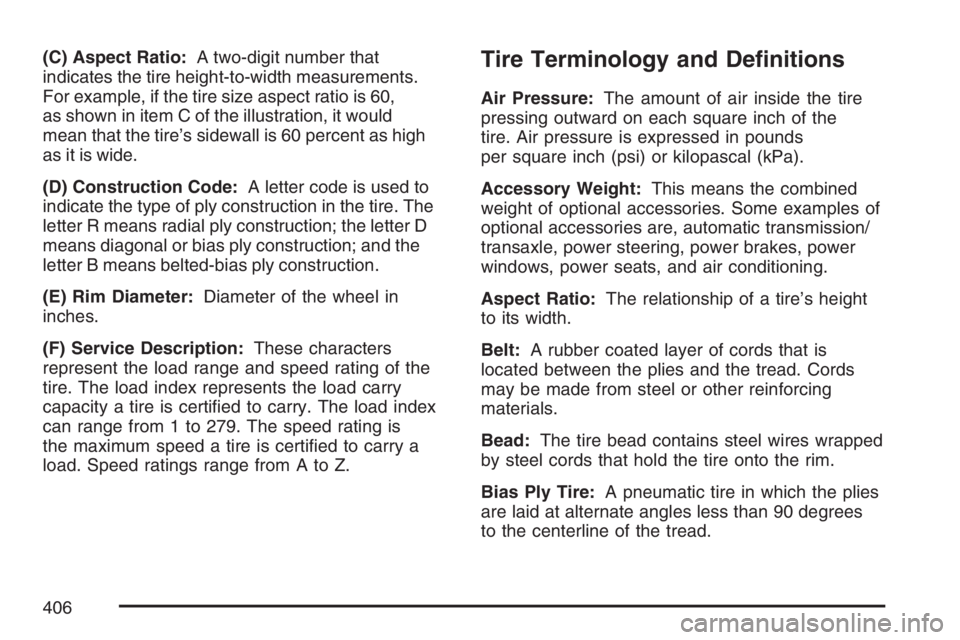
(C) Aspect Ratio:A two-digit number that
indicates the tire height-to-width measurements.
For example, if the tire size aspect ratio is 60,
as shown in item C of the illustration, it would
mean that the tire’s sidewall is 60 percent as high
as it is wide.
(D) Construction Code:A letter code is used to
indicate the type of ply construction in the tire. The
letter R means radial ply construction; the letter D
means diagonal or bias ply construction; and the
letter B means belted-bias ply construction.
(E) Rim Diameter:Diameter of the wheel in
inches.
(F) Service Description:These characters
represent the load range and speed rating of the
tire. The load index represents the load carry
capacity a tire is certied to carry. The load index
can range from 1 to 279. The speed rating is
the maximum speed a tire is certied to carry a
load. Speed ratings range from A to Z.Tire Terminology and Denitions
Air Pressure:The amount of air inside the tire
pressing outward on each square inch of the
tire. Air pressure is expressed in pounds
per square inch (psi) or kilopascal (kPa).
Accessory Weight:This means the combined
weight of optional accessories. Some examples of
optional accessories are, automatic transmission/
transaxle, power steering, power brakes, power
windows, power seats, and air conditioning.
Aspect Ratio:The relationship of a tire’s height
to its width.
Belt:A rubber coated layer of cords that is
located between the plies and the tread. Cords
may be made from steel or other reinforcing
materials.
Bead:The tire bead contains steel wires wrapped
by steel cords that hold the tire onto the rim.
Bias Ply Tire:A pneumatic tire in which the plies
are laid at alternate angles less than 90 degrees
to the centerline of the tread.
406
Page 411 of 512
Tire Pressure Monitor System
The Tire Pressure Monitor System (TPMS) uses
radio and sensor technology to check tire pressure
levels. TPMS sensors are mounted onto each
tire and wheel assembly, except for the spare tire.
The TPMS sensors monitor the air pressure in
your vehicle’s tires and transmit tire pressure
readings to a receiver located in the vehicle.
When a low tire pressure condition is detected,
the TPMS illuminates the low tire pressure
warning light, located in the instrument panel
cluster. If your vehicle has the uplevel Driver
Information Center (DIC), a warning message to
check the pressure in a specic tire displays at
the same time the low tire pressure warning light
comes on. The low tire pressure warning light
and the DIC warning message CHECK TIRE
PRESSURE come on at each ignition cycle
until the tires are inated to the correct
ination pressure. Vehicles that have the
uplevel DIC buttons can also check tire
pressure levels by pressing the gages button.For additional information and details about the
DIC operation and displays seeDIC Operation and
Displays on page 200andDIC Warnings and
Messages on page 208.
During cooler weather conditions, the low tire
pressure warning light and the DIC warning
message, if your vehicle has this feature, may
come on when the vehicle is rst started, and then
turn off as you start to drive. This could be an
early indicator that the air pressure in the tire(s)
are getting low and need to be inated to the
proper pressure.
Each tire, including the spare (if provided), should
be checked monthly when cold and inated
to the ination pressure recommended by the
vehicle manufacturer on the vehicle placard or tire
ination pressure label. (If your vehicle has tires
of a different size than the size indicated on
the vehicle placard or tire ination pressure label,
you should determine the proper tire ination
pressure for those tires.)
411
Page 415 of 512
6. Proceed to the passenger side front tire,
and repeat the procedure in Step 5.
7. Proceed to the passenger side rear tire,
and repeat the procedure in Step 5.
8. Proceed to the driver side rear tire, and
repeat the procedure in Step 5.
9. After hearing the conrming horn chirp for the
driver side rear tire, the horn chirps two more
times to signal the tire learning process
has ended. Turn the ignition switch to OFF.
10. Set all four tires to the recommended air
pressure level as indicated on the tire and
loading information label.
11. Put the valve caps back on the valve stems.Federal Communications Commission
(FCC) and Industry and Science Canada
The Tire Pressure Monitor System (TPMS)
operates on a radio frequency and complies with
Part 15 of the FCC Rules. Operation is subject
to the following two conditions:
1. This device may not cause harmful
interference.
2. This device must accept any interference
received, including interference that may
cause undesired operation.
The Tire Pressure Monitor System (TPMS)
operates on a radio frequency and complies with
RSS-210 of Industry and Science Canada.
Operation is subject to the following two conditions:
1. This device may not cause interference.
2. This device must accept any interference
received, including interference that may
cause undesired operation of the device.
Changes or modications to this system by other
than an authorized service facility could void
authorization to use this equipment.
415
Page 422 of 512
Temperature – A, B, C
The temperature grades are A (the highest),
B, and C, representing the tire’s resistance to
the generation of heat and its ability to dissipate
heat when tested under controlled conditions
on a specied indoor laboratory test wheel.
Sustained high temperature can cause the material
of the tire to degenerate and reduce tire life,
and excessive temperature can lead to sudden tire
failure. The grade C corresponds to a level of
performance which all passenger car tires must
meet under the Federal Motor Vehicle Safety
Standard No. 109. Grades B and A represent
higher levels of performance on the laboratory
test wheel than the minimum required by law.
Warning:The temperature grade for this tire
is established for a tire that is properly inated and
not overloaded. Excessive speed, underination,
or excessive loading, either separately or in
combination, can cause heat buildup and possible
tire failure.
Wheel Alignment and Tire Balance
The tires and wheels on your vehicle were aligned
and balanced carefully at the factory to give you
the longest tire life and best overall performance.
Adjustments to wheel alignment and tire
balancing will not be necessary on a regular basis.
However, if you notice unusual tire wear or your
vehicle pulling to one side or the other, the
alignment may need to be checked. If you notice
your vehicle vibrating when driving on a smooth
road, your tires and wheels may need to be
rebalanced. See your dealer for proper diagnosis.
Wheel Replacement
Replace any wheel that is bent, cracked, or badly
rusted or corroded. If wheel nuts keep coming
loose, the wheel, wheel bolts, and wheel
nuts should be replaced. If the wheel leaks air,
replace it (except some aluminum wheels,
which can sometimes be repaired). See your
dealer if any of these conditions exist.
Your dealer will know the kind of wheel you need.
422
Page 446 of 512
Finish Damage
Any stone chips, fractures or deep scratches
in the nish should be repaired right away.
Bare metal will corrode quickly and may develop
into major repair expense.
Minor chips and scratches can be repaired with
touch-up materials available from your dealer.
Larger areas of nish damage can be corrected
in your dealer’s body and paint shop.
Underbody Maintenance
Chemicals used for ice and snow removal and
dust control can collect on the underbody. If these
are not removed, corrosion and rust can develop
on the underbody parts such as fuel lines,
frame, oor pan, and exhaust system even though
they have corrosion protection.At least every spring, ush these materials from the
underbody with plain water. Clean any areas where
mud and debris can collect. Dirt packed in close
areas of the frame should be loosened before being
ushed. Your dealer or an underbody car washing
system can do this for you.
Chemical Paint Spotting
Some weather and atmospheric conditions can
create a chemical fallout. Airborne pollutants can
fall upon and attack painted surfaces on the
vehicle. This damage can take two forms: blotchy,
ring-shaped discolorations, and small, irregular
dark spots etched into the paint surface.
Although no defect in the paint job causes this, GM
will repair, at no charge to the owner, the surfaces
of new vehicles damaged by this fallout condition
within 12 months or 12,000 miles (20 000 km) of
purchase, whichever occurs rst.
446
Page 452 of 512
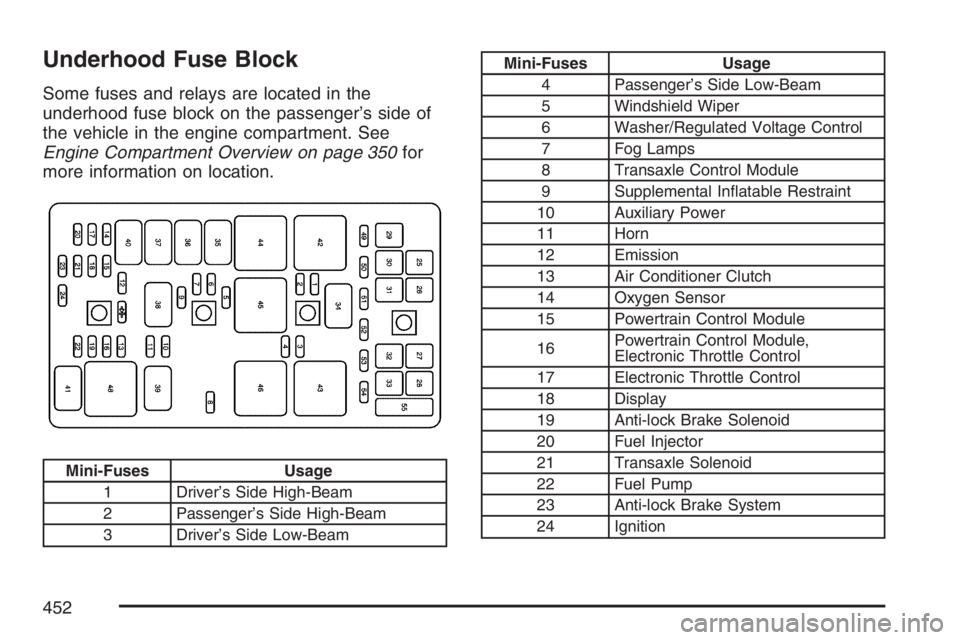
Underhood Fuse Block
Some fuses and relays are located in the
underhood fuse block on the passenger’s side of
the vehicle in the engine compartment. See
Engine Compartment Overview on page 350for
more information on location.
Mini-Fuses Usage
1 Driver’s Side High-Beam
2 Passenger’s Side High-Beam
3 Driver’s Side Low-Beam
Mini-Fuses Usage
4 Passenger’s Side Low-Beam
5 Windshield Wiper
6 Washer/Regulated Voltage Control
7 Fog Lamps
8 Transaxle Control Module
9 Supplemental Inatable Restraint
10 Auxiliary Power
11 Horn
12 Emission
13 Air Conditioner Clutch
14 Oxygen Sensor
15 Powertrain Control Module
16Powertrain Control Module,
Electronic Throttle Control
17 Electronic Throttle Control
18 Display
19 Anti-lock Brake Solenoid
20 Fuel Injector
21 Transaxle Solenoid
22 Fuel Pump
23 Anti-lock Brake System
24 Ignition
452
Page 453 of 512
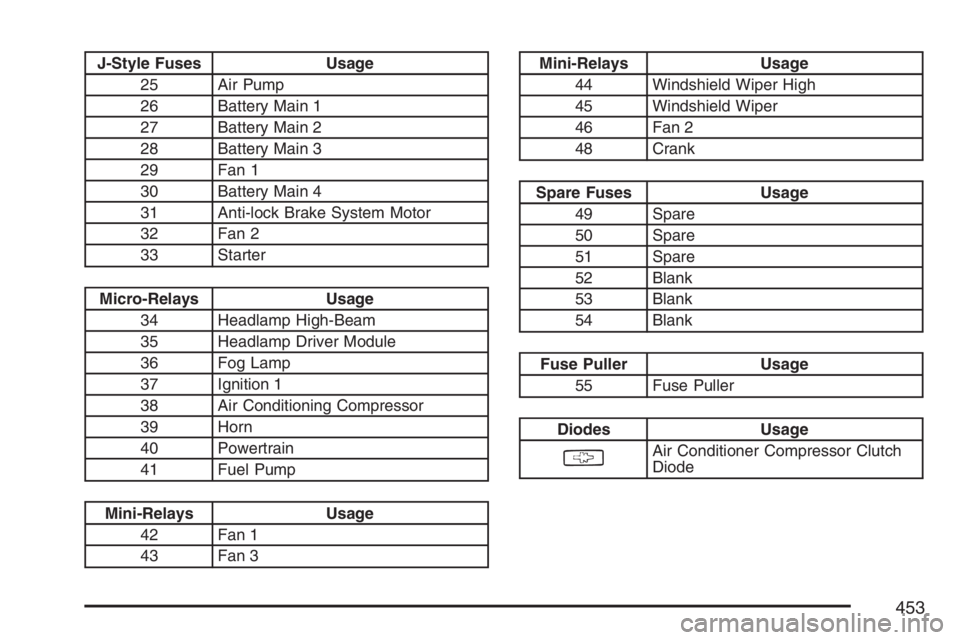
J-Style Fuses Usage
25 Air Pump
26 Battery Main 1
27 Battery Main 2
28 Battery Main 3
29 Fan 1
30 Battery Main 4
31 Anti-lock Brake System Motor
32 Fan 2
33 Starter
Micro-Relays Usage
34 Headlamp High-Beam
35 Headlamp Driver Module
36 Fog Lamp
37 Ignition 1
38 Air Conditioning Compressor
39 Horn
40 Powertrain
41 Fuel Pump
Mini-Relays Usage
42 Fan 1
43 Fan 3
Mini-Relays Usage
44 Windshield Wiper High
45 Windshield Wiper
46 Fan 2
48 Crank
Spare Fuses Usage
49 Spare
50 Spare
51 Spare
52 Blank
53 Blank
54 Blank
Fuse Puller Usage
55 Fuse Puller
Diodes Usage
§Air Conditioner Compressor Clutch
Diode
453
Page 454 of 512
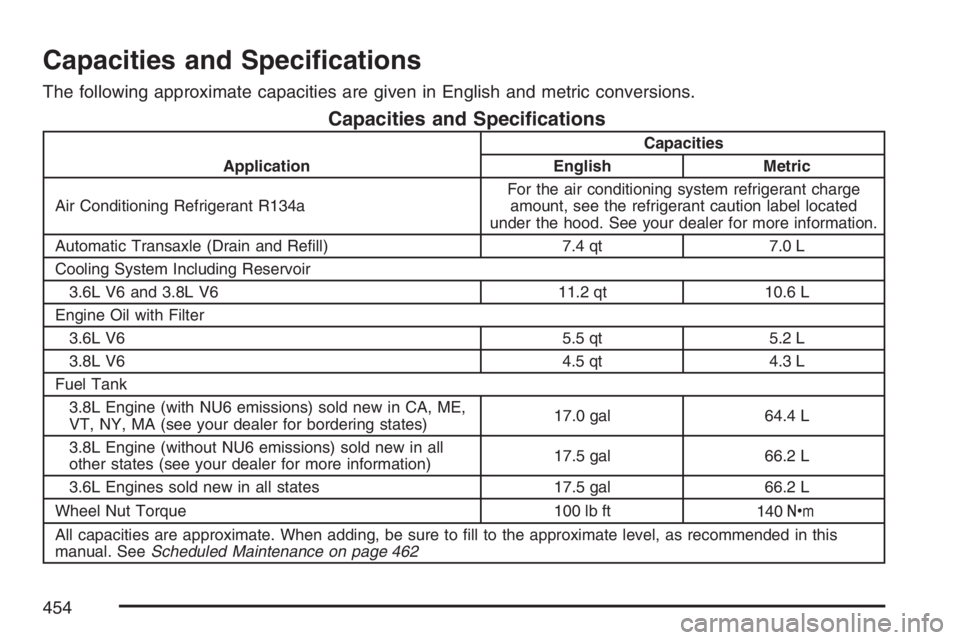
Capacities and Specications
The following approximate capacities are given in English and metric conversions.
Capacities and Specications
ApplicationCapacities
English Metric
Air Conditioning Refrigerant R134aFor the air conditioning system refrigerant charge
amount, see the refrigerant caution label located
under the hood. See your dealer for more information.
Automatic Transaxle (Drain and Rell) 7.4 qt 7.0 L
Cooling System Including Reservoir
3.6L V6 and 3.8L V6 11.2 qt 10.6 L
Engine Oil with Filter
3.6L V6 5.5 qt 5.2 L
3.8L V6 4.5 qt 4.3 L
Fuel Tank
3.8L Engine (with NU6 emissions) sold new in CA, ME,
VT, NY, MA (see your dealer for bordering states)17.0 gal 64.4 L
3.8L Engine (without NU6 emissions) sold new in all
other states (see your dealer for more information)17.5 gal 66.2 L
3.6L Engines sold new in all states 17.5 gal 66.2 L
Wheel Nut Torque 100 lb ft
140Y
All capacities are approximate. When adding, be sure to ll to the approximate level, as recommended in this
manual. SeeScheduled Maintenance on page 462
454
Page 459 of 512
Your Vehicle and the Environment
Proper vehicle maintenance not only helps to keep
your vehicle in good working condition, but also
helps the environment. All recommended
maintenance is important. Improper vehicle
maintenance can even affect the quality of the air
we breathe. Improper uid levels or the wrong
tire ination can increase the level of emissions
from your vehicle. To help protect our environment,
and to keep your vehicle in good condition, be
sure to maintain your vehicle properly.
Using the Maintenance Schedule
We at General Motors want to help you keep your
vehicle in good working condition. But we do
not know exactly how you will drive it. You may
drive very short distances only a few times a week.
Or you may drive long distances all the time in
very hot, dusty weather. You may use your vehicle
in making deliveries. Or you may drive it to
work, to do errands, or in many other ways.
459
Page 461 of 512
Some maintenance services can be complex.
So, unless you are technically qualied and have
the necessary equipment, you should have
your GM Goodwrench
®dealer do these jobs.
When you go to your GM Goodwrench
®dealer for
your service needs, you will know that GM-trained
and supported service technicians will perform
the work using genuine GM parts.
If you want to purchase service information, see
Service Publications Ordering Information on
page 495.Owner Checks and Services on page 466tells you
what should be checked, when to check it, and
what you can easily do to help keep your vehicle in
good condition.
The proper replacement parts, uids, and
lubricants to use are listed inRecommended
Fluids and Lubricants on page 470andNormal
Maintenance Replacement Parts on page 471.
When your vehicle is serviced, make sure these
are used. All parts should be replaced and all
necessary repairs done before you or anyone else
drives the vehicle. We recommend the use of
genuine GM parts.
461