body BUICK LACROSSE 2007 Owner's Guide
[x] Cancel search | Manufacturer: BUICK, Model Year: 2007, Model line: LACROSSE, Model: BUICK LACROSSE 2007Pages: 512
Page 307 of 512
Driving Through Deep Standing Water
Notice:If you drive too quickly through
deep puddles or standing water, water can
come in through your engine’s air intake and
badly damage your engine. Never drive through
water that is slightly lower than the underbody
of your vehicle. If you cannot avoid deep
puddles or standing water, drive through them
very slowly.
Driving Through Flowing Water
{CAUTION:
Flowing or rushing water creates strong
forces. If you try to drive through owing
water, as you might at a low water
crossing, your vehicle can be carried
CAUTION: (Continued)
CAUTION: (Continued)
away. As little as six inches of owing
water can carry away a smaller vehicle.
If this happens, you and other vehicle
occupants could drown. Do not ignore
police warning signs, and otherwise be
very cautious about trying to drive
through owing water.
Some Other Rainy Weather Tips
Besides slowing down, allow some extra
following distance. And be especially careful
when you pass another vehicle. Allow yourself
more clear room ahead, and be prepared to
have your view restricted by road spray.
Have good tires with proper tread depth. See
Tires on page 402.
307
Page 316 of 512
Unless you have the Anti-Lock Brake System
(ABS), you will want to brake very gently, too. If
you do have ABS, seeAnti-Lock Brake System
(ABS) on page 291. ABS improves your vehicle’s
stability when you make a hard stop on a
slippery road. Whether you have ABS or not, you
will want to begin stopping sooner than you
would on dry pavement. Without ABS, if you feel
your vehicle begin to slide, let up on the brakes
a little. Push the brake pedal down steadily to get
the most traction you can.
Remember, unless you have ABS, if you brake so
hard that your wheels stop rolling, you will just
slide. Brake so your wheels always keep rolling
and you can still steer.
Whatever your braking system, allow greater
following distance on any slippery road.
Watch for slippery spots. The road might be
ne until you hit a spot that is covered with
ice. On an otherwise clear road, ice patches
may appear in shaded areas where the
sun cannot reach, such as around clumps of
trees, behind buildings, or under bridges.
Sometimes the surface of a curve or an
overpass may remain icy when the
surrounding roads are clear.If you see a patch of ice ahead of you, brake
before you are on it. Try not to brake while
you are actually on the ice, and avoid sudden
steering maneuvers.
If You Are Caught in a Blizzard
If you are stopped by heavy snow, you could be in
a serious situation. You should probably stay
with your vehicle unless you know for sure that you
are near help and you can hike through the
snow. Here are some things to do to summon
help and keep yourself and your passengers safe:
Turn on your hazard ashers.
Tie a red cloth to your vehicle to alert police
that you have been stopped by the snow.
Put on extra clothing or wrap a blanket around
you. If you do not have blankets or extra
clothing, make body insulators from
newspapers, burlap bags, rags, oor
mats — anything you can wrap around
yourself or tuck under your clothing to
keep warm.
316
Page 331 of 512
Total Weight on Your Vehicle’s Tires
Be sure the vehicle’s tires are inated to the upper
limit for cold tires. These numbers can be found
on the Tire-Loading Information label. SeeLoading
Your Vehicle on page 319. Be sure not to go
over the GVW limit for the vehicle, or the GAWR,
including the weight of the trailer tongue. If a
weight distribution hitch is used, make sure not to
go over the rear axle limit before applying the
weight distribution spring bars.
Hitches
It is important to have the correct hitch equipment.
Crosswinds, large trucks going by and rough
roads are a few reasons why the right hitch
is needed. Here are some rules to follow:
The rear bumper on the vehicle is not intended
for hitches. Do not attach rental hitches or
other bumper-type hitches to it. Use only
a frame-mounted hitch that does not attach to
the bumper.
If holes need to be made in the body of the
vehicle to install a trailer hitch, then be sure
to seal the holes later when the hitch is
removed. If the holes are not sealed, deadly
carbon monoxide (CO) from the exhaust
can get into the vehicle. SeeEngine Exhaust
on page 122. Dirt and water can, too.
Safety Chains
Chains should always be attached between the
vehicle and the trailer. Cross the safety chains
under the tongue of the trailer so that the tongue
will not drop to the road if it becomes separated
from the hitch. Instructions about safety chains
may be provided by the hitch manufacturer or by
the trailer manufacturer. Follow the manufacturer’s
recommendation for attaching safety chains
and do not attach them to the bumper. Always
leave just enough slack so the rig can be turned.
And, never allow safety chains to drag on the
ground.
331
Page 338 of 512
Windshield Wiper Blade Replacement....... 401
Tires............................................................ 402
Tire Sidewall Labeling............................... 403
Tire Terminology and Denitions............... 406
Ination - Tire Pressure............................. 409
Tire Pressure Monitor System................... 411
Tire Inspection and Rotation...................... 416
When It Is Time for New Tires.................. 417
Buying New Tires...................................... 418
Different Size Tires and Wheels................ 420
Uniform Tire Quality Grading..................... 421
Wheel Alignment and Tire Balance............ 422
Wheel Replacement.................................. 422
Tire Chains............................................... 424
If a Tire Goes Flat.................................... 425
Changing a Flat Tire................................. 426
Removing the Spare Tire and Tools.......... 427
Removing the Flat Tire and Installing
the Spare Tire....................................... 429
Storing a Flat or Spare Tire and Tools...... 435
Compact Spare Tire.................................. 437Appearance Care........................................ 438
Cleaning the Inside of Your Vehicle.......... 438
Fabric/Carpet............................................. 440
Leather...................................................... 441
Instrument Panel, Vinyl, and Other
Plastic Surfaces..................................... 441
Care of Safety Belts.................................. 442
Weatherstrips............................................ 442
Washing Your Vehicle............................... 442
Cleaning Exterior Lamps/Lenses................ 443
Finish Care............................................... 443
Windshield and Wiper Blades.................... 444
Aluminum or Chrome-Plated Wheels......... 444
Tires......................................................... 445
Sheet Metal Damage................................. 445
Finish Damage.......................................... 446
Underbody Maintenance............................ 446
Chemical Paint Spotting............................ 446
Vehicle Care/Appearance Materials............ 447
Section 5 Service and Appearance Care
338
Page 423 of 512
Each new wheel should have the same
load-carrying capacity, diameter, width, offset
and be mounted the same way as the one
it replaces.
If you need to replace any of your wheels, wheel
bolts, or wheel nuts, replace them only with
new GM original equipment parts. This way,
you will be sure to have the right wheel, wheel
bolts, and wheel nuts for your vehicle.
{CAUTION:
Using the wrong replacement wheels,
wheel bolts, or wheel nuts on your vehicle
can be dangerous. It could affect the
braking and handling of your vehicle,
make your tires lose air and make you
lose control. You could have a collision
in which you or others could be injured.
Always use the correct wheel, wheel
bolts, and wheel nuts for replacement.Notice:The wrong wheel can also cause
problems with bearing life, brake cooling,
speedometer or odometer calibration,
headlamp aim, bumper height, vehicle ground
clearance, and tire or tire chain clearance
to the body and chassis.
SeeChanging a Flat Tire on page 426for more
information.
Used Replacement Wheels
{CAUTION:
Putting a used wheel on your vehicle is
dangerous. You cannot know how it has
been used or how far it has been driven.
It could fail suddenly and cause a crash.
If you have to replace a wheel, use a new
GM original equipment wheel.
423
Page 445 of 512
Notice:Using chrome polish on aluminum
wheels could damage the wheels. The repairs
would not be covered by your warranty.
Use chrome polish on chrome wheels only.
Use chrome polish only on chrome-plated wheels,
but avoid any painted surface of the wheel, and
buff off immediately after application.
Notice:If you drive your vehicle through an
automatic car wash that has silicone carbide
tire cleaning brushes, you could damage
the aluminum or chrome-plated wheels.
The repairs would not be covered by your
warranty. Never drive a vehicle equipped with
aluminum or chrome-plated wheels through
an automatic car wash that uses silicone
carbide tire cleaning brushes.
Do not take your vehicle through an automatic car
wash that has silicone carbide tire cleaning
brushes. These brushes can also damage the
surface of these wheels.Tires
To clean the tires, use a stiff brush with tire
cleaner.
Notice:Using petroleum-based tire dressing
products on your vehicle may damage the
paint nish and/or tires. When applying a tire
dressing, always wipe off any overspray
from all painted surfaces on your vehicle.
Sheet Metal Damage
If the vehicle is damaged and requires sheet metal
repair or replacement, make sure the body
repair shop applies anti-corrosion material to parts
repaired or replaced to restore corrosion
protection.
Original manufacturer replacement parts will
provide the corrosion protection while maintaining
the warranty.
445
Page 446 of 512
Finish Damage
Any stone chips, fractures or deep scratches
in the nish should be repaired right away.
Bare metal will corrode quickly and may develop
into major repair expense.
Minor chips and scratches can be repaired with
touch-up materials available from your dealer.
Larger areas of nish damage can be corrected
in your dealer’s body and paint shop.
Underbody Maintenance
Chemicals used for ice and snow removal and
dust control can collect on the underbody. If these
are not removed, corrosion and rust can develop
on the underbody parts such as fuel lines,
frame, oor pan, and exhaust system even though
they have corrosion protection.At least every spring, ush these materials from the
underbody with plain water. Clean any areas where
mud and debris can collect. Dirt packed in close
areas of the frame should be loosened before being
ushed. Your dealer or an underbody car washing
system can do this for you.
Chemical Paint Spotting
Some weather and atmospheric conditions can
create a chemical fallout. Airborne pollutants can
fall upon and attack painted surfaces on the
vehicle. This damage can take two forms: blotchy,
ring-shaped discolorations, and small, irregular
dark spots etched into the paint surface.
Although no defect in the paint job causes this, GM
will repair, at no charge to the owner, the surfaces
of new vehicles damaged by this fallout condition
within 12 months or 12,000 miles (20 000 km) of
purchase, whichever occurs rst.
446
Page 463 of 512
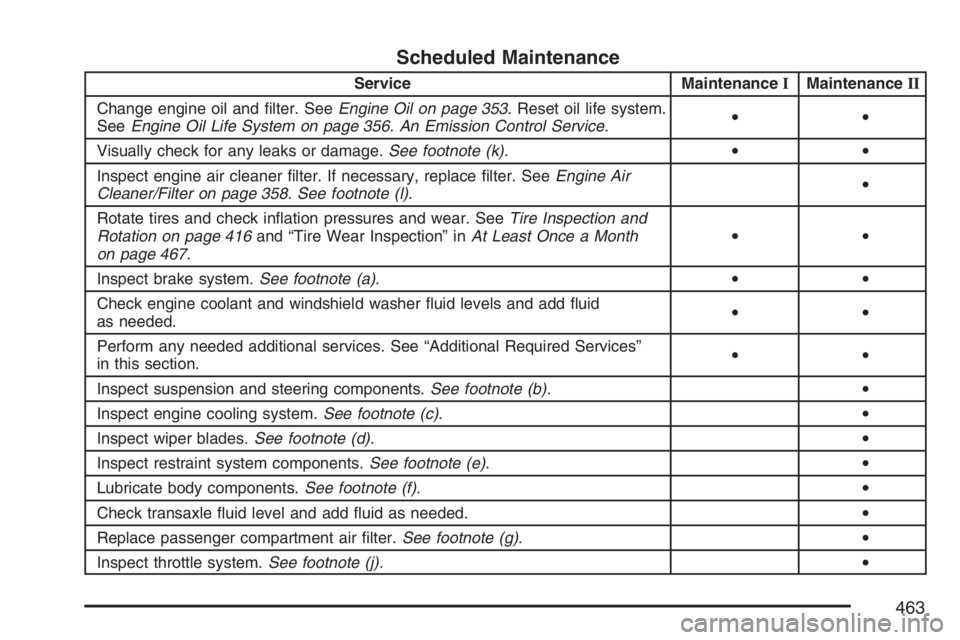
Scheduled Maintenance
Service MaintenanceIMaintenanceII
Change engine oil and lter. SeeEngine Oil on page 353. Reset oil life system.
SeeEngine Oil Life System on page 356.An Emission Control Service.••
Visually check for any leaks or damage.See footnote (k).••
Inspect engine air cleaner lter. If necessary, replace lter. SeeEngine Air
Cleaner/Filter on page 358.See footnote (l).•
Rotate tires and check ination pressures and wear. SeeTire Inspection and
Rotation on page 416and “Tire Wear Inspection” inAt Least Once a Month
on page 467.••
Inspect brake system.See footnote (a).••
Check engine coolant and windshield washer uid levels and add uid
as needed.••
Perform any needed additional services. See “Additional Required Services”
in this section.••
Inspect suspension and steering components.See footnote (b).•
Inspect engine cooling system.See footnote (c).•
Inspect wiper blades.See footnote (d).•
Inspect restraint system components.See footnote (e).•
Lubricate body components.See footnote (f).•
Check transaxle uid level and add uid as needed.•
Replace passenger compartment air lter.See footnote (g).•
Inspect throttle system.See footnote (j).•
463
Page 465 of 512
Maintenance Footnotes
(a)Visually inspect brake lines and hoses for
proper hook-up, binding, leaks, cracks, chang,
etc. Inspect disc brake pads for wear and rotors for
surface condition. Inspect other brake parts,
including calipers, parking brake, etc.
(b)Visually inspect front and rear suspension and
steering system for damaged, loose, or missing
parts or signs of wear. Inspect power steering lines
and hoses for proper hook-up, binding, leaks,
cracks, chang, etc.
(c)Visually inspect hoses and have them replaced
if they are cracked, swollen, or deteriorated.
Inspect all pipes, ttings and clamps; replace with
genuine GM parts as needed. To help ensure
proper operation, a pressure test of the cooling
system and pressure cap and cleaning the outside
of the radiator and air conditioning condenser is
recommended at least once a year.
(d)Visually inspect wiper blades for wear or
cracking. Replace wiper blades that appear worn
or damaged or that streak or miss areas of
the windshield.(e)Make sure the safety belt reminder light and all
your belts, buckles, latch plates, retractors, and
anchorages are working properly. Look for
any other loose or damaged safety belt system
parts. If you see anything that might keep a safety
belt system from doing its job, have it repaired.
Have any torn or frayed safety belts replaced. Also
look for any opened or broken airbag coverings,
and have them repaired or replaced. The
airbag system does not need regular maintenance.
(f)Lubricate all key lock cylinders. Lubricate all
hinges and latches, including those for the
body doors, hood, secondary latch, pivots, spring
anchor, release pawl, rear compartment, glove
box door, and console door. More frequent
lubrication may be required when exposed to a
corrosive environment. Applying silicone grease on
weatherstrips with a clean cloth will make them
last longer, seal better, and not stick or squeak.
(g)If you drive regularly under dusty conditions,
the lter may require replacement more often.
465
Page 469 of 512
Ignition Transaxle Lock Check
While parked, and with the parking brake set, try
to turn the ignition to OFF in each shift lever
position.
The ignition should turn to OFF only when the
shift lever is in PARK (P).
The ignition key should come out only in OFF.
Contact your GM Goodwrench
®dealer if service
is required.
Parking Brake and Automatic Transaxle
Park (P) Mechanism Check
{CAUTION:
When you are doing this check, your
vehicle could begin to move. You or
others could be injured and property
could be damaged. Make sure there is
room in front of your vehicle in case it
begins to roll. Be ready to apply the
regular brake at once should the vehicle
begin to move.Park on a fairly steep hill, with the vehicle facing
downhill. Keeping your foot on the regular
brake, set the parking brake.
To check the parking brake’s holding ability:
With the engine running and transaxle in
NEUTRAL (N), slowly remove foot pressure
from the regular brake pedal. Do this until the
vehicle is held by the parking brake only.
To check the PARK (P) mechanism’s holding
ability: With the engine running, shift to
PARK (P). Then release the parking brake
followed by the regular brake.
Contact your GM Goodwrench
®dealer if service
is required.
Underbody Flushing Service
At least every spring, use plain water to ush any
corrosive materials from the underbody. Take
care to clean thoroughly any areas where mud and
other debris can collect.
469