seats BUICK LACROSSE 2007 Owner's Guide
[x] Cancel search | Manufacturer: BUICK, Model Year: 2007, Model line: LACROSSE, Model: BUICK LACROSSE 2007Pages: 512
Page 164 of 512
A high electrical load occurs when several of the
following loads are on: headlamps, high beams,
fog lamps, rear window defogger, climate
control fan at high speed, heated seats, engine
cooling fans, trailer loads, and loads plugged into
accessory power outlets.
EPM works to prevent excessive discharge of the
battery. It does this by balancing the generator’s
output and the vehicle’s electrical needs. It
can increase engine idle speed to generate more
power, whenever needed. It can temporarily
reduce the power demands of some accessories.
Normally, these actions occur in steps or levels,
without being noticeable. In rare cases at the
highest levels of corrective action, this action may
be noticeable to the driver. If so, the Driver
Information Center (DIC) message might display
Battery Saver Active. If this message is displayed,
it is recommended that the driver reduce the
electrical loads as much as possible. See
DIC Warnings and Messages on page 208.Battery Run-Down Protection
This helps prevent the vehicle’s battery from
draining in case the interior courtesy lamps,
reading lamps, trunk lamp, underhood lamp, glove
box lamps, or sun visor vanity lamps, if equipped,
are accidently left on. If any of these lamps
are left on while the ignition is off, they will
automatically turn off after 10 minutes. The lamps
will not come back on again until one of the
following occurs:
The ignition is turned on.
The interior lamps control is turned off, then to
door or on.
Ultrasonic Rear Parking
Assist (URPA)
Your vehicle may be equipped with Ultrasonic Rear
Parking Assist (URPA). URPA is designed to help
you park while in REVERSE (R) and operates only
at speeds less than 3 mph (5 km/h). URPA can help
you avoid colliding with objects such as parked
vehicles. The system can detect objects 5 feet
(1.5 m) behind your vehicle and tell you how close
those objects are to your rear bumper.
164
Page 173 of 512
Automatic Operation
AUTO (Automatic):Press the AUTO button for
automatic control of the inside temperature, the air
delivery mode, and the fan speed. There might
be a delay of two to three minutes before the fan
comes on when the automatic operation is
used in cold weather. For the automatic system to
function, the temperature must be set between
61°F (15°C) and 89°F (32°C).
1. Adjust the temperature to a comfortable
setting.
2. Press the PASS button or the up or down
arrows on the passenger side to turn the
passenger temperature set on and off. When
turned on, the passenger temperature will
be the same as the driver setting. Press the
up or down arrow on passenger side to adjust
the passenger temperature setting.
When the passenger’s temperature set is off,
the passenger display will be off and the
driver’s set temperature will be for the driver
and passenger.In cold weather, the system will start at
reduced fan speeds to avoid blowing cold air
into the vehicle until warmer air is available.
The system will start out blowing air at the oor
but may change modes automatically as the
vehicle warms up to maintain the chosen
temperature setting. The length of time needed
for warm up will depend on the outside
temperature and the length of time that has
elapsed since the vehicle was last driven.
3. Wait for the system to regulate. This may take
from 10 to 30 minutes. Then, adjust the
temperature, if necessary.
Do not cover the solar sensor located in the
center of the instrument panel, near the
windshield. For more information on the solar
sensor, see “Sensors” later in this section.
4. Press OFF to turn the climate control system
off. Only the rear defog and heated seats will
function. Press AUTO or any other button
except the heated seats or rear defog to turn
the climate control system back on.
173
Page 175 of 512
9y(Fan):Press this button to increase the fan
speed. Pressing the arrows cancels the automatic
operation and places the system in manual or
semi-automatic mode. Press the AUTO button to
return to automatic operation. If the airow
seems low when the fan is at the highest setting,
the passenger compartment air lter may need
to be replaced. For more information see
Passenger Compartment Air Filter on page 178
andScheduled Maintenance on page 462.
6(Floor):This mode directs most of the air to
the oor, with some air directed to the side window
outlets and a small amount to the windshield.
)(Bi-Level):This setting directs airow to the
instrument panel and oor outlets. A small amount
of air is also directed to the windshield and the
side window outlets.
Y(Vent):This mode directs air through the
instrument panel outlets.
h(Recirculation):Press this button to turn
recirculation mode on or off. This mode keeps
outside air from coming into the vehicle. It can be
used to help reduce the outside air and odors
that enter your vehicle or help cool the air inside
the vehicle quicker.
Recirculation is not available while in the oor,
defrost, or oor/defog modes. Using recirculation
for long periods of time may cause the air
inside your vehicle to become too dry.
Recirculation mode has a ve minute timer after
which the system allows for some fresh outside air
into the vehicle to maintain interior air quality.
#(Air Conditioning):Press this button to turn
the air conditioning compressor on and off.
The indicator light on the button will come on
when the air conditioning is on. The indicator light
will change with each button press even when
conditions prevent operation.
((Heated Seats):Press this button to turn the
driver or passenger heated seats on and off. See
Heated Seats on page 10for additional information.
175
Page 177 of 512
Rear Window Defogger
The rear window defogger uses a warming grid to
remove fog or frost from the rear window. The
rear window defogger will only work when
the engine is running.
=(Rear Window Defogger):Press this button
to turn the rear window defogger on and off.
Be sure to clear as much snow from the rear
window as possible.
The rear window defogger will turn off about
20 minutes after the button is pressed. If turned
on again, the defogger will only run for about
20 minutes before turning off. The defogger can
also be turned off by pressing the button again or
by turning off the engine.
Do not drive the vehicle until all the windows
are clear.
Notice:Do not use a razor blade or sharp
object to clear the inside rear window. Do not
adhere anything to the defogger grid lines
in the rear glass. These actions may damage
the rear defogger. Repairs would not be
covered by your warranty.
Outlet Adjustment
Use the thumbwheels located between the center
outlets to open and close the outlets. Move the
lever in the center of each air outlet to adjust the
direction of the airow.
Operation Tips
Clear away any ice, snow or leaves from the
air inlets at the base of the windshield that
may block the ow of air into the vehicle.
Use of non-GM approved hood deectors
may adversely affect the performance of
the system.
Keep the path under the front seats clear of
objects to help circulate the air inside of the
vehicle more effectively.
This vehicle has a passenger compartment air
lter. If the airow seems low when the fan is
at the highest setting it may need to be
replaced. For more information, see
Passenger Compartment Air Filter on
page 178.
177
Page 185 of 512
SeePassenger Sensing System on page 75for
more on this, including important safety
information.
If, after several seconds, all status indicator lights
remain on, or if there are no lights at all, there
may be a problem with the lights or the passenger
sensing system. See your dealer for service.
{CAUTION:
If the off indicator and the airbag
readiness light ever come on together, it
means that something may be wrong with
the airbag system. If this ever happens,
have the vehicle serviced promptly,
because an adult-size person sitting in the
right front passenger seat may not have
the protection of the frontal airbag. See
Airbag Readiness Light on page 182.
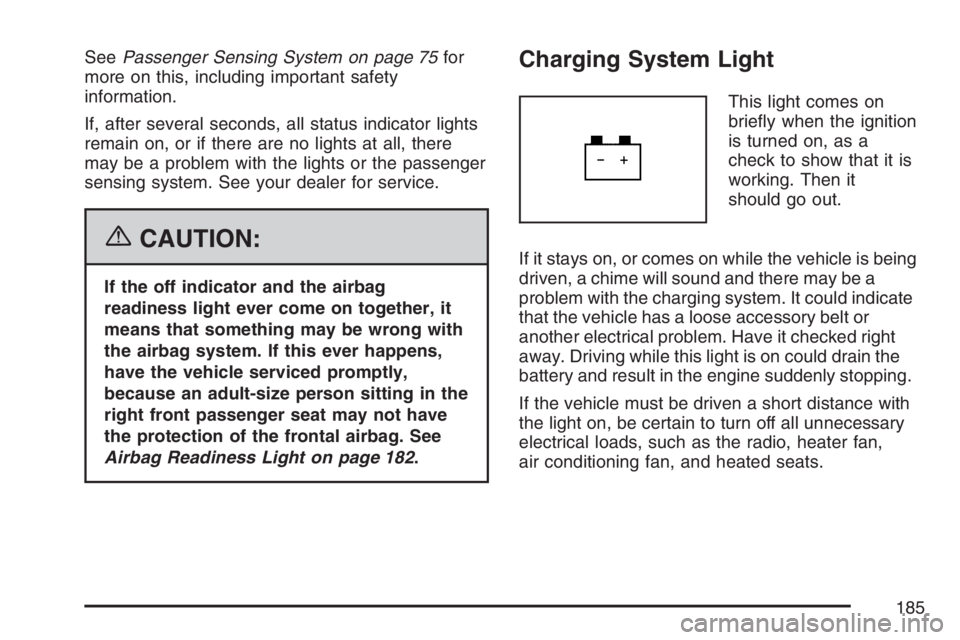
Charging System Light
This light comes on
briey when the ignition
is turned on, as a
check to show that it is
working. Then it
should go out.
If it stays on, or comes on while the vehicle is being
driven, a chime will sound and there may be a
problem with the charging system. It could indicate
that the vehicle has a loose accessory belt or
another electrical problem. Have it checked right
away. Driving while this light is on could drain the
battery and result in the engine suddenly stopping.
If the vehicle must be driven a short distance with
the light on, be certain to turn off all unnecessary
electrical loads, such as the radio, heater fan,
air conditioning fan, and heated seats.
185
Page 325 of 512
{CAUTION:
Things you put inside your vehicle can
strike and injure people in a sudden stop
or turn, or in a crash.
Put things in the trunk of your vehicle.
In a trunk, put them as far forward as
you can. Try to spread the weight
evenly.
Never stack heavier things, like
suitcases, inside the vehicle so that
some of them are above the tops of
the seats.
Do not leave an unsecured child
restraint in your vehicle.
When you carry something inside the
vehicle, secure it whenever you can.
Do not leave a seat folded down
unless you need to.
Towing
Towing Your Vehicle
Consult your dealer or a professional towing
service if you need to have your disabled vehicle
towed. SeeRoadside Assistance Program on
page 484.
If you want to tow your vehicle behind another
vehicle for recreational purposes (such as behind
a motorhome), see “Recreational Vehicle
Towing” following.
325
Page 406 of 512
(C) Aspect Ratio:A two-digit number that
indicates the tire height-to-width measurements.
For example, if the tire size aspect ratio is 60,
as shown in item C of the illustration, it would
mean that the tire’s sidewall is 60 percent as high
as it is wide.
(D) Construction Code:A letter code is used to
indicate the type of ply construction in the tire. The
letter R means radial ply construction; the letter D
means diagonal or bias ply construction; and the
letter B means belted-bias ply construction.
(E) Rim Diameter:Diameter of the wheel in
inches.
(F) Service Description:These characters
represent the load range and speed rating of the
tire. The load index represents the load carry
capacity a tire is certied to carry. The load index
can range from 1 to 279. The speed rating is
the maximum speed a tire is certied to carry a
load. Speed ratings range from A to Z.Tire Terminology and Denitions
Air Pressure:The amount of air inside the tire
pressing outward on each square inch of the
tire. Air pressure is expressed in pounds
per square inch (psi) or kilopascal (kPa).
Accessory Weight:This means the combined
weight of optional accessories. Some examples of
optional accessories are, automatic transmission/
transaxle, power steering, power brakes, power
windows, power seats, and air conditioning.
Aspect Ratio:The relationship of a tire’s height
to its width.
Belt:A rubber coated layer of cords that is
located between the plies and the tread. Cords
may be made from steel or other reinforcing
materials.
Bead:The tire bead contains steel wires wrapped
by steel cords that hold the tire onto the rim.
Bias Ply Tire:A pneumatic tire in which the plies
are laid at alternate angles less than 90 degrees
to the centerline of the tread.
406
Page 451 of 512
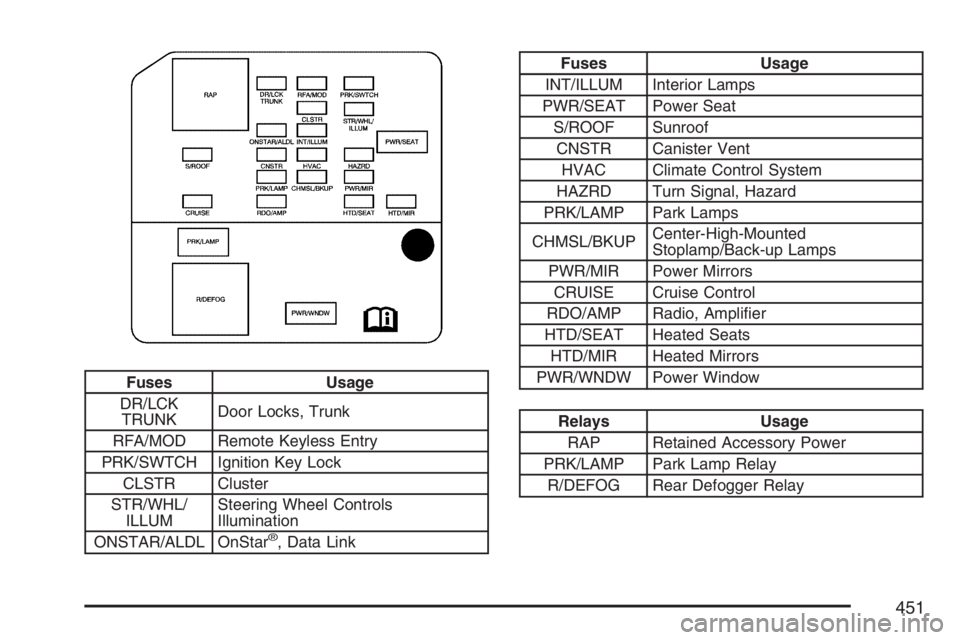
Fuses Usage
DR/LCK
TRUNKDoor Locks, Trunk
RFA/MOD Remote Keyless Entry
PRK/SWTCH Ignition Key Lock
CLSTR Cluster
STR/WHL/
ILLUMSteering Wheel Controls
Illumination
ONSTAR/ALDL OnStar
®, Data Link
Fuses Usage
INT/ILLUM Interior Lamps
PWR/SEAT Power Seat
S/ROOF Sunroof
CNSTR Canister Vent
HVAC Climate Control System
HAZRD Turn Signal, Hazard
PRK/LAMP Park Lamps
CHMSL/BKUPCenter-High-Mounted
Stoplamp/Back-up Lamps
PWR/MIR Power Mirrors
CRUISE Cruise Control
RDO/AMP Radio, Amplier
HTD/SEAT Heated Seats
HTD/MIR Heated Mirrors
PWR/WNDW Power Window
Relays Usage
RAP Retained Accessory Power
PRK/LAMP Park Lamp Relay
R/DEFOG Rear Defogger Relay
451
Page 503 of 512
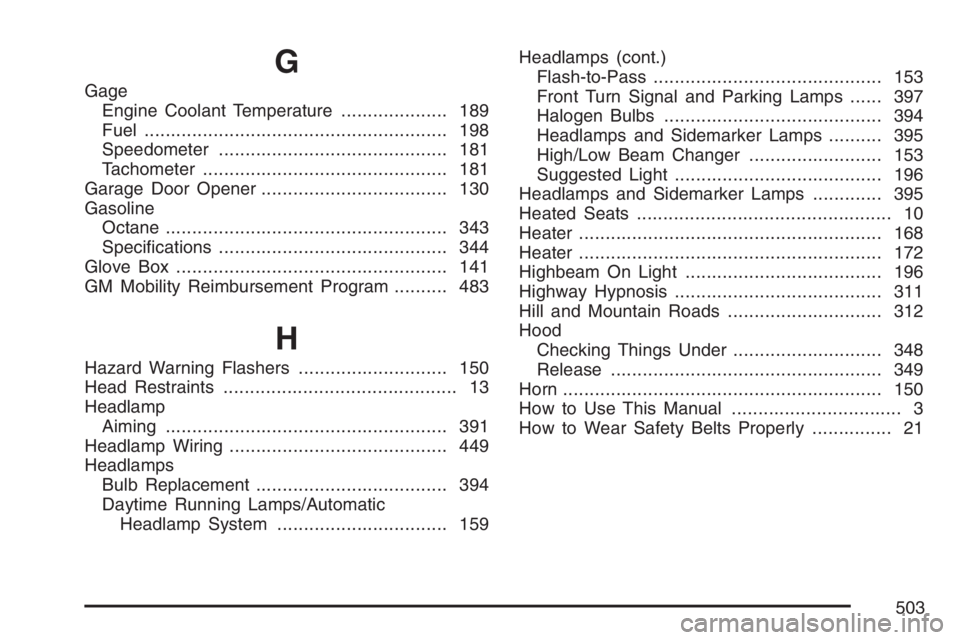
G
Gage
Engine Coolant Temperature.................... 189
Fuel......................................................... 198
Speedometer........................................... 181
Tachometer.............................................. 181
Garage Door Opener................................... 130
Gasoline
Octane..................................................... 343
Specications........................................... 344
Glove Box................................................... 141
GM Mobility Reimbursement Program.......... 483
H
Hazard Warning Flashers............................ 150
Head Restraints............................................ 13
Headlamp
Aiming..................................................... 391
Headlamp Wiring......................................... 449
Headlamps
Bulb Replacement.................................... 394
Daytime Running Lamps/Automatic
Headlamp System................................ 159Headlamps (cont.)
Flash-to-Pass........................................... 153
Front Turn Signal and Parking Lamps...... 397
Halogen Bulbs......................................... 394
Headlamps and Sidemarker Lamps.......... 395
High/Low Beam Changer......................... 153
Suggested Light....................................... 196
Headlamps and Sidemarker Lamps............. 395
Heated Seats................................................ 10
Heater......................................................... 168
Heater......................................................... 172
Highbeam On Light..................................... 196
Highway Hypnosis....................................... 311
Hill and Mountain Roads............................. 312
Hood
Checking Things Under............................ 348
Release................................................... 349
Horn............................................................ 150
How to Use This Manual ................................ 3
How to Wear Safety Belts Properly............... 21
503
Page 509 of 512
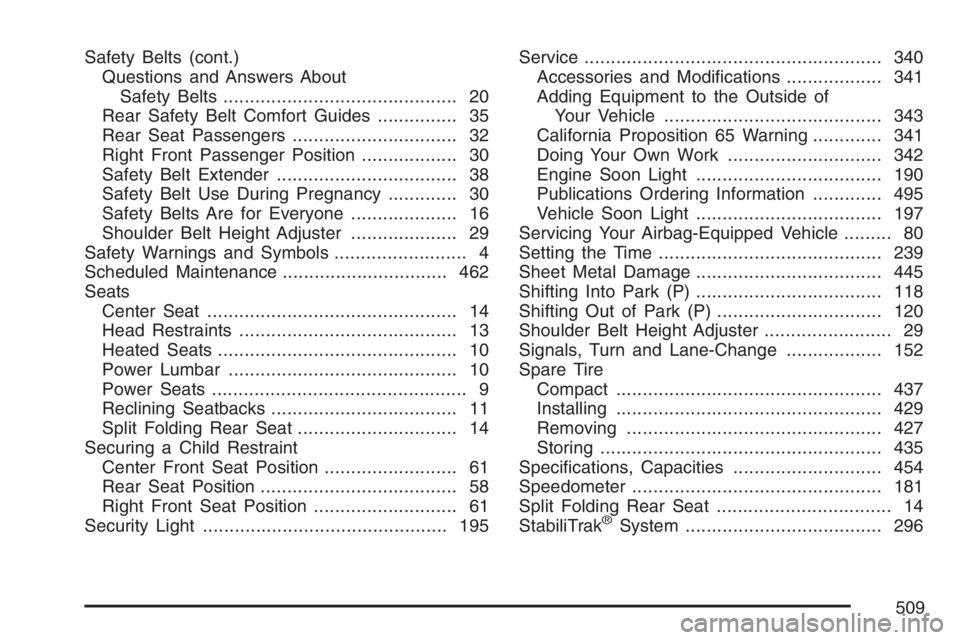
Safety Belts (cont.)
Questions and Answers About
Safety Belts............................................ 20
Rear Safety Belt Comfort Guides............... 35
Rear Seat Passengers............................... 32
Right Front Passenger Position.................. 30
Safety Belt Extender.................................. 38
Safety Belt Use During Pregnancy............. 30
Safety Belts Are for Everyone.................... 16
Shoulder Belt Height Adjuster.................... 29
Safety Warnings and Symbols......................... 4
Scheduled Maintenance............................... 462
Seats
Center Seat............................................... 14
Head Restraints......................................... 13
Heated Seats............................................. 10
Power Lumbar........................................... 10
Power Seats................................................ 9
Reclining Seatbacks................................... 11
Split Folding Rear Seat.............................. 14
Securing a Child Restraint
Center Front Seat Position......................... 61
Rear Seat Position..................................... 58
Right Front Seat Position........................... 61
Security Light.............................................. 195Service........................................................ 340
Accessories and Modications.................. 341
Adding Equipment to the Outside of
Your Vehicle......................................... 343
California Proposition 65 Warning............. 341
Doing Your Own Work............................. 342
Engine Soon Light................................... 190
Publications Ordering Information............. 495
Vehicle Soon Light................................... 197
Servicing Your Airbag-Equipped Vehicle......... 80
Setting the Time.......................................... 239
Sheet Metal Damage................................... 445
Shifting Into Park (P)................................... 118
Shifting Out of Park (P)............................... 120
Shoulder Belt Height Adjuster........................ 29
Signals, Turn and Lane-Change.................. 152
Spare Tire
Compact.................................................. 437
Installing.................................................. 429
Removing................................................ 427
Storing..................................................... 435
Specications, Capacities............................ 454
Speedometer............................................... 181
Split Folding Rear Seat................................. 14
StabiliTrak
®System..................................... 296
509