belt BUICK LACROSSE 2007 Repair Manual
[x] Cancel search | Manufacturer: BUICK, Model Year: 2007, Model line: LACROSSE, Model: BUICK LACROSSE 2007Pages: 512
Page 406 of 512
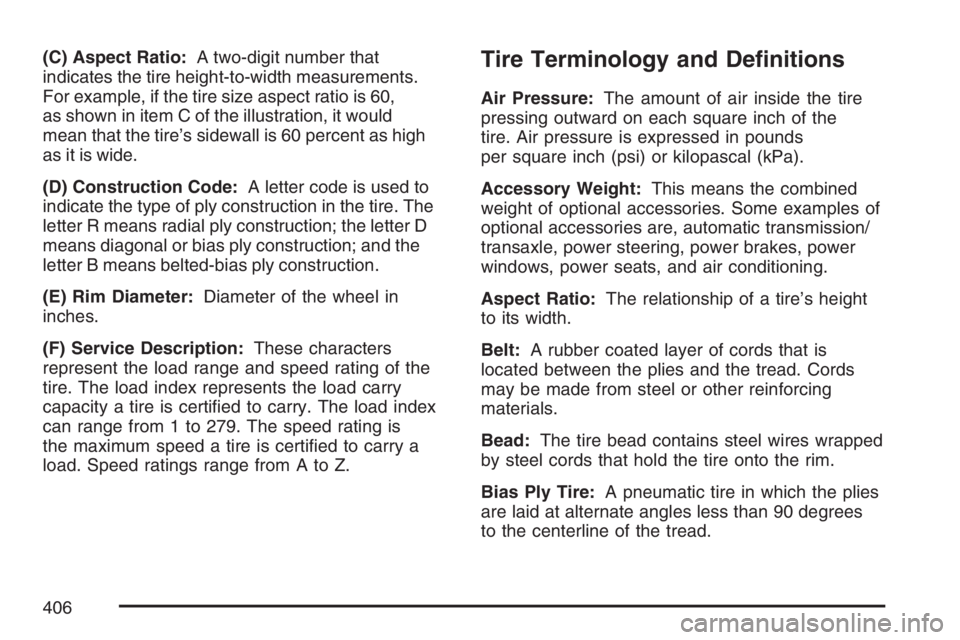
(C) Aspect Ratio:A two-digit number that
indicates the tire height-to-width measurements.
For example, if the tire size aspect ratio is 60,
as shown in item C of the illustration, it would
mean that the tire’s sidewall is 60 percent as high
as it is wide.
(D) Construction Code:A letter code is used to
indicate the type of ply construction in the tire. The
letter R means radial ply construction; the letter D
means diagonal or bias ply construction; and the
letter B means belted-bias ply construction.
(E) Rim Diameter:Diameter of the wheel in
inches.
(F) Service Description:These characters
represent the load range and speed rating of the
tire. The load index represents the load carry
capacity a tire is certied to carry. The load index
can range from 1 to 279. The speed rating is
the maximum speed a tire is certied to carry a
load. Speed ratings range from A to Z.Tire Terminology and Denitions
Air Pressure:The amount of air inside the tire
pressing outward on each square inch of the
tire. Air pressure is expressed in pounds
per square inch (psi) or kilopascal (kPa).
Accessory Weight:This means the combined
weight of optional accessories. Some examples of
optional accessories are, automatic transmission/
transaxle, power steering, power brakes, power
windows, power seats, and air conditioning.
Aspect Ratio:The relationship of a tire’s height
to its width.
Belt:A rubber coated layer of cords that is
located between the plies and the tread. Cords
may be made from steel or other reinforcing
materials.
Bead:The tire bead contains steel wires wrapped
by steel cords that hold the tire onto the rim.
Bias Ply Tire:A pneumatic tire in which the plies
are laid at alternate angles less than 90 degrees
to the centerline of the tread.
406
Page 419 of 512
{CAUTION:
Mixing tires could cause you to lose
control while driving. If you mix tires of
different sizes, brands, or types (radial
and bias-belted tires), the vehicle may not
handle properly, and you could have a
crash. Using tires of different sizes,
brands, or types may also cause damage
to your vehicle. Be sure to use the correct
size, brand, and type of tires on all
wheels. It is all right to drive with your
compact spare temporarily, as it was
developed for use on your vehicle. See
Compact Spare Tire on page 437.
{CAUTION:
If you use bias-ply tires on your vehicle,
the wheel rim anges could develop
cracks after many miles of driving. A tire
and/or wheel could fail suddenly, causing
a crash. Use only radial-ply tires with the
wheels on your vehicle.
If you must replace your vehicle’s tires with those
that do not have a TPC Spec number, make
sure they are the same size, load range, speed
rating, and construction type (radial and
bias-belted tires) as your vehicle’s original tires.
Your vehicle’s original equipment tires are listed on
the Tire and Loading Information label. This
label is attached to the vehicle’s center pillar
(B-pillar). SeeLoading Your Vehicle on page 319,
for more information about the Tire and Loading
Information label and its location on your vehicle.
419
Page 442 of 512
Care of Safety Belts
Keep belts clean and dry.
{CAUTION:
Do not bleach or dye safety belts. If you
do, it may severely weaken them. In a
crash, they might not be able to provide
adequate protection. Clean safety belts
only with mild soap and lukewarm water.
Weatherstrips
Silicone grease on weatherstrips will make them
last longer, seal better, and not stick or squeak.
Apply silicone grease with a clean cloth. During
very cold, damp weather frequent application may
be required. SeeRecommended Fluids and
Lubricants on page 470.
Washing Your Vehicle
The paint nish on the vehicle provides beauty,
depth of color, gloss retention, and durability.
The best way to preserve the vehicle’s nish is to
keep it clean by washing it often with lukewarm
or cold water.
Do not wash the vehicle in the direct rays of the
sun. Use a car washing soap. Do not use strong
soaps or chemical detergents. Be sure to rinse the
vehicle well, removing all soap residue completely.
Approved cleaning products can be obtained
from your dealer. SeeVehicle Care/Appearance
Materials on page 447. Do not use cleaning agents
that are petroleum based, or that contain acid or
abrasives. All cleaning agents should be ushed
promptly and not allowed to dry on the surface, or
they could stain. Dry the nish with a soft, clean
chamois or an all-cotton towel to avoid surface
scratches and water spotting.
High pressure car washes may cause water to
enter the vehicle.
442
Page 457 of 512
Maintenance Schedule................................ 458
Introduction............................................... 458
Maintenance Requirements........................ 458
Your Vehicle and the Environment............ 459
Using the Maintenance Schedule............... 459
Scheduled Maintenance............................. 462
Additional Required Services..................... 464
Maintenance Footnotes.............................. 465Owner Checks and Services..................... 466
At Each Fuel Fill....................................... 467
At Least Once a Month............................. 467
At Least Once a Year............................... 468
Recommended Fluids and Lubricants........ 470
Normal Maintenance Replacement Parts..... 471
Engine Drive Belt Routing......................... 472
Maintenance Record.................................. 473
Section 6 Maintenance Schedule
457
Page 464 of 512
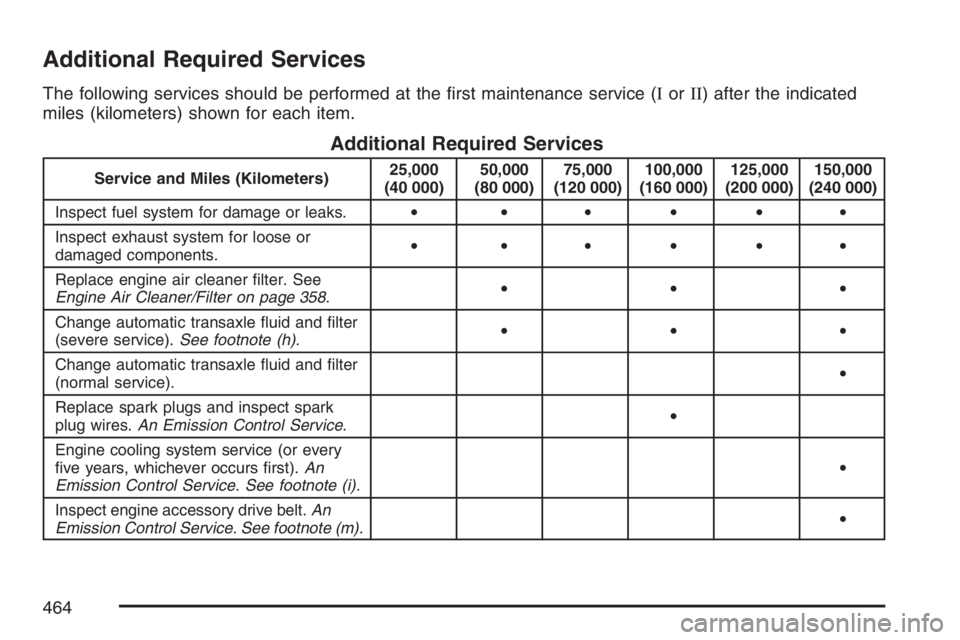
Additional Required Services
The following services should be performed at the rst maintenance service (IorII) after the indicated
miles (kilometers) shown for each item.
Additional Required Services
Service and Miles (Kilometers)25,000
(40 000)50,000
(80 000)75,000
(120 000)100,000
(160 000)125,000
(200 000)150,000
(240 000)
Inspect fuel system for damage or leaks.• •••••
Inspect exhaust system for loose or
damaged components.• •••••
Replace engine air cleaner lter. See
Engine Air Cleaner/Filter on page 358.•••
Change automatic transaxle uid and lter
(severe service).See footnote (h).•••
Change automatic transaxle uid and lter
(normal service).•
Replace spark plugs and inspect spark
plug wires.An Emission Control Service.•
Engine cooling system service (or every
ve years, whichever occurs rst).An
Emission Control Service. See footnote (i).•
Inspect engine accessory drive belt.An
Emission Control Service. See footnote (m).•
464
Page 465 of 512
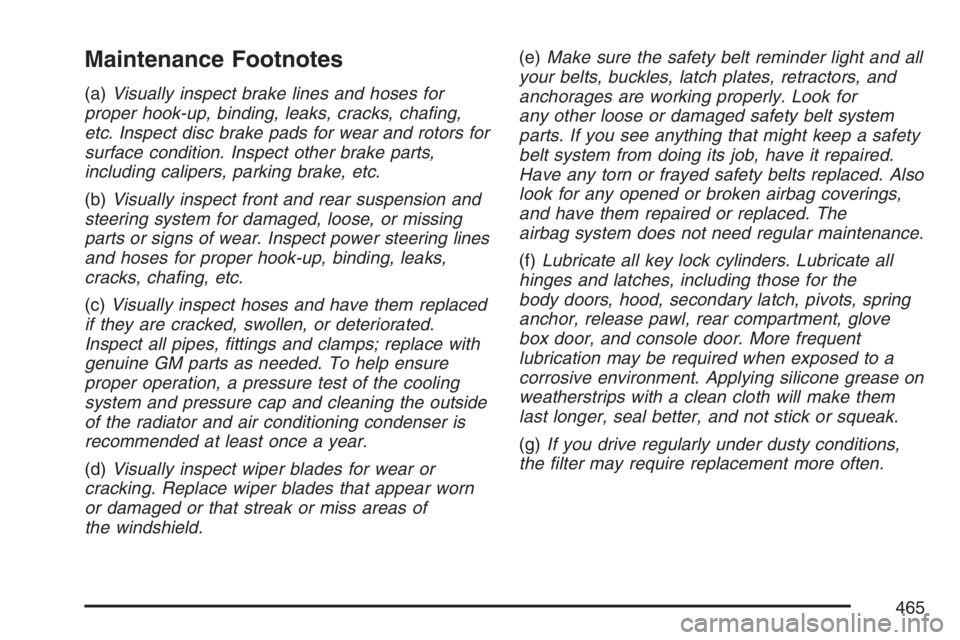
Maintenance Footnotes
(a)Visually inspect brake lines and hoses for
proper hook-up, binding, leaks, cracks, chang,
etc. Inspect disc brake pads for wear and rotors for
surface condition. Inspect other brake parts,
including calipers, parking brake, etc.
(b)Visually inspect front and rear suspension and
steering system for damaged, loose, or missing
parts or signs of wear. Inspect power steering lines
and hoses for proper hook-up, binding, leaks,
cracks, chang, etc.
(c)Visually inspect hoses and have them replaced
if they are cracked, swollen, or deteriorated.
Inspect all pipes, ttings and clamps; replace with
genuine GM parts as needed. To help ensure
proper operation, a pressure test of the cooling
system and pressure cap and cleaning the outside
of the radiator and air conditioning condenser is
recommended at least once a year.
(d)Visually inspect wiper blades for wear or
cracking. Replace wiper blades that appear worn
or damaged or that streak or miss areas of
the windshield.(e)Make sure the safety belt reminder light and all
your belts, buckles, latch plates, retractors, and
anchorages are working properly. Look for
any other loose or damaged safety belt system
parts. If you see anything that might keep a safety
belt system from doing its job, have it repaired.
Have any torn or frayed safety belts replaced. Also
look for any opened or broken airbag coverings,
and have them repaired or replaced. The
airbag system does not need regular maintenance.
(f)Lubricate all key lock cylinders. Lubricate all
hinges and latches, including those for the
body doors, hood, secondary latch, pivots, spring
anchor, release pawl, rear compartment, glove
box door, and console door. More frequent
lubrication may be required when exposed to a
corrosive environment. Applying silicone grease on
weatherstrips with a clean cloth will make them
last longer, seal better, and not stick or squeak.
(g)If you drive regularly under dusty conditions,
the lter may require replacement more often.
465
Page 466 of 512
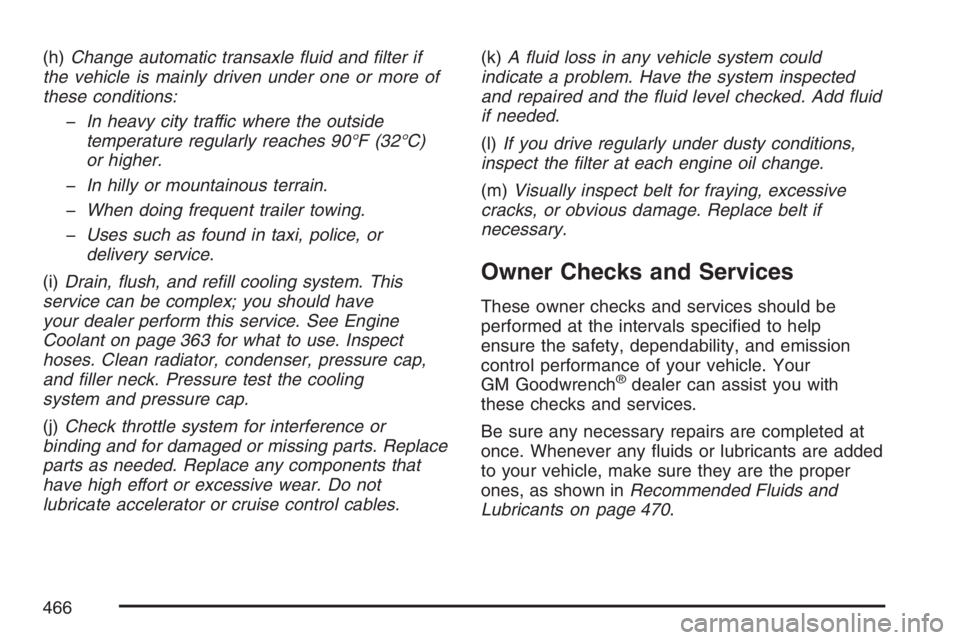
(h)Change automatic transaxle uid and lter if
the vehicle is mainly driven under one or more of
these conditions:
In heavy city traffic where the outside
temperature regularly reaches 90°F (32°C)
or higher.
In hilly or mountainous terrain.
When doing frequent trailer towing.
Uses such as found in taxi, police, or
delivery service.
(i)Drain, ush, and rell cooling system. This
service can be complex; you should have
your dealer perform this service. See Engine
Coolant on page 363 for what to use. Inspect
hoses. Clean radiator, condenser, pressure cap,
and ller neck. Pressure test the cooling
system and pressure cap.
(j)Check throttle system for interference or
binding and for damaged or missing parts. Replace
parts as needed. Replace any components that
have high effort or excessive wear. Do not
lubricate accelerator or cruise control cables.(k)A uid loss in any vehicle system could
indicate a problem. Have the system inspected
and repaired and the uid level checked. Add uid
if needed.
(l)If you drive regularly under dusty conditions,
inspect the lter at each engine oil change.
(m)Visually inspect belt for fraying, excessive
cracks, or obvious damage. Replace belt if
necessary.
Owner Checks and Services
These owner checks and services should be
performed at the intervals specied to help
ensure the safety, dependability, and emission
control performance of your vehicle. Your
GM Goodwrench
®dealer can assist you with
these checks and services.
Be sure any necessary repairs are completed at
once. Whenever any uids or lubricants are added
to your vehicle, make sure they are the proper
ones, as shown inRecommended Fluids and
Lubricants on page 470.
466
Page 472 of 512
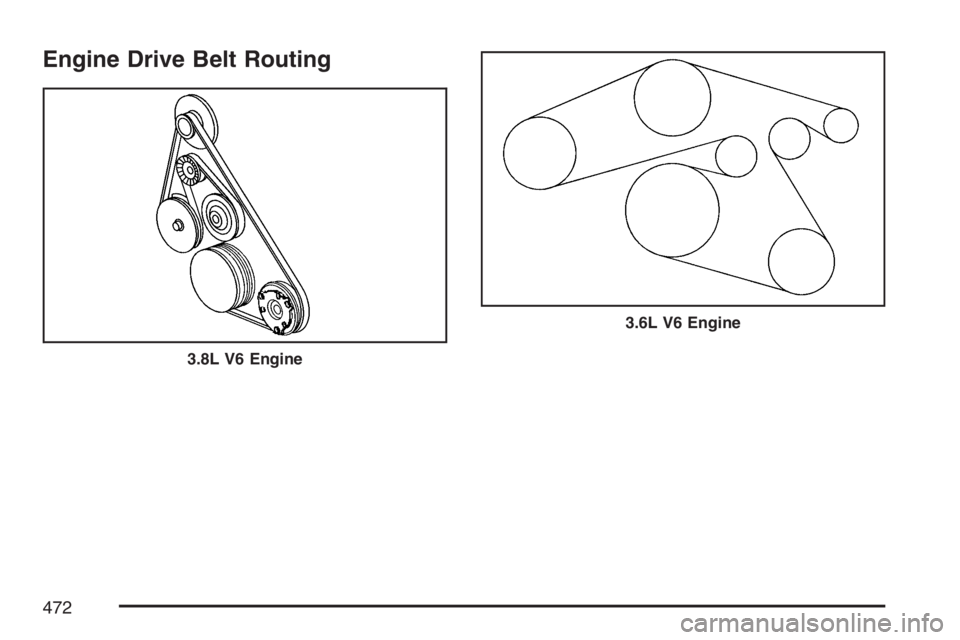
Engine Drive Belt Routing
3.8L V6 Engine
3.6L V6 Engine
472
Page 489 of 512
Additional Program Information
All program options, such as shuttle service, may
not be available at every dealer. Please contact
your dealer for specic information about
availability. All Courtesy Transportation
arrangements will be administered by appropriate
dealer personnel.
General Motors reserves the right to unilaterally
modify, change or discontinue Courtesy
Transportation at any time and to resolve all
questions of claim eligibility pursuant to the terms
and conditions described herein at its sole
discretion.
Vehicle Data Collection and Event
Data Recorders
Your vehicle, like other modern motor vehicles, has
a number of sophisticated computer systems that
monitor and control several aspects of the vehicle’s
performance. Your vehicle uses on-board vehicle
computers to monitor emission control components
to optimize fuel economy, to monitor conditions for
airbag deployment and, if so equipped, to provide
anti-lock braking and to help the driver control the
vehicle in difficult driving situations.Some information may be stored during regular
operations to facilitate repair of detected
malfunctions; other information is stored only in a
crash event by computer systems, such as those
commonly called Event Data Recorders (EDR).
In a crash event, computer systems, such as the
airbag Sensing and Diagnostic Module (SDM)
in your vehicle may record information about the
condition of the vehicle and how it was operated,
such as data related to engine speed, brake
application, throttle position, vehicle speed, safety
belt usage, airbag readiness, airbag performance,
and the severity of a collision. If your vehicle is
equipped with StabiliTrak
®, steering performance,
including yaw rate, steering wheel angle, and
lateral acceleration, is also recorded. This
information has been used to improve vehicle
crash performance and may be used to improve
crash performance of future vehicles and
driving safety. Unlike the data recorders on many
airplanes, these on-board systems do not
record sounds, such as conversation of vehicle
occupants.
489
Page 497 of 512
A
Accessories and Modications..................... 341
Accessory Power Outlet(s).......................... 167
Adding Equipment to Your Airbag-Equipped
Vehicle....................................................... 81
Additives, Fuel............................................ 344
Add-On Electrical Equipment....................... 449
Air Cleaner/Filter, Engine............................. 358
Air Conditioning..................................168, 172
Airbag
Passenger Status Indicator....................... 183
Readiness Light....................................... 182
Airbag Sensing and Diagnostic
Module (SDM).......................................... 489
Airbag System............................................... 66
Adding Equipment to Your
Airbag-Equipped Vehicle......................... 81
How Does an Airbag Restrain?.................. 73
Passenger Sensing System....................... 75
Servicing Your Airbag-Equipped Vehicle..... 80
What Makes an Airbag Inate?.................. 73
What Will You See After an Airbag
Inates?................................................. 74
When Should an Airbag Inate?................. 71
Where Are the Airbags?............................. 68Antenna, Backglass..................................... 283
Antenna, XM™ Satellite Radio
Antenna System....................................... 284
Anti-Lock Brake System (ABS).................... 291
Anti-Lock Brake, System Warning Light....... 187
Appearance Care
Aluminum or Chrome-Plated Wheels........ 444
Care of Safety Belts................................ 442
Chemical Paint Spotting........................... 446
Cleaning Exterior Lamps/Lenses.............. 443
Cleaning the Inside of Your Vehicle.......... 438
Fabric/Carpet........................................... 440
Finish Care.............................................. 443
Finish Damage......................................... 446
Instrument Panel, Vinyl, and Other
Plastic Surfaces.................................... 441
Leather.................................................... 441
Sheet Metal Damage............................... 445
Tires........................................................ 445
Underbody Maintenance........................... 446
Vehicle Care/Appearance Materials.......... 447
Washing Your Vehicle .............................. 442
Weatherstrips........................................... 442
Windshield and Wiper Blades................... 444
Ashtray(s).................................................... 168
497