5-12 BUICK LACROSSE 2008 User Guide
[x] Cancel search | Manufacturer: BUICK, Model Year: 2008, Model line: LACROSSE, Model: BUICK LACROSSE 2008Pages: 440
Page 300 of 440
Pressure Cap
Notice:If the pressure cap is not tightly installed,
coolant loss and possible engine damage may
occur. Be sure the cap is properly and tightly
secured.
SeeEngine Compartment Overview on page 5-12for
more information on location.
Engine Overheating
There is a coolant temperature gage and a warning light
on the instrument panel cluster that indicate an
overheated engine condition. SeeEngine Coolant
Temperature Gage on page 3-40andEngine Coolant
Temperature Warning Light on page 3-40for more
information.
In addition, if your vehicle is equipped with a Driver
Information Center (DIC), you will nd an ENGINE
COOLANT HOT and a REDUCED POWER STOP
WHEN SAFE message displayed on the DIC. SeeDIC
Warnings and Messages on page 3-58for more
information.
5-30
Page 310 of 440
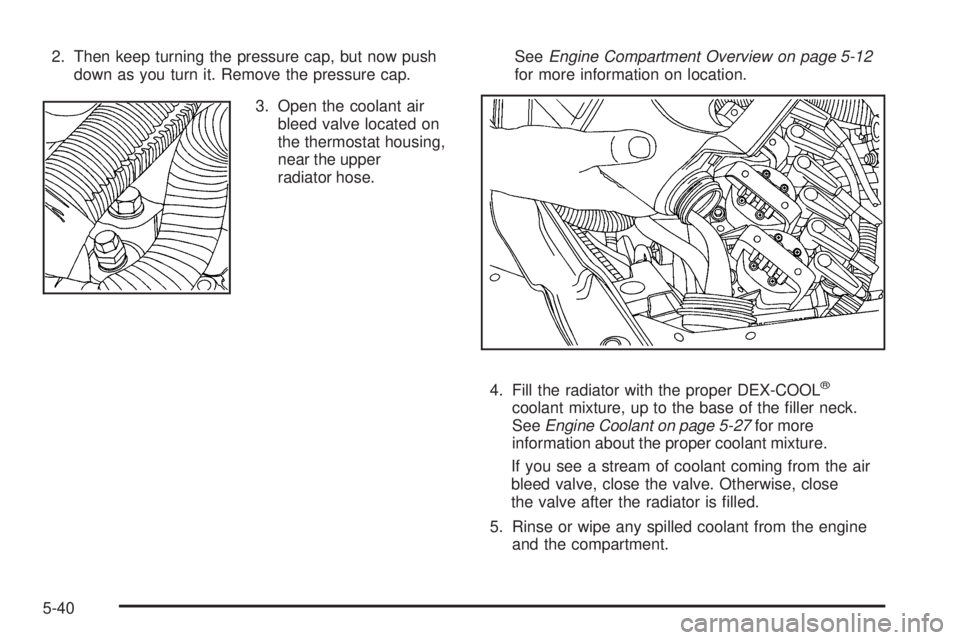
2. Then keep turning the pressure cap, but now push
down as you turn it. Remove the pressure cap.
3. Open the coolant air
bleed valve located on
the thermostat housing,
near the upper
radiator hose.SeeEngine Compartment Overview on page 5-12
for more information on location.
4. Fill the radiator with the proper DEX-COOL
®
coolant mixture, up to the base of the ller neck.
SeeEngine Coolant on page 5-27for more
information about the proper coolant mixture.
If you see a stream of coolant coming from the air
bleed valve, close the valve. Otherwise, close
the valve after the radiator is lled.
5. Rinse or wipe any spilled coolant from the engine
and the compartment.
5-40
Page 313 of 440
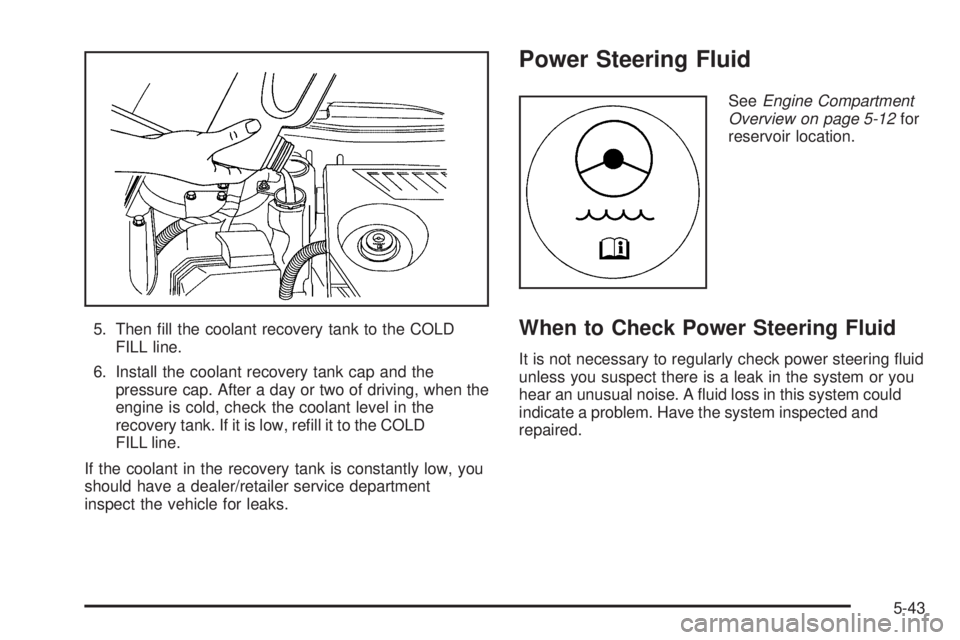
5. Then ll the coolant recovery tank to the COLD
FILL line.
6. Install the coolant recovery tank cap and the
pressure cap. After a day or two of driving, when the
engine is cold, check the coolant level in the
recovery tank. If it is low, rell it to the COLD
FILL line.
If the coolant in the recovery tank is constantly low, you
should have a dealer/retailer service department
inspect the vehicle for leaks.
Power Steering Fluid
SeeEngine Compartment
Overview on page 5-12for
reservoir location.
When to Check Power Steering Fluid
It is not necessary to regularly check power steering uid
unless you suspect there is a leak in the system or you
hear an unusual noise. A uid loss in this system could
indicate a problem. Have the system inspected and
repaired.
5-43
Page 315 of 440
Adding Washer Fluid
When the windshield washer uid is low, a low washer
uid light may appear on the instrument panel cluster.
SeeLow Washer Fluid Warning Light on page 3-47
for more information.
In addition, if your vehicle has a Driver Information
Center (DIC), the LOW WASHER FLUID message will
display when the uid level is low. SeeDIC Warnings
and Messages on page 3-58for more information.
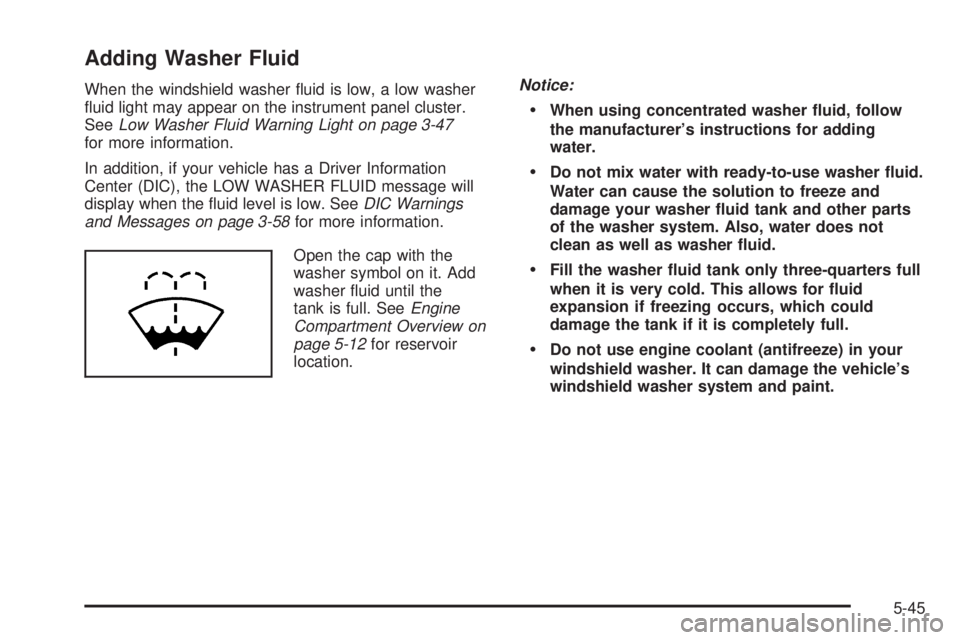
Open the cap with the
washer symbol on it. Add
washer uid until the
tank is full. SeeEngine
Compartment Overview on
page 5-12for reservoir
location.Notice:
When using concentrated washer uid, follow
the manufacturer’s instructions for adding
water.
Do not mix water with ready-to-use washer uid.
Water can cause the solution to freeze and
damage your washer uid tank and other parts
of the washer system. Also, water does not
clean as well as washer uid.
Fill the washer uid tank only three-quarters full
when it is very cold. This allows for uid
expansion if freezing occurs, which could
damage the tank if it is completely full.
Do not use engine coolant (antifreeze) in your
windshield washer. It can damage the vehicle’s
windshield washer system and paint.
5-45
Page 316 of 440
Brakes
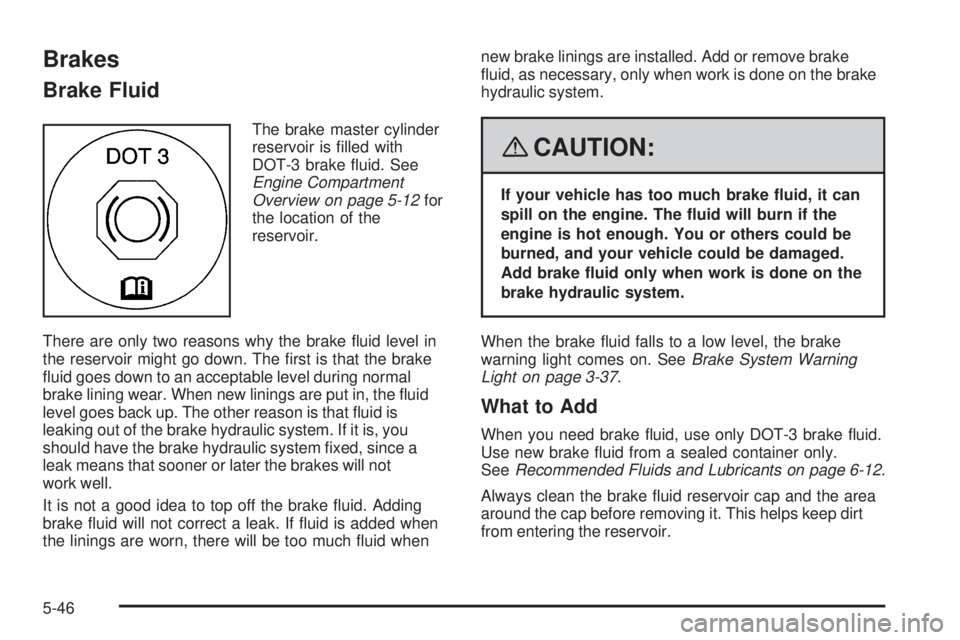
Brake Fluid
The brake master cylinder
reservoir is lled with
DOT-3 brake uid. See
Engine Compartment
Overview on page 5-12for
the location of the
reservoir.
There are only two reasons why the brake uid level in
the reservoir might go down. The rst is that the brake
uid goes down to an acceptable level during normal
brake lining wear. When new linings are put in, the uid
level goes back up. The other reason is that uid is
leaking out of the brake hydraulic system. If it is, you
should have the brake hydraulic system xed, since a
leak means that sooner or later the brakes will not
work well.
It is not a good idea to top off the brake uid. Adding
brake uid will not correct a leak. If uid is added when
the linings are worn, there will be too much uid whennew brake linings are installed. Add or remove brake
uid, as necessary, only when work is done on the brake
hydraulic system.
{CAUTION:
If your vehicle has too much brake uid, it can
spill on the engine. The uid will burn if the
engine is hot enough. You or others could be
burned, and your vehicle could be damaged.
Add brake uid only when work is done on the
brake hydraulic system.
When the brake uid falls to a low level, the brake
warning light comes on. SeeBrake System Warning
Light on page 3-37.
What to Add
When you need brake uid, use only DOT-3 brake uid.
Use new brake uid from a sealed container only.
SeeRecommended Fluids and Lubricants on page 6-12.
Always clean the brake uid reservoir cap and the area
around the cap before removing it. This helps keep dirt
from entering the reservoir.
5-46
Page 319 of 440
Battery
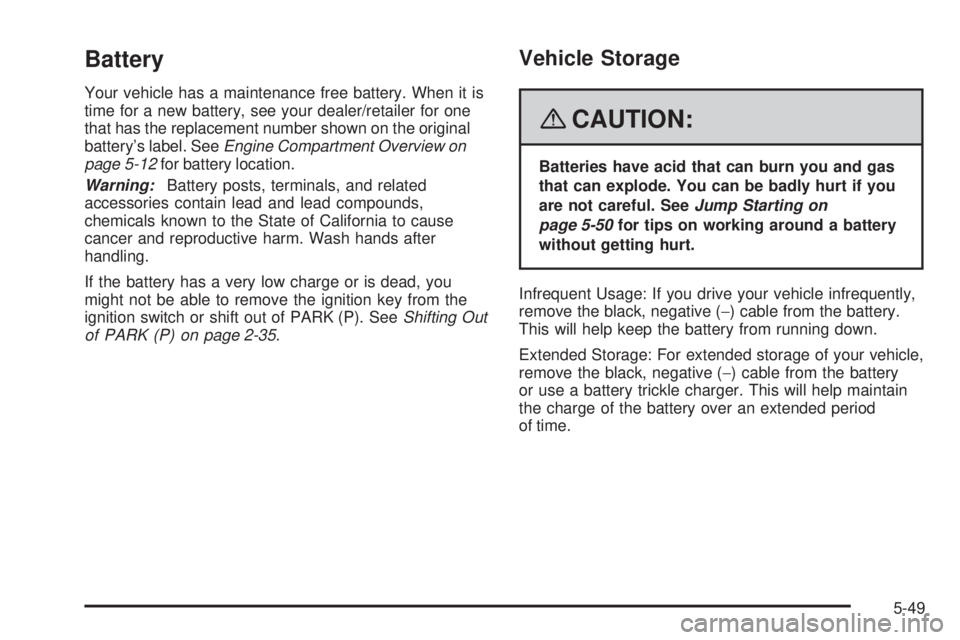
Your vehicle has a maintenance free battery. When it is
time for a new battery, see your dealer/retailer for one
that has the replacement number shown on the original
battery’s label. SeeEngine Compartment Overview on
page 5-12for battery location.
Warning:Battery posts, terminals, and related
accessories contain lead and lead compounds,
chemicals known to the State of California to cause
cancer and reproductive harm. Wash hands after
handling.
If the battery has a very low charge or is dead, you
might not be able to remove the ignition key from the
ignition switch or shift out of PARK (P). SeeShifting Out
of PARK (P) on page 2-35.
Vehicle Storage
{CAUTION:
Batteries have acid that can burn you and gas
that can explode. You can be badly hurt if you
are not careful. SeeJump Starting on
page 5-50for tips on working around a battery
without getting hurt.
Infrequent Usage: If you drive your vehicle infrequently,
remove the black, negative (−) cable from the battery.
This will help keep the battery from running down.
Extended Storage: For extended storage of your vehicle,
remove the black, negative (−) cable from the battery
or use a battery trickle charger. This will help maintain
the charge of the battery over an extended period
of time.
5-49
Page 321 of 440
Notice:If you leave your radio or other accessories
on during the jump starting procedure, they could
be damaged. The repairs would not be covered by
your warranty. Always turn off your radio and other
accessories when jump starting your vehicle.
3. Turn off the ignition on both vehicles. Unplug
unnecessary accessories plugged into the cigarette
lighter or the accessory power outlets. Turn off the
radio and all lamps that are not needed. This will
avoid sparks and help save both batteries. And it
could save the radio!
4. Open the hood on the other vehicle and locate the
positive (+) and negative (−) terminal locations on
that vehicle.
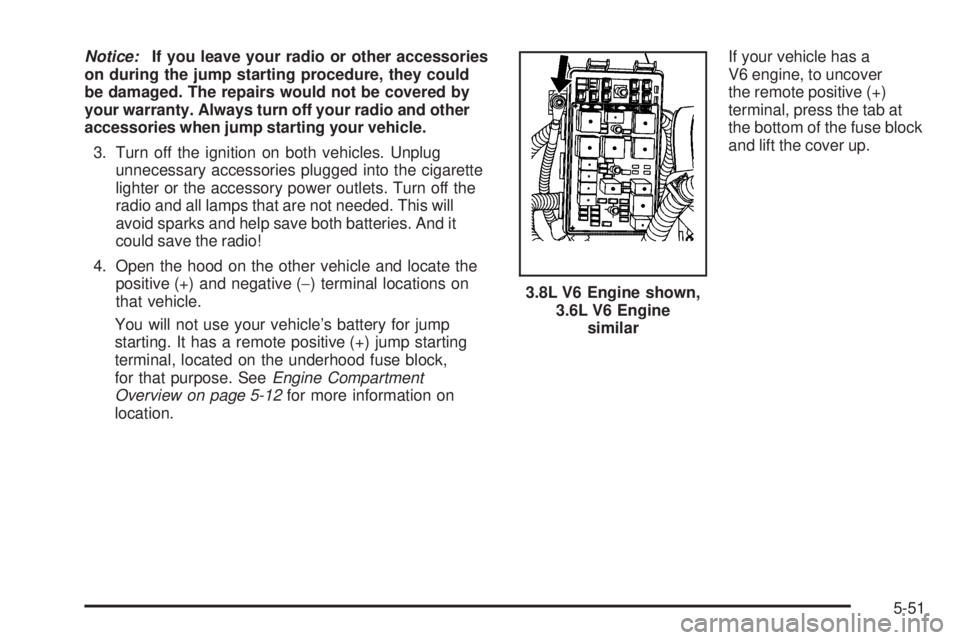
You will not use your vehicle’s battery for jump
starting. It has a remote positive (+) jump starting
terminal, located on the underhood fuse block,
for that purpose. SeeEngine Compartment
Overview on page 5-12for more information on
location.If your vehicle has a
V6 engine, to uncover
the remote positive (+)
terminal, press the tab at
the bottom of the fuse block
and lift the cover up.
3.8L V6 Engine shown,
3.6L V6 Engine
similar
5-51
Page 382 of 440
Underhood Fuse Block
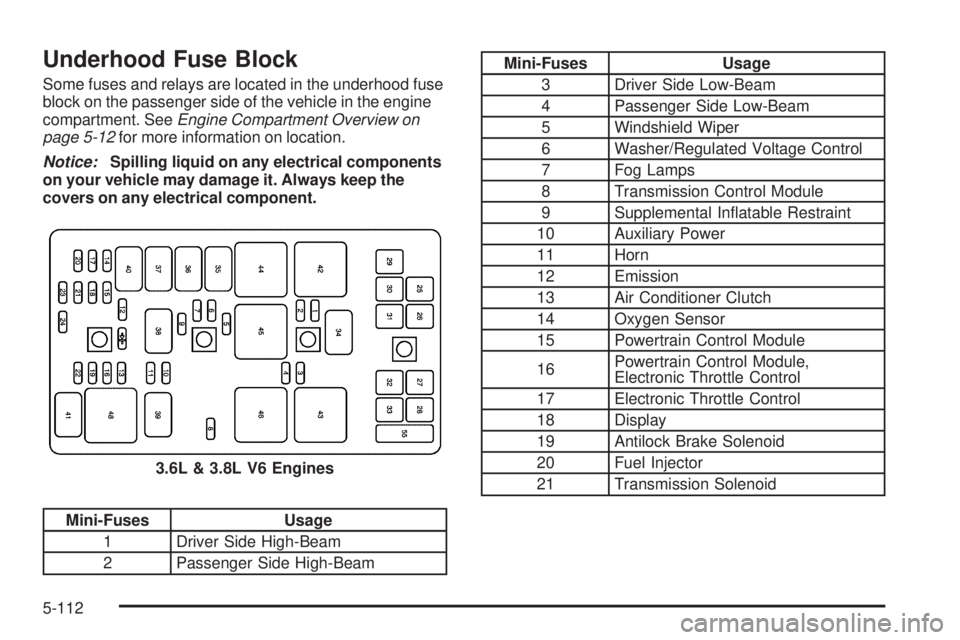
Some fuses and relays are located in the underhood fuse
block on the passenger side of the vehicle in the engine
compartment. SeeEngine Compartment Overview on
page 5-12for more information on location.
Notice:Spilling liquid on any electrical components
on your vehicle may damage it. Always keep the
covers on any electrical component.
Mini-Fuses Usage
1 Driver Side High-Beam
2 Passenger Side High-Beam
Mini-Fuses Usage
3 Driver Side Low-Beam
4 Passenger Side Low-Beam
5 Windshield Wiper
6 Washer/Regulated Voltage Control
7 Fog Lamps
8 Transmission Control Module
9 Supplemental Inatable Restraint
10 Auxiliary Power
11 Horn
12 Emission
13 Air Conditioner Clutch
14 Oxygen Sensor
15 Powertrain Control Module
16Powertrain Control Module,
Electronic Throttle Control
17 Electronic Throttle Control
18 Display
19 Antilock Brake Solenoid
20 Fuel Injector
21 Transmission Solenoid 3.6L & 3.8L V6 Engines
5-112
Page 431 of 440
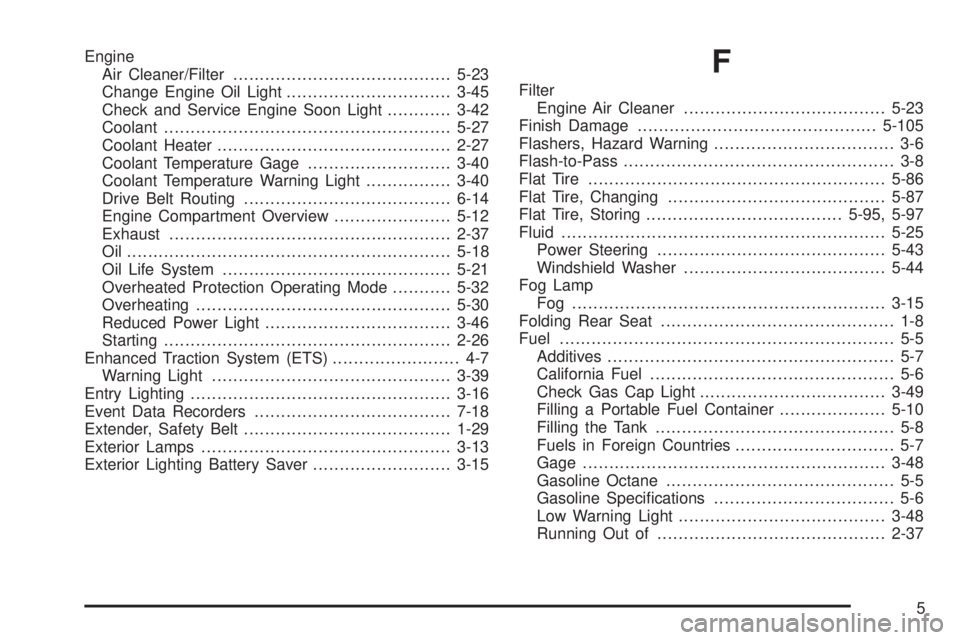
Engine
Air Cleaner/Filter.........................................5-23
Change Engine Oil Light...............................3-45
Check and Service Engine Soon Light............3-42
Coolant......................................................5-27
Coolant Heater............................................2-27
Coolant Temperature Gage...........................3-40
Coolant Temperature Warning Light................3-40
Drive Belt Routing.......................................6-14
Engine Compartment Overview......................5-12
Exhaust.....................................................2-37
Oil .............................................................5-18
Oil Life System...........................................5-21
Overheated Protection Operating Mode...........5-32
Overheating................................................5-30
Reduced Power Light...................................3-46
Starting......................................................2-26
Enhanced Traction System (ETS)........................ 4-7
Warning Light.............................................3-39
Entry Lighting.................................................3-16
Event Data Recorders.....................................7-18
Extender, Safety Belt.......................................1-29
Exterior Lamps...............................................3-13
Exterior Lighting Battery Saver..........................3-15F
Filter
Engine Air Cleaner......................................5-23
Finish Damage.............................................5-105
Flashers, Hazard Warning.................................. 3-6
Flash-to-Pass................................................... 3-8
Flat Tire........................................................5-86
Flat Tire, Changing.........................................5-87
Flat Tire, Storing.....................................5-95, 5-97
Fluid.............................................................5-25
Power Steering...........................................5-43
Windshield Washer......................................5-44
Fog Lamp
Fog ...........................................................3-15
Folding Rear Seat............................................ 1-8
Fuel............................................................... 5-5
Additives...................................................... 5-7
California Fuel.............................................. 5-6
Check Gas Cap Light...................................3-49
Filling a Portable Fuel Container....................5-10
Filling the Tank............................................. 5-8
Fuels in Foreign Countries.............................. 5-7
Gage.........................................................3-48
Gasoline Octane........................................... 5-5
Gasoline Specications.................................. 5-6
Low Warning Light.......................................3-48
Running Out of...........................................2-37
5