fuel cap BUICK LACROSSE 2010 User Guide
[x] Cancel search | Manufacturer: BUICK, Model Year: 2010, Model line: LACROSSE, Model: BUICK LACROSSE 2010Pages: 414
Page 336 of 414
9-54 Vehicle Care
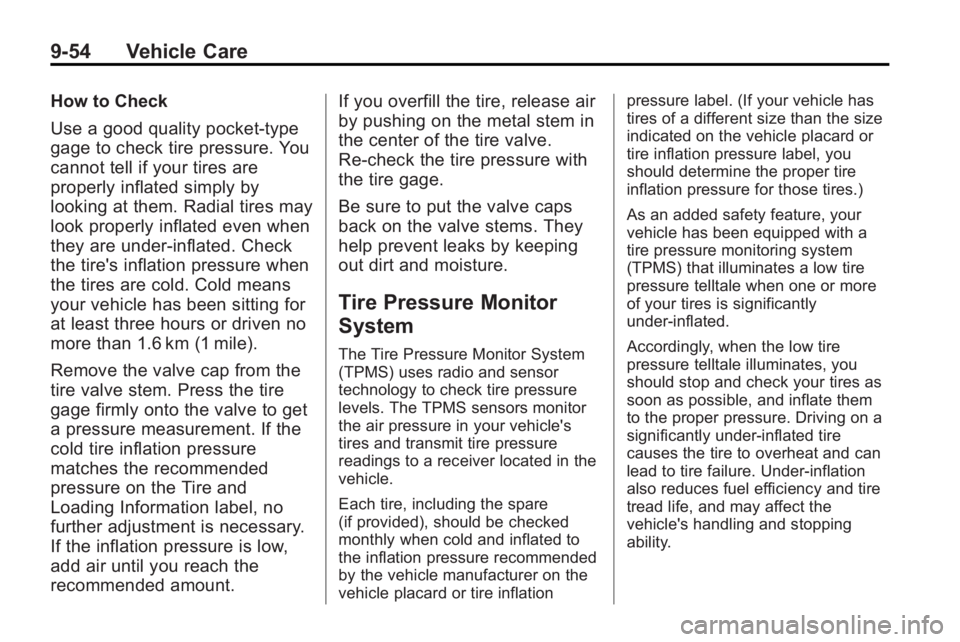
How to Check
Use a good quality pocket-type
gage to check tire pressure. You
cannot tell if your tires are
properly inflated simply by
looking at them. Radial tires may
look properly inflated even when
they are under-inflated. Check
the tire's inflation pressure when
the tires are cold. Cold means
your vehicle has been sitting for
at least three hours or driven no
more than 1.6 km (1 mile).
Remove the valve cap from the
tire valve stem. Press the tire
gage firmly onto the valve to get
a pressure measurement. If the
cold tire inflation pressure
matches the recommended
pressure on the Tire and
Loading Information label, no
further adjustment is necessary.
If the inflation pressure is low,
add air until you reach the
recommended amount.If you overfill the tire, release air
by pushing on the metal stem in
the center of the tire valve.
Re-check the tire pressure with
the tire gage.
Be sure to put the valve caps
back on the valve stems. They
help prevent leaks by keeping
out dirt and moisture.
Tire Pressure Monitor
System
The Tire Pressure Monitor System
(TPMS) uses radio and sensor
technology to check tire pressure
levels. The TPMS sensors monitor
the air pressure in your vehicle's
tires and transmit tire pressure
readings to a receiver located in the
vehicle.
Each tire, including the spare
(if provided), should be checked
monthly when cold and inflated to
the inflation pressure recommended
by the vehicle manufacturer on the
vehicle placard or tire inflation pressure label. (If your vehicle has
tires of a different size than the size
indicated on the vehicle placard or
tire inflation pressure label, you
should determine the proper tire
inflation pressure for those tires.)
As an added safety feature, your
vehicle has been equipped with a
tire pressure monitoring system
(TPMS) that illuminates a low tire
pressure telltale when one or more
of your tires is significantly
under-inflated.
Accordingly, when the low tire
pressure telltale illuminates, you
should stop and check your tires as
soon as possible, and inflate them
to the proper pressure. Driving on a
significantly under-inflated tire
causes the tire to overheat and can
lead to tire failure. Under-inflation
also reduces fuel efficiency and tire
tread life, and may affect the
vehicle's handling and stopping
ability.
Page 375 of 414
Service and Maintenance 10-5
.SeeIgnition Transmission Lock
Check on page 9‑28.
.See Park Brake and P (Park)
Mechanism Checkon
page 9‑28.
.Engine cooling system and
pressure cap pressure check.
Radiator and air conditioning
condenser outside cleaning.
See Cooling System
on
page 9‑17.
.Exhaust system and nearby heat
shields inspection for loose or
damaged components.
.Accelerator pedal check for
damage, high effort, or binding.
Replace if needed.
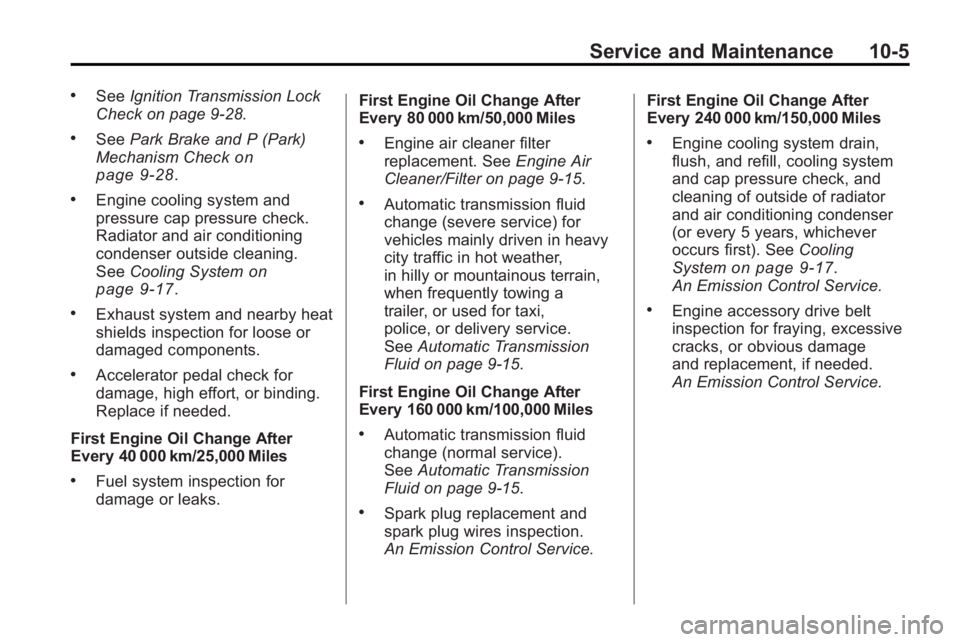
First Engine Oil Change After
Every 40 000 km/25,000 Miles
.Fuel system inspection for
damage or leaks. First Engine Oil Change After
Every 80 000 km/50,000 Miles
.Engine air cleaner filter
replacement. See
Engine Air
Cleaner/Filter on page 9‑15.
.Automatic transmission fluid
change (severe service) for
vehicles mainly driven in heavy
city traffic in hot weather,
in hilly or mountainous terrain,
when frequently towing a
trailer, or used for taxi,
police, or delivery service.
See Automatic Transmission
Fluid on page 9‑15.
First Engine Oil Change After
Every 160 000 km/100,000 Miles
.Automatic transmission fluid
change (normal service).
See Automatic Transmission
Fluid on page 9‑15.
.Spark plug replacement and
spark plug wires inspection.
An Emission Control Service. First Engine Oil Change After
Every 240 000 km/150,000 Miles
.Engine cooling system drain,
flush, and refill, cooling system
and cap pressure check, and
cleaning of outside of radiator
and air conditioning condenser
(or every 5 years, whichever
occurs first). See
Cooling
System
on page 9‑17.
An Emission Control Service.
.Engine accessory drive belt
inspection for fraying, excessive
cracks, or obvious damage
and replacement, if needed.
An Emission Control Service.
Page 385 of 414

Technical Data 11-3
ApplicationCapacities
Metric English
Fuel Tank
AWD 74.0 L 19.5 gal
FWD 70.5 L 18.6 gal
Transmission Fluid* (Drain and Refill)
2.4L L4 Engine, 6–Speed Automatic 8.0 L 8.5 qt
3.0L V6 Engine, All Wheel Drive, 6–Speed Automatic 9.0 L 9.5 qt
3.0L V6 Engine, Front Wheel Drive, 6–Speed Automatic 9.0 L 9.5 qt
3.6L V6 Engine, 6–Speed Automatic 9.0 L 9.5 qt
Wheel Nut Torque 150 Y110 ft lb
*See Automatic Transmission Fluid
on page 9‑15for information on checking fluid level.
All capacities are approximate. When adding, be sure to fill to the approximate level, as recommended in this
manual. Recheck fluid level after filling.
Page 404 of 414
i-2 INDEX
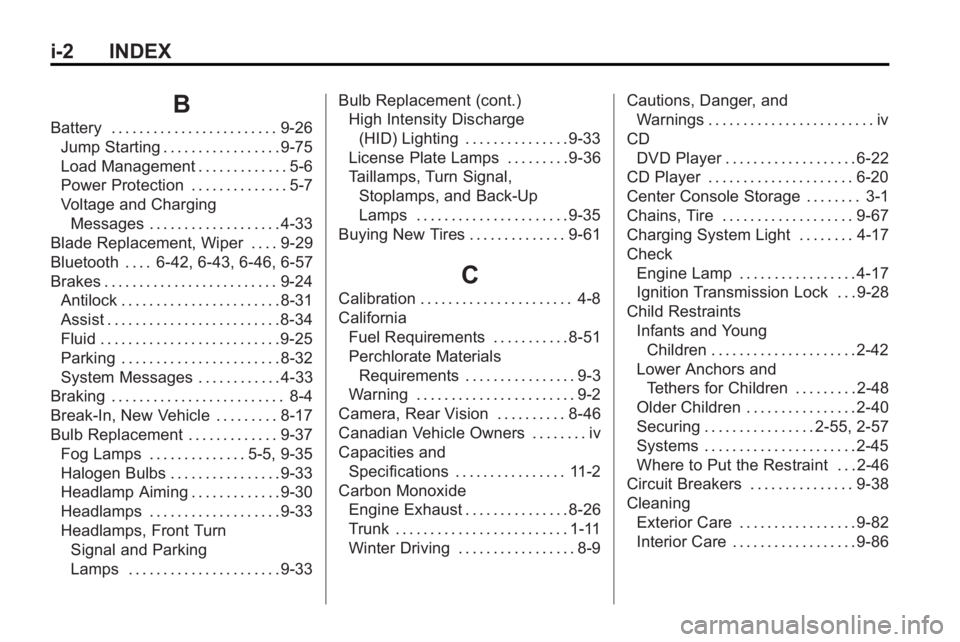
B
Battery . . . . . . . . . . . . . . . . . . . . . . . . 9-26Jump Starting . . . . . . . . . . . . . . . . . 9-75
Load Management . . . . . . . . . . . . . 5-6
Power Protection . . . . . . . . . . . . . . 5-7
Voltage and ChargingMessages . . . . . . . . . . . . . . . . . . . 4-33
Blade Replacement, Wiper . . . . 9-29
Bluetooth . . . . 6-42, 6-43, 6-46, 6-57
Brakes . . . . . . . . . . . . . . . . . . . . . . . . . 9-24 Antilock . . . . . . . . . . . . . . . . . . . . . . . 8-31
Assist . . . . . . . . . . . . . . . . . . . . . . . . . 8-34
Fluid . . . . . . . . . . . . . . . . . . . . . . . . . . 9-25
Parking . . . . . . . . . . . . . . . . . . . . . . . 8-32
System Messages . . . . . . . . . . . . 4-33
Braking . . . . . . . . . . . . . . . . . . . . . . . . . 8-4
Break-In, New Vehicle . . . . . . . . . 8-17
Bulb Replacement . . . . . . . . . . . . . 9-37
Fog Lamps . . . . . . . . . . . . . . 5-5, 9-35
Halogen Bulbs . . . . . . . . . . . . . . . . 9-33
Headlamp Aiming . . . . . . . . . . . . . 9-30
Headlamps . . . . . . . . . . . . . . . . . . . 9-33
Headlamps, Front TurnSignal and Parking
Lamps . . . . . . . . . . . . . . . . . . . . . . 9-33 Bulb Replacement (cont.)
High Intensity Discharge
(HID) Lighting . . . . . . . . . . . . . . . 9-33
License Plate Lamps . . . . . . . . . 9-36
Taillamps, Turn Signal,
Stoplamps, and Back-Up
Lamps . . . . . . . . . . . . . . . . . . . . . . 9-35
Buying New Tires . . . . . . . . . . . . . . 9-61
C
Calibration . . . . . . . . . . . . . . . . . . . . . . 4-8
California Fuel Requirements . . . . . . . . . . . 8-51
Perchlorate MaterialsRequirements . . . . . . . . . . . . . . . . 9-3
Warning . . . . . . . . . . . . . . . . . . . . . . . 9-2
Camera, Rear Vision . . . . . . . . . . 8-46
Canadian Vehicle Owners . . . . . . . . iv
Capacities and Specifications . . . . . . . . . . . . . . . . 11-2
Carbon Monoxide Engine Exhaust . . . . . . . . . . . . . . . 8-26
Trunk . . . . . . . . . . . . . . . . . . . . . . . . . 1-11
Winter Driving . . . . . . . . . . . . . . . . . 8-9 Cautions, Danger, and
Warnings . . . . . . . . . . . . . . . . . . . . . . . . iv
CD DVD Player . . . . . . . . . . . . . . . . . . . 6-22
CD Player . . . . . . . . . . . . . . . . . . . . . 6-20
Center Console Storage . . . . . . . . 3-1
Chains, Tire . . . . . . . . . . . . . . . . . . . 9-67
Charging System Light . . . . . . . . 4-17
Check Engine Lamp . . . . . . . . . . . . . . . . . 4-17
Ignition Transmission Lock . . . 9-28
Child Restraints Infants and YoungChildren . . . . . . . . . . . . . . . . . . . . . 2-42
Lower Anchors and Tethers for Children . . . . . . . . . 2-48
Older Children . . . . . . . . . . . . . . . . 2-40
Securing . . . . . . . . . . . . . . . . 2-55, 2-57
Systems . . . . . . . . . . . . . . . . . . . . . . 2-45
Where to Put the Restraint . . . 2-46
Circuit Breakers . . . . . . . . . . . . . . . 9-38
Cleaning
Exterior Care . . . . . . . . . . . . . . . . . 9-82
Interior Care . . . . . . . . . . . . . . . . . . 9-86