tow BUICK LACROSSE 2011 Service Manual
[x] Cancel search | Manufacturer: BUICK, Model Year: 2011, Model line: LACROSSE, Model: BUICK LACROSSE 2011Pages: 462, PDF Size: 5.73 MB
Page 328 of 462
Black plate (16,1)Buick LaCrosse Owner Manual - 2011
10-16 Vehicle Care
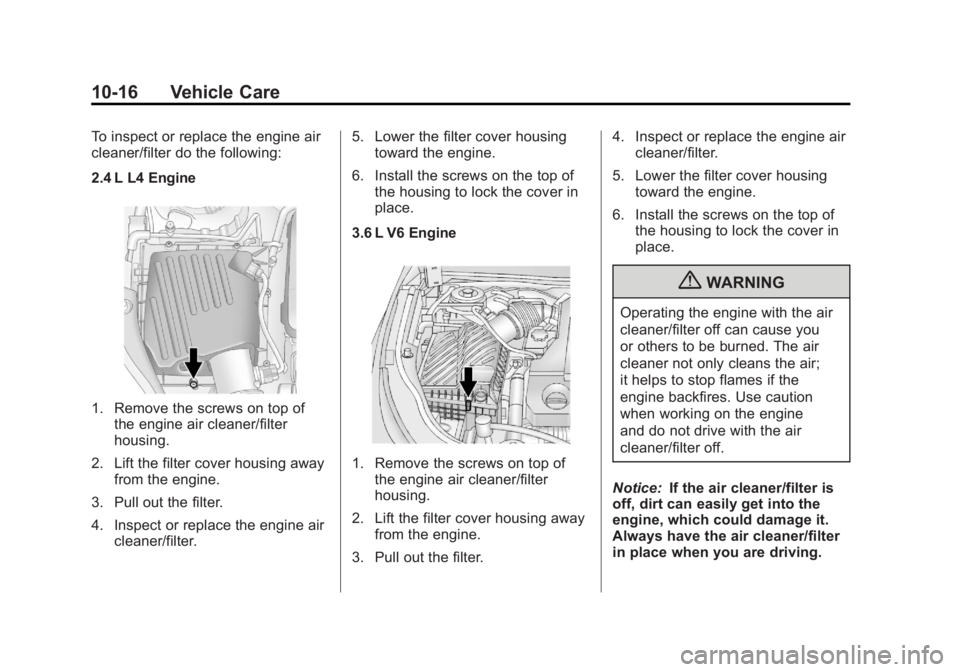
To inspect or replace the engine air
cleaner/filter do the following:
2.4 L L4 Engine
1. Remove the screws on top ofthe engine air cleaner/filter
housing.
2. Lift the filter cover housing away from the engine.
3. Pull out the filter.
4. Inspect or replace the engine air cleaner/filter. 5. Lower the filter cover housing
toward the engine.
6. Install the screws on the top of the housing to lock the cover in
place.
3.6 L V6 Engine
1. Remove the screws on top of the engine air cleaner/filter
housing.
2. Lift the filter cover housing away from the engine.
3. Pull out the filter. 4. Inspect or replace the engine air
cleaner/filter.
5. Lower the filter cover housing toward the engine.
6. Install the screws on the top of the housing to lock the cover in
place.
{WARNING
Operating the engine with the air
cleaner/filter off can cause you
or others to be burned. The air
cleaner not only cleans the air;
it helps to stop flames if the
engine backfires. Use caution
when working on the engine
and do not drive with the air
cleaner/filter off.
Notice: If the air cleaner/filter is
off, dirt can easily get into the
engine, which could damage it.
Always have the air cleaner/filter
in place when you are driving.
Page 334 of 462
Black plate (22,1)Buick LaCrosse Owner Manual - 2011
10-22 Vehicle Care
If No Steam is Coming from
the Engine Compartment
If an engine overheat warning is
displayed but no steam can be seen
or heard, the problem might not be
too serious. Sometimes the engine
can get a little too hot when the
vehicle:
.Climbs a long hill on a hot day
.Stops after high-speed driving
.Idles for long periods in traffic
.Tows a trailer
If the overheat warning displays with
no sign of steam:
1. Turn the air conditioning off.
2. Turn the heater on to the highest temperature and to the highest
fan speed. Open the windows
as necessary. 3. In heavy traffic, let the engine
idle in N (Neutral) while stopped.
If it is safe to do so, pull off
the road, shift to P (Park)
or N (Neutral) and let the
engine idle.
If the temperature overheat gauge
is no longer in the overheat zone
or an overheat warning no longer
displays, the vehicle can be driven.
Continue to drive the vehicle slowly
for about 10 minutes. Keep a safe
vehicle distance from the vehicle in
front. If the warning does not come
back on, continue to drive normally.
If the warning continues, pull
over, stop, and park the vehicle
right away.
If there is no sign of steam,
idle the engine for three minutes
while parked. If the warning is still
displayed, turn off the engine until it
cools down. Also, see Overheated
Engine Protection Operating Mode
on page 10‑22.
Overheated Engine
Protection
Operating Mode
This emergency operating mode
allows the vehicle to be driven
to a safe place in an emergency
situation. If an overheated engine
condition exists, an overheat
protection mode which alternates
firing groups of cylinders helps
prevent engine damage. In this
mode, there is significant loss in
power and engine performance.
The engine coolant temperature
warning light comes on the
instrument panel, to indicate the
vehicle has entered overheated
engine protection operating mode.
The temperature gauge also
indicates an overheat condition
exists. Driving extended km (mi)
and/or towing a trailer in the
overheat protection mode should
be avoided.
Page 342 of 462
Black plate (30,1)Buick LaCrosse Owner Manual - 2011
10-30 Vehicle Care
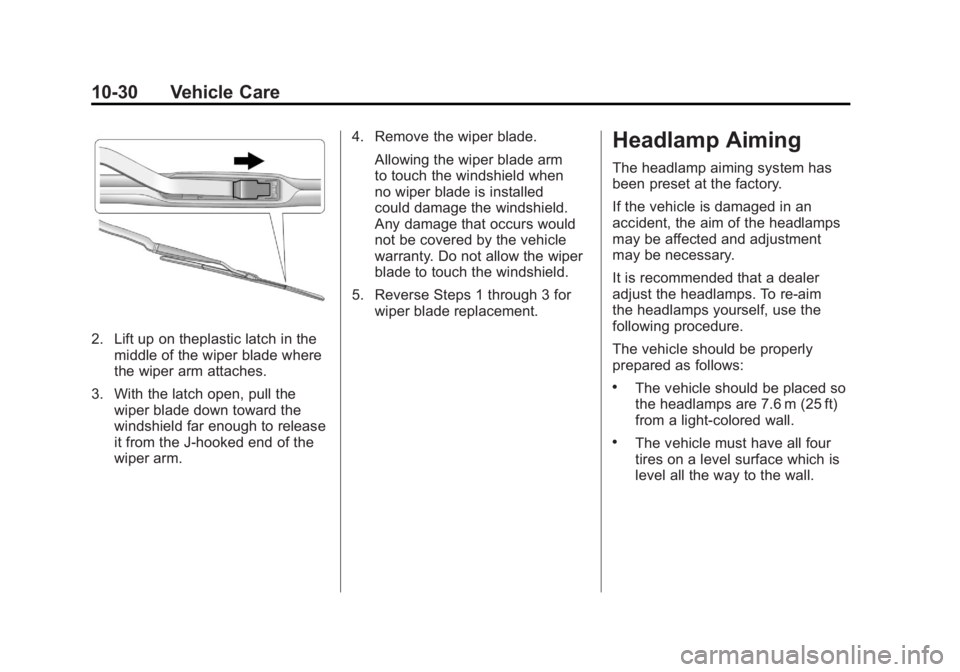
2. Lift up on theplastic latch in themiddle of the wiper blade where
the wiper arm attaches.
3. With the latch open, pull the wiper blade down toward the
windshield far enough to release
it from the J-hooked end of the
wiper arm. 4. Remove the wiper blade.
Allowing the wiper blade arm
to touch the windshield when
no wiper blade is installed
could damage the windshield.
Any damage that occurs would
not be covered by the vehicle
warranty. Do not allow the wiper
blade to touch the windshield.
5. Reverse Steps 1 through 3 for wiper blade replacement.
Headlamp Aiming
The headlamp aiming system has
been preset at the factory.
If the vehicle is damaged in an
accident, the aim of the headlamps
may be affected and adjustment
may be necessary.
It is recommended that a dealer
adjust the headlamps. To re-aim
the headlamps yourself, use the
following procedure.
The vehicle should be properly
prepared as follows:
.The vehicle should be placed so
the headlamps are 7.6 m (25 ft)
from a light‐colored wall.
.The vehicle must have all four
tires on a level surface which is
level all the way to the wall.
Page 354 of 462
Black plate (42,1)Buick LaCrosse Owner Manual - 2011
10-42 Vehicle Care
Mini Relays Usage7 Engine Control
Module
9 Cooling Fan
13 Cooling Fan
15 Run/Crank
17 Rear Window
Defogger
Micro
Relays Usage
2 Starter
4 Wiper Speed
5 Wiper Control
10 Cooling Fan
14 Headlamp
Low BeamInstrument Panel Fuse
Block
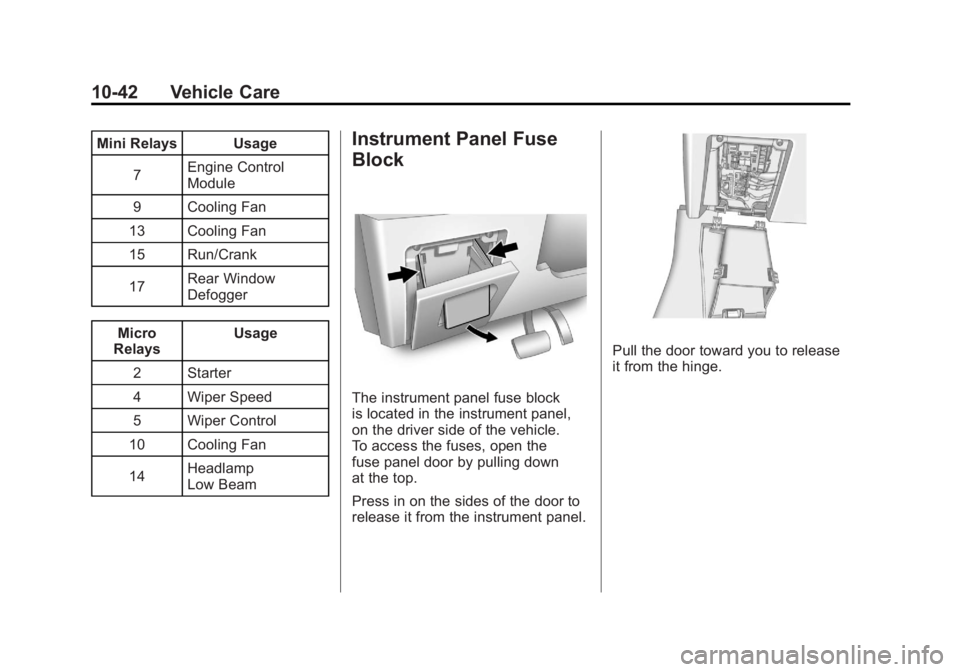
The instrument panel fuse block
is located in the instrument panel,
on the driver side of the vehicle.
To access the fuses, open the
fuse panel door by pulling down
at the top.
Press in on the sides of the door to
release it from the instrument panel.
Pull the door toward you to release
it from the hinge.
Page 374 of 462
Black plate (62,1)Buick LaCrosse Owner Manual - 2011
10-62 Vehicle Care
Do not include the compact
spare tire in the tire rotation.
After the tires have been
rotated, adjust the front and
rear inflation pressures as
shown on the Tire and Loading
Information label. SeeTire
Pressure on page 10‑54
and Vehicle Load Limits on
page 9‑12.
Reset the Tire Pressure Monitor
System. See Tire Pressure
Monitor Operation on
page 10‑57. Make certain that all wheel
nuts are properly tightened.
See
“Wheel Nut Torque” under
Capacities and Specifications on
page 12‑2.
{WARNING
Rust or dirt on a wheel, or on the
parts to which it is fastened, can
make wheel nuts become loose
after time. The wheel could come
off and cause an accident. When
changing a wheel, remove any
rust or dirt from places where the
wheel attaches to the vehicle.
In an emergency, use a cloth or
a paper towel to do this; but be
sure to use a scraper or wire
brush later, if needed, to get all
the rust or dirt off. See If a Tire
Goes Flat on page 10‑70.
Lightly coat the center of the
wheel hub with wheel bearing
grease after a wheel change
or tire rotation to prevent
corrosion or rust build-up.
Do not get grease on the flat
wheel mounting surface or
on the wheel nuts or bolts.
Page 382 of 462
Black plate (70,1)Buick LaCrosse Owner Manual - 2011
10-70 Vehicle Care
If a Tire Goes Flat
It is unusual for a tire to blowout,
especially if the tires are maintained
properly. See Tires. If air goes out
of a tire, it is much more likely to
leak out slowly. But if there is ever a
blowout, here are a few tips about
what to expect and what to do:
If a front tire fails, the flat tire
creates a drag that pulls the
vehicle toward that side. Take
your foot off the accelerator pedal
and grip the steering wheel firmly.
Steer to maintain lane position,
and then gently brake to a stop,
well off the road, if possible.
AA rear blowout, particularly on a
curve, acts much like a skid and
may require the same correction
as used in a skid. Stop pressingthe accelerator pedal and steer
to straighten the vehicle. It may
be very bumpy and noisy. Gently
brake to a stop, well off the road,
if possible.
{WARNING
Driving on a flat tire will cause
permanent damage to the tire.
Re-inflating a tire after it has
been driven on while severely
underinflated or flat may cause
a blowout and a serious crash.
Never attempt to re-inflate a tire
that has been driven on while
severely underinflated or flat.
Have your dealer or an authorized
tire service center repair or
replace the flat tire as soon
as possible.
{WARNING
Lifting a vehicle and getting
under it to do maintenance or
repairs is dangerous without the
appropriate safety equipment and
training. If a jack is provided with
the vehicle, it is designed only for
changing a flat tire. If it is used for
anything else, you or others could
be badly injured or killed if the
vehicle slips off the jack. If a jack
is provided with the vehicle, only
use it for changing a flat tire.
If a tire goes flat, avoid further tire
and wheel damage by driving slowly
to a level place, well off the road,
if possible. Turn on the hazard
warning flashers. See Hazard
Warning Flashers on page 6‑4.
Page 394 of 462
Black plate (82,1)Buick LaCrosse Owner Manual - 2011
10-82 Vehicle Care
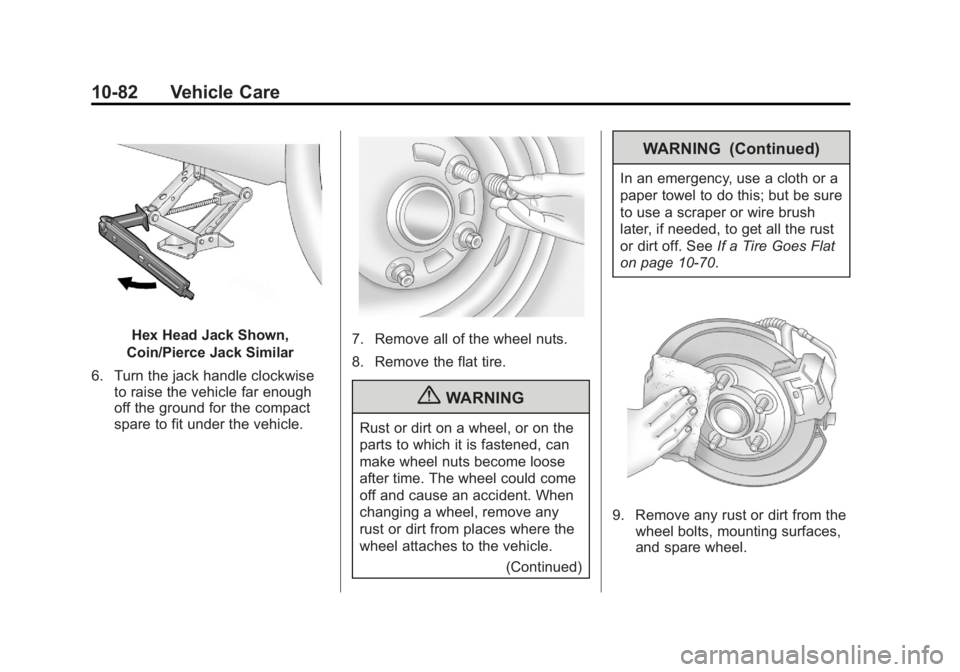
Hex Head Jack Shown,
Coin/Pierce Jack Similar
6. Turn the jack handle clockwise to raise the vehicle far enough
off the ground for the compact
spare to fit under the vehicle.7. Remove all of the wheel nuts.
8. Remove the flat tire.
{WARNING
Rust or dirt on a wheel, or on the
parts to which it is fastened, can
make wheel nuts become loose
after time. The wheel could come
off and cause an accident. When
changing a wheel, remove any
rust or dirt from places where the
wheel attaches to the vehicle.
(Continued)
WARNING (Continued)
In an emergency, use a cloth or a
paper towel to do this; but be sure
to use a scraper or wire brush
later, if needed, to get all the rust
or dirt off. SeeIf a Tire Goes Flat
on page 10‑70.
9. Remove any rust or dirt from the wheel bolts, mounting surfaces,
and spare wheel.
Page 395 of 462
Black plate (83,1)Buick LaCrosse Owner Manual - 2011
Vehicle Care 10-83
10. Install the compact spare tire.
{WARNING
Never use oil or grease on bolts
or nuts because the nuts might
come loose. The vehicle's wheel
could fall off, causing a crash.
11. Put the wheel nuts back on with the rounded end of the
nuts toward the wheel. Turn
each nut clockwise by hand
until the wheel is held against
the hub.
12. Lower the vehicle by turning the jack handle
counterclockwise. Lower
the jack completely.
{WARNING
Wheel nuts that are improperly or
incorrectly tightened can cause
the wheels to become loose or
(Continued)
WARNING (Continued)
come off. The wheel nuts should
be tightened with a torque wrench
to the proper torque specification
after replacing. Follow the
torque specification supplied by
the aftermarket manufacturer
when using accessory locking
wheel nuts. SeeCapacities and
Specifications on page 12‑2 for
original equipment wheel nut
torque specifications.
Notice: Improperly tightened
wheel nuts can lead to brake
pulsation and rotor damage.
To avoid expensive brake repairs,
evenly tighten the wheel nuts
in the proper sequence and to
the proper torque specification.
See Capacities and Specifications
on page 12‑2 for the wheel nut
torque specification.
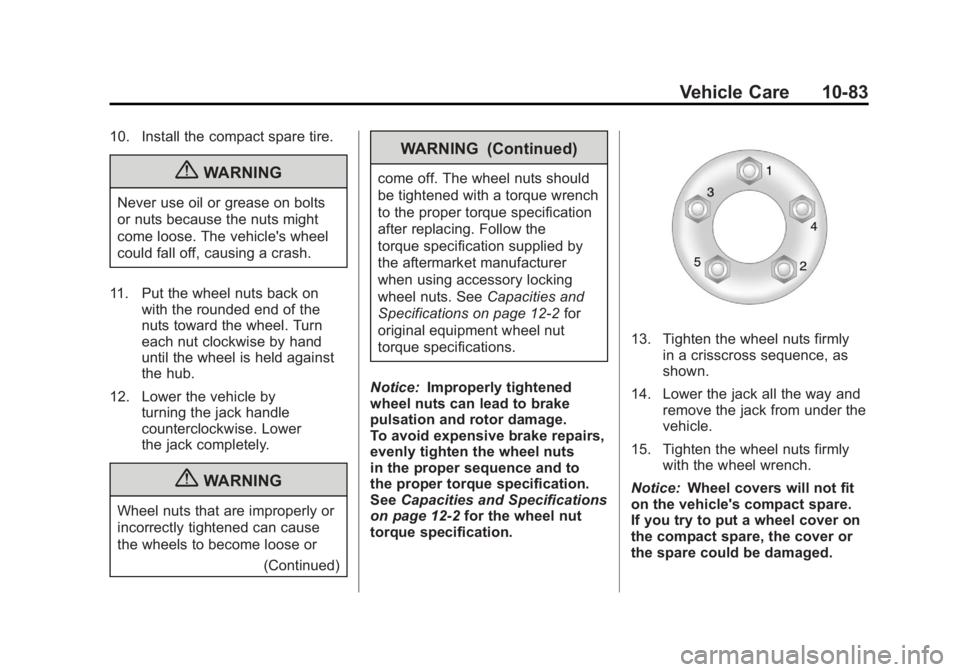
13. Tighten the wheel nuts firmly
in a crisscross sequence, as
shown.
14. Lower the jack all the way and remove the jack from under the
vehicle.
15. Tighten the wheel nuts firmly with the wheel wrench.
Notice: Wheel covers will not fit
on the vehicle's compact spare.
If you try to put a wheel cover on
the compact spare, the cover or
the spare could be damaged.
Page 401 of 462
Black plate (89,1)Buick LaCrosse Owner Manual - 2011
Vehicle Care 10-89
To disconnect the jumper cables
from both vehicles:
1. Disconnect the blacknegative (−) cable from the
vehicle that had the dead
battery.
2. Disconnect the black negative (−) cable from the
vehicle with the good battery.
3. Disconnect the red positive (+) cable from the vehicle with the
good battery.
4. Disconnect the red positive (+) cable from the other vehicle.
5. Return the caps over the positive (+) and negative (–)
terminals to their original
positions.Towing
Towing the Vehicle
Notice: To avoid damage,
the disabled vehicle should
be towed with all four wheels
off the ground. Care must be
taken with vehicles that have
low ground clearance and/or
special equipment. Always
flatbed on a car carrier.
Consult your dealer or a
professional towing service if the
disabled vehicle must be towed.
See Roadside Assistance Program
(U.S. and Canada) on page 13‑8
or Roadside Assistance Program
(Mexico) on page 13‑10.
To tow the vehicle behind another
vehicle for recreational purposes,
such as behind a motor home, see
“Recreational Vehicle Towing” in this
section.
Recreational Vehicle
Towing
Recreational vehicle towing means
towing the vehicle behind another
vehicle such as a motor home.
The two most common types of
recreational vehicle towing are
known as dinghy towing and dolly
towing. Dinghy towing is towing the
vehicle with all four wheels on the
ground. Dolly towing is towing the
vehicle with two wheels on the
ground and two wheels up on
a device known as a dolly.
Here are some important things to
consider before recreational vehicle
towing:
.What is the towing capacity
of the towing vehicle?
Be sure to read the tow
vehicle manufacturer's
recommendations.
Page 402 of 462
Black plate (90,1)Buick LaCrosse Owner Manual - 2011
10-90 Vehicle Care
.What is the distance that will be
travelled? Some vehicles have
restrictions on how far and how
long they can tow.
.Is the proper towing equipment
going to be used? See your
dealer or trailering professional
for additional advice and
equipment recommendations.
.Is the vehicle ready to be
towed? Just as preparing the
vehicle for a long trip, make
sure the vehicle is prepared
to be towed.
Dinghy Towing from the Front
When dinghy towing, the vehicle
should be run at the beginning of
each day and at each RV fuel stop
for about five minutes. This will
ensure proper lubrication of
transmission components.
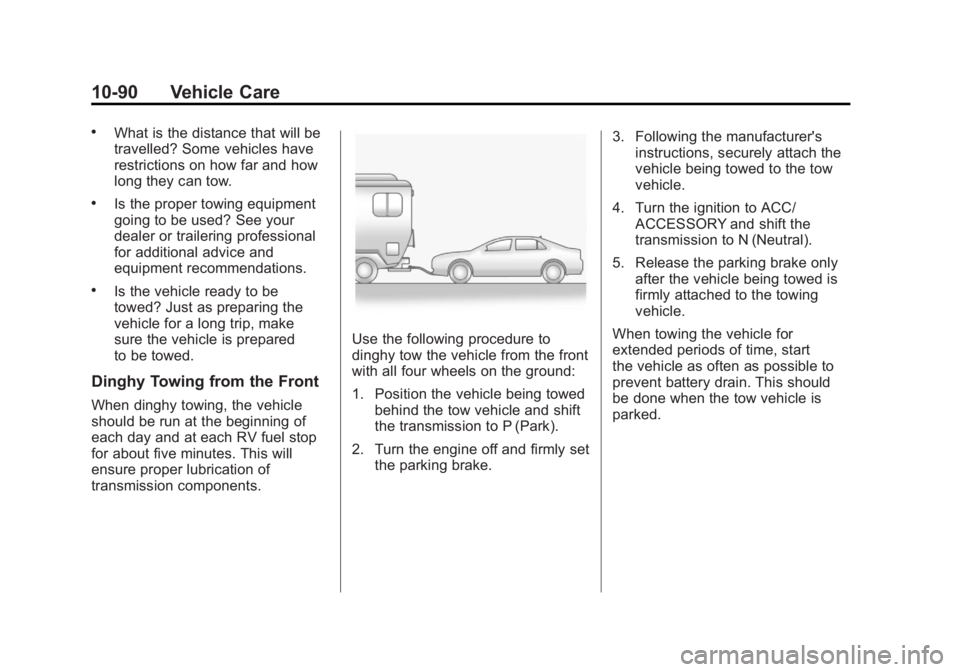
Use the following procedure to
dinghy tow the vehicle from the front
with all four wheels on the ground:
1. Position the vehicle being towedbehind the tow vehicle and shift
the transmission to P (Park).
2. Turn the engine off and firmly set the parking brake. 3. Following the manufacturer's
instructions, securely attach the
vehicle being towed to the tow
vehicle.
4. Turn the ignition to ACC/ ACCESSORY and shift the
transmission to N (Neutral).
5. Release the parking brake only after the vehicle being towed is
firmly attached to the towing
vehicle.
When towing the vehicle for
extended periods of time, start
the vehicle as often as possible to
prevent battery drain. This should
be done when the tow vehicle is
parked.