heating BUICK LACROSSE 2011 Owner's Manual
[x] Cancel search | Manufacturer: BUICK, Model Year: 2011, Model line: LACROSSE, Model: BUICK LACROSSE 2011Pages: 462, PDF Size: 5.73 MB
Page 20 of 462
Black plate (14,1)Buick LaCrosse Owner Manual - 2011
1-14 In Brief
Climate Controls
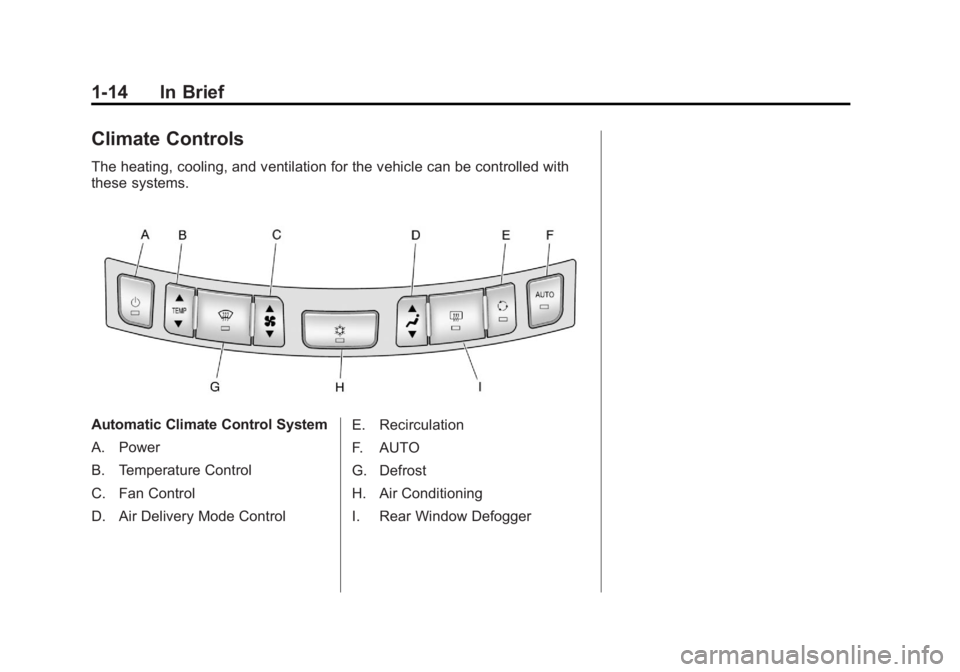
The heating, cooling, and ventilation for the vehicle can be controlled with
these systems.
Automatic Climate Control System
A. Power
B. Temperature Control
C. Fan Control
D. Air Delivery Mode ControlE. Recirculation
F. AUTO
G. Defrost
H. Air Conditioning
I. Rear Window Defogger
Page 41 of 462
Black plate (9,1)Buick LaCrosse Owner Manual - 2011
Keys, Doors and Windows 2-9
Starting the Engine Using Remote
Start
To start the engine using the remote
start feature:
1. Aim the Remote Keyless Entrytransmitter at the vehicle.
2. Press
Q.
3. Immediately after completing Step 2, press and hold
/until
the turn signal lamps flash, or for
about 2 seconds if the vehicle is
not in view.
Once the vehicle is started, the
parking lamps will turn on and
remain on as long as the engine
is running.
Turn the ignition to ON/RUN
(key access), or select the
ON/RUN/START ignition position
(keyless access), to drive the
vehicle. The engine will shut off after
10 minutes unless a time
extension is done or the ignition
is put in ON/RUN (key access) or
ON/RUN/START (keyless access).
Vehicles with an automatic climate
control system will default to a
heating or cooling mode depending
on the outside temperature during a
remote start. When the key is turned
to ON/RUN (key access), or the
ON/RUN/START ignition position
is selected (keyless access), the
climate control system will turn on
at the setting the vehicle was set to
when the vehicle was last turned off.
Vehicles with heated or heated and
ventilated front seats can have this
feature turn on automatically during
a remote start. See
“Remote Start
Heated Seats” and“Remote Start
Vented Seats” underVehicle
Personalization on page 5‑39
for more information. Extending Engine Run Time
For a 10-minute extension, repeat
Steps 1 and 2 while the engine is
still running. The remote start can
only be extended once.
When the remote start is extended,
the second 10 minutes will start
immediately.
For example, if the vehicle has
been running for five minutes, and
10 minutes are added, the engine
will run for a total of 15 minutes.
A maximum of two remote starts or
remote start attempts are allowed
between ignition cycles.
The vehicle's ignition must be
turned on and then back off before
the remote start procedure can be
used again.
Page 125 of 462
Black plate (3,1)Buick LaCrosse Owner Manual - 2011
Instruments and Controls 5-3
SeeBluetooth (Overview) on
page 7‑46 orBluetooth
(Infotainment Controls) on
page 7‑48 orBluetooth (Voice
Recognition) on page 7‑53,
the OnStar Owner's Guide, or
the separate Navigation System
Manual for more information.
$ i(Mute/End Call): Press
to silence the vehicle speakers
only. Press again to turn the
sound on. For vehicles with
OnStar or Bluetooth systems,
press to reject an incoming call,
or end a current call.
_SRC^(Rotary Control): Press
to select an audio source.
Press
_or^to select the next or
previous favorite radio station, CD,
DVD track/chapter (with navigation),
or MP3 track.
+
x− (Volume): Press + to
increase the volume. Press −to
decrease the volume.
Heated Steering Wheel
For vehicles with a heated steering
wheel, the button for this feature
is located on the climate control
system.
(: Press to turn the heated
steering wheel on or off. A light
on the button displays when the
feature is turned on.
The steering wheel takes about
three minutes to start heating.
Horn
Press near the horn symbols or
press on the steering wheel pad
to sound the horn.
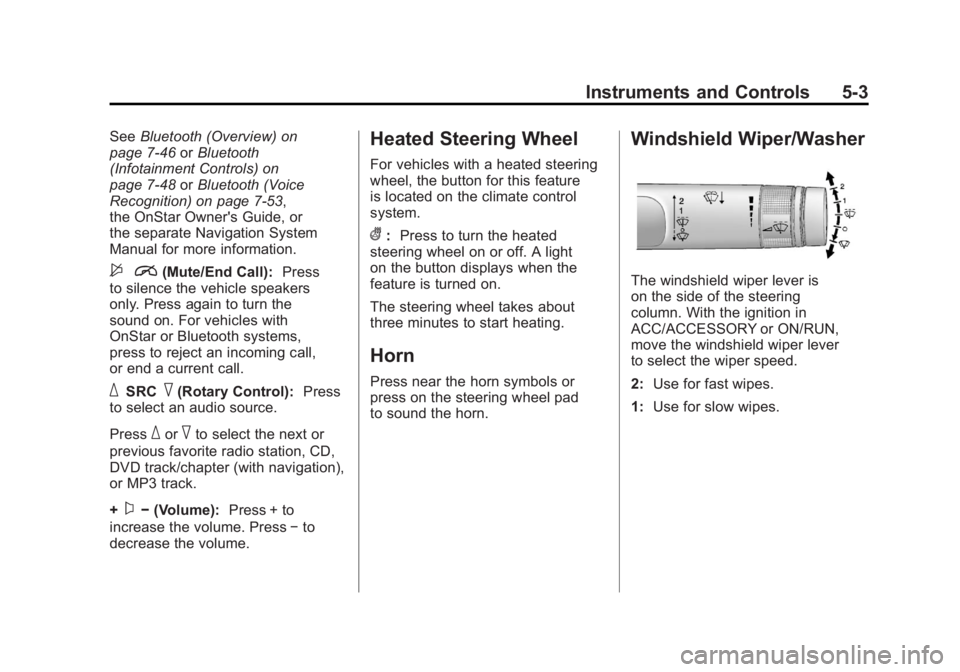
Windshield Wiper/Washer
The windshield wiper lever is
on the side of the steering
column. With the ignition in
ACC/ACCESSORY or ON/RUN,
move the windshield wiper lever
to select the wiper speed.
2: Use for fast wipes.
1: Use for slow wipes.
Page 135 of 462
Black plate (13,1)Buick LaCrosse Owner Manual - 2011
Instruments and Controls 5-13
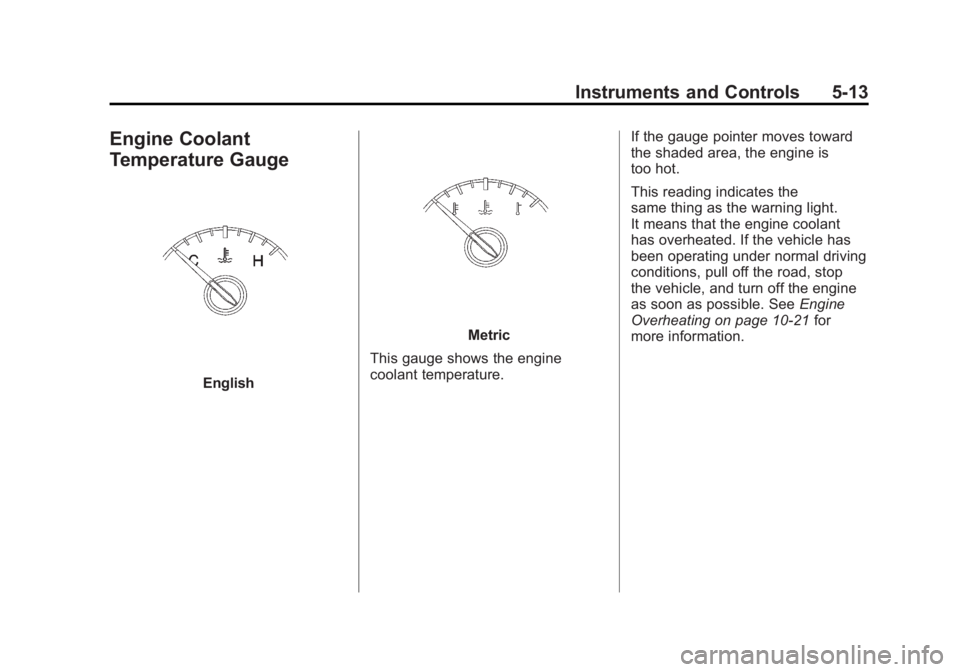
Engine Coolant
Temperature Gauge
English
Metric
This gauge shows the engine
coolant temperature. If the gauge pointer moves toward
the shaded area, the engine is
too hot.
This reading indicates the
same thing as the warning light.
It means that the engine coolant
has overheated. If the vehicle has
been operating under normal driving
conditions, pull off the road, stop
the vehicle, and turn off the engine
as soon as possible. See
Engine
Overheating on page 10‑21 for
more information.
Page 157 of 462
Black plate (35,1)Buick LaCrosse Owner Manual - 2011
Instruments and Controls 5-35
TRUNK OPEN
This message will display when
the trunk is open. Close the trunk
completely.
Engine Cooling System
Messages
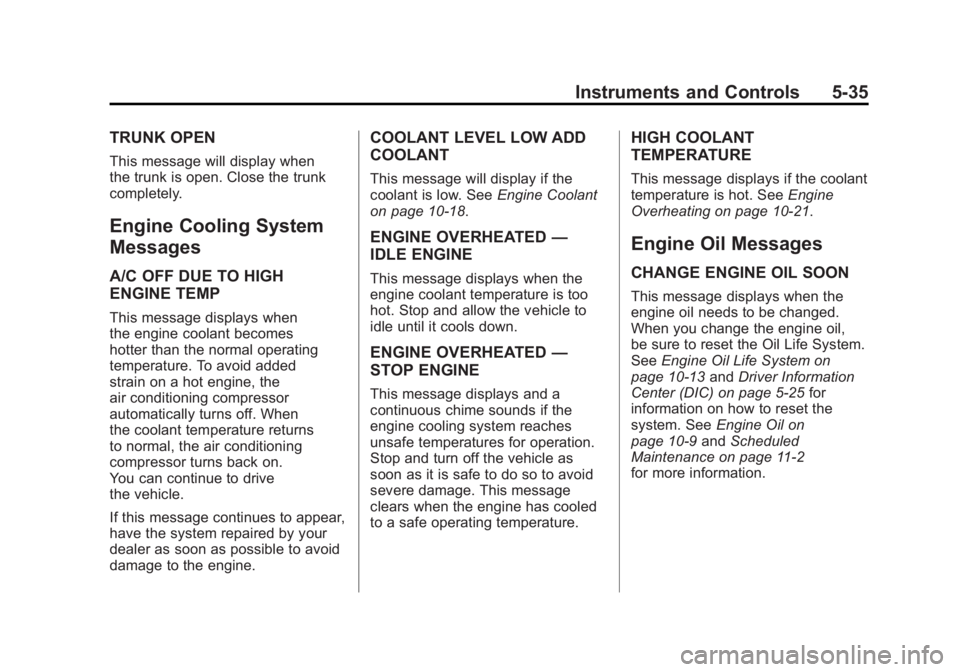
A/C OFF DUE TO HIGH
ENGINE TEMP
This message displays when
the engine coolant becomes
hotter than the normal operating
temperature. To avoid added
strain on a hot engine, the
air conditioning compressor
automatically turns off. When
the coolant temperature returns
to normal, the air conditioning
compressor turns back on.
You can continue to drive
the vehicle.
If this message continues to appear,
have the system repaired by your
dealer as soon as possible to avoid
damage to the engine.
COOLANT LEVEL LOW ADD
COOLANT
This message will display if the
coolant is low. SeeEngine Coolant
on page 10‑18.
ENGINE OVERHEATED —
IDLE ENGINE
This message displays when the
engine coolant temperature is too
hot. Stop and allow the vehicle to
idle until it cools down.
ENGINE OVERHEATED —
STOP ENGINE
This message displays and a
continuous chime sounds if the
engine cooling system reaches
unsafe temperatures for operation.
Stop and turn off the vehicle as
soon as it is safe to do so to avoid
severe damage. This message
clears when the engine has cooled
to a safe operating temperature.
HIGH COOLANT
TEMPERATURE
This message displays if the coolant
temperature is hot. See Engine
Overheating on page 10‑21.
Engine Oil Messages
CHANGE ENGINE OIL SOON
This message displays when the
engine oil needs to be changed.
When you change the engine oil,
be sure to reset the Oil Life System.
See Engine Oil Life System on
page 10‑13 andDriver Information
Center (DIC) on page 5‑25 for
information on how to reset the
system. See Engine Oil on
page 10‑9 andScheduled
Maintenance on page 11‑2
for more information.
Page 241 of 462
Black plate (1,1)Buick LaCrosse Owner Manual - 2011
Climate Controls 8-1
Climate Controls
Climate Control Systems
Automatic Climate ControlSystem . . . . . . . . . . . . . . . . . . . . . . 8-1
Dual Automatic Climate Control System . . . . . . . . . . . . . . . . . . . . . . 8-4
Air Vents
Air Vents . . . . . . . . . . . . . . . . . . . . . . 8-8
Maintenance
Air Intake . . . . . . . . . . . . . . . . . . . . . 8-8
Passenger Compartment AirFilter . . . . . . . . . . . . . . . . . . . . . . . . . 8-8
Climate Control Systems
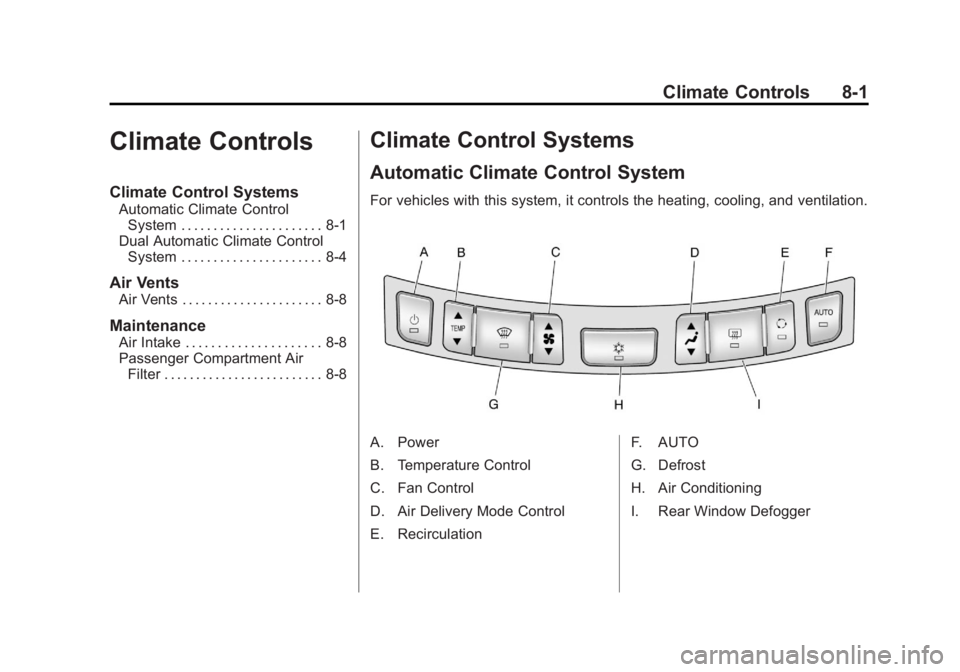
Automatic Climate Control System
For vehicles with this system, it controls the heating, cooling, and ventilation.
A. Power
B. Temperature Control
C. Fan Control
D. Air Delivery Mode Control
E. Recirculation F. AUTO
G. Defrost
H. Air Conditioning
I. Rear Window Defogger
Page 244 of 462
Black plate (4,1)Buick LaCrosse Owner Manual - 2011
8-4 Climate Controls
Sensor
The solar sensor, located on top
of the instrument panel near the
windshield, monitors the solar heat.
The climate control system uses
the sensor information to adjust
the temperature, fan speed,
recirculation, and air delivery
mode for best comfort.
Do not cover the sensor or the
automatic climate control system
may not work properly.
Dual Automatic Climate Control System
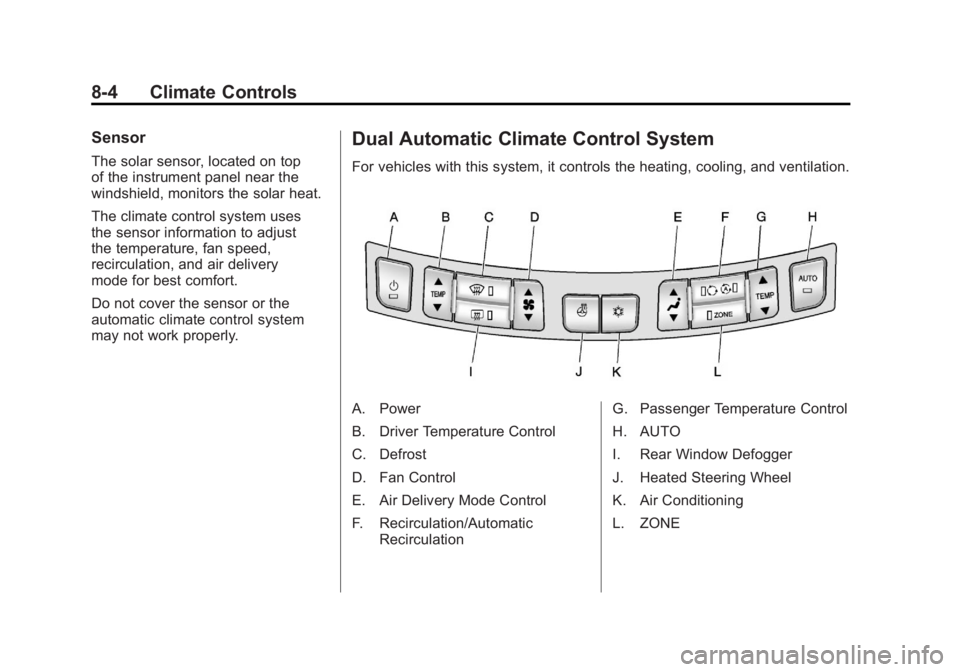
For vehicles with this system, it controls the heating, cooling, and ventilation.
A. Power
B. Driver Temperature Control
C. Defrost
D. Fan Control
E. Air Delivery Mode Control
F. Recirculation/AutomaticRecirculation G. Passenger Temperature Control
H. AUTO
I. Rear Window Defogger
J. Heated Steering Wheel
K. Air Conditioning
L. ZONE
Page 308 of 462
Black plate (58,1)Buick LaCrosse Owner Manual - 2011
9-58 Driving and Operating
Making Turns
Notice:Making very sharp turns
while trailering could cause the
trailer to come in contact with
the vehicle. The vehicle could
be damaged. Avoid making very
sharp turns while trailering.
When turning with a trailer, make
wider turns than normal so the
trailer will not strike soft shoulders,
curbs, road signs, trees or other
objects. Use the turn signal well in
advance and avoid jerky or sudden
maneuvers.
Turn Signals when Towing a
Trailer
The turn signal indicators on the
instrument panel flash whenever
signaling a turn or lane change.
Properly hooked up, the trailer
lamps also flash, telling other
drivers the vehicle is turning,
changing lanes or stopping.
When towing a trailer, the arrows on
the instrument panel flash for turns
even if the bulbs on the trailer are
burned out. Check occasionally to
be sure the trailer bulbs are still
working.
Driving on Grades
Reduce speed and shift to a
lower gear before starting down
a long or steep downgrade. If the
transmission is not shifted down,
the brakes might have to be used
so much that they would get hot
and no longer work well. The vehicle can tow in D (Drive).
Use a lower gear if the transmission
shifts too often.
When towing at high altitude on
steep uphill grades, engine coolant
boils at a lower temperature than
at normal altitudes. If the engine is
turned off immediately after towing
at high altitude on steep uphill
grades, the vehicle could show
signs similar to engine overheating.
To avoid this, let the engine run
while parked, preferably on level
ground, with the transmission in
P (Park) for a few minutes before
turning the engine off. If the
overheat warning comes on, see
Engine Overheating on page 10‑21.
Page 309 of 462
Black plate (59,1)Buick LaCrosse Owner Manual - 2011
Driving and Operating 9-59
Parking on Hills
{WARNING
Parking the vehicle on a hill
with the trailer attached can be
dangerous. If something goes
wrong, the rig could start to move.
People can be injured, and both
the vehicle and the trailer can be
damaged. When possible, always
park the rig on a flat surface.
If parking the rig on a hill:
1. Press the brake pedal, but do not shift into P (Park) yet. Turn
the wheels into the curb if facing
downhill or into traffic if facing
uphill.
2. Have someone place chocks under the trailer wheels. 3. When the wheel chocks are in
place, release the brake pedal
until the chocks absorb the load.
4. Reapply the brake pedal. Then apply the parking brake and shift
into P (Park).
5. Release the brake pedal.
Leaving After Parking on a Hill
1. Apply and hold the brake pedal while you:
.Start the engine.
.Shift into a gear.
.Release the parking brake.
2. Let up on the brake pedal.
3. Drive slowly until the trailer is clear of the chocks.
4. Stop and have someone pick up and store the chocks.
Maintenance when Trailer
Towing
The vehicle needs service
more often when pulling a trailer.
See the Maintenance Schedule
booklet for more information.
Things that are especially important
in trailer operation are automatic
transmission fluid, engine oil, axle
lubricant, belts, cooling system and
brake system. Inspect these before
and during the trip.
Check periodically to see that all
hitch nuts and bolts are tight.
Engine Cooling when Trailer
Towing
The cooling system may temporarily
overheat during severe operating
conditions. See Engine Overheating
on page 10‑21.
Page 313 of 462
Black plate (1,1)Buick LaCrosse Owner Manual - 2011
Vehicle Care 10-1
Vehicle Care
General Information
General Information . . . . . . . . . . 10-2
California Proposition65 Warning . . . . . . . . . . . . . . . . . 10-3
California Perchlorate Materials Requirements . . . . 10-3
Accessories and Modifications . . . . . . . . . . . . . . . 10-3
Vehicle Checks
Doing Your OwnService Work . . . . . . . . . . . . . . . 10-4
Hood . . . . . . . . . . . . . . . . . . . . . . . . 10-5
Engine Compartment Overview . . . . . . . . . . . . . . . . . . . 10-6
Engine Oil . . . . . . . . . . . . . . . . . . . 10-9
Engine Oil Life System . . . . . 10-13
Automatic Transmission Fluid . . . . . . . . . . . . . . . . . . . . . . 10-15
Engine Air Cleaner/Filter . . . . 10-15 Cooling System . . . . . . . . . . . . 10-17
Engine Coolant . . . . . . . . . . . . . 10-18
Engine Overheating . . . . . . . . 10-21
Overheated Engine
Protection
Operating Mode . . . . . . . . . . . 10-22
Power Steering Fluid . . . . . . . 10-23
Washer Fluid . . . . . . . . . . . . . . . 10-24
Brakes . . . . . . . . . . . . . . . . . . . . . 10-24
Brake Fluid . . . . . . . . . . . . . . . . . 10-25
Battery . . . . . . . . . . . . . . . . . . . . . 10-27
Starter Switch Check . . . . . . . 10-27
Automatic Transmission Shift Lock Control Function
Check . . . . . . . . . . . . . . . . . . . . . 10-28
Ignition Transmission Lock Check . . . . . . . . . . . . . . . . . . . . . 10-28
Park Brake and P (Park) Mechanism Check . . . . . . . . 10-29
Wiper Blade Replacement . . . . . . . . . . . . . . 10-29
Headlamp Aiming
Headlamp Aiming . . . . . . . . . . 10-30
Bulb Replacement
Bulb Replacement . . . . . . . . . . 10-33
Halogen Bulbs . . . . . . . . . . . . . . 10-33
High Intensity Discharge(HID) Lighting . . . . . . . . . . . . . 10-33
Headlamps, Front Turn
Signal and Parking
Lamps . . . . . . . . . . . . . . . . . . . . 10-34
Taillamps, Turn Signal, Stoplamps, and Back-Up
Lamps . . . . . . . . . . . . . . . . . . . . 10-35
License Plate Lamp . . . . . . . . 10-36
Replacement Bulbs . . . . . . . . . 10-37
Electrical System
Electrical System Overload . . . . . . . . . . . . . . . . . . 10-38
Fuses and Circuit
Breakers . . . . . . . . . . . . . . . . . . 10-39
Engine Compartment Fuse Block . . . . . . . . . . . . . . . . . . . . . 10-39
Instrument Panel Fuse Block . . . . . . . . . . . . . . . . . . . . . 10-42
Rear Compartment Fuse Block . . . . . . . . . . . . . . . . . . . . . 10-44