brake BUICK LESABRE 1993 User Guide
[x] Cancel search | Manufacturer: BUICK, Model Year: 1993, Model line: LESABRE, Model: BUICK LESABRE 1993Pages: 324, PDF Size: 17.02 MB
Page 84 of 324
CAUTION: (Continued)
It can be dangerous to get out of your vehicle if
the shift lever
is not fully in “P’ (Park) with the
parking brake firmly
set. Your vehicle can roll.
Don’t leave your vehicle when the engine
is
running unless you have to. If you’ve left the
engine running, the
vehicle can move suddenly.
You or others could be injured. To be sure your
vehicle won’t move, even when you’re
on fairly
level ground, always set your parking brake
and
after you move the shift lever to “P” (Park).&
Follow the proper steps to be sure your vehicle
won’t move. See “Shifting Into ‘P’ (Park)’’ in the’
Index.
If you are parking OR a hill, or if you’re pulling a
trailer, also $&e “Parking on Hills’’ or “Towing a
Trailer” in the Index. , I
Power Windows
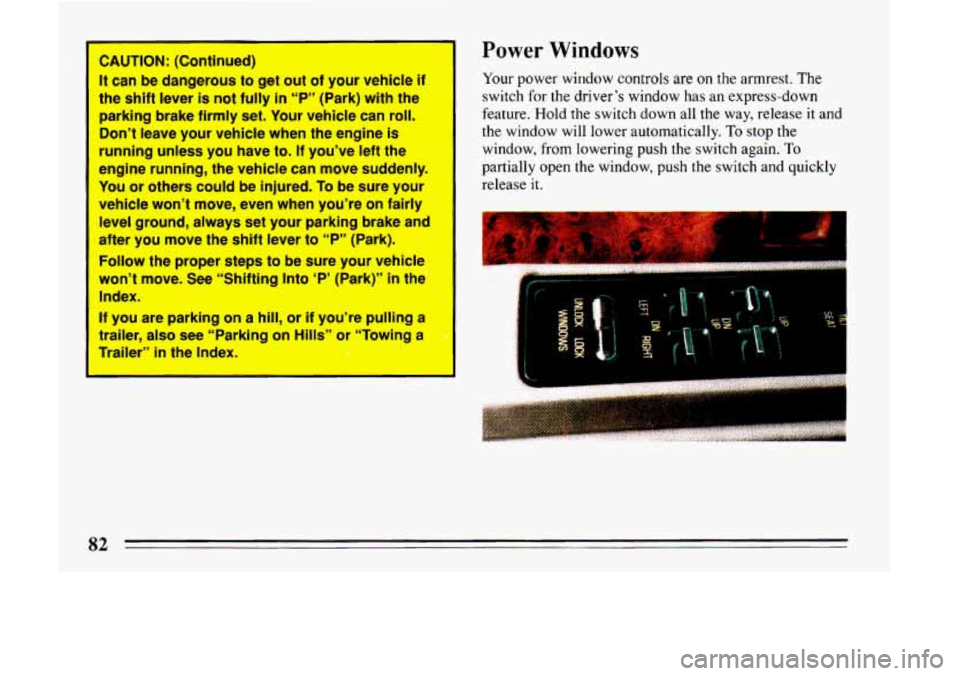
Your power window controls are on the armrest. The
switch for the driver’s window has an express-down
feature. Hold the switch down all the way, release it and
the window will lower automatically.
To stop the
window, from lowering push the switch again.
To
partially open the window, push the switch and quickly
release it.
82
Page 91 of 324
NOTICE:
When using concentrated washer fluid
iollow the manufacturer instructions for
~ Idding water.
I 0 Don’t mix water with ready to use washe
fluid
. Water can cause the solution to
freeze and damage your washer fluid tank
and other parts of
t
water doesn’t clean as well as washer
0 Fill your washer fluid tank only 3/4 full
when it’s very cold. This
allows for
expansion, which c
it is completely full.
0 Don’t use radiator a
windshield washer. It c
paint.
I
Cruise Control (Option)
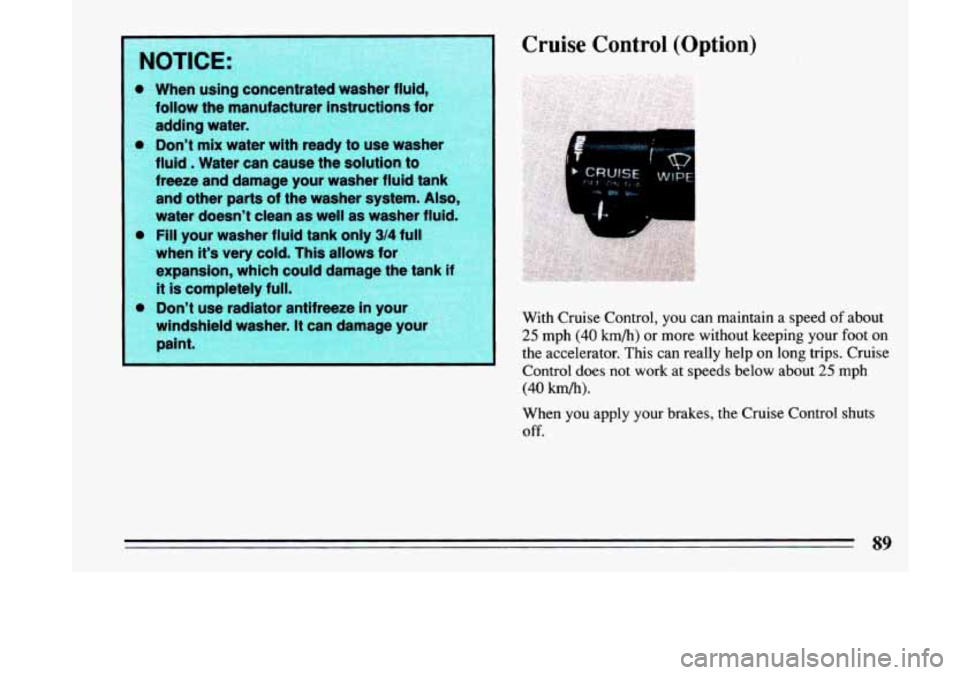
With Cruise Control, you can maintain a speed of about
25 mph (40 km/h) or more without keeping your foot on
~ the accelerator. This can really help on long trips. Cruise
Control
does not work at speeds below about 25 mph
(40 km/h).
When you apply your brakes, the Cruise Control shuts
off.
Page 93 of 324
2. Get up to the speed you want.
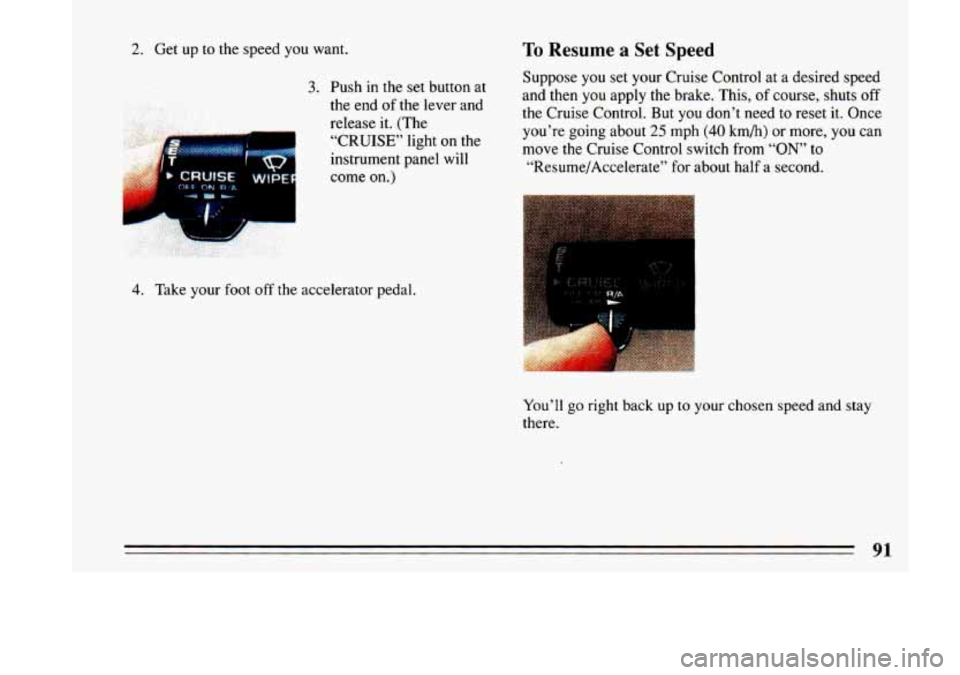
3. Push in the set button at
the end of the lever and
release it. (The
“CRUISE’ light
on the
instrument panel will come on.)
4. Take your foot off the accelerator pedal.
To Resume a Set Speed
Suppose you set your Cruise Control at a desired speed
and then you apply the brake. This, of course, shuts off
the Cruise Control. But you don’t need to reset it. Once
you’re going about
25 mph (40 km/h) or more, you can
move the Cruise Control switch from
“ON” to
“Resume/Accelerate”
for about half a second.
You’ll go right back up to your chosen speed and stay
there.
91
Page 94 of 324
I A CAUTION:
If you hold the switch at “ResumelAccelerate” .
longer than half a second, the vehicle will keep
going faster until you release the switch or apply
the brake. You could be startled and even lose
control.
So unless you want to go faster, don’t
hold the switch at “Resume/Accelerate.”
To Increase !heed While Using Cruise
Control
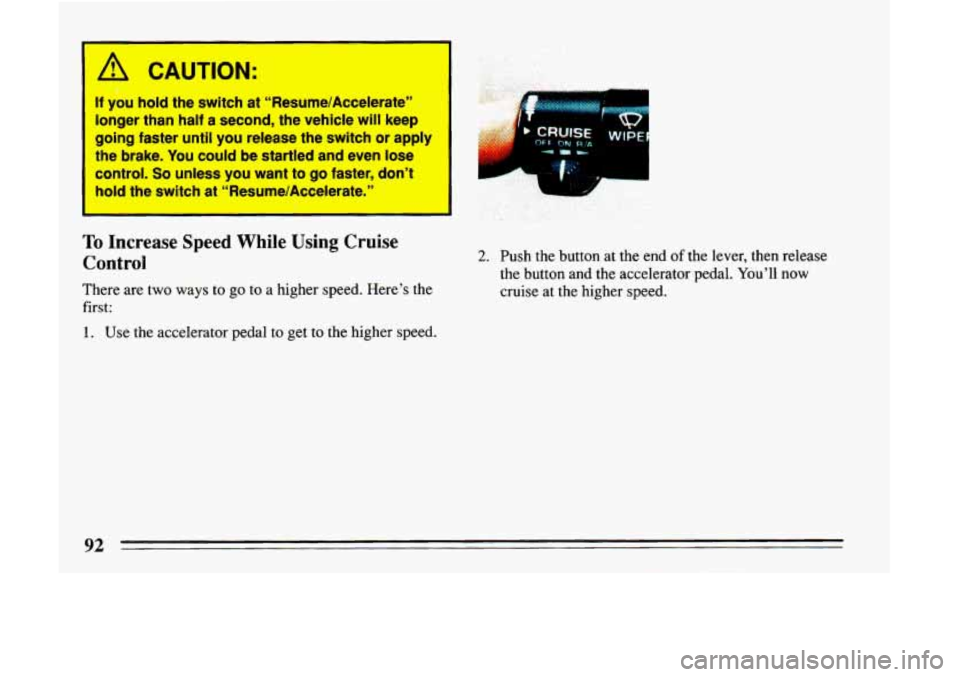
There are two ways to go to a higher speed. Here’s the
first:
1. Use the accelerator pedal to get to the higher speed.
2. Push the button at the end of the lever, then release
the button and
the accelerator pedal. You’ll now
cruise at the higher speed.
92
-
Page 96 of 324
Passing Another Vehicle While Using Cruise Control
Use the accelerator pedal to increase your speed. When
you take your foot
off the pedal, your vehicle will slow
down to the Cruise Control speed you set earlier.
Using Cruise Control on Hills
How well your Cruise Control will work on hills
depends upon your speed, load, and the steepness
of the
hills. When going up steep hills, you may have to step
on the accelerator pedal to maintain your speed. When
going downhill,
you may have to brake or shift to a
lower gear to keep your speed down. Of course,
applying the brake takes you out of Cruise Control.
Many drivers find this to be too much trouble and don't
use Cruise Control on steep hills.
To Get Out of Cruise Control
There are two ways to turn off the Cruise Control:
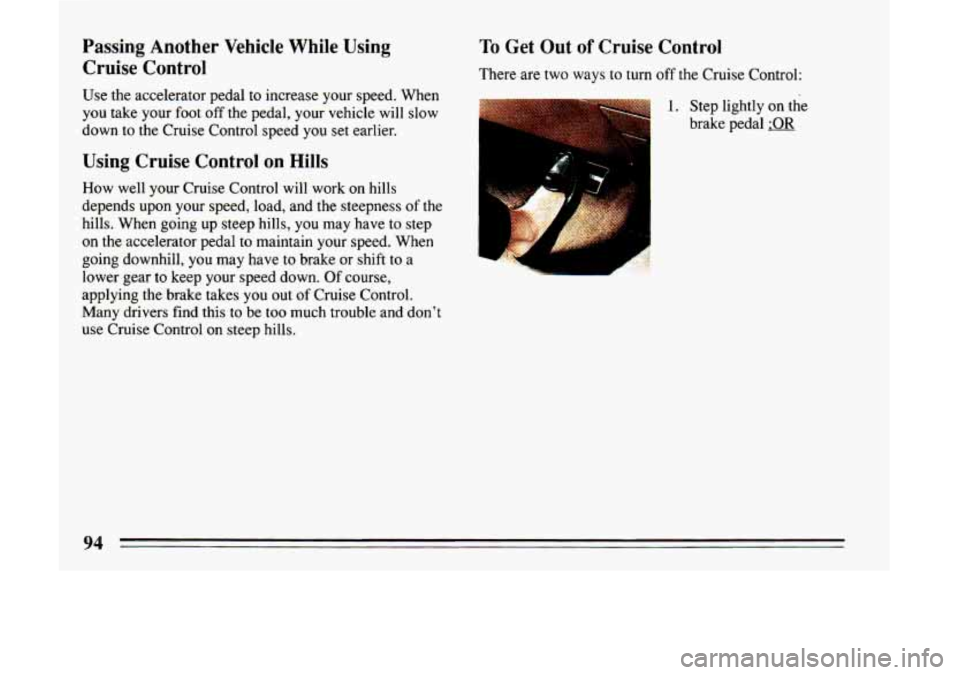
1. Step lightly on the
brake pedal
:OR
94
Page 109 of 324
Your fuel gage shows about how much fuel is in your
tank. It works
only when the engine is on. When the
indicator nears
“E,” you still have a little fuel left. You
need to get more
fuel right away.
Here are four concerns some owners have had about the
fuel gage. All these situations are normal and indicate
nothing wrong with the
fuel gage.
0
0
0
0
At the gas station, the gas pump shuts off before the
gage reads
“F’.
It takes more (or less) gas to fill up than the gage
indicated. For example, the gage may have indicated
1/2
full, but it took more (or less) than half of the
tank’s capacity to fill it.
The gage moves a little when you turn a corner,
speed up, or stop your vehicle.
When
you turn the engine off, the gage doesn’t go all
the way back to “E”.
Low Fuel Light
If your Buick has this option, a yellow light near the fuel
gage, will
go on when your vehicle is low on fuel.
You should get more fuel as soon as you can.
Brake System Warning Light
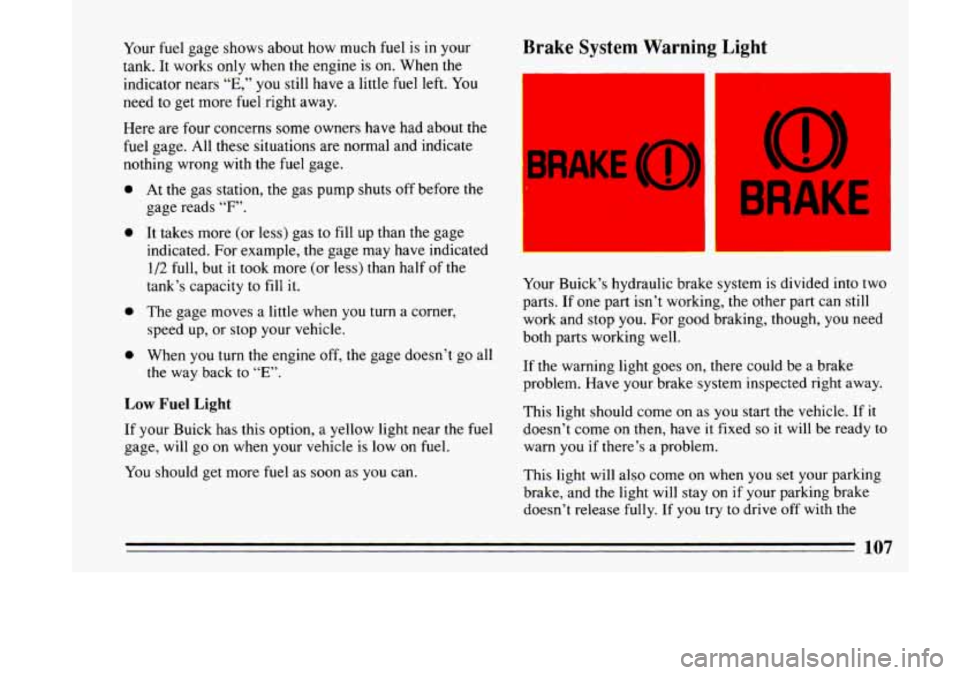
Your Buick’s hydraulic brake system is divided into two
parts. If one part isn’t working, the other part can still
work and stop
you. For good braking, though, you need
both parts working well.
If the warning light goes on, there could be a brake
problem. Have your brake system inspected right away.
This light should come on as
you start the vehicle. If it
doesn’t come on then, have it fixed so it will be ready to
warn you if there’s a problem.
This light will also come on when you set your parking
brake, and the light will stay on
if your parking brake
doesn’t release
fully. If you try to drive off with the
107
Page 110 of 324
parking brake set, a chime will also come on until you
release the parking brake. If the light and chime stay on
after your parking brake is
fully released, it means you
have a brake problem. If the light and chime come on
while driving, pull
off the road and stop carefully. You
may notice that the pedal is harder to push. Or, the pedal
may go closer to the floor. It may take longer to stop. If
the light is still on, have the vehicle towed for service.
(See “Towing Your Car” in the Index.)
1 &!A CAUTION:
Your brake system may not be working properly
if the brake warning light is on. Rriving with the
brake warning light on can lead to an accident. If
the light is still on after you’ve pulled off the road
and stopped carefully, have the vehicle towed for
service.
Anti-Lock Brake System Warning Light
1-
ANTI
LOCK
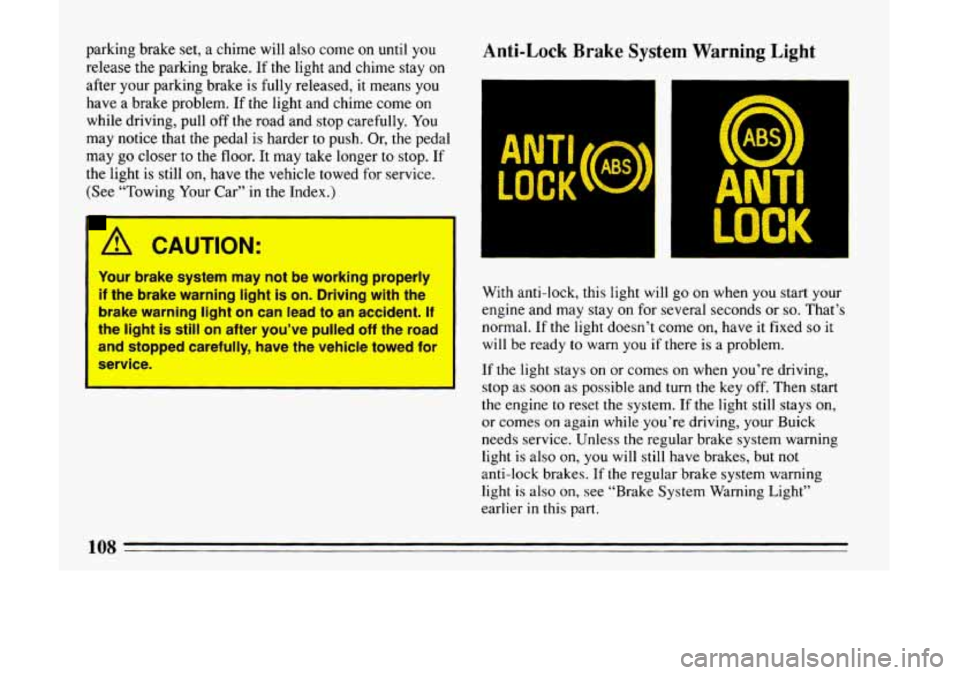
With anti-lock, this light will go on when you start your
engine and may stay on for several seconds or
so. That’s
normal. If the light doesn’t come on, have it fixed
so it
will be ready to warn you if there is a problem.
If the light stays on or comes
on when you’re driving,
stop as soon as possible and turn the key off. Then start
the engine
to reset the system. If the light still stays on,
or comes
on again while you’re driving, your Buick
needs service. Unless
the regular brake system warning
light is also
on, you will still have brakes, but not
anti-lock brakes. If the regular brake system warning
light
is also on, see “Brake System Warning Light”
earlier
in this part.
108
Page 111 of 324
The anti-lock brake system warning light may also come Traction Control System Warning Light
on when you are driving with a compact spare tire. If (Option)
this happens, the light means you won’t have anti-lock
until you replace the compact spare with a full-size tire.
If the warning light stays on after you replace the
compact spare with a full-size tire, or
if it comes on
again when you’re driving, your Buick needs service.
TRACTION
OFF
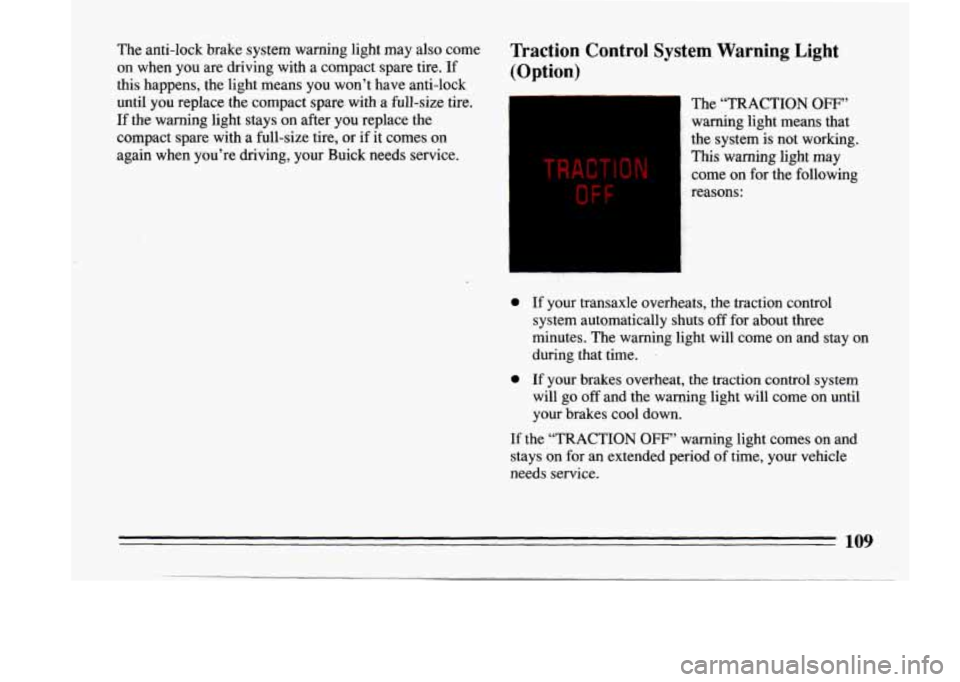
The “TRACTION OFF”
warning light means that
the system is not working.
This warning light may
come on for the following
reasons:
0 If your transaxle overheats, the traction control
system automatically shuts
off for about three
minutes. The warning light will come on and stay on
during that time.
.
0 If your brakes overheat, the traction control system
will
go off and the warning light will come on until
your brakes cool down.
If the “TRACTION
OFF” warning light comes on and
stays on for an extended period
of time, your vehicle
needs service.
109
Page 155 of 324
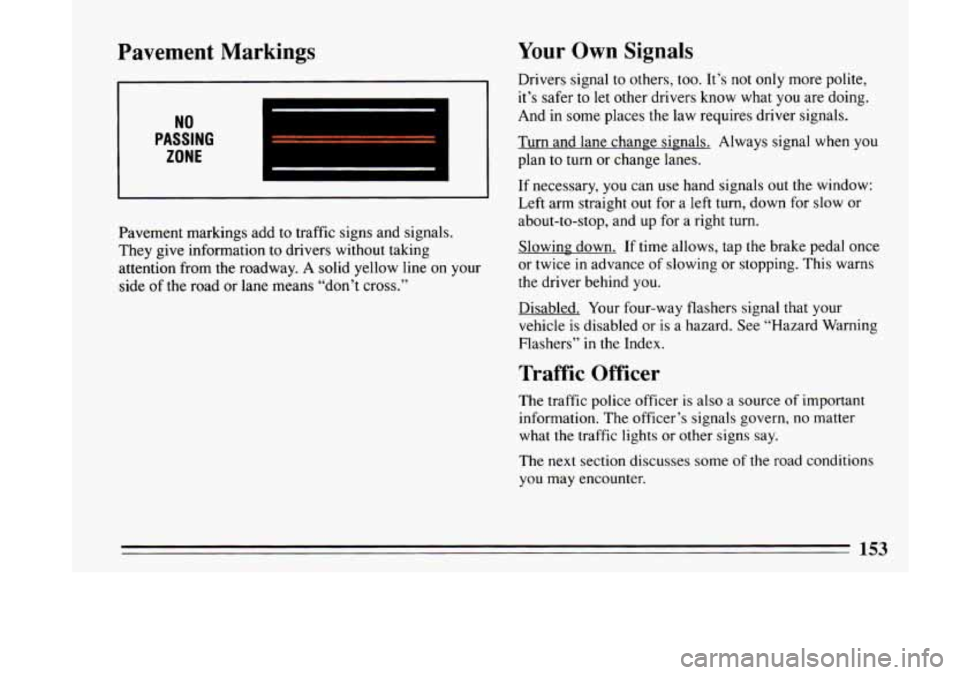
Pavement Markings
NO
PASSING
ZONE
Pavement markings add to traffic signs and signals.
They give information to drivers without taking
attention from the roadway. A solid yellow line on your
side
of the road or lane means “don’t cross.’’
Your Own Signals
Drivers signal to others, too. It’s not only more polite,
it’s safer to let other drivers know what
you are doing.
And in some places the law requires driver signals.
Turn and
lane change signals. Always signal when you
plan to turn or change lanes.
If necessary, you can use hand signals
out the window:
Left arm straight out for a left turn, down for slow or
about-to-stop, and
up for a right turn.
Slowinn down. If time allows, tap the brake pedal once
or twice in advance of slowing or stopping. This warns
the driver behind
you.
Disabled. Your four-way flashers signal that your
vehicle is disabled
or is a hazard. See “Hazard Warning
Flashers” in the Index.
Traffic Officer
The traffic police officer is also a source of important
information. The officer’s signals govern, no matter
what the traffic lights or other signs say.
The next section discusses some
of the road conditions
you may encounter.
153
Page 156 of 324
Defensive Driving
The best advice anyone can give about driving is: Drive
defensively.
Please start with a very important safety device in your
Buick: Buckle up. (See “Safety Belts” in the Index.)
Defensive driving really means “be ready for anything.”
On city streets, rural roads, or freeways, it means
“always expect the unexpected.”
Assume that pedestrians or other drivers are going to be
careless and make mistakes. Anticipate what they might
do. Be ready for their mistakes.
Expect children
to dash out from behind parked cars,
often followed by other children. Expect occupants in
parked cars
to open doors into traffic. Watch for
movement in parked cars
-- someone may be about to
open a door.
Expect other drivers to run stop signs when you are
on a
through street. Be ready
to brake if necessary as you go
through intersections. You may not have to use the
brake, but if you do, you will be ready.
If you’re driving through a shopping center parking lot
where there are well-marked lanes, directional arrows,
and designated parking areas, expect some drivers
to
ignore all these markings and dash straight toward one
part of the lot.
Pedestrians can be careless. Watch for them. In general,
you must give way to pedestrians even if you know you
have the right of way.
Rear-end collisions are about the most preventable of
accidents. Yet they are common. Allow enough
following distance. It’s the best defensive driving
maneuver, in both city and rural driving. You never
know when the vehicle in front
of you is going to brake
or turn suddenly.
Here’s a final bit
of information about defensive driving.
The most dangerous time for driving in the
U.S. is very
early
on Sunday morning. In fact, GM Research studies
show that the most and the least dangerous times for
driving, every week, fall on the same day. That day is
Sunday. The most dangerous time is Sunday from
3 a.m.
to
4 a.m. The safest time is Sunday from 10 a.m. to 11
a.m. Driving the same distance on a Sunday at 3 a.m.
isn’t just
a little more dangerous than it is at 10 a.m. It’s
about 134 times more dangerous!
That leads to the next section.