instrument panel BUICK LESABRE 1993 User Guide
[x] Cancel search | Manufacturer: BUICK, Model Year: 1993, Model line: LESABRE, Model: BUICK LESABRE 1993Pages: 324, PDF Size: 17.02 MB
Page 100 of 324
Daytime Running Lights (Canada Only)
The Canadian Federal Government has decided that
“Daytime Running Lights” (DRL) are a
useful feature,
in that DRL can make your vehicle more visible to
pedestrians and other drivers during daylight hours.
DRL are required on new vehicles sold in Canada.
Your DRL work with
a light sensor on top of the
instrument panel. Don’t cover it up.
The low beam headlights will come on at reduced
brightness in daylight when:
The ignition is on
The headlight switch is off, and
The transaxle is not in “P” (Park).
At dusk, the exterior lights will come
on automatically
and the low beams will change
to full brightness. At
dawn, the exterior lights will go out and the low beams
will change
to the reduced brightness of DRL (if the
headlight switch is
off).
Of course, you may still turn on the headlights any time
you need to.
To idle your vehicle with the DRL off, shift the
transaxle into
“P” (Park). The DRL will stay off until
you
shift out of “P” (Park).
To turn off all exterior lighting at night when
you are
parked, move the twilight sentinel control from
ON to
OFF, if it was on from the start. Or, move the control
from
OFF to ON, then back to OFF, if it was off from
the start. The lights will come back
on when you move
the transaxle
out of PARK.
Page 106 of 324
Storage Armrest (Option) The Instrument Panel: Your
Information System
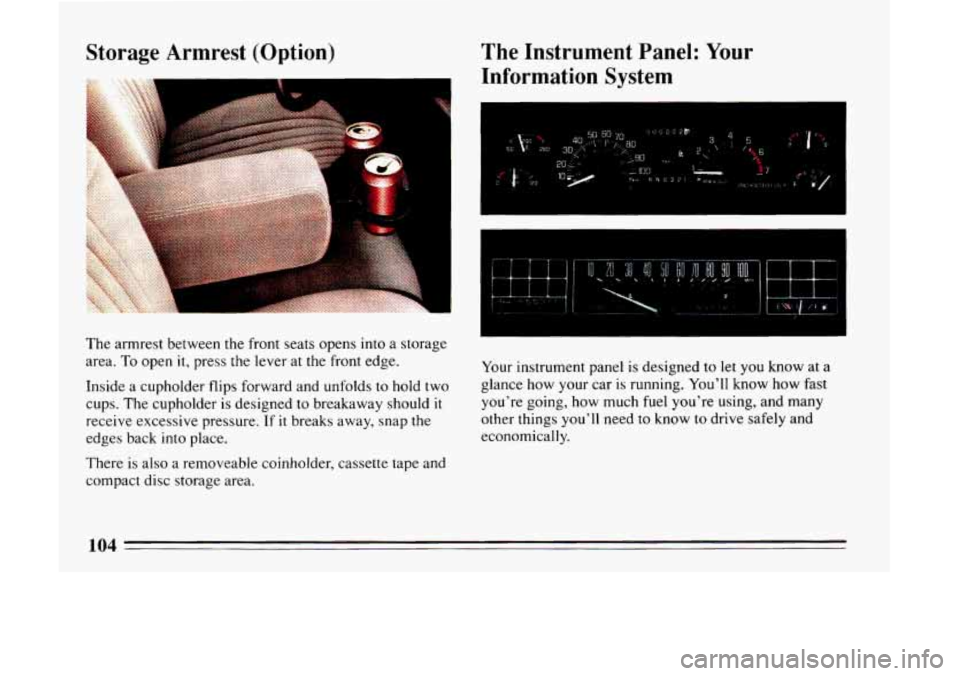
The armrest between the front seats opens into a storage
area.
To open it, press the lever at the front edge.
Inside a cupholder flips forward and unfolds to hold two
cups. The cupholder
is designed to breakaway should it
receive excessive pressure. If it breaks away, snap the
edges back into place.
There
is also a removeable coinholder, cassette tape and
compact disc storage area.
Your instrument panel is designed to let you know at a
glance
how your car is running. You'll know how fast
you're going, how much fuel you're using, and many
other things you'll need to know to drive safely and
economically.
104
Page 114 of 324
I NOTICE:
If you keep driving your vehicle wlrn rnis llgr In,
after a while the emission controls won’t worK as
well, your fuel economy won’t be as good and
your engine may not run
as smoothly. This could
Engine Oil Pressure Light And Gage
i
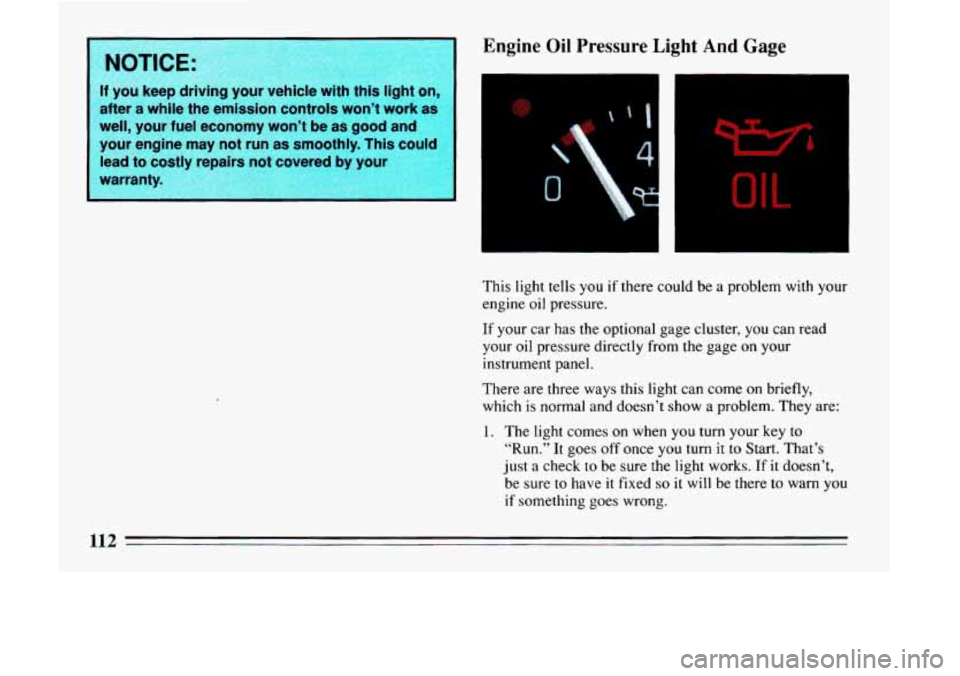
This light tells you if there could be a problem with your
engine oil pressure.
If your car has the optional gage cluster, you can read
your oil pressure directly from the gage on your
instrument panel.
There are three ways this light can come
on briefly,
which is normal and doesn’t show a problem. They are:
1. The light comes on when you turn your key to
“Run.”
It goes off once you turn it to Start. That’s
just a check to be sure
the light works. If it doesn’t,
be sure to have
it fixed so it will be there to warn you
if something goes wrong.
112
Page 116 of 324
“Change Oil Soon’’ Light (Option)
This light is activated by
the Engine Oil Life
Monitor System. It
indicates that the engine oil
has degraded enough to
require changing. See
“Engine Oil”
in the Index.
After changing the engine oil, the system should be
reset.
This will cause the “Change Oil Soon” light once
again, to be lit for just
the bulb check period of 3
seconds.
This
is determined by electronically monitoring engine
speed, coolant temperature and vehicle speed. Since the
change interval is dependent on driving habits and
conditions, the “Change Oil Soon” light may come on as
early as
2,000 miles or less for harsh circumstances.
The “Change Oil Soon” light is lit for three seconds as a
bulb check each time the ignition key is turned to
the
RUN position. If an oil change is required, it will stay
on for 60 seconds each time the engine is started. If the
“Change Oil Soon” light is on continuously, there is a
problem with the Oil Life Monitor System and service
is
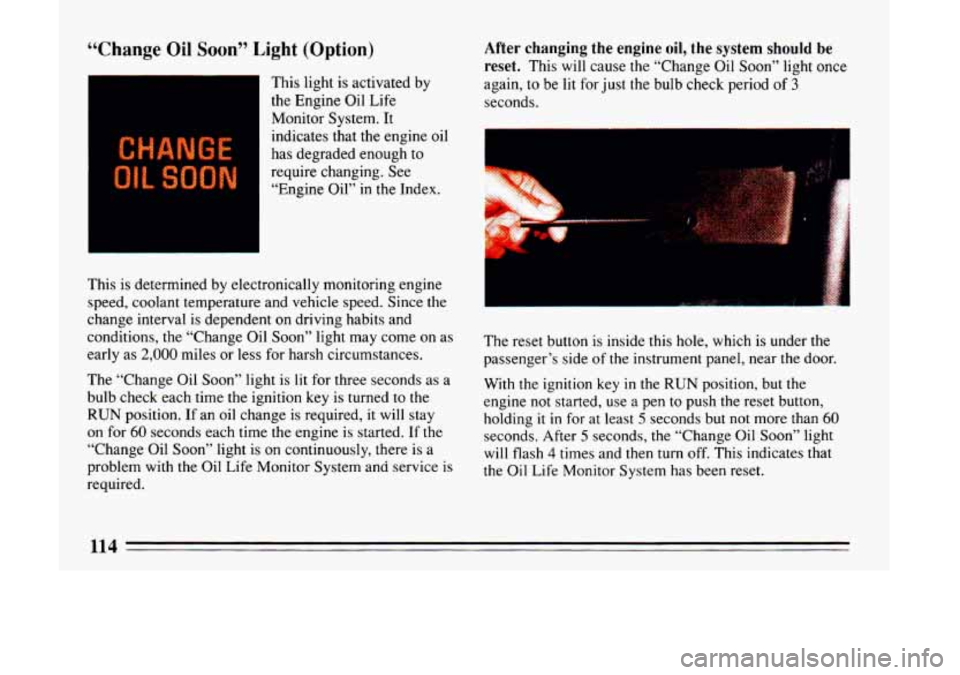
required. The reset button
is inside this hole, which is under the
passenger’s side of the instrument panel, near the door.
With the ignition key in
the RUN position, but the
engine not started, use a pen
to push the reset button,
holding
it in for at least 5 seconds but not more than 60
seconds. After 5 seconds, the “Change Oil Soon” light
will flash
4 times and then turn off. This indicates that
the Oil Life Monitor System has been reset.
1lA
I
Page 123 of 324
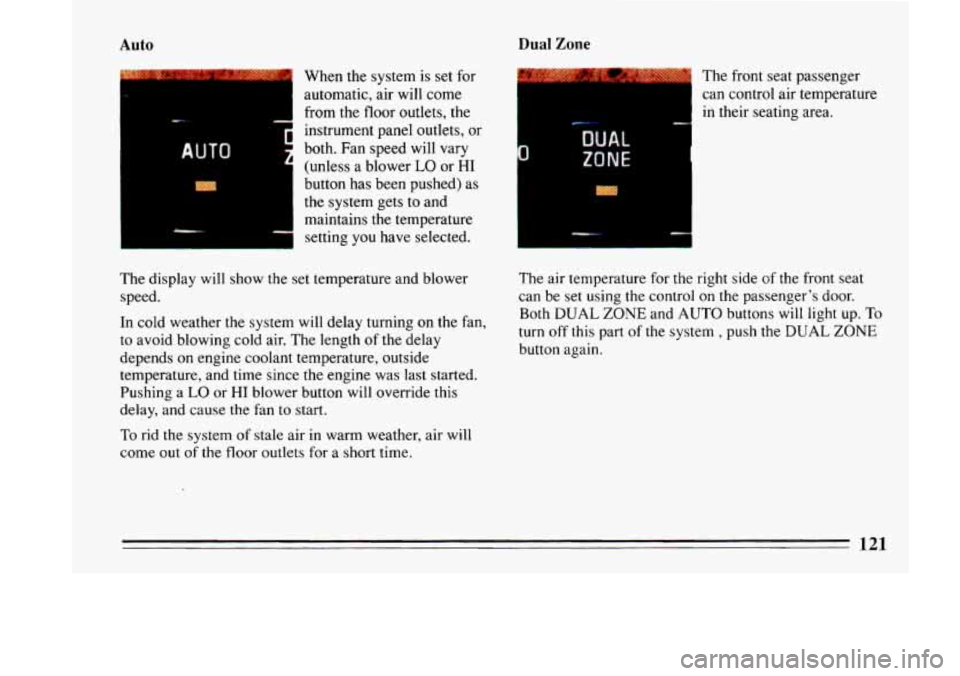
Auto
When the system is set for
automatic, air will come
from the floor outlets, the
instrument panel outlets, or
both.
Fan speed will vary
(unless a blower
LO or HI
button has been pushed) as
the system gets to and
maintains the temperature
setting
you have selected.
Dual Zone
____
The front seat passenger
can control air temperature
in their seating area.
The display will show the set temperature and blower
speed.
In cold weather the system will delay turning on the fan,
to avoid blowing cold air. The length
of the delay
depends
on engine coolant temperature, outside
temperature, and time since the engine was last started.
Pushing a
LO or HI blower button will override this
delay, and cause the fan to start.
To rid the system of stale air in warm weather, air will
come out
of the floor outlets for a short time. The air temperature for
the right side of the front seat
can be set using the control on
the passenger’s door.
Both
DUAL ZONE and AUTO buttons will light up. To
turn off this part of the system , push the DUAL ZONE
button again.
121
Page 127 of 324
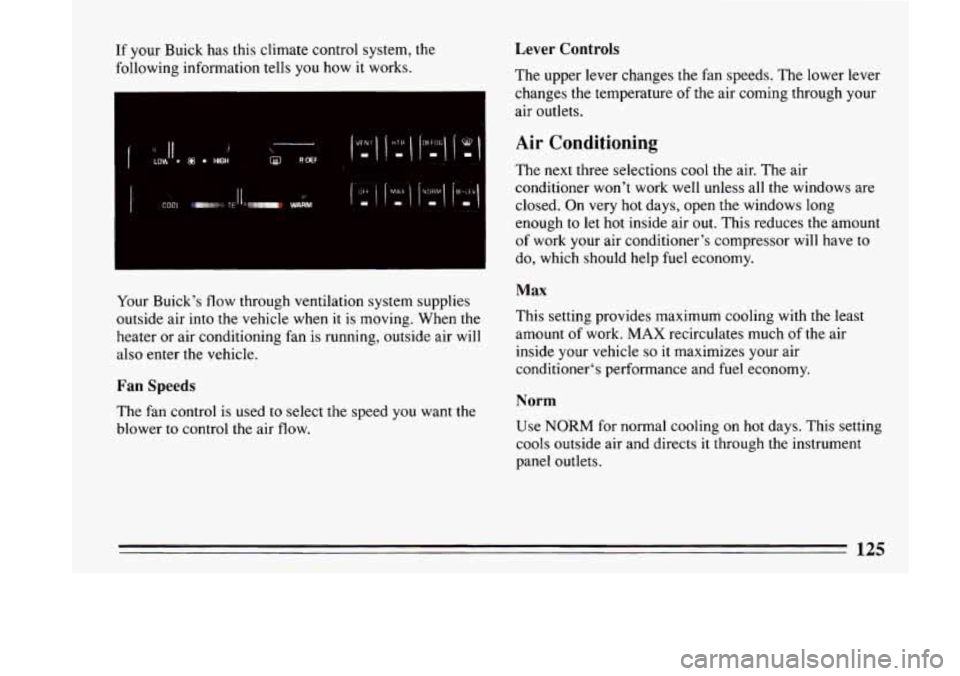
If your Buick has this climate control system, the
following information tells you how it works.
Your Buick's flow through ventilation system supplies
outside air into
the vehicle when it is moving. When the
heater or air conditioning fan is running, outside air
will
also enter the vehicle.
Fan Speeds
The fan control is used to select the speed you want the
blower to control the air flow.
Lever Controls
The upper lever changes the fan speeds. The lower lever
changes the temperature
of the air coming through your
air outlets.
Air Conditioning
The next three selections cool the air. The air
conditioner won't work well unless all the windows are
closed. On very hot days, open the windows long
enough
to let hot inside air out. This reduces the amount
of work your air conditioner's compressor will have to
do, which should help fuel economy.
Max
This setting provides maximum cooling with the least
amount of work.
MAX recirculates much of the air
inside your vehicle
so it maximizes your air
conditioner's performance and fuel economy.
Norm
Use NORM for normal cooling on hot days. This setting
cools outside air and directs it through the instrument
panel outlets.
125
Page 128 of 324
Bi-Level
This setting is designed for use on sunny days when the
air is only moderately warm or
cool. On days like these,
the sun may adequately warm your upper body, but your
lower body may
not be warm enough.
The Bi-level setting directs outside air into your vehicle
in two ways. Cool air is directed toward your upper
body through the instrument panel outlets, while slightly
warmed air is directed through the heater outlet at your
feet.
The air conditioner compressor operates in all Air
Conditioning positions and the Defrost position when
the outside temperature is above
48 OF (9OC).
When you don’t need to cool the outside air, use the
VENT, HEAT, or DEFROST settings. Adjust the
temperature control for comfort. You’ll get better fuel
economy (gas mileage) if you’re
not cooling the outside
air. When
you cool the air, your engine runs a
refrigeration compressor, and it has to work harder.
Vent
For mild outside temperature, when little heating or
cooling is needed, use the
VENT setting. Air will flow
through the instrument panel outlets. Use
the air outlets to
turn on, adjust and turn
off the air flow. Adjust the
temperature lever to the desired temperature.
Heater
When outside temperatures are cold, pressing the HTR
setting and adjusting the temperature lever
will send
warm air through the floor outlets, and some through the
defroster vents.
Def
The Defrost setting directs most of the air flow toward
the windshield. Use defrost when
you want to remove
fog or ice from
the windshield. When it’s 48 OF (9 “C) or
warmer, you’ll get cooled air.
Defog
Air entering the car will be evenly split between the
floor outlets and the outlets near the windshield. You
can control the temperature of the air and the fan speed
to clear the foggy windows.
126
Page 162 of 324
0 If your engine ever stops while you’re driving, brake
normally but don’t pump your brakes.
If you do, the
pedal may get harder to push down.
If your engine
stops, you will still have some power brake assist.
But
you will use it when you brake. Once the power assist
is used up, it may take longer to stop and the brake
pedal will be harder to push.
Anti-Lock Brakes (ABS)
Your Buick has an advanced electronic braking system
that will help prevent skidding.
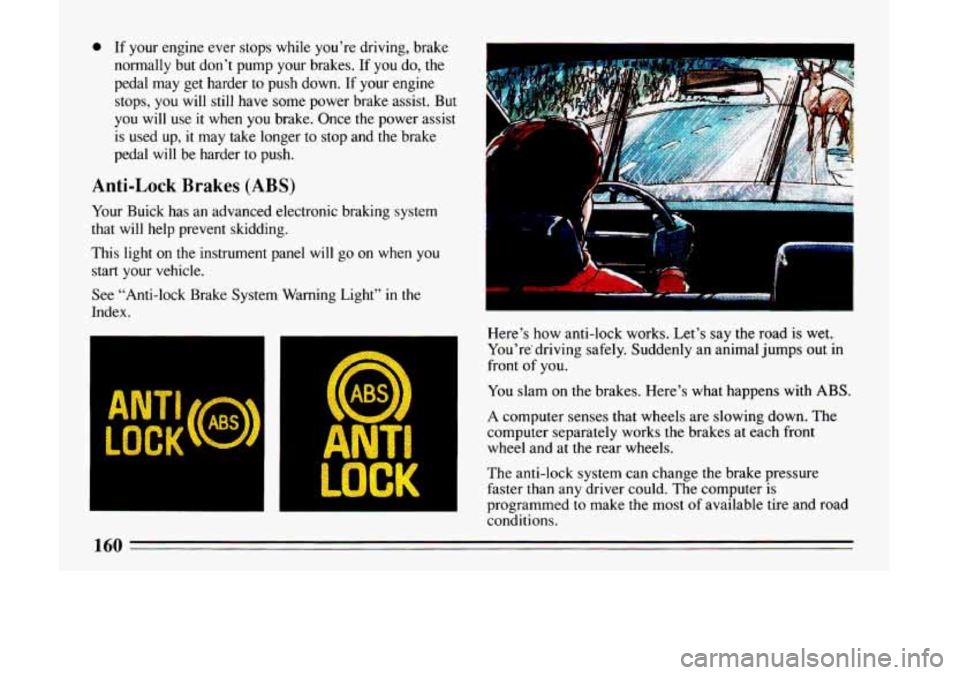
This light
on the instrument panel will go on when you
start your vehicle.
See “Anti-lock Brake System Warning Light”
in the
Index.
@
ANTI
LOCK
‘1 ”. j ’ ;I
- -’ y- ..-
a,
rn
e,
Here’s how anti-lock works. Let’s say the road is wet.
You’re. driving safely. Suddenly an animal jumps
out in
front
of you.
You slam on the brakes. Here’s what happens with ABS.
A computer senses that wheels are slowing down. The
computer separately works the brakes at each front
wheel and at the rear wheels.
The anti-lock system can change the brake pressure
faster than any driver could. The computer
is
programmed to make the most of available tire and road
conditions.
160
Page 195 of 324
Following Distance
Stay at least twice as far behind the vehicle ahead as you
would when driving your vehicle without a trailer. This
can help
you avoid situations that require heavy braking
and sudden turns.
Passing
You’ll need more passing distance up ahead when
you’re towing a trailer. And, because you’re a good deal
longer, you’ll need to go much farther beyond the
passed vehicle before you can return
to your lane.
Backing Up
Hold the bottom of the steering wheel with one hand.
Then,
to move the trailer to the left, just move that hand
to the left. To move the trailer to the right, move your
hand
to the right. Always back up slowly and, if
possible, have someone guide you.
Making nrns
When you’re turning with a trailer, make wider turns
than normal. Do this
so your trailer won’t strike soft
shoulders, curbs, road signs, trees, or other objects.
Avoid jerky or sudden maneuvers. Signal well
in
advance.
Turn Signals When Towing a Trailer
When you tow a trailer, your vehicle has to have a
different turn signal flasher and extra wiring. The green
arrows
on your instrument panel will flash whenever
you signal a turn
or lane change. Properly hooked up,
the trailer lights will also flash, telling other drivers
you’re about to turn, change lanes or stop.
When towing a trailer, the green arrows on your
instrument panel will flash for turns even if the bulbs on
the trailer are burned out.
Thus, you may think drivers
behind you are seeing your signal when they are
not. It’s
important to check occasionally to be sure the trailer
bulbs are still working.
Driving On Grades
Reduce speed and shift to a lower gear before you start
down a long or steep downgrade. If you don’t shift
down,
you might have to use your brakes so much that
they would get hot and no longer work well.
On a long uphill grade, shift down to “D” (Drive) and
reduce your speed to around
45 mph (70 km/h) to
reduce the possibility of engine and transaxle
overheating.
193
Page 210 of 324
Engine Overheating
You will find the warning light about a hot engine on
your Buick instrument panel,
If you have the optional gage cluster, you may also have
a coolant temperature warning gage.
If Steam Is Coming From Your Engine:
CAUTION:
eam from an overheated engine can burn you
badly, even if you just open
the hood. Stay away
from
the engine if you see or hear steam coming
from
it. Just turn it off and get everyone away
From the vehicle until
it cools down. Wait until
there
is no sign of steam or coolant before
opening the hood.
If you keep driving when your engine is
overheated, the liquids in it can catch fire. You or
others could be badly burned. Stop your engine
if it overheats, and get out of the vehicle until the
engine is cool. badly
damaged. The costly
covered by your warranty.
If No Steam Is Coming From Your Engine:
If you get the overheat warning but see or hear no
steam, the problem may not be too serious. Sometimes
the engine can get a little too
hot when you:
Climb a long hill on a hot day.
Stop after high speed driving.
Idle for long periods in traffic.
Tow a trailer.
If you get the overheat warning with no sign of steam,
try this for a minute or so:
1. Turn off your air conditioner.
2. Turn on your heater to full hot at the highest fan
speed and open the window as necessary.
3. If you’re in a traffic jam, shift to “N” (Neutral).
208