tires BUICK LESABRE 1993 User Guide
[x] Cancel search | Manufacturer: BUICK, Model Year: 1993, Model line: LESABRE, Model: BUICK LESABRE 1993Pages: 324, PDF Size: 17.02 MB
Page 182 of 324
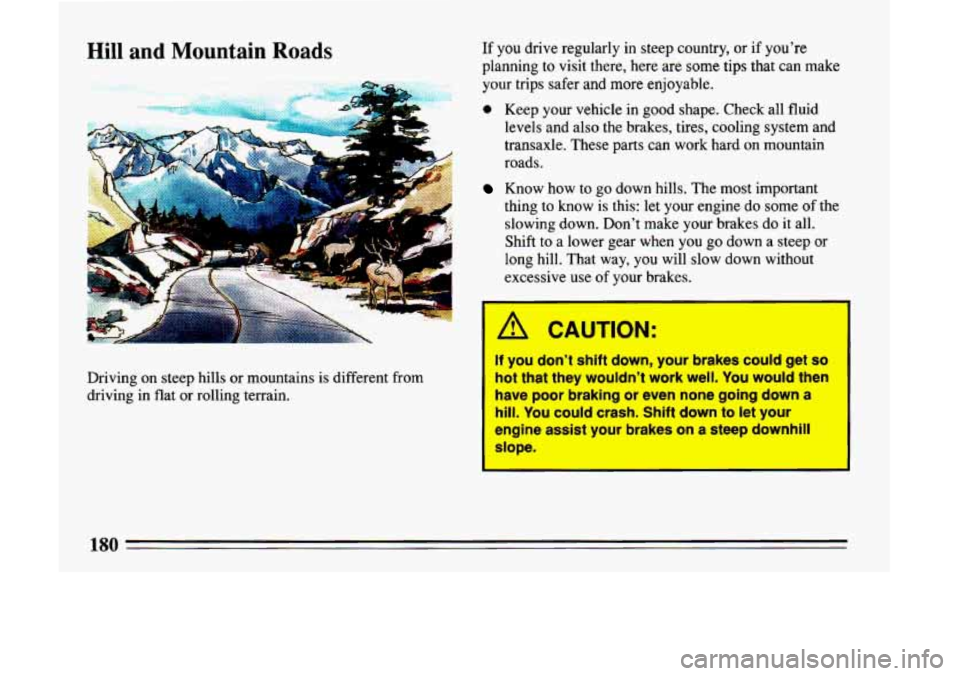
Hill and Mountain Roads
-.
Driving on steep hills or mountains is different from
driving in flat or rolling terrain.
If you drive regularly in steep country, or if you're
planning to visit there, here are
some tips that can make
your trips safer and
more enjoyable.
0 Keep your vehicle in good shape. Check all fluid
levels and also the brakes, tires, cooling system and
transaxle. These parts can work hard
on mountain
roads.
Know how to go down hills. The most important
thing
to know is this: let your engine do some of the
slowing down. Don't make your brakes do it all.
Shift
to a lower gear when you go down a steep or
long hill. That way, you will slow down without
excessive use of your brakes.
A CAUTION:
If you don't shift down, your brakes could get so
hot that they wouldn't work well. You would then
have poor braking
or even none going down a
hill. You could crash. Shift down to let your
engine assist your brakes on
a steep downhill
slope.
180
Page 184 of 324
Parking on Hills
Hills and mountains mean spectacular scenery. But
please be careful where you stop if you decide
to look at
the view or take pictures. Look for pull-offs or parking
areas provided for scenic viewing. Another
part
of this manual tells how to use your parking
brake (see “Parking Brake” in the Index). But on
a
mountain or steep hill, you can do one more thing. You
can turn your front wheels
to keep your vehicle from
rolling downhill or
out into trafflc.
Here’s how:
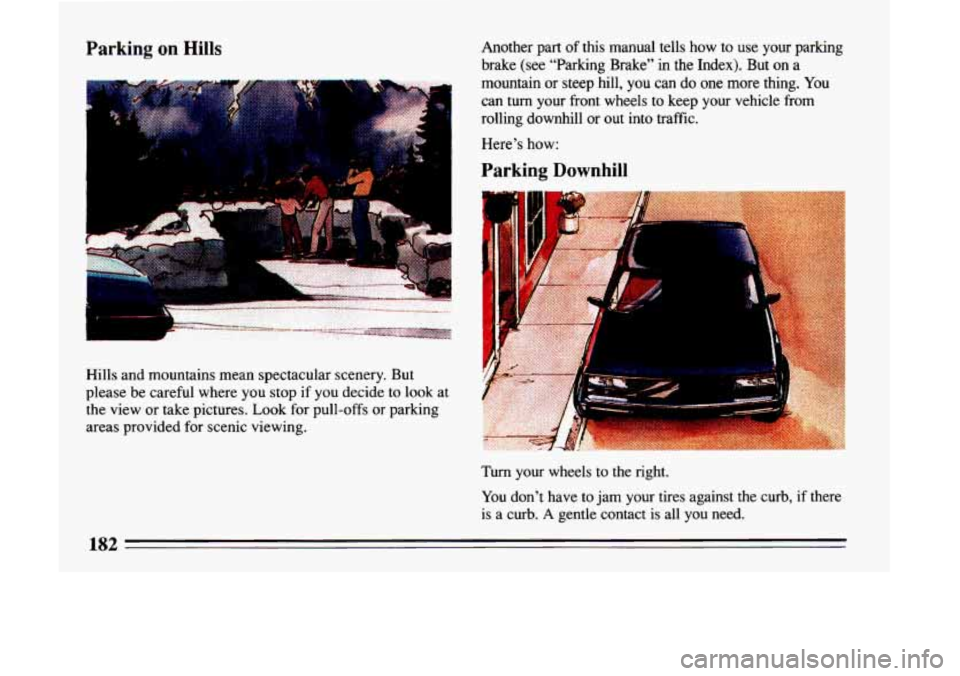
Parking Downhill
Turn your wheels to the right.
You don’t have to jam your tires against the curb, if there
is a curb.
A gentle contact is all you need.
182
Page 187 of 324
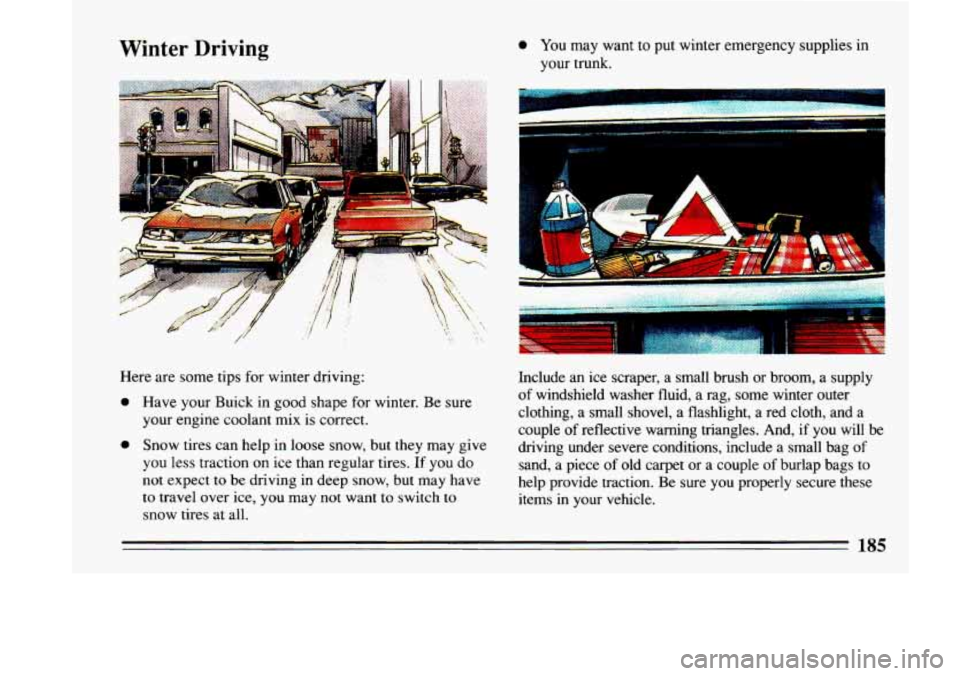
Winter Driving 0 You may want to put winter emergency supplies in
your trunk.
Here are some tips for winter driving:
0 Have your Buick in good shape for winter. Be sure
your engine coolant mix
is correct.
0 Snow tires can help in loose snow, but they may give
you less traction
on ice than regular tires. If you do
not expect
to be driving in deep snow, but may have
to travel over ice, you may not want to switch to
snow tires at all. Include an ice scraper,
a small brush
or broom, a supply
of windshield washer fluid, a rag, some winter outer
clothing, a small shovel, a flashlight, a red cloth, and a
couple
of reflective warning triangles. And, if you will be
driving under severe conditions, include a small bag
of
sand, a piece of old carpet or a couple of burlap bags to
help provide traction. Be sure you properly secure these
items in your vehicle.
185
Page 188 of 324
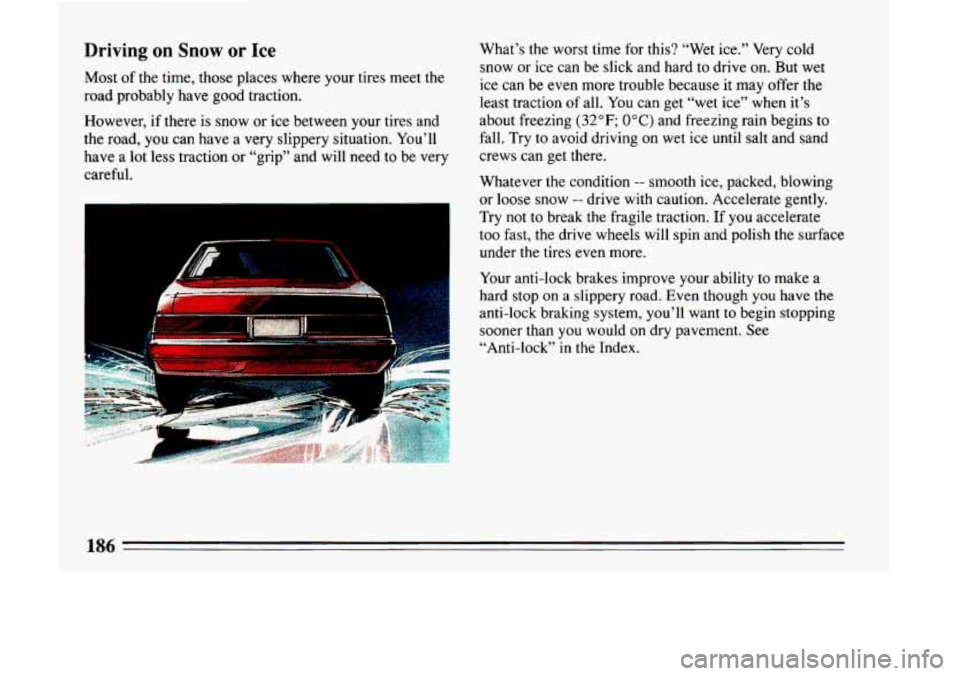
Driving on Snow or Ice
Most of the time, those places where your tires meet the
road probably have good traction.
However, if there is snow or ice between your tires and
the road,
you can have a very slippery situation. You’ll
have a lot less traction or “grip” and will need to be very
careful.
I
What’s the worst time for this? “Wet ice.” Very cold
snow or ice can be slick and hard
to drive on. But wet
ice can be even more trouble because it may offer the
least traction
of all. You can get “wet ice” when it’s
about freezing
(32 OF; OOC) and freezing rain begins to
fall. Try
to avoid driving on wet ice until salt and sand
crews can get there.
Whatever the condition
-- smooth ice, packed, blowing
or loose snow
-- drive with caution. Accelerate gently.
Try not to break the fragile traction.
If you accelerate
too fast, the drive wheels will spin and polish the surface
under the tires even more.
Your anti-lock brakes improve your ability to make a
hard stop
on a slippery road. Even though you have the
anti-lock braking system, you’ll want
to begin stopping
sooner than
you would on dry pavement. See
“Anti-lock‘’ in
the Index.
186
Page 191 of 324
from the cold. But do it as little as possible. Preserve the
fuel
as long as you can. To help keep warm, you can get
out of the vehicle and do some fairly vigorous exercises
every half hour or
so until help comes.
If You’re Stuck in Deep Snow
This manual explains how to get the vehicle out of deep
snow without damaging it. See “Rocking Your Vehicle”
in the Index.
Towing a Trailer
I- I
A CAUTION:
If you don’t use‘the correct equipment and drive
properly, you can lose control when you pull a
trailer. For example, if the trailer Is too heavy, the
brakes may not work well - or even at all. You
and your passengers could be seriously iniured.
Pull a trailer only if you have followed all tt
steps in this section.
I
vehicle and result in costly repairs not covered
by your warranty. To pull a traAer correctly,
follow I
the advice in this section.
Your car can tow a trailer. To identify what the vehicle
trailering capacity is for your vehicle, you should read
the information
in “Weight of the Trailer” that appears
later in this section. But trailering
is different than just
driving your vehicle by itself. Trailering means changes
in handling, durability, and fuel economy. Successful,
safe trailering takes correct equipment, and it has to be
used properly.
That’s the reason for this section. In it are many
time-tested, important trailering tips and safety rules. Many
of these are important for your safety and that of
your passengers. So please read this section carefully
before you pull a trailer.
Load-pulling components such as the engine, transaxle,
wheel assemblies, and tires are forced to work harder
against the drag
of the added weight. The engine is
required to operate at relatively higher speeds and under greater loads, generating extra heat. What’s more, the
189
Page 193 of 324
Weight of the Trailer Tongue
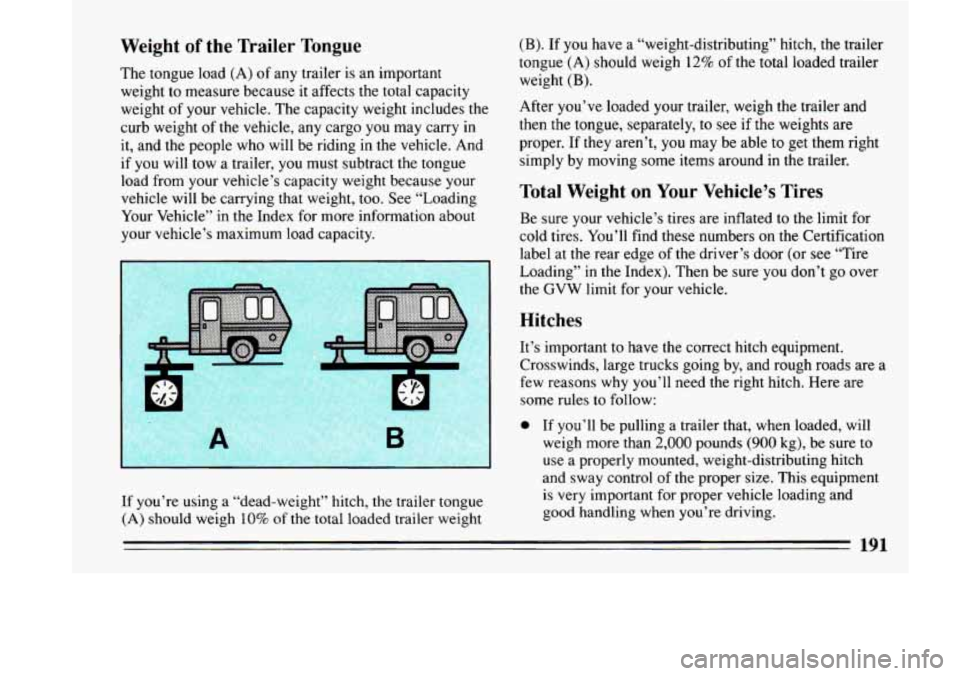
The tongue load (A) of any trailer is an important
weight
to measure because it affects the total capacity
weight
of your vehicle. The capacity weight includes the
curb weight
of the vehicle, any cargo you may carry in
it, and the people who will be riding in the vehicle. And
if
you will tow a trailer, you must subtract the tongue
load from your vehicle’s capacity weight because your
vehicle will be carrying that weight, too. See “Loading
Your Vehicle” in the Index for more information about
your vehicle’s maximum load capacity.
A
If you’re using a “dead-weight” hitch, the trailer tongue
(A) should weigh 10% of the total loaded trailer weight (B).
If you have a “weight-distributing” hitch, the trailer
tongue
(A) should weigh 12% of the total loaded trailer
weight (B).
After you’ve loaded your trailer, weigh the trailer and
then the tongue, separately, to see
if the weights are
proper. If they aren’t, you may be able to get them right
simply by moving some items around in the trailer.
Total Weight on Your Vehicle’s Tires
Be sure your vehicle’s tires are inflated to the limit for
cold tires. You’ll find these numbers on the Certification
label at the rear edge of the driver’s door (or see “Tire
Loading” in the Index). Then be sure you don’t go over
the
GVW limit for your vehicle.
Hitches
It’s important to have the correct hitch equipment.
Crosswinds, large trucks going by, and rough roads are a
few reasons why you’ll need the right hitch. Here are
some rules to follow:
0 If you’ll be pulling a trailer that, when loaded, will
weigh more than
2,000 pounds (900 kg), be sure to
use a properly mounted, weight-distributing hitch
and sway control
of the proper size. This equipment
is very important for proper vehicle loading and
good handling when you’re driving.
191
Page 194 of 324
e e Will you have to make any holes in the body of your vehicle when you install a trailer hitch? If you
do,
then be sure to seal the holes later when you remove
the hitch. If you don’t seal them, deadly carbon
monoxide
(CO) from your exhaust can get into your
vehicle (see “Carbon Monoxide” in the Index). Dirt
and water can, too.
The bumpers on your vehicle are not intended for
hitches.
Do not attach rental hitches or other
bumper-type hitches to them. adequate.
Be sure to read and follow the instructions for
the trailer brakes
so you’ll be able to install, adjust and
maintain them properly. Because you have anti-lock
brakes, do not try to tap into your vehicle’s brake
system.
If you do, both brake systems won’t work well,
or at all.
Driving with a Trailer
Towing a trailer requires a certain amount of experience.
Before setting out for the open road, you’ll want to get
to know your rig. Acquaint yourself with the feel of
handling and braking with the added weight of the
trailer. And always keep in mind that the vehicle you are
driving is now a good deal longer and not nearly
so
responsive as your vehicle is by itself.
Safety Chains
You should always attach chains between your vehicle
and your trailer.
Cross the safety chains under the
tongue
of the trailer so that the tongue will not drop to
the road if it becomes separated from the hitch.
Instructions about safety chains may be provided by the
hitch manufacturer or by the trailer manufacturer.
Follow the manufacturer’s recommendation for
attaching safety chains. Always leave just enough slack
so you can turn with your rig. And, never allow safety
chains to drag
on the ground.
Trailer Brakes
If your trailer weighs more than 1,000 pounds (450 kg)
loaded, then it needs its own brakes
-- and they must be
192
~-
Before you start, check the trailer hitch and platform,
safety chains, electrical connector, lights, tires
and
mirror adjustment. If the trailer has electric brakes, start
your vehicle and trailer moving and then apply the
trailer brake controller by hand to be sure the brakes are
working. This lets you check your electrical connection
at the same time.
During your trip, check occasionally
to be sure that the
load is secure, and that the lights and any trailer brakes
are still working.
Page 205 of 324
12. Remove the cables in reverse order to prevent
electrical shorting. Take care that they don't touch
each other
or any other metal.
rp+,
GOOD BATTERY
I:
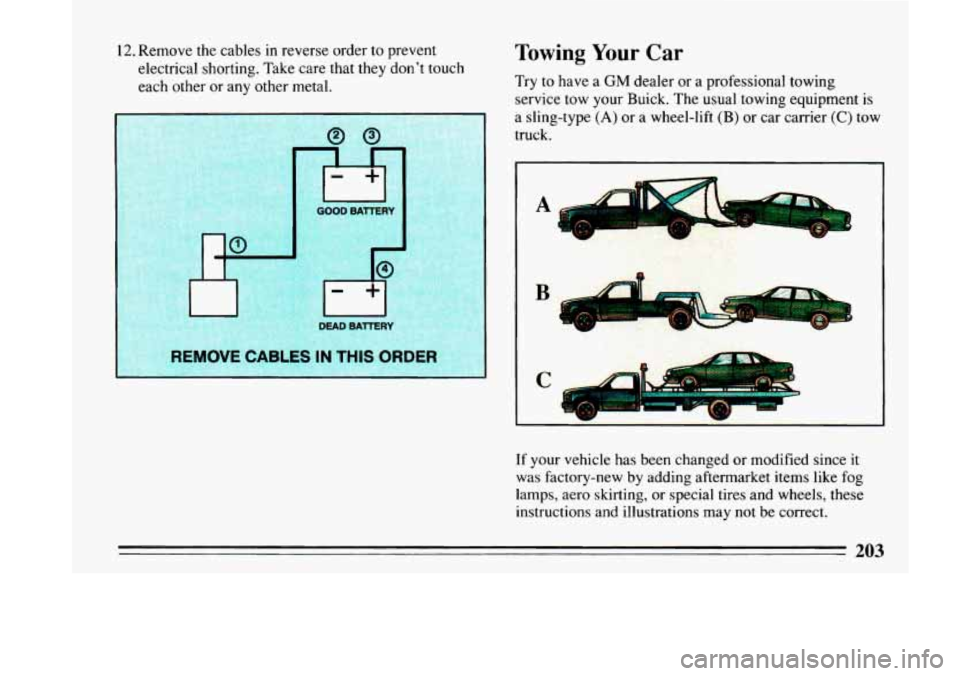
Towing Your Car
Try to have a GM dealer or a professional towing
service tow your Buick. The usual towing equipment is
a sling-type
(A) or a wheel-lift (B) or car carrier (C) tow
truck.
I
If your vehicle has been changed or modified since it
was factory-new by adding aftermarket items like fog
lamps, aero skirting, or special tires and wheels, these
instructions and illustrations may not be correct.
203
Page 218 of 324
If a Tire Goes Flat
It’s unusual for a tire to “blow out” while you’re driving,
especially if you maintain your tires properly.
If air goes
out of a tire, it’s much more likely to leak out slowly.
But if you should ever have a “blowout,” here are a few
tips about what to expect and what to do:
If a front tire fails,
the flat tire will create a drag that
pulls the vehicle toward that side. Take your foot off the
accelerator pedal and grip the steering wheel firmly. Steer to maintain lane position, then gently brake to a
stop well out
of the traffic lane.
A rear blowout, particularly on a curve, acts much like a
skid and may require the same correction you’d use in a
skid. In any rear blowout, remove your foot from the
accelerator pedal. Get the vehicle under control
by
steering the way you want the vehicle to go. It may be
very bumpy and noisy, but you can still steer. Gently
brake to a stop, well
off the road if possible.
If your tire goes flat, the next section shows how to use
your jacking equipment to change a flat tire safely.
Changing a Flat Tire
If a tire goes flat, avoid further tire and wheel damage
by driving slowly to
a level place. Turn on your hazard
warning flashers.
A CAUTION:
Changing 8 tire can cause an injury. The vehicle
can
slip off the jack and roll over you or other
people. You and they could be badly injured. Find
eve1 place to change your tire. To help prevent
the vehicle from moving:
1. Set the parking brake firmly.
2. Put the shift lever In “P” (Park).
3. Turn off the engine.
lo be even more certain the vehicle won’t move,
you can put chocks at the front and rear of the tire
Farthest away from the one being changed. That
would
be the tire on the other side of the vehicle,
at the oppll le end.
216
-
Page 229 of 324
Compact Spare Tire
Although the compact spare was fully inflated when
your vehicle was new, it can lose air after a time. Check
the inflation pressure regularly. It should be
60 psi (420
Wa). The compact spare is made to go up to 3,000 miles
(5000 km), so you can finish your trip and have your
full-size tire repaired or replaced where you want. Of
course, it’s best
to replace your spare with a full-size tire
as soon as
you can. Your spare will last longer and be in
good shape in case you need it again.
Your anti-lock brake system warning light may come
on
when you are driving with a compact spare. See
“Anti-Lock Brake System Warning Light” in the Index. Don’t
use your
compact spare on some other vehicle.
And don’t mix your compact spare or wheel with other
wheels or tires. They won’t fit. Keep your spare and its
wheel together.
Tire chains wo
them will damage
y
chains too. Do
compact spar I
A CnUTION:
Storing a jack, a tire, or other equipment in the
passenger compartment of the vehicle could
cause injury. In a sudden stop or colllsian, loose
mwipment could strike someone. Store all these
.__ the proper place.
I
227