turn signal BUICK LESABRE 1993 User Guide
[x] Cancel search | Manufacturer: BUICK, Model Year: 1993, Model line: LESABRE, Model: BUICK LESABRE 1993Pages: 324, PDF Size: 17.02 MB
Page 178 of 324
Pull to the right (with care) and stop clear of
intersections
when you see or hear emergency
vehicles.
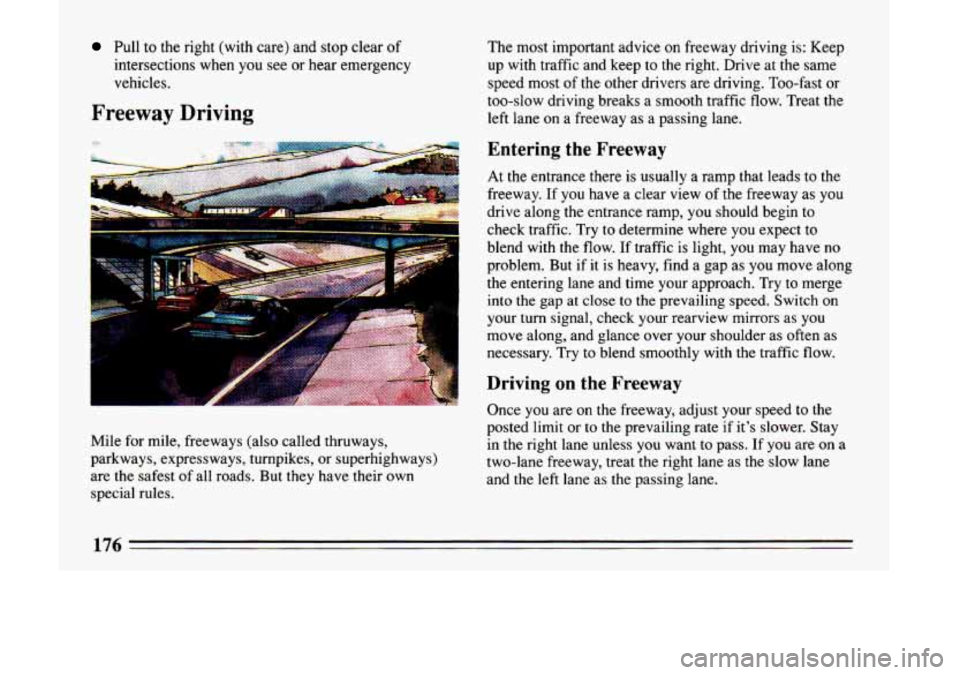
Freeway Driving
The most important advice on freeway driving is: Keep up
with traffic and keep to the right. Drive at the same
speed most
of the other drivers are driving. Too-fast or
too-slow driving breaks
a smooth traffic flow. Treat the
left lane on a freeway as a passing lane.
Mile for mile, freeways (also called thruways,
parkways, expressways, turnpikes, or superhighways)
are the safest
of all roads. But they have their own
special rules.
Entering the Freeway
At the entrance there is usually a ramp that leads to the
freeway. If you have a clear view of the freeway as you
drive along the entrance ramp, you should begin to
check traffic. Try
to determine where you expect to
blend with
the flow. If traffic is light, you may have no
problem. But if
it is heavy, find a gap as you move along
the entering lane and time your approach. Try
to merge
into the gap at
close to the prevailing speed. Switch on
your turn signal, check your rearview mirrors as you
move along, and glance over your shoulder as often as
necessary. Try
to blend smoothly with the traffic flow.
Driving on the Freeway
Once you are on the freeway, adjust your speed to the
posted limit or
to the prevailing rate if it’s slower. Stay
in the right lane unless you want to pass. If you are on a
two-lane freeway, treat the right lane as the slow lane
and the left lane as the passing lane.
Page 179 of 324
If you are on a three-lane freeway, treat the right lane as
the slower-speed through lane, the middle lane as the
higher-speed through lane, and the left lane
as the
passing lane.
Before changing lanes, check your rearview mirrors.
Then use your turn signal.
Just before
you leave the lane, glance quickly over your
shoulder to make sure there isn’t another vehicle in your
“blind” spot.
If you are moving from an outside
to a center lane on a
freeway having more than two lanes, make sure another
vehicle isn’t about to move into the same spot. Look at
the vehicles two lanes over and watch for telltale signs:
turn signals flashing, an increase in speed, or moving
toward the edge of the lane. Be prepared
to delay your
move.
Once
you are moving on the freeway, make certain you
allow
a reasonable following distance. Expect to move
slightly slower at night.
Leaving the Freeway
When you want to leave the freeway, move to the proper
lane well in advance. Dashing across lanes at the last
minute
is dangerous. If you miss your exit do not, under any circumstances, stop
and back up. Drive
on to the
next exit.
AI each exit point is a deceleration lane. Ideally it
should
be long enough for you to enter it at freeway
speed (after signaling,
of course) and then do your
braking before moving onto the exit ramp.
Unfortunately,
not all deceleration lanes are long enough
-- some are too short for all the braking. Decide when to
start braking. If you must brake on the through lane, and
if there is traffic close behind you, you can allow a little
extra time and flash your brake lights
(in addition to
your turn signal) as extra warning that
you are about to
slow down and exit.
The exit ramp can be curved, sometimes quite sharply.
I ne exit speed is usually posted. Reduce your speed
according to your speedometer, not
to your sense of
motion. After driving for any distance at higher speeds,
you may tend
to think you are going slower than you
actually are.
For example, 40 mph (65 km/h) might
seem like only
20 mph (30 km/h). Obviously, this could
lead to serious trouble on a ramp designed for
20 mph
(30 km/h)!
177
Page 181 of 324
On two-lane highways or undivided multilane highways
that do not have controlled access, you’ll want to watch for some situations not usually found on freeways.
Examples are: stop signs and signals, shopping centers with direct access to the highway, no passing zones and school zones, vehicles turning left and right off the road,
pedestrians, cyclists, parked vehicles, and even animals.
Highway Hypnosis
Is there actually such a condition as “highway
hypnosis”? Or is it just plain falling asleep at the wheel?
Call it highway hypnosis, lack of awareness, or
whatever.
There is something about an easy stretch
of road with
the same scenery, along with the hum of the tires on the
road, the drone of the engine, and the rush of the wind
against the vehicle that can make you sleepy. Don’t let it
happen to you! If it does, your vehicle can leave the
road in less than a second, and you could crash and be
injured. What can you
do about highway hypnosis? First, be
aware that it can happen.
Then here are some tips:
e
e
m
0
Make sure your vehicle is well ventilated, with a
comfortably cool interior.
Keep your eyes moving. Scan the road ahead and
to
the sides. Check your rearview mirrors frequently
and your instruments from time
to time. This can
help you avoid
a fixed stare.
Wear good sunglasses in bright light. Glare can
cause drowsiness. But don’t wear sunglasses at
night. They will drastically reduce your overall
vision
at the very time you need all the seeing power
you have.
If you get sleepy, pull off the road into a rest, service,
or parking area and take a nap, get some exercise, or
both. For safety, treat drowsiness on the highway as
an emergency.
As in any driving situation, keep pace with traffic and
allow adequate following distances.
Page 190 of 324
passengers safe: Turn on your hazard flashers. Tie a red
cloth to your vehicle to alert police that you’ve been
stopped
by the snow. Put on extra clothing or wrap a
blanket around you.
If you have no blankets or extra
clothing, make body insulators from newspapers, burlap
bags, rags, floor mats
-- anything you can wrap around
yourself or tuck under your clothing to keep warm.
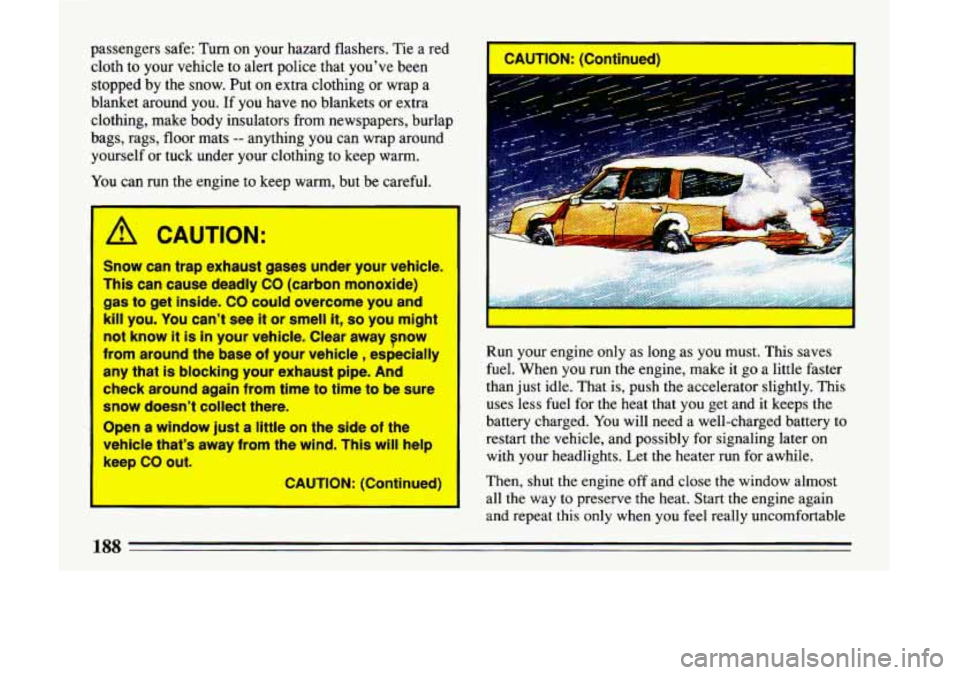
You can run the engine to keep warm, but be careful.
CAUTION: (Continued)
-
4
I-
b, CAUTION:
Snow can trap exhaust gases under your vehicle.
Thls can cause deadly CO (carbon monoxlda)
gas to get inslde. Cb could overcome you and
kill you. You can’t see It or smell it, 50 you might
not know it is in your vehicle. Clear away pow
from around the base of your vehicle I especially
any that is blocking your exhaugt pipe. And
cbk around again from time to time to be sum
snow doesn’t collect them
Open
a window just a little on the slde of the
vehicle that’s away from the wind. This will help
keep CO out.
CAUTION: (Continued)
Run your engine only as long as you must. This saves
fuel. When you run the engine, make it go
a little faster
than just idle. That
is, push the accelerator slightly. This
uses less fuel for the heat that you get and it keeps the
battery charged.
You will need a well-charged battery to
restart the vehicle, and possibly for signaling later on
with your headlights. Let the heater run for awhile.
Then, shut the engine off and close the window almost
all the way to preserve the heat. Start the engine again
and repeat this only when you feel really uncomfortable
188
Page 195 of 324
Following Distance
Stay at least twice as far behind the vehicle ahead as you
would when driving your vehicle without a trailer. This
can help
you avoid situations that require heavy braking
and sudden turns.
Passing
You’ll need more passing distance up ahead when
you’re towing a trailer. And, because you’re a good deal
longer, you’ll need to go much farther beyond the
passed vehicle before you can return
to your lane.
Backing Up
Hold the bottom of the steering wheel with one hand.
Then,
to move the trailer to the left, just move that hand
to the left. To move the trailer to the right, move your
hand
to the right. Always back up slowly and, if
possible, have someone guide you.
Making nrns
When you’re turning with a trailer, make wider turns
than normal. Do this
so your trailer won’t strike soft
shoulders, curbs, road signs, trees, or other objects.
Avoid jerky or sudden maneuvers. Signal well
in
advance.
Turn Signals When Towing a Trailer
When you tow a trailer, your vehicle has to have a
different turn signal flasher and extra wiring. The green
arrows
on your instrument panel will flash whenever
you signal a turn
or lane change. Properly hooked up,
the trailer lights will also flash, telling other drivers
you’re about to turn, change lanes or stop.
When towing a trailer, the green arrows on your
instrument panel will flash for turns even if the bulbs on
the trailer are burned out.
Thus, you may think drivers
behind you are seeing your signal when they are
not. It’s
important to check occasionally to be sure the trailer
bulbs are still working.
Driving On Grades
Reduce speed and shift to a lower gear before you start
down a long or steep downgrade. If you don’t shift
down,
you might have to use your brakes so much that
they would get hot and no longer work well.
On a long uphill grade, shift down to “D” (Drive) and
reduce your speed to around
45 mph (70 km/h) to
reduce the possibility of engine and transaxle
overheating.
193
Page 198 of 324
Hazard Warning Flashers
I
I
.-
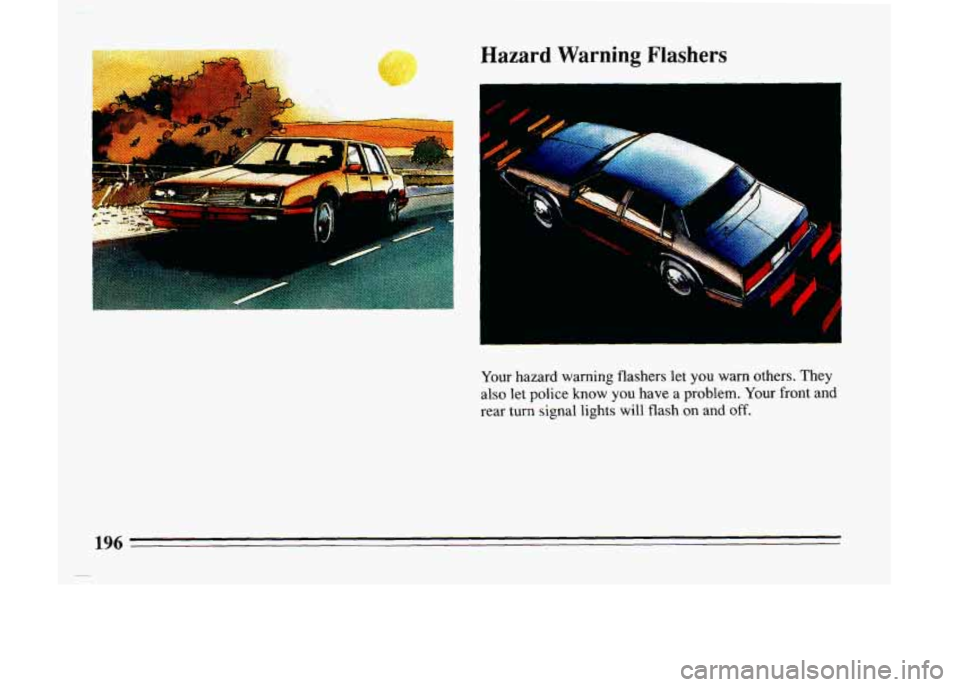
Your hazard warning flashers let you warn others. They
also
let police know you have a problem. Your front and
rear turn signal lights will flash on
and off.
196
Page 199 of 324
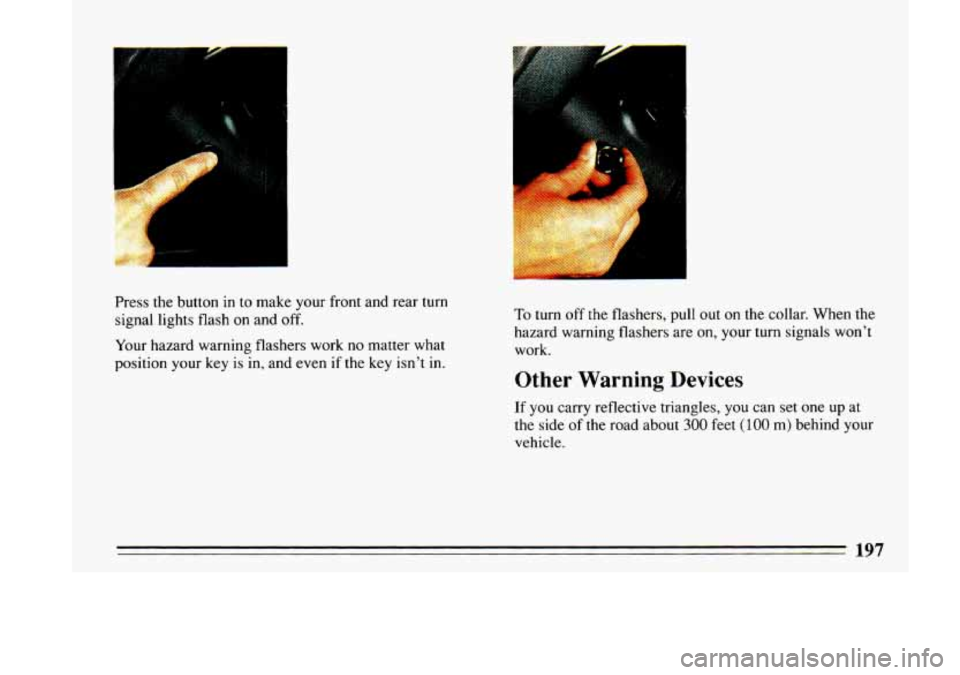
Press the button in to make your front and rear turn
signal lights flash on and
off.
Your hazard warning flashers work no matter what
position your key
is in, and even if the key isn't in.
To turn off the flashers, pull out on the collar. When the
hazard warning flashers are on, your turn signals won't
work.
Other Warning Devices
If you carry reflective triangles, you can set one up at
the side
of the road about 300 feet (1 00 m) behind your
vehicle.
197
Page 308 of 324
Brake Adjustment
................................... 163
Fluid 248 .......................................
Lining Replacement. How to Drive After .......... 249
Master Cylinder
.............................. 248
Brake-Transaxle Shift Interlock
................... 73. 80
Brake System. Antilock Warning Light ............... 108
Brake System Warning Light
....................... 107
Brake Wear Indicators. Disc
....................... 162
Brakes. Antilock
................................ 160
Braking Emergencies
............................. 163
Braking if Your Engine Stops
...................... 160
Break-In. New Vehicle
............................. 68
Break-In Schedule. When Towing a Trailer
............ 189
Bulb Replacement. Headlamp
...................... 250
Bulb Replacement Taillamp
........................ 252
Bulbs. Halogen
.................................. 250
Bulbs.
Turn Signal ................................ 85
Parking ...................................... 76
PedalTravel
................................. 163
Brakes,Rear
.................................... 163
Braking 158 ........................................
Bulbchart ..................................... 274
Camper. Towing a
.............................. 189
...................................... Capacities 275
Cap. Radiator Pressure 245
Care,Appearance
................................ 262
I ............................ Carbon Monoxide in Exhaust ....................... 81
Cassette Tape Player Care
......................... 141
Cautions, Safety
.................................. 10
CB Radio, Adding a
.............................. 128
I
Cellular Telephone. Adding a ...................... 128
“Change Oil Soon” Light
.......................... 114
Change Oil. When to
............................. *239
Changing a Flat Tire
.............................. 216
Charge.Battery.. Warning Light
..................... 115 .
“Check Oil Level” Light .......................... 113
Engine Coolant
............................... 243
Engine Oil Level
.............................. 236
Power Steering Fluid
.......................... 246
Safety Belt Systems
............................ 55
Transaxle Fluid ............................... 241
Windshield Washer Fluid
.......................... 247
Chemical Paint Spotting
........................... 367
Children and Safety Belts
.......................... 41
Cleaner. Air
............... .................... 240
Aluminum Wheels
............................ 266
Inside Your Car
................................ 262
Outside Your Car
............................. 265
Top of the Instrument Panel ..................... 264
Underbody
of Your Car ........................ 267
Vinyl
or Leather .............................. 264
..................................... Chains. Tie 261
Checking BrakeFluid
.................................. 248
UndertheHood
................................. 234
.................................. Child Restraints 43
Cigarette Lighter
................................ 103
CircuitBreakers
................................. 270
City Driving 175
Cleaning ....................................
Fabric ...................................... 263
Glass
...................................... 265
PowerAntenna
............................... 142
Safety Belts 265 ..................................
Page 311 of 324
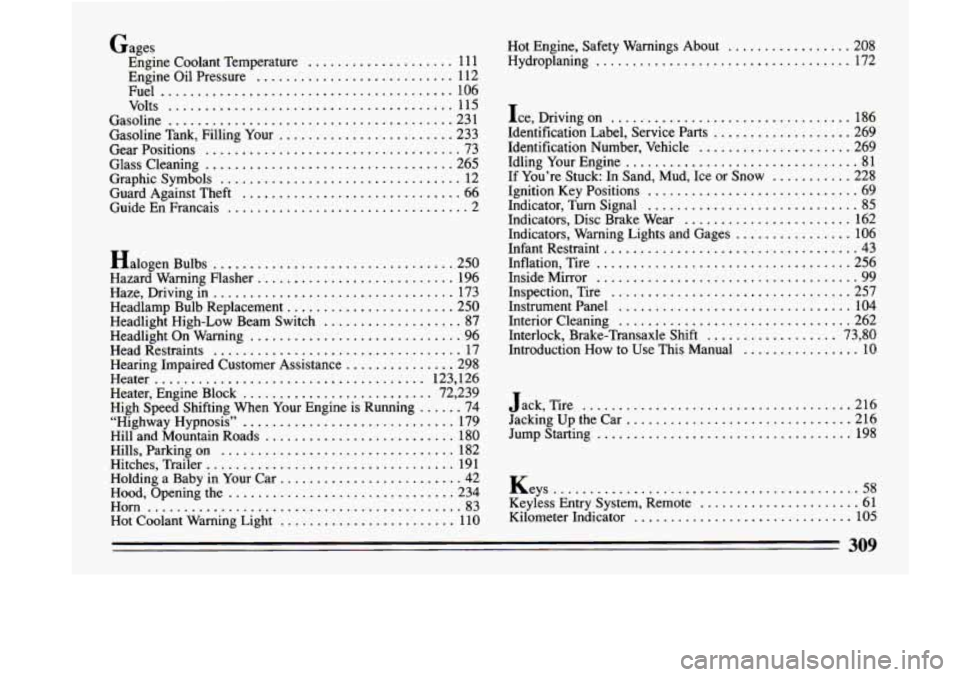
Gages Engine Coolant Temperature
.................... 11 1
Engine Oil Pressure
........................... 112
Fuel
........................................ 106
Volts
....................................... 115
Gasoline
....................................... 231
Gasoline Tank. Filling Your
........................ 233
Gear Positions
................................... 73
Glass Cleaning
.................................. 265
Graphic Symbols
................................. 12
Guard Against Theft
.............................. 66
Guide En Francais
................................. 2
I
H
H
H
H
H
H
H
H
H
H
“I
H
H
H
H
H
H
H
Ialogen Bulbs ................................. 250
[azard Warning Flasher
........................... 196
[aze. Driving in
................................. 173
[eadlamp Bulb Replacement
....................... 250
[eadlight On Warning
............................. 96
[ead Restraints
.................................. 17
[earing Impaired Customer Assistance
............... 298
[eater
..................................... 123. 126
.eater. Engine Block
.......................... 72. 239
Highway Hypnosis”
............................. 179
:ill and Mountain Roads
.......................... 180
ills. Parking on
................................ 182
.itches. Trailer
.................................. 191
:olding a Baby in Your Car
......................... 42
.ood. Opening the
............................... 234
:orn ........................................... 83
:ot Coolant Warning Light
........................ 110
[eadlight High-Low Beam Switch ................... 87
:igh Speed Shifting When Your Engine is Running
...... 74 Hot Engine. Safety Warnings About
................. 208
Hydroplaning ................................... 172
Ice. Driving
on ................................. 186
Identification Label. Service Parts
................... 269
Identification Number. Vehicle
..................... 269
Idling Your Engine
................................ 81
If You’re Stuck: In Sand. Mud. Ice or Snow
........... 228
Ignition Key Positions
............................ -69
Indicator.
Turn Signal ............................. 85
Indicators. Disc Brake Wear ....................... 162
Indicators. Warning Lights and Gages
................ 106
Infant Restraint
................................... 43
Inflation. Tire
................................... 256
Inside Mirror
.................................... 99
Inspection. Tire
................................. 257
Instrument Panel
................................ 104
Interior Cleaning
................................ 262
Interlock. Brake-Transaxle Shift
.................. 73. 80
Introduction How to Use This Manual ................ 10
..................................... J ack. Tire 216
Jacking Up the Car
.............................. -216
Jump Starting
................................... 198
Keys
.......................................... 58
Keyless Entry System. Remote
...................... 61
Kilometer Indicator
.............................. 105
309
.._ .. .
Page 312 of 324
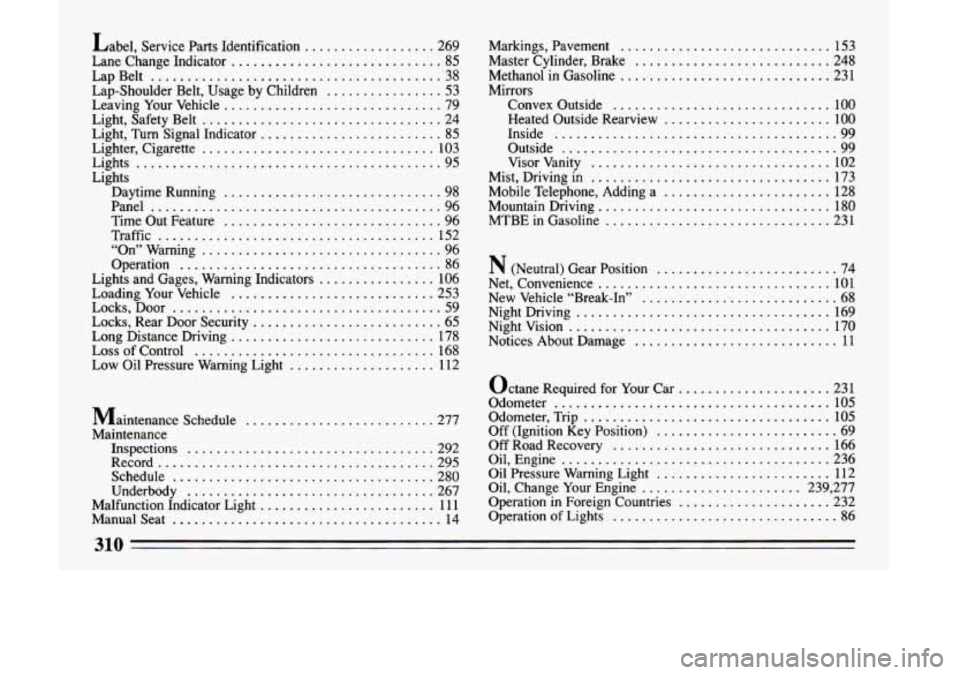
Label. Service Parts Identification .................. 269
Lane Change Indicator
............................. 85
LapBelt
........................................ 38
Lap-Shoulder Belt. Usage by Children
................ 53
Leaving Your Vehicle .............................. 79
Light. Safety Belt
................................. 24
Light.
Turn Signal Indicator ......................... 85
Lighter. Cigarette ................................ 103
Lights
.......................................... 95
Lights
Daytime Running
.............................. 98
Panel
........................................ 96
Time Out Feature
.............................. 96
Traffic
...................................... 152
“On” Warning
................................. 96
Operation
.................................... 86
Lights and Gages. Warning Indicators ................ 106
Loading Your Vehicle
............................ 253
Locks. Door
..................................... 59
Locks. Rear Door Security
.......................... 65
Long Distance Driving ............................ 178
Loss of Control
................................. 168
Low Oil Pressure Warning Light
.................... 112
Maintenance Schedule
.......................... 277
Maintenance Inspections
.................................. 292
Record
...................................... 295
Schedule
.................................... 280
Underbody
.................................. 267
Malfunction Indicator Light
........................ 11 1
Manualseat ..................................... 14 Markings. Pavement
............................. 153
Master Cylinder. Brake ........................... 248
Methanol
in Gasoline ............................. 231
Mirrors Convex Outside
.............................. 100
Heated Outside Rearview
....................... 100
Inside
....................................... 99
Outside
...................................... 99
Visor Vanity
................................. 102
Mist. Driving
in ................................. 173
Mobile Telephone. Adding a
....................... 128
Mountain Driving
................................ 180
MTBE in Gasoline
............................... 231
N (Neutral) Gear Position ......................... 74
Net. Convenience
................................ 101
New Vehicle “Break-In”
........................... 68
NightDriving
................................... 169
Night Vision .................................... 170
Notices About Damage
............................ 11
Octane Required for Your Car
..................... 231
Odometer
...................................... 105
Odometer. Trip
.................................. 105
Off (Ignition Key Position)
......................... 69
Off Road Recovery
.............................. 166
Oil. Engine
..................................... 236
Oil Pressure Warning Light
........................ 112
Operation
in Foreign Countries ..................... 232
Operation of Lights
............................... 86
Oil. Change Your Engine
...................... 239. 277
310 __ .. ~