oil BUICK LESABRE 1993 Owner's Manual
[x] Cancel search | Manufacturer: BUICK, Model Year: 1993, Model line: LESABRE, Model: BUICK LESABRE 1993Pages: 324, PDF Size: 17.02 MB
Page 246 of 324
parts. You can also use a recycled coolant conforming to
GM Specification 1825-M with a complete coolant flush
and refill. Use GM Engine Coolant Supplement (sealer)
with any complete coolant change.
If you use these, you
don’t need
to add anything else.
I k!, CAUTION:
Adding only plain water to your cooling system
can be dangerous. Plain water,
or some other
liquid like alcohol, can boil before the proper
coolant mix will. Your vehicle’s coolant warning
system
is set for the proper coolant mix. With
plain water or the wrong mix, your engine could
get too
hot but you wouldn’t get the overheat
warning. Your engine could catch fire
and you or
others could be burned.
Use a 5050 mix of clean
water and a proper antifreeze.
I
I NO IC i:
IT you use an Improper coolant mix, your engine
could overheat and be badly damaged. The
repair cost wouldn’t be covered
by your
warranty.
Too much water in the mix can treeze
and crack the engine, radiator, heater core and other
parts.
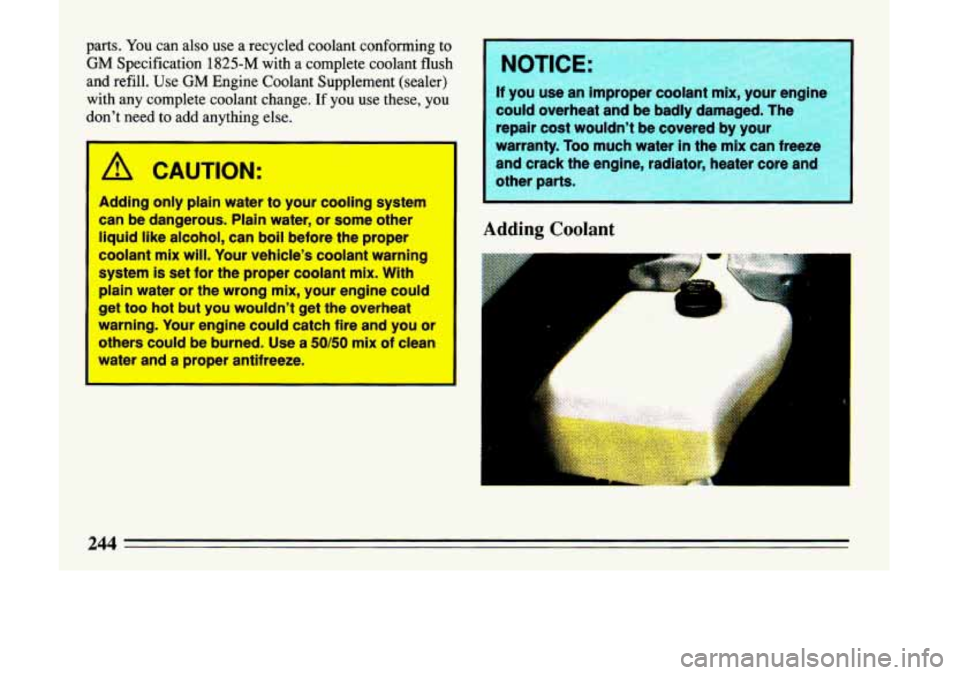
Adding Coolant
Page 251 of 324
What to Add:
When you do need brake fluid, use only DOT-3 brake
fluid
-- such as Delco Supreme 11 @ (GM Part
No. 1052535). Use new brake fluid from a sealed
container only.
DOT-5 silic
your vehicle. Don’t use it.
0 Don’t let someone put in the wrong kind o
fluid. For example, just a few drops of
mineral-based oil, such as engine
oil, in
your brake system can damage brake
system parts
so badly that they’ll have to
Brake fluid can damage paint,
so be caref
Replacing Brake System Parts
The braking system on a modern vehicle is complex. Its
many parts have to be of top quality and work well
together if the vehicle is to have really good braking. Vehicles
we design and test have top-quality GM brake
parts in them, as your Buick does when it is new. When
you replace parts of your braking system -- for example,
when your brake linings wear down and you have to
have new ones put in
-- be sure you get new genuine
GM replacement parts.
If you don’t, your brakes may no
longer work properly. For example, if someone puts in
brake linings that are wrong for your vehicle, the
balance between your front and rear brakes can change,
for the worse. The braking performance you’ve come to
expect can change in many other ways if someone puts
in the wrong replacement brake parts.
Battery
Every new Buick has a Delco Freedoms battery. You
never have to add water to one of these. When it’s time
for a new battery, we recommend a Delco Freedoms
battery. Get one that has the catalog number shown
on
the original battery’s label.
Vehicle Storage
If you’re not going to drive your vehicle for 25 days or
more, take
off the black, negative (-) cable from the
battery. This will help keep your battery from running
down.
249
Page 265 of 324
0 Use solvent-type cleaners in a well-ventilated area
only. If you use them, don’t saturate the stained area.
0 If a ring forms after spot cleaning, clean the entire
area immediately or it will set.
Using Foam-Type Cleaner on Fabric
0
0
0
0
0
0
0
0
0
0
Vacuum and brush the area to remove any loose dirt.
Always clean a whole trim panel or section. Mask
surrounding trim along stitch or welt lines.
Mix Multi-Purpose Powdered Cleaner following the
directions on the container label.
Use suds
only and apply with a clean sponge.
Don’t saturate the material.
Don’t rub it roughly.
As soon as you’ve cleaned the section, use a sponge
to remove the suds.
Rinse the section with
a clean, wet sponge.
Wipe off what’s left with a slightly damp paper towel
or cloth.
Then dry
it immediately with an air hose, a hair
dryer
or a heat lamp.
I
Wipe with a clean cloth.
Using Solvent-Type Cleaner on
Fabric
First, see if you have to use solvent-type cleaner at all.
Some spots and stains will clean off better with just
water and mild soap.
If you need
to use it, then:
0
0
Gently scrape excess soil from the trim material with
a clean, dull knife or scraper. Use very little cleaner,
light pressure and clean cloths (preferably
cheesecloth). Cleaning should start
at the outside of
the stain, “feathering” toward the center. Keep
changing to a clean section of the cloth.
When you clean a stain from fabric, immediately dry
the area with an air hose, hair dryer, or heat lamp to
help prevent a cleaning ring. (See the previous
NOTICE.)
263
Page 266 of 324
Special Cleaning Problems
Greasy or Oily Stains: Like grease, oil, butter,
margarine, shoe polish, coffee with cream, chewing
gum, cosmetic creams, vegetable oils, wax crayon, tar
and asphalt.
Carefully scrape off excess stain.
Then follow the solvent-type instructions above.
Shoe polish, wax crayon, tar and asphalt will stain if
left on a vehicle seat fabric. They should be removed
as soon as possible. Be careful, because the cleaner
will dissolve them and may cause them to bleed.
Non-Greasy Stains: Like catsup, coffee (black), egg,
fruit, fruit juice, milk, soft drinks, wine, vomit, urine and
blood.
Carefully scrape off excess stain, then sponge the
soiled area with cool water.
If a stain remains, follow the foam-type instructions
above.
If an odor lingers after cleaning vomit or urine, treat
the area with a waterbaking soda solution:
1
teaspoon (5 ml) of baking soda to 1 cup (250 ml) of
lukewarm water.
0 Finally, if needed, clean lightly with solvent-type
cleaner.
Combination Stains: Like candy, ice cream,
mayonnaise, chili sauce and unknown stains.
Carefully scrape off excess stain, then clean with
cool water
and allow to dry.
0 If a stain remains, clean it with solvent-type cleaner.
Cleaning Vinyl or Leather
Just use warm water and a clean cloth.
Rub with a clean, damp cloth to remove dirt. You
Things like tar, asphalt and shoe polish will stain if may have to do it more than once.
you don’t get them
off quickly. Use a clean cloth and
solvent-type vinylbeather cleaner.
Cleaning the Top of the Instrument
Panel
Use only mild soap and water to clean the top surfaces
of the instrument panel. Sprays containing silicones or
waxes may cause annoying reflections in the windshield
and even make it difficult to see through the windshield
under certain conditions.
264
Page 269 of 324
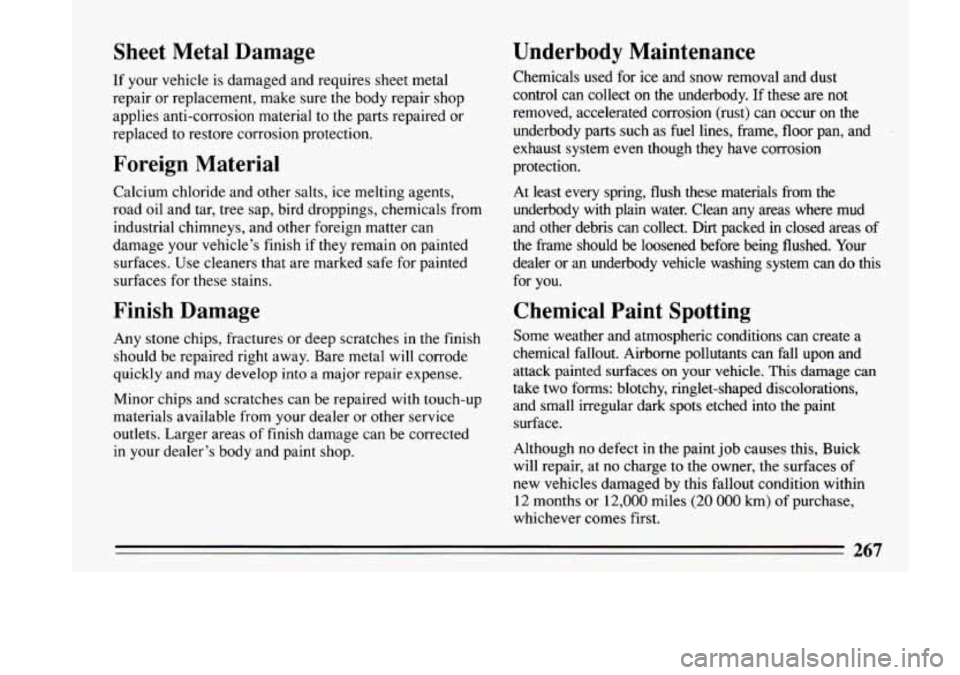
Sheet Metal Damage
If your vehicle is damaged and requires sheet metal
repair or replacement, make sure the body repair shop
applies anti-corrosion material to the parts repaired or
replaced to restore corrosion protection.
Foreign Material
Calcium chloride and other salts, ice melting agents,
road oil and tar, tree sap, bird droppings, chemicals from
industrial chimneys, and other foreign matter can
damage your vehicle’s finish if
they remain on painted
surfaces. Use cleaners that are marked
safe for painted
surfaces for
these stains.
Finish Damage
Any stone chips, fractures or deep scratches in the finish
should be repaired right away. Bare metal will corrode
quickly and may develop
into a major repair expense.
Minor chips and Scratches can be repaired with touch-up
materials available from your dealer or other service
outlets. Larger areas of finish damage can be corrected
in your dealer’s body and paint shop.
Underbody Maintenance
Chemicals used for ice and snow removal and dust
control can collect on the underbody.
If these are not
removed, accelerated corrosion (rust) can occur on the
underbody parts such as fuel lines, frame, floor pan, and
exhaust system even though they have corrosion
protection.
At least every spring, flush these materials from the
underbody with plain water. Clean any areas where mud
and other debris can collect.
Dirt packed in closed areas of
the frame should be
loosened before being flushed. Your
dealer or an underbody vehicle washing system can do this
for
you.
Chemical Paint Spotting
Some weather and atmospheric conditions can create a
chemical fallout. Airborne pollutants can fall upon and
attack painted surfaces
on your vehicle. This damage can
take two forms: blotchy, ringlet-shaped discolorations,
and small irregular dark spots etched into the paint
surface.
Although no defect in the paint job causes this, Buick
will repair, at
no charge to the owner, the surfaces of
new vehicles damaged by this fallout condition within
12 months or 12,000 miles (20 000 km) of purchase,
whichever comes first.
Page 270 of 324
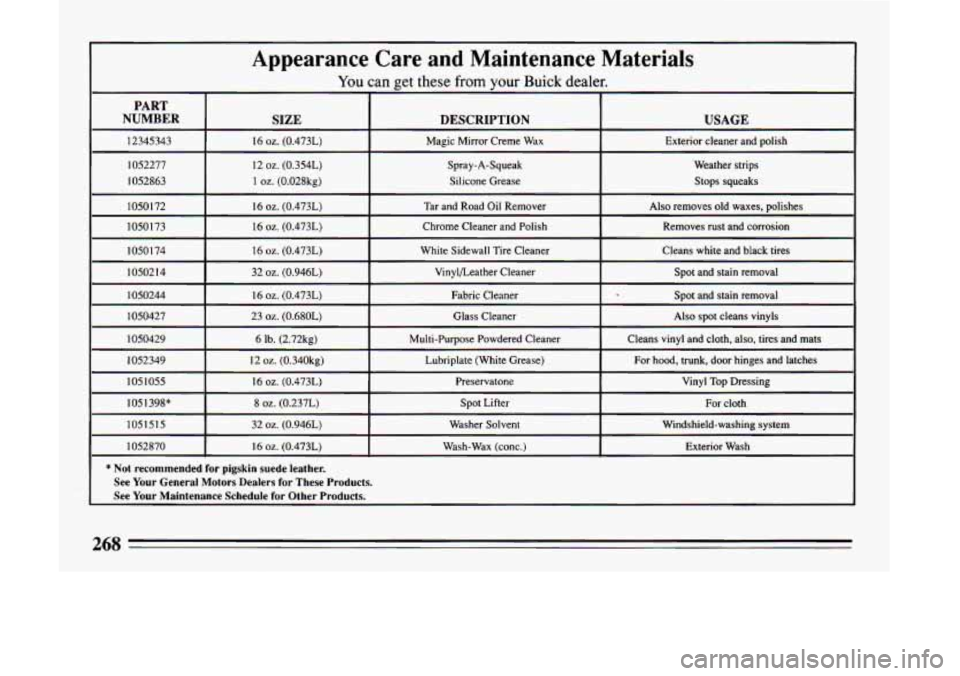
Appearance Care and Maintenance Materials
You can get these from your Buick dealer.
PART
NUMBER USAGE
DESCRIPTION
SIZE
12345343
Stops squeaks Silicone Grease
1 oz. (0.028kg)
1052863 Weather strips
Spray-A-Squeak
12
02. (0.354L)
1052277 Exterior cleaner and polish Magic Mirror Creme
Wax
16
02. (0.473L)
1050 172
Cleans white and black tires White Sidewall Tire Cleaner
16 oz. (0.473L) 1050 I74 Removes rust and corrosion
Chrome Cleaner and Polish
16 oz. (0.473L)
1050173 Also removes old waxes, polishes
Tar and Road Oil Remover
16
oz. (0.473L)
1050214 32
02. (0.946L) Vinylbeather
Cleaner Spot and stain removal
1050244 16
02. (0.473L) Fabric Cleaner Spot and stain removal
1050427 23
02. (0.680L) Glass Cleaner Also spot cleans vinyls
1050429 6
Ib. (2.72kg) Multi-Purpose Powdered Cleaner Cleans vinyl and cloth, also, tires and mats
1052349 12
02. (0.340kg) Lubriplate (White Grease) For hood, trunk, door hinges and latches
1051055 16
oz. (0.473L) Preservatone Vinyl Top Dressing
1051398*
8 oz. (0.237L) Spot Lifter For cloth
1051515 32
02. (0.946L) Washer Solvent Windshield-washing system
1052870 16
02. (0.473L) Wash-Wax (conc.) Exterior Wash
I
I
* Not recommended for pigskin suede leather.
See Your General Motors Dealers
for These Products. I
I
I See Your Maintenance Schedule for Other Products. I
Page 273 of 324
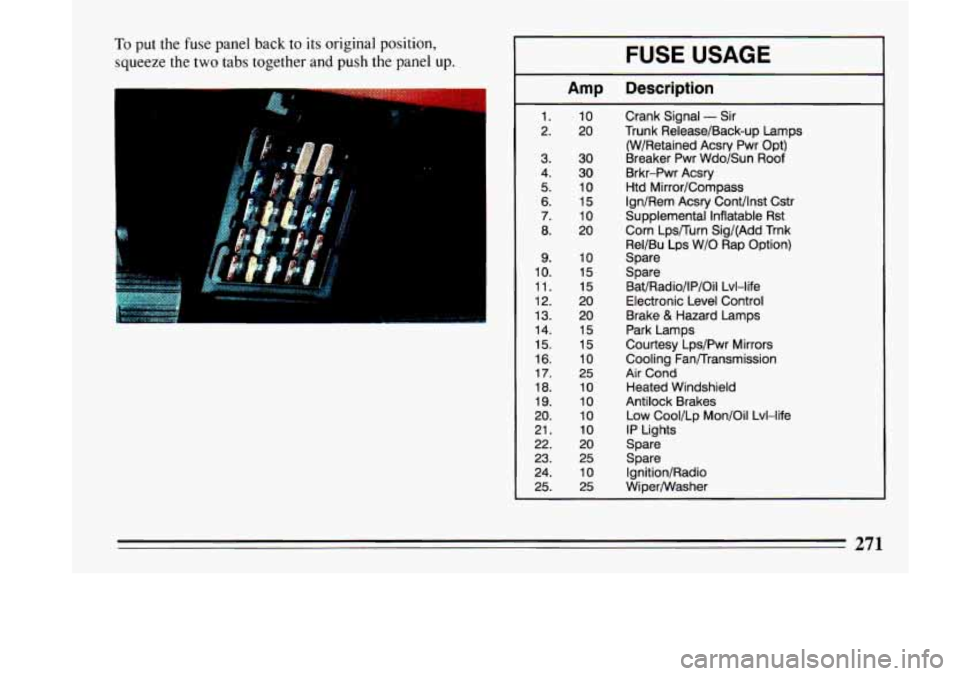
To put the fuse panel back to its original position,
squeeze the two tabs together and push the panel up.
r
E
6
P-
..
-
FUSE USAGE
--- ~
Amp Description
1.
2.
3.
4.
5.
6.
7.
8.
9.
10.
11.
12.
13.
14.
15.
16.
17.
18.
19.
20.
21.
22.
23.
24.
25. 10
20
30
30
10
15
10
20
10
15
15
20
20
15 15
10
25
10
10 10
10
20
25
10
25
Crank Signal - Sir
Trunk Release/Back-up Lamps (W/Retained Acsrv Pwr Opt)
Breaker Pwr Wdo/Sun Roof
Brkr-Pwr Acsry
Htd Mirror/Compass
Ign/Rem Acsry Cont/lnst Cstr
Supplemental Inflatable
Rst
Corn Lpsflurn Sig/(Add Trnk
Rel/Bu Lps W/O Rap Option)
Spare
Spare
Bat/Radio/lP/Oil Lvl-life
Electronic Level Control
Brake
& Hazard Lamps
Park Lamps
Courtesy Lps/Pwr Mirrors
Cooling Fanflransmission
Air Cond
Heated Windshield
Antilock Brakes Low Cool/Lp Mon/Oil Lvl-life
IP Lights
Spare
Spare Ignition/Radio
WiperWasher
271
Page 277 of 324
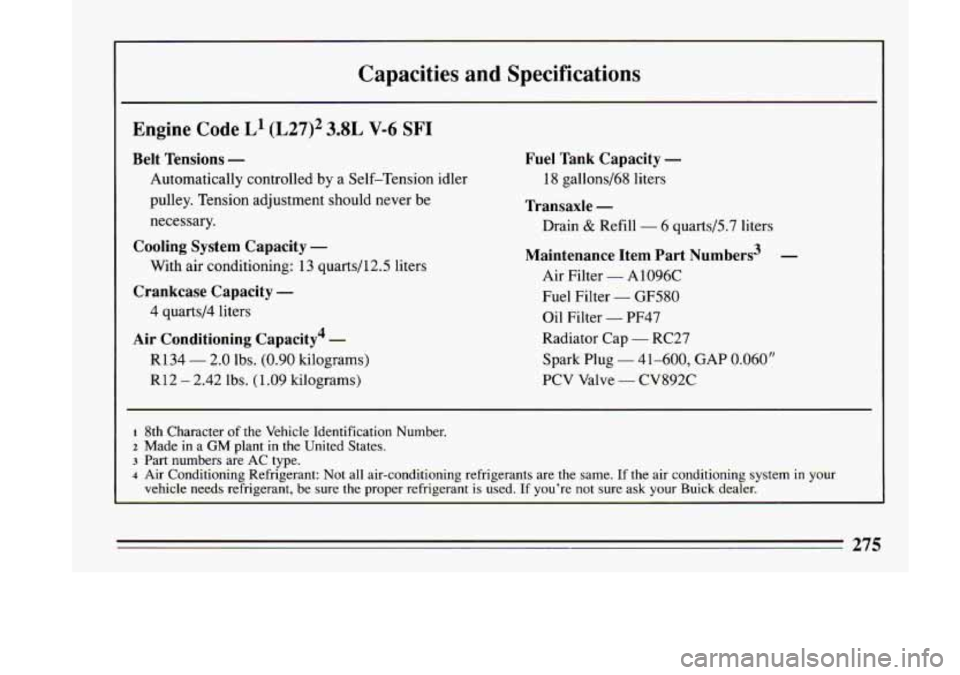
Capacities and Specifications
Engine Code L1 (L27)2 3.8L V-6 SF1
Belt Tensions -
Automatically controlled by a Self-Tension idler
pulley. Tension adjustment should never
be
necessary.
Cooling System Capacity -
Crankcase Capacity -
Air Conditioning Capacity4 -
With air conditioning: 13 quarts/l2.5 liters
4 quarts/4 liters
R134
- 2.0 lbs. (0.90 kilograms)
R12 - 2.42 lbs. ( 1.09 kilograms)
Fuel Tank Capacity -
18 gallons/68 liters
Transaxle -
Drain & Refill - 6 quarts/5.7 liters
Maintenance Item Part Numbers3 -
Air Filter - A1096C
Fuel Filter
- GF580
Oil Filter
- PF47
Radiator Cap - RC27
Spark Plug
- 41-600, GAP 0.060”
PCV Valve
- CV892C
1 8th Character of the Vehicle Identification Number.
2 Made in a GM plant in the United States.
3 Part numbers are AC type.
4 Air Conditioning Refrigerant: Not all air-conditioning refrigerants are the same. If the air conditioning system in your
vehicle needs refrigerant, be sure the proper refrigerant
is used. If you’re not sure ask your Buick dealer.
Page 280 of 324
I IMPORTANT:
KEEP ENGINE OIL AT THE PROPER
LEVELANDCHANGEAS RECOMMENDED
1
Protection I
Plan I
Have you purchased the GM Protection Plan? The
Plan supplements your new vehicle warranties. See
your Buick dealer for details.
Introduction
A Word About Maintenance
We at General Motors want to help you keep your
vehicle in good working condition. But we don’t know
exactly
how you’ll drive it. You may drive very short
distances
only a few times a week. Or you may drive
long distances all the time in very hot, dusty weather.
You may use your vehicle in making deliveries. Or you
may drive it to work, to do errands or in many other
ways.
Because of all the different ways people
use their GM
vehicles, maintenance needs vary. You may even need
more frequent checks and replacements than you will
find in the schedules in this part.
So please read this part
and note how
you drive. If you have any questions on
how to keep your vehicle in good condition,
see your
Buick dealer, the place many GM owners choose to
have their maintenance work done. Your dealer can be
relied upon to
use proper parts and practices.
278
Page 284 of 324
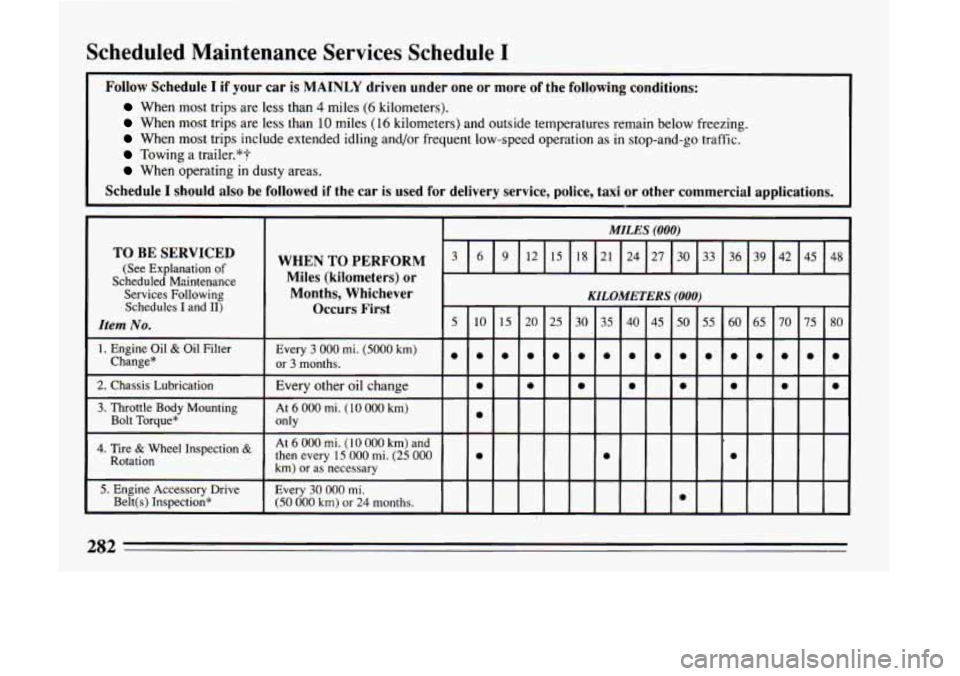
Scheduled Maintenance Services Schedule I
Follow Schedule I if your car is MAINLY driven under one .or more of the following conditions:
When most trips are less than 4 miles (6 kilometers).
When most trips are less than 10 miles (16 kilometers) and outside temperatures remain below freezing.
When most trips include extended idling and/or frequent low-speed operation as in stop-and-go traffic.
Towing a trailer.*?
When operating in dusty areas.
Schedule I should also be followed if the car is used for delivery service, police, taxi or other commercial applications.
I I MILES (000) ~ ~ ~~
TO BE SERVICED
Miles (kilometers) or
Scheduled Mzintenance
48 45 42 39
36
33 30 27
24 21 18 15 12 9 6 3 WHEN TO PERFORM (See Explanation of
~ ~~ ~~
Services Following
Schedules I and
11)
Months, Whichever
Occurs First
Item No.
1. Engine Oil & Oil Filter Every 3 000 mi. (5000 km)
Change* or
3 months.
2. Chassis Lubrication Every
other oil change
3. Throttle Body Mounting At 6 000 mi. (10 000 km)
~~
Bolt Torque*
only
4* Tire & Inspection & then every 15 000 mi. (25 000 At 6 000 mi. ( 10 000 km) and
km)
or as necessary
Rotation
5. Engine
Accessory Drive
Every 30 000 mi.
Belt(s) Inspection* (50 000 km) or 24 months.
5 10
e.
e
e
e
20 25
e.
e
KILOMETERS (000)
30 35
me
e
e
40 45
em
e
50 55
me
e
e
282