warning BUICK LESABRE 1993 Owner's Guide
[x] Cancel search | Manufacturer: BUICK, Model Year: 1993, Model line: LESABRE, Model: BUICK LESABRE 1993Pages: 324, PDF Size: 17.02 MB
Page 214 of 324
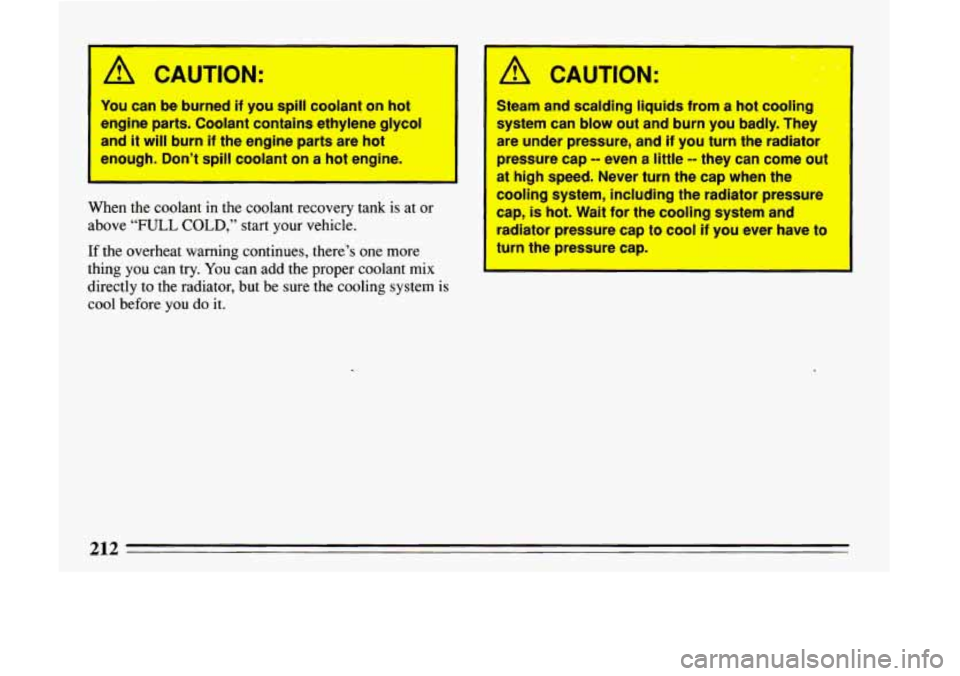
A CAUTION:
You can be burned if you spill coolant on hot
engine parts. Coolant contains ethylene
glycol
and it will burn if the engine parts are hot
enough. Don’t
spill coolant on a hot engine.
When the coolant in the coolant recovery tank is at or
above “FULL COLD,” start your vehicle.
If the overheat warning continues, there’s one more
thing you can try.
You can add the proper coolant mix
directly to the radiator, but be sure the cooling system
is
cool before you do it.
Steam and scalding -liquids from a hot cooling
system
can blow out and burn you badly. They
are under pressure,
and if you turn the radiator
pressure cap
- even a little -- they can come out
at high speed..Never turn the cap when the
cooling system, including the radiatorpressure
cap, is hot. Wait for the cooling system and
radiator pressure
cap to cool if you ever have40
turn the pressure cap.
212
Page 218 of 324
If a Tire Goes Flat
It’s unusual for a tire to “blow out” while you’re driving,
especially if you maintain your tires properly.
If air goes
out of a tire, it’s much more likely to leak out slowly.
But if you should ever have a “blowout,” here are a few
tips about what to expect and what to do:
If a front tire fails,
the flat tire will create a drag that
pulls the vehicle toward that side. Take your foot off the
accelerator pedal and grip the steering wheel firmly. Steer to maintain lane position, then gently brake to a
stop well out
of the traffic lane.
A rear blowout, particularly on a curve, acts much like a
skid and may require the same correction you’d use in a
skid. In any rear blowout, remove your foot from the
accelerator pedal. Get the vehicle under control
by
steering the way you want the vehicle to go. It may be
very bumpy and noisy, but you can still steer. Gently
brake to a stop, well
off the road if possible.
If your tire goes flat, the next section shows how to use
your jacking equipment to change a flat tire safely.
Changing a Flat Tire
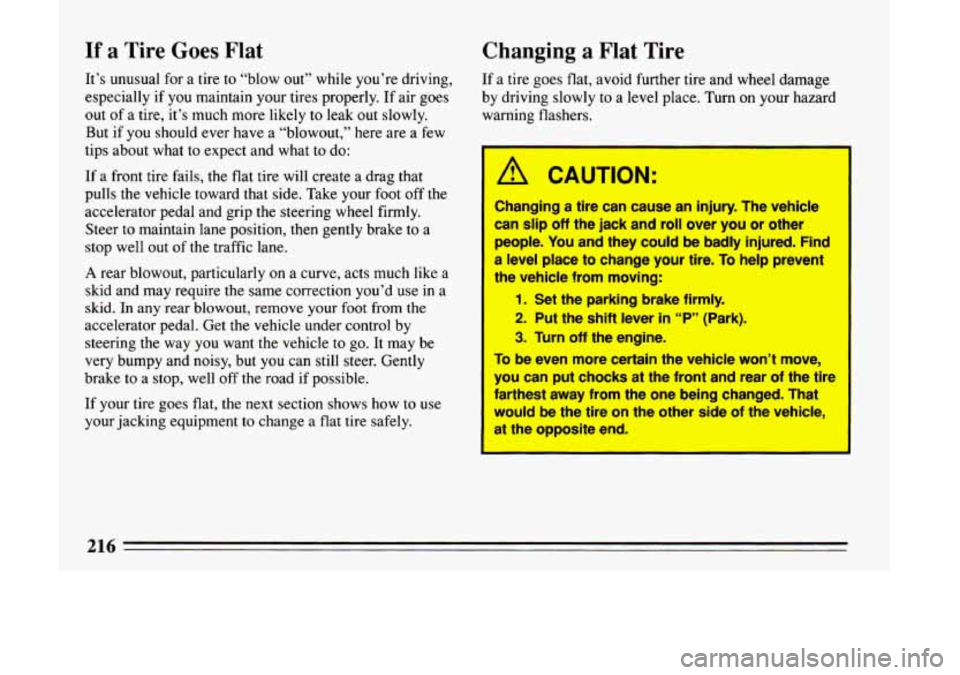
If a tire goes flat, avoid further tire and wheel damage
by driving slowly to
a level place. Turn on your hazard
warning flashers.
A CAUTION:
Changing 8 tire can cause an injury. The vehicle
can
slip off the jack and roll over you or other
people. You and they could be badly injured. Find
eve1 place to change your tire. To help prevent
the vehicle from moving:
1. Set the parking brake firmly.
2. Put the shift lever In “P” (Park).
3. Turn off the engine.
lo be even more certain the vehicle won’t move,
you can put chocks at the front and rear of the tire
Farthest away from the one being changed. That
would
be the tire on the other side of the vehicle,
at the oppll le end.
216
-
Page 229 of 324
Compact Spare Tire
Although the compact spare was fully inflated when
your vehicle was new, it can lose air after a time. Check
the inflation pressure regularly. It should be
60 psi (420
Wa). The compact spare is made to go up to 3,000 miles
(5000 km), so you can finish your trip and have your
full-size tire repaired or replaced where you want. Of
course, it’s best
to replace your spare with a full-size tire
as soon as
you can. Your spare will last longer and be in
good shape in case you need it again.
Your anti-lock brake system warning light may come
on
when you are driving with a compact spare. See
“Anti-Lock Brake System Warning Light” in the Index. Don’t
use your
compact spare on some other vehicle.
And don’t mix your compact spare or wheel with other
wheels or tires. They won’t fit. Keep your spare and its
wheel together.
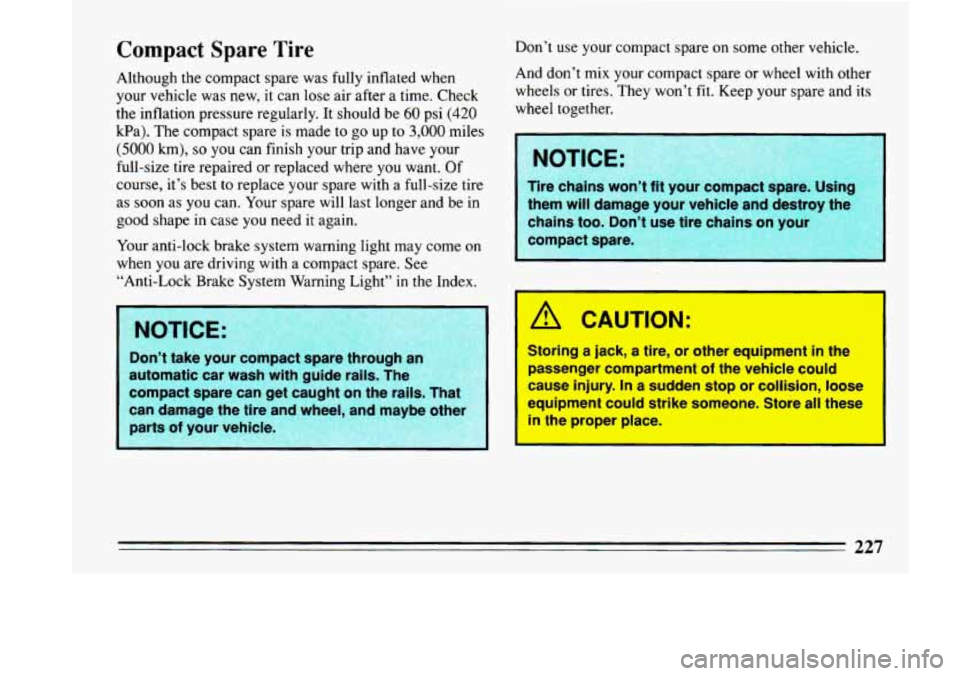
Tire chains wo
them will damage
y
chains too. Do
compact spar I
A CnUTION:
Storing a jack, a tire, or other equipment in the
passenger compartment of the vehicle could
cause injury. In a sudden stop or colllsian, loose
mwipment could strike someone. Store all these
.__ the proper place.
I
227
Page 245 of 324
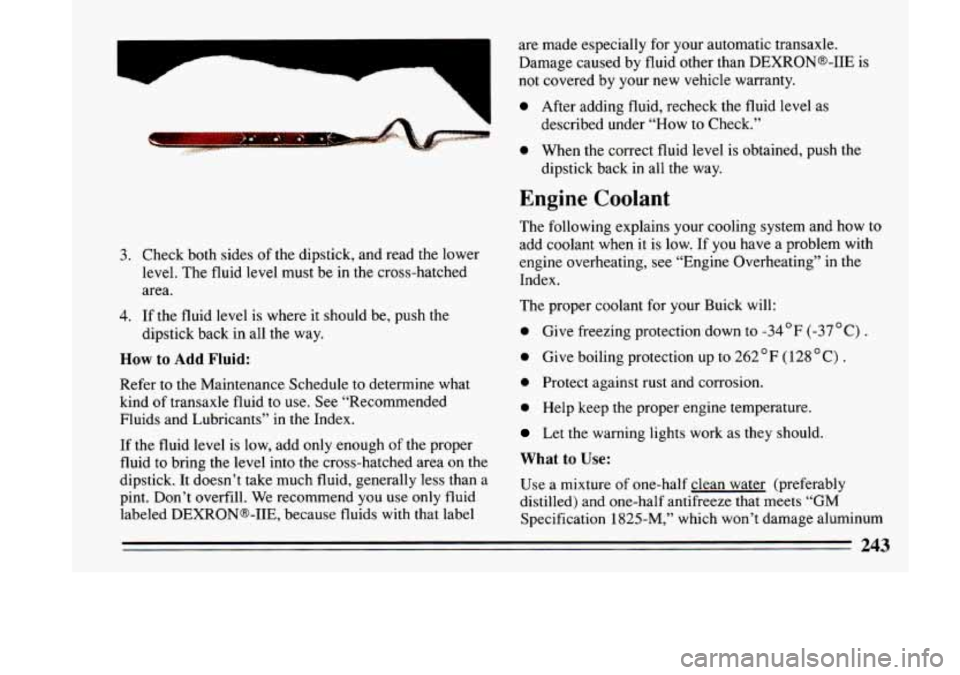
3.
4.
Check both sides of the dipstick, and read the lower
level. The fluid level must be in the cross-hatched
area.
If the fluid level is where it should be, push the
dipstick back in all the way.
How to Add Fluid:
Refer to the Maintenance Schedule to determine what
kind
of transaxle fluid to use. See “Recommended
Fluids and Lubricants” in the Index.
If the fluid level
is low, add only enough of the proper
fluid to bring the level into the cross-hatched area on the
dipstick. It doesn’t take much fluid, generally less than a
pint. Don’t overfill. We recommend you use only fluid
labeled DEXRONa-IIE, because fluids with that label are made especially for your automatic transaxle.
Damage caused by fluid other than DEXRONs-IIE
is
not covered by your new vehicle warranty.
0 After adding fluid, recheck the fluid level as
described under “How to Check.”
0 When the correct fluid level is obtained, push the
dipstick back in all the way.
Engine Coolant
The following explains your cooling system and how to
add coolant when it is low. If you have a problem with
engine overheating, see “Engine Overheating” in the
Index.
The proper coolant for your Buick will:
0 Give freezing protection down to -34OF (-37OC) .
0 Give boiling protection up to 262°F (128 “C) .
0 Protect against rust and corrosion.
0 Help keep the proper engine temperature.
Let the warning lights work as they should.
What to Use:
Use a mixture of one-half clean water (preferably
distilled) and one-half antifreeze that meets
“GM
Specification 1825-M,” which won’t damage aluminum
243
Page 246 of 324
parts. You can also use a recycled coolant conforming to
GM Specification 1825-M with a complete coolant flush
and refill. Use GM Engine Coolant Supplement (sealer)
with any complete coolant change.
If you use these, you
don’t need
to add anything else.
I k!, CAUTION:
Adding only plain water to your cooling system
can be dangerous. Plain water,
or some other
liquid like alcohol, can boil before the proper
coolant mix will. Your vehicle’s coolant warning
system
is set for the proper coolant mix. With
plain water or the wrong mix, your engine could
get too
hot but you wouldn’t get the overheat
warning. Your engine could catch fire
and you or
others could be burned.
Use a 5050 mix of clean
water and a proper antifreeze.
I
I NO IC i:
IT you use an Improper coolant mix, your engine
could overheat and be badly damaged. The
repair cost wouldn’t be covered
by your
warranty.
Too much water in the mix can treeze
and crack the engine, radiator, heater core and other
parts.
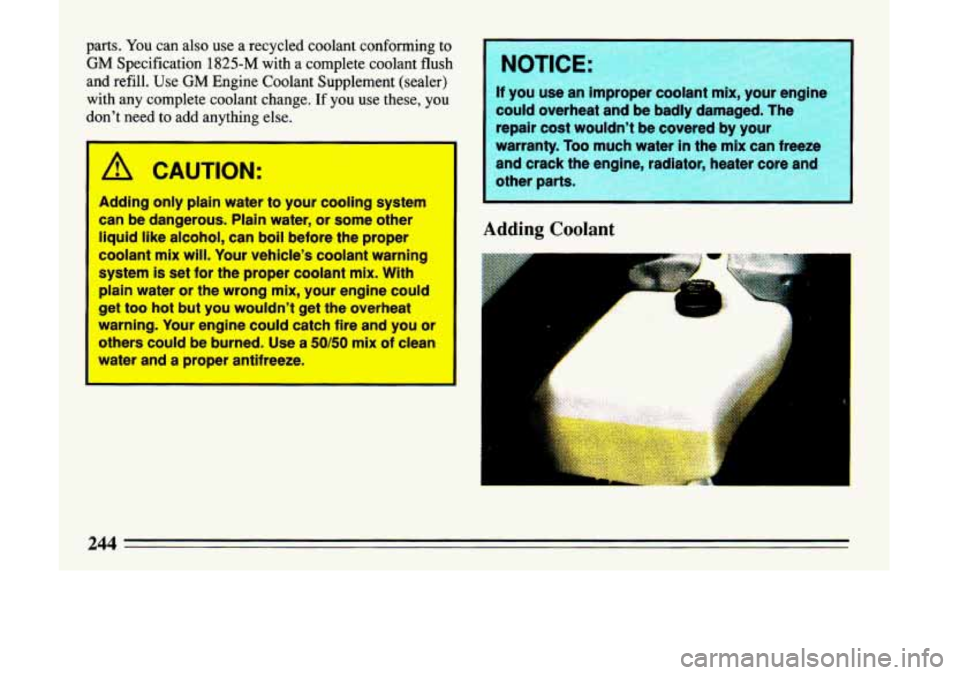
Adding Coolant
Page 250 of 324
Brake Master Cylinder
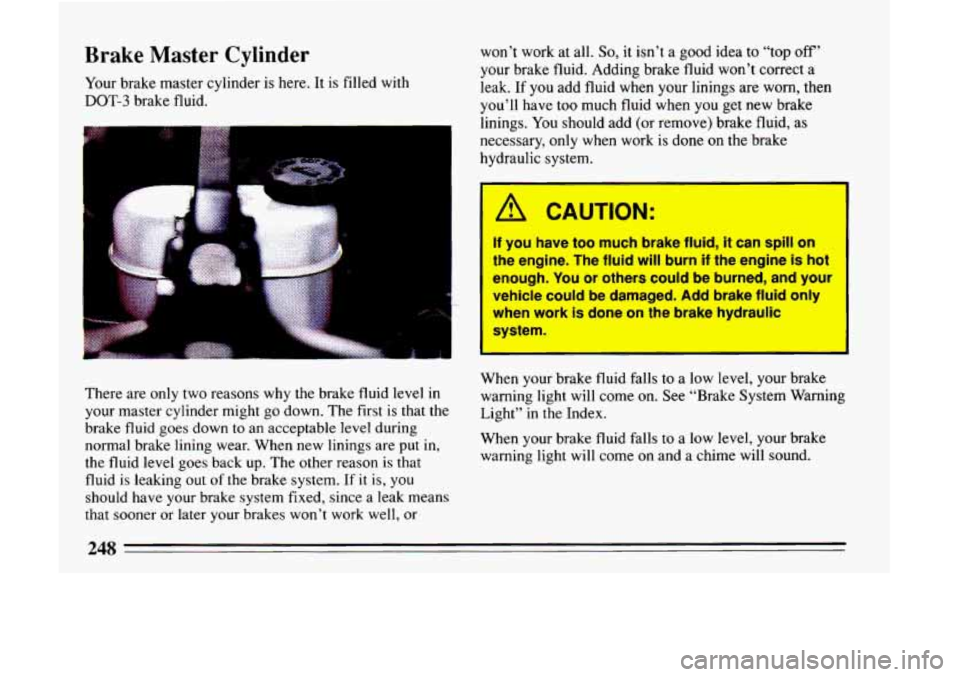
Your brake master cylinder is here. It is filled with
DOT-3 brake fluid. won’t
work at all.
So, it isn’t a good idea to “top off’
your brake fluid. Adding brake fluid won’t correct a
leak.
If you add fluid when your linings are worn, then
you’ll have too much fluid when you get new brake
linings. You should add (or remove) brake fluid, as
necessary, only when work
is done on the brake
hydraulic system.
A CAUTION:
If you have too much brake fluid, it can spill on
the engine. The fluid will burn if the engine is hat
,..ough. You or others could be burned, and you1
vehicle could be damaged. Add brake fluid only
when work is done on the brake hydraulic
system.
There are only two reasons why the brake fluid level in
your master cylinder might
go down. The first is that the
brake fluid goes down to an acceptable level during
normal brake lining wear. When new linings are put in,
the fluid level goes back up.
The other reason is that
fluid
is leaking out of the brake system. If it is, you
should have your brake system fixed, since a leak means
that sooner
or later your brakes won’t work well, or When your brake
fluid falls to a low level, your brake
warning light will come on. See “Brake System Warning
Light” in the Index.
When your brake fluid falls to a low
level, your brake
warning light will come
on and a chime will sound.
248
Page 261 of 324
A CAUTION:
;
Mixing tires could cause you to lose control
while driving. If you mix tires of different sizes
or
types (radial and bias-belted tires), the vehicle
may not handle properly, and you could have a
crash. Be sure to use the same size and type
tires
on all four wheels.
It’s all right to drive with your compact spare,
though. It was developed for use on your vehicle.
I I
Uniform Tire Quality Grading
The following information relates to the system
developed by the United States National Highway
Traffic Safety Administration which grades tires by
treadwear, traction and temperature performance. (This
applies only to vehicles sold in the United States.)
Treadwear
The treadwear grade is a comparative rating based on
the wear rate of the tire when tested under controlled
conditions on a specified government test course. For
example,
a tire graded 150 would wear one and a half
(1 1/2) times as well on the government course as a tire graded
100. The relative performance
of tires depends
upon the actual conditions
of their use, however, and
may depart significantly from the norm due to variations
in driving habits, service practices and differences in
road characteristics and climate.
Traction - A, B, C
The traction grades, from highest to lowest are: A, B,
and C. They represent the tire’s ability to stop on wet
pavement as measured under controlled conditions
on
specified government test surfaces of asphalt and
concrete.
A tire marked C may have poor traction
performance.
Warning: The traction grade assigned to this tire
is based
on braking (straight-ahead) traction tests and does not
include cornering (turning) traction.
Temperature - A, B, C
The temperature grades are A (the highest), B, and C,
representing the tire’s resistance to the generation of
heat and its ability to dissipate heat when tested under
controlled conditions on a specified indoor laboratory
test wheel. Sustained high temperature can cause the
material
of the tire to degenerate and reduce tire life, and
excessive temperature can lead to sudden tire failure.
The grade
C corresponds to a level of performance
Page 262 of 324
which all passenger car tires must meet under the
Federal Motor Vehicle Safety Standard
No. 109. Grades
B and
A represent higher levels of performance on the
laboratory test wheel than the minimum required by law.
Warning: The temperature grade for this tire is
established for a tire that is properly inflated and not
overloaded. Excessive speed, underinflation, or
excessive loading, either separately or in combination,
can cause heat buildup and possible tire failure.
Those grades are molded on the sidewalls of passenger
car tires.
While the tires available as standard or optional
equipment on General Motors vehicles may vary with respect to these grades, all such tires meet General
Motors performance standards and have been approved
for use on General Motors vehicles. All passenger type
(P Metric) tires must conform to Federal safety
requirements in addition to these grades.
Wheel Alignment and Tire Balance
The wheels on your vehicle were aligned and balanced
carefully at
the factory to give you the longest tire life
and best overall performance. In most cases, you will not need
to have your wheels
aligned again. However, if you notice unusual tire wear
or your vehicle pulling one way or the other, the
alignment may need to be reset.
If you notice your
vehicle vibrating when driving on a smooth road, your
wheels may need
to be rebalanced.
Wheel Replacement
Replace any wheel that is bent, cracked or badly rusted.
If wheel nuts keep coming loose, the wheel, wheel bolts,
and wheel nuts should be replaced.
If the wheel leaks air
out, replace it (except some aluminum wheels, which
can sometimes be repaired). See your Buick dealer if
any
of these conditions exist.
Your dealer
will know the kind of wheel you need.
Each new wheel should have the same load carrying
capacity, diameter, width, offset, and be mounted the
same way as
the one it replaces.
If you need to replace any of your wheels, wheel bolts, or wheel nuts, replace them only with new GM original
equipment
parts. This way, you will be sure to have the
right wheel, wheel bolts, and wheel nuts for your Buick model.
260
Page 276 of 324
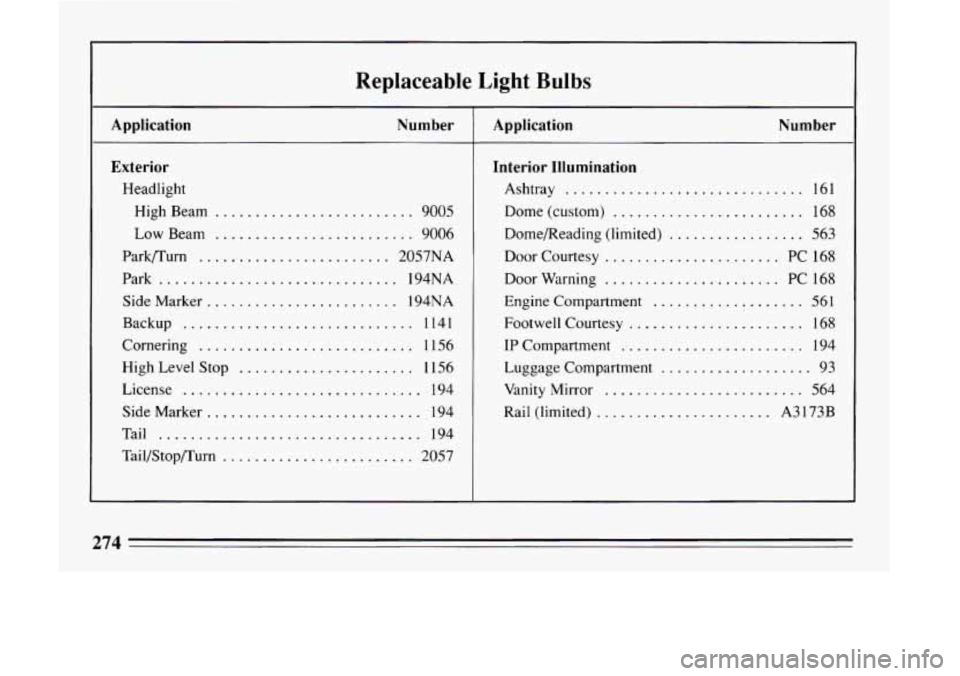
Replaceable Light Bulbs
Application Number
Exterior
Headlight High Beam
......................... 9005
Low Beam
......................... 9006
Parknurn
........................ 2057NA
Park
.............................. 194NA
Side Marker
........................ 194NA
Backup
............................. 1141
Cornering
........................... 1156
High Level Stop
...................... 1156
License
.............................. 194
Side Marker
........................... 194
Tail ................................. 194
Tail/Stop/Turn
........................ 2057
Application Number
Interior Illumination
Ashtray .............................. 161
Dome (custom)
........................ 168
Domemeading (limited)
................. 563
Door Courtesy ...................... PC 168
Door Warning
...................... PC 168
Engine Compartment
................... 561
Footwell Courtesy ...................... 168
IP Compartment ....................... 194
Luggage Compartment
................... 93
Vanity Mirror
......................... 564
Rail (limited) ...................... A3173B
274
Page 295 of 324
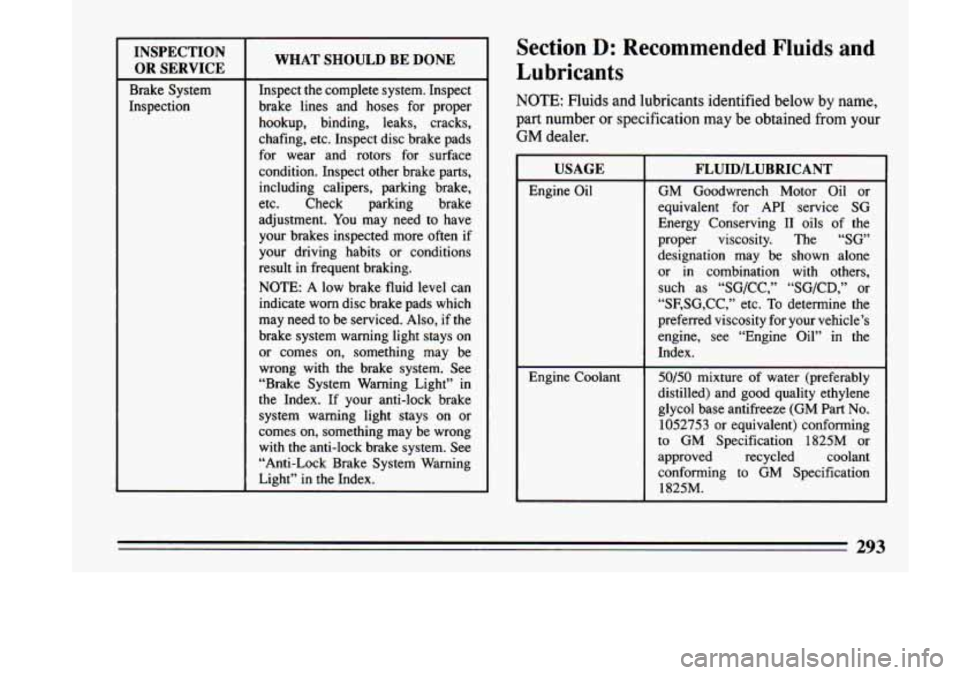
INSPECTION OR SERVICE
Brake System
Inspection
WHAT SHOULD BE DONE
Inspect the complete system. Inspect
brake lines and hoses for proper hookup, binding, leaks, cracks,
chafing, etc. Inspect disc brake pads
for wear and rotors for surface
condition. Inspect other brake parts, including calipers, parking brake,
etc. Check parking brake
adjustment.
You may need to have
your brakes inspected more often
if
your driving habits or conditions
result in frequent braking.
NOTE:
A low brake fluid level can
indicate worn disc brake pads which
may need to be serviced. Also,
if the
brake system warning light stays on
or comes on, something may be
wrong with the brake system. See
“Brake System Warning Light” in
the Index. If your anti-lock brake
system warning light stays
on or
comes on, something may be wrong
with the anti-lock brake system. See
“Anti-Lock Brake System Warning
Light” in the Index.
Section D: Recommended Fluids and
Lubricants
NOTE: Fluids and lubricants identified below by name,
part number
or specification may be obtained from your
GM dealer.
FLUID/LUBRICANT
GM Goodwrench Motor Oil or
equivalent for API service SG
Energy Conserving I1 oils of the
proper viscosity. The
“SG’
designation may be shown alone
or
in combination with others,
such as “SG/CC,” “SG/CD,” or
“SF,SG,CC,” etc.
To determine the
preferred viscosity for your vehicle’s
engine, see “Engine Oil’’ in the
Index.
50/50 mixture of water (preferably
distilled) and good quality ethylene
glycol base antifreeze (GM Part
No.
1052753 or equivalent) conforming
to GM Specification 1825M or
approved recycled coolant
conforming to GM Specification
1825M.
293
-