lock BUICK LESABRE 1993 Workshop Manual
[x] Cancel search | Manufacturer: BUICK, Model Year: 1993, Model line: LESABRE, Model: BUICK LESABRE 1993Pages: 324, PDF Size: 17.02 MB
Page 190 of 324
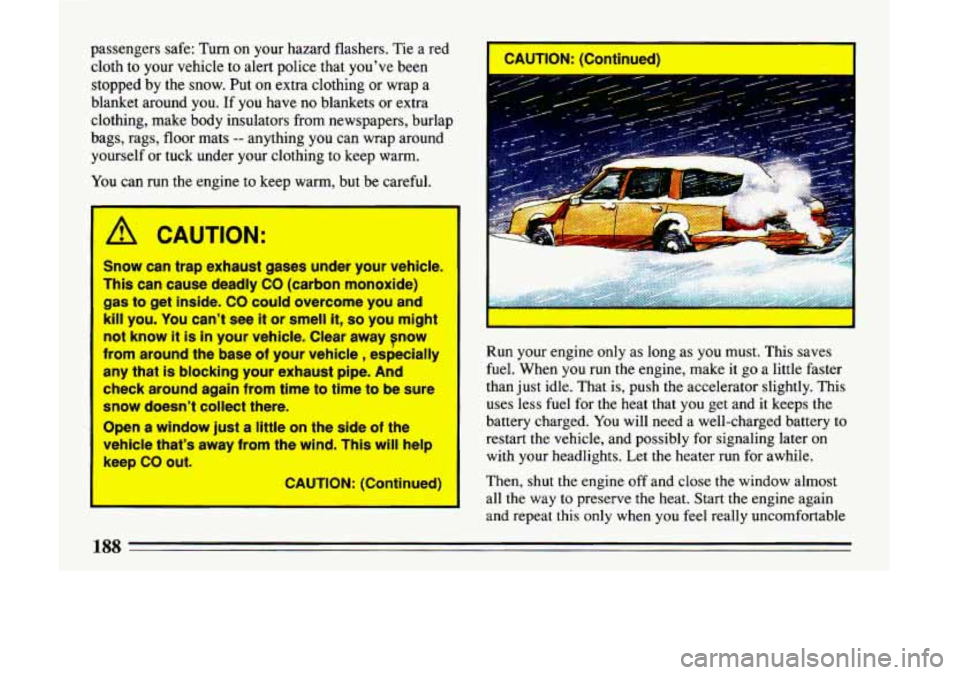
passengers safe: Turn on your hazard flashers. Tie a red
cloth to your vehicle to alert police that you’ve been
stopped
by the snow. Put on extra clothing or wrap a
blanket around you.
If you have no blankets or extra
clothing, make body insulators from newspapers, burlap
bags, rags, floor mats
-- anything you can wrap around
yourself or tuck under your clothing to keep warm.
You can run the engine to keep warm, but be careful.
CAUTION: (Continued)
-
4
I-
b, CAUTION:
Snow can trap exhaust gases under your vehicle.
Thls can cause deadly CO (carbon monoxlda)
gas to get inslde. Cb could overcome you and
kill you. You can’t see It or smell it, 50 you might
not know it is in your vehicle. Clear away pow
from around the base of your vehicle I especially
any that is blocking your exhaugt pipe. And
cbk around again from time to time to be sum
snow doesn’t collect them
Open
a window just a little on the slde of the
vehicle that’s away from the wind. This will help
keep CO out.
CAUTION: (Continued)
Run your engine only as long as you must. This saves
fuel. When you run the engine, make it go
a little faster
than just idle. That
is, push the accelerator slightly. This
uses less fuel for the heat that you get and it keeps the
battery charged.
You will need a well-charged battery to
restart the vehicle, and possibly for signaling later on
with your headlights. Let the heater run for awhile.
Then, shut the engine off and close the window almost
all the way to preserve the heat. Start the engine again
and repeat this only when you feel really uncomfortable
188
Page 194 of 324
e e Will you have to make any holes in the body of your vehicle when you install a trailer hitch? If you
do,
then be sure to seal the holes later when you remove
the hitch. If you don’t seal them, deadly carbon
monoxide
(CO) from your exhaust can get into your
vehicle (see “Carbon Monoxide” in the Index). Dirt
and water can, too.
The bumpers on your vehicle are not intended for
hitches.
Do not attach rental hitches or other
bumper-type hitches to them. adequate.
Be sure to read and follow the instructions for
the trailer brakes
so you’ll be able to install, adjust and
maintain them properly. Because you have anti-lock
brakes, do not try to tap into your vehicle’s brake
system.
If you do, both brake systems won’t work well,
or at all.
Driving with a Trailer
Towing a trailer requires a certain amount of experience.
Before setting out for the open road, you’ll want to get
to know your rig. Acquaint yourself with the feel of
handling and braking with the added weight of the
trailer. And always keep in mind that the vehicle you are
driving is now a good deal longer and not nearly
so
responsive as your vehicle is by itself.
Safety Chains
You should always attach chains between your vehicle
and your trailer.
Cross the safety chains under the
tongue
of the trailer so that the tongue will not drop to
the road if it becomes separated from the hitch.
Instructions about safety chains may be provided by the
hitch manufacturer or by the trailer manufacturer.
Follow the manufacturer’s recommendation for
attaching safety chains. Always leave just enough slack
so you can turn with your rig. And, never allow safety
chains to drag
on the ground.
Trailer Brakes
If your trailer weighs more than 1,000 pounds (450 kg)
loaded, then it needs its own brakes
-- and they must be
192
~-
Before you start, check the trailer hitch and platform,
safety chains, electrical connector, lights, tires
and
mirror adjustment. If the trailer has electric brakes, start
your vehicle and trailer moving and then apply the
trailer brake controller by hand to be sure the brakes are
working. This lets you check your electrical connection
at the same time.
During your trip, check occasionally
to be sure that the
load is secure, and that the lights and any trailer brakes
are still working.
Page 207 of 324
When your vehicle is being towed, have the ignition key
off. The steering wheel should be clamped in a
straight-ahead position, with a clamping device designed
for towing service.
Do not use the vehicle’s steering
column lock for this. The transaxle should be in Neutral
and the parking brake released.
Don’t have your vehicle towed on the front wheels,
unless
you must. If the vehicle must be towed on the
front wheels, don’t
go more than 55 mph (88 kph) or
farther than
500 miles (800 km) or your transaxle will
be damaged.
If these limits must be exceeded, then the
front wheels have to be supported on a dolly.
-
A CAUTION:
A vehicle can fall from a car carrier if it isn’t
properly secured, This can cause a collision,
serious personal injury and vehlcle damage. The
vehicle should be tightly secured with chains
or
steel cables before it is transported.
Don’t use substitutes (ropes, leather straps,
canvas webbing, etc.) that can be cut by sharp
zdges underneath the towed vehicle.
Page 223 of 324
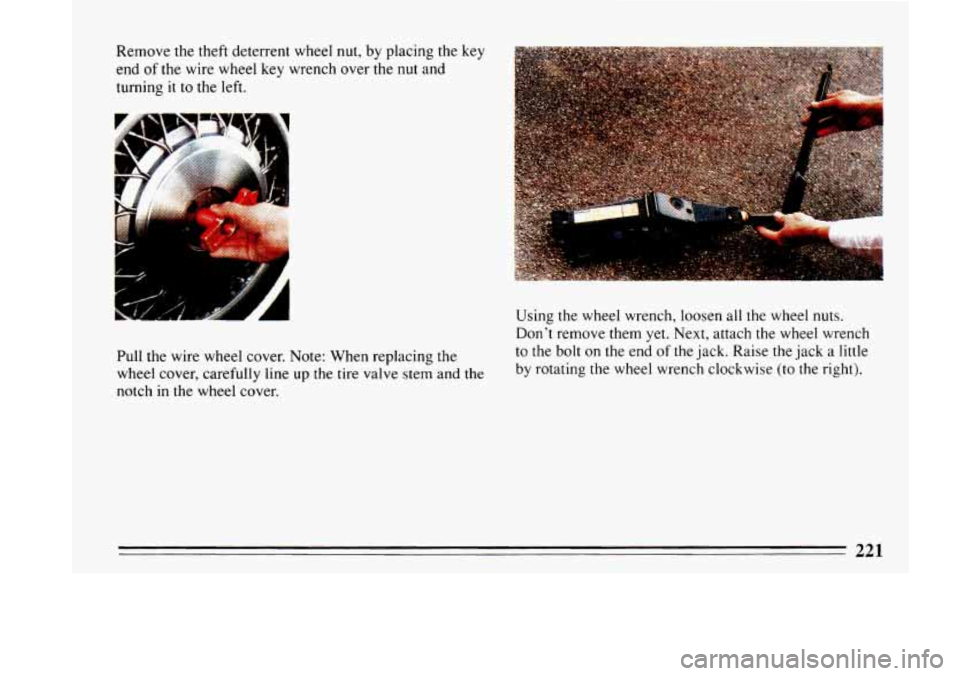
Remove the theft deterrent wheel nut, by placing the key
end of the wire wheel key wrench over the nut and
turning it to the left.
Pull the wire wheel cover. Note: When replacing the
wheel cover, carefully line up the tire valve stem and the
notch in the wheel cover. Using the wheel wrench, loosen
all the
wheel nuts.
Don’t remove them yet. Next, attach the wheel wrench
to the bolt
on the end of the jack. Raise the jack a little
by rotating the wheel wrench clockwise (to the right).
221
Page 225 of 324
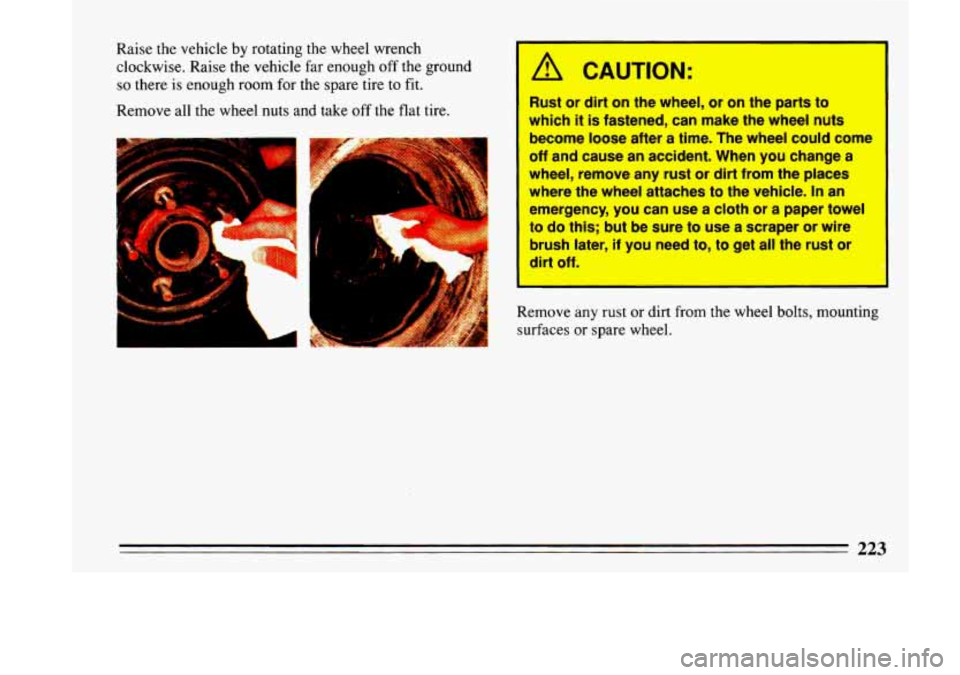
Raise the vehicle by rotating the wheel wrench
clockwise. Raise
the vehicle far enough off the ground
so there is enough room for the spare tire to fit.
Remove all the wheel nuts and take off the flat tire.
pll
f
CAUTION:
Rust or dirt on the wheel, or on the parts to
which it is fastened, can make the wheel nuts
become loose after a time. The wheel could come
riff and cause an accident. When you change a
eel, remove any rust or dirt from the places
where the wheel attaches to the vehicle. In
an
erngrgeocy, you can use a cloth or a paper towel
to do this; but be sure to use a scraper or wire
dirt Offa "
brush later, if you need to, to get all the rust or
I
Remove any rust or dirt from the wheel bolts, mounting
surfaces or spare wheel.
223
Page 227 of 324
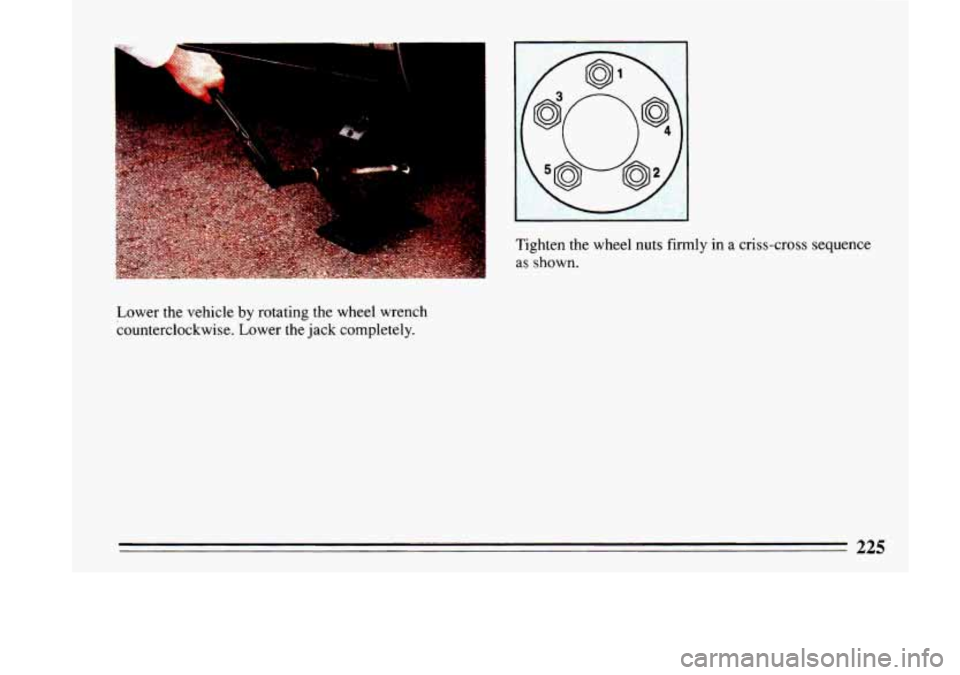
I.
Lower the vehicle by rotating the wheel wrench
counterclockwise. Lower the jack completely. Tighte.n
the wheel
nuts firmly in a criss-cross sequence
as
shown.
225
Page 229 of 324
Compact Spare Tire
Although the compact spare was fully inflated when
your vehicle was new, it can lose air after a time. Check
the inflation pressure regularly. It should be
60 psi (420
Wa). The compact spare is made to go up to 3,000 miles
(5000 km), so you can finish your trip and have your
full-size tire repaired or replaced where you want. Of
course, it’s best
to replace your spare with a full-size tire
as soon as
you can. Your spare will last longer and be in
good shape in case you need it again.
Your anti-lock brake system warning light may come
on
when you are driving with a compact spare. See
“Anti-Lock Brake System Warning Light” in the Index. Don’t
use your
compact spare on some other vehicle.
And don’t mix your compact spare or wheel with other
wheels or tires. They won’t fit. Keep your spare and its
wheel together.
Tire chains wo
them will damage
y
chains too. Do
compact spar I
A CnUTION:
Storing a jack, a tire, or other equipment in the
passenger compartment of the vehicle could
cause injury. In a sudden stop or colllsian, loose
mwipment could strike someone. Store all these
.__ the proper place.
I
227
Page 235 of 324
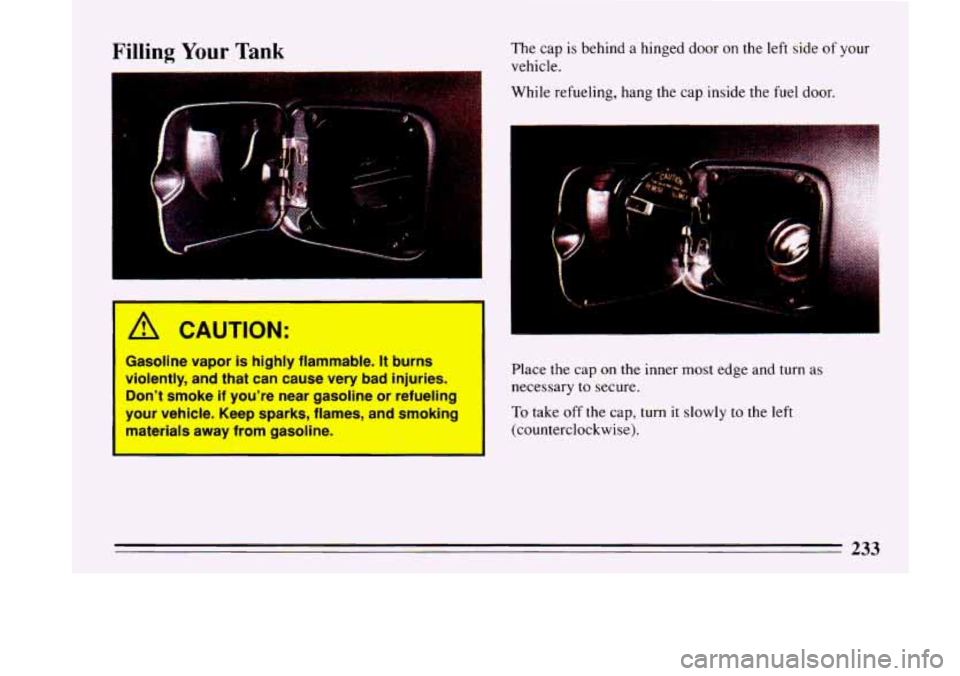
Filling Your Tank
.. .-
The cap is behind a hinged door on the left side of your
vehicle.
While refueling, hang the cap inside the fuel door.
I
A CAUTION:
Gasoline vapor is highly flammable. It burns
violently, and that can cause very bad injuries.
Don’t smoke
if you’re near gasoline or refueling
your vehicle. Keep sparks, flames, and smoking
materials away from gasoline.
Place the cap on the inner most edge and turn as
necessary to secure.
To take off the cap, turn it slowly to the left
(counterclockwise).
233
Page 241 of 324
SAE low-30
As shown in the viscosity chart, SAE low-30 is best
for your vehicle. However, you can use SAE 5W-30
if
it’s going to be colder than 60 F ( 16 C) before
your next oil change. When it’s very cold, below
0 F (- 1 8 C), you should use SAE 5W-30.
These numbers on an oil container show its viscosity, or
thickness,
Do not use other viscosity oils such as SAE
1OW-40 or SAE 20W-50.
Energy Conserving I1
Oils with these words on the container will help
you
save fuel.
This doughnut-shaped logo (symbol) is used on most oil
containers to help
you select the correct oil.
You should look for this on the oil container, and use
only those oils that display the logo.
GM Goodwrench@
oil (in Canada, GM Engine Oil)
meets all the requirements for your vehicle.
Engine Oil Additives: Don’t add anything to your oil.
Your Buick dealer is ready to advise if you think
something should be added.
When to Change Engine Oil: See if any one of these
is true for you:
Then go
to the front of the vehicle and release the
secondary hood release. Lift the hood.
Most trips are less than 4 miles (6 km).
0 It’s below freezing outside and most trips are less
than
10 miles ( 16 km).
0 The engine is at low speed most of the time (as in
0 You tow a trailer often.
0 Most trips are through dusty places.
If any one of these is true for your vehicle, then you
need to change your oil and filter every 3,000 miles
(5 000 km) or 3 months -- whichever comes first.
(See “Change Oil Soon” in the Index.)
If none of them is true, change the oil every
7,500 miles
(12 500 km) or 12 months -- whichever comes first.
Change the filter at the first oil change and at every
other oil change after that. (See “Change Oil Soon”
in the Index.)
Engine Block Heater: An engine block heater can be a
big help if you have to park outside in very cold
weather,
0 F (- 18 C) or colder. If your vehicle has this
option,
see “Engine Block Heater” in the Index.
door-to-door delivery, or
in stop-and-go traffic).
239
Page 252 of 324
A CAUTION:
Batteries have acid that can burn you and gas
that can explode. You can be badly hurt if you
aren’t careful. See
“Jump Starting” in the Index
for tips on working around a battery without
getting hurt.
I
Contact your dealer to learn how to prepare your vehicle
for longer storage periods.
Halogen Bulbs
1 6!& CAUTION:
Halogen bulbs have pressurized gas inside and
can burst if you drop or scratch the bulb. You or
others could be injured. Take special careowhen
handling and disposing of halogen bulbs.
I
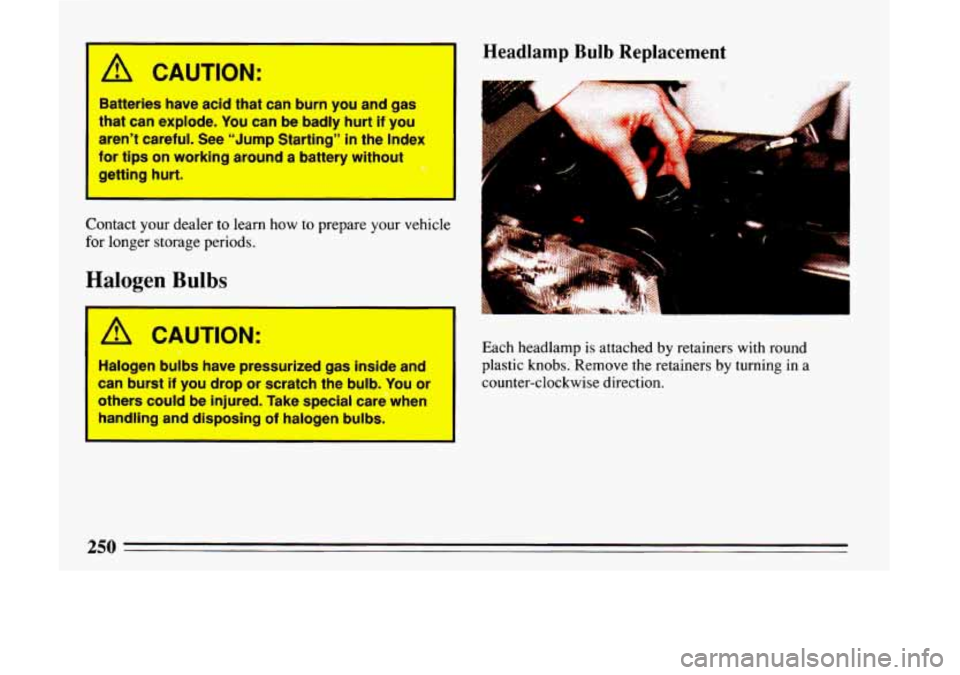
Headlamp Bulb Replacement
a,
--.
Each headlamp is attached by retainers with round
plastic knobs. Remove the retainers
by turning in a
counter-clockwise direction.
250