night vision BUICK LESABRE 1993 Owners Manual
[x] Cancel search | Manufacturer: BUICK, Model Year: 1993, Model line: LESABRE, Model: BUICK LESABRE 1993Pages: 324, PDF Size: 17.02 MB
Page 171 of 324
vehicle is skidding. Learn to recognize warning clues -
such as enough water, ice or packed snow on the road to
make a “mirrored surface”
- and slow down when you
have any doubt.
Remember: Any anti-lock braking system (ABS) helps
avoid only the braking skid. Steer the way
you want to go.
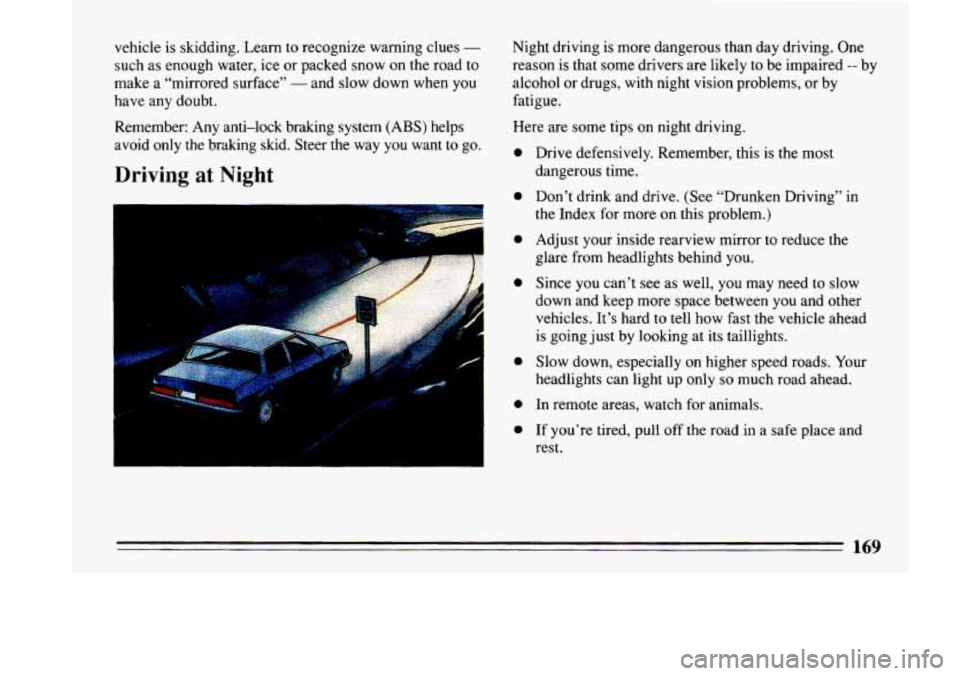
Driving at Night
Night driving is more dangerous than day driving. One
reason is that some drivers are likely
to be impaired -- by
alcohol or drugs, with night vision problems, or by
fatigue.
Here are some tips on night driving.
0
0
0
0
0
0
0
Drive defensively. Remember, this is the most
dangerous time.
Don’t drink and drive, (See “Drunken Driving’’ in
the Index for more
on this problem.)
Adjust your inside rearview mirror to reduce the
glare from headlights behind you.
Since you can’t see as well,
you may need to slow
down and keep more space between you and other
vehicles. It’s hard to tell
how fast the vehicle ahead
is going just by looking at its taillights.
Slow down, especially on higher speed roads. Your
headlights can light up only
so much road ahead.
In remote areas, watch for animals.
If you’re tired, pull off the road in a safe place and
rest.
169
Page 172 of 324
Night Vision
No one can see as well at night as in the daytime. But as
we get older these differences increase.
A SO-year-old
driver may require at least twice as much light to see the
same thing at night as a 20-year-old.
What you do in the daytime can also affect your night
vision. For example, if you spend the day
in bright
sunshine you are wise to wear sunglasses. Your eyes will
have less trouble adjusting to night.
But if you’re driving, don’t wear sunglasses at night.
They may cut down on glare from headlights, but
they
also make a lot of things invisible that should remain
visible
- such as parked cars, obstacles, pedestrians, or
even trains blocking railway crossings. You may want to
put on your sunglasses after you have pulled into
a
brightly-lighted service or refreshment area. Eyes shielded from that glare may adjust more quickly to
darkness back on the road. But be sure to remove your sunglasses before you leave the service area.
You can be temporarily blinded by approaching lights. It
can take a second
or two, or even several seconds, for
your eyes to readjust to the dark. When you are faced
with severe glare (as from
a driver who doesn’t lower
the high beams, or a vehicle with misaimed headlights), slow down
a little. Avoid staring directly into the
approaching lights. If there is a line of opposing traffic,
make occasional glances over the line of headlights to
make certain that one of the vehicles isn’t starting to
move into your lane. Once you are past the bright lights,
give your eyes time to readjust before resuming speed.
High Beams
If the vehicle approaching you has its high beams on,
signal by flicking yours to high and then back
to low
beam. This is the usual signal to lower the headlight
beams. If the other driver still doesn’t lower the beams,
resist the temptation to put your high beams on. This only makes two half-blinded drivers.
On a freeway, use your high beams only in remote areas
where you won’t impair approaching drivers. In some
places, like cities, using high beams is illegal.
When you follow another vehicle on a freeway or
highway, use low beams. True, most vehicles now have day-night mirrors that enable the driver to reduce glare. But outside mirrors are not of this type and high beams
from behind can bother the driver ahead.
170
-
Page 173 of 324
A Few More Night Driving Suggestions
Keep your windshield and all the glass on your vehicle
clean
-- inside and out. Glare at night is made much
worse by dirt on the glass. Even the inside
of the glass
can build up a film caused by dust. Tobacco smoke also
makes inside glass surfaces very filmy and can be a
vision hazard if it’s left there.
Dirty glass makes lights dazzle and flash more than
clean glass would, making the pupils
of your eyes
contract repeatedly. You might even want
to keep a cloth
and some glass cleaner in your vehicle if
you need to
clean your glass frequently.
Remember that your headlights light up far less
of a
roadway when you are in a turn
or curve.
Keep your eyes moving; that way, it’s easier to pick out
dimly lighted objects.
Just
as your headlights should be checked regularly for
proper aim,
so should your eyes be examined regularly.
Some drivers suffer from night blindness
-- the inability
to see in dim light -- and aren’t even aware of it.
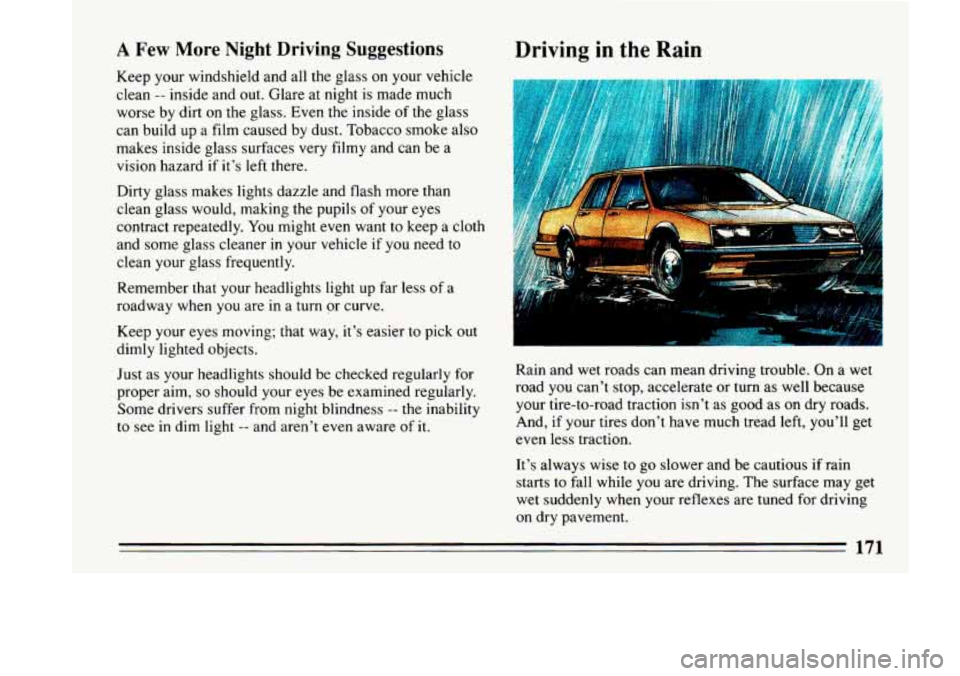
Driving in the Rain
/’ ..
Rain and wet roads can mean driving trouble. On a wet
road you can’t stop, accelerate or turn as well because
your tire-to-road traction isn’t as good
as on dry roads.
And, if your tires don’t have much tread left, you’ll get
even less traction.
It’s always wise to go slower and be cautious if rain
starts to fall while you are driving. The surface may get
wet suddenly when your reflexes are tuned for driving
on dry pavement.
171
Page 181 of 324
On two-lane highways or undivided multilane highways
that do not have controlled access, you’ll want to watch for some situations not usually found on freeways.
Examples are: stop signs and signals, shopping centers with direct access to the highway, no passing zones and school zones, vehicles turning left and right off the road,
pedestrians, cyclists, parked vehicles, and even animals.
Highway Hypnosis
Is there actually such a condition as “highway
hypnosis”? Or is it just plain falling asleep at the wheel?
Call it highway hypnosis, lack of awareness, or
whatever.
There is something about an easy stretch
of road with
the same scenery, along with the hum of the tires on the
road, the drone of the engine, and the rush of the wind
against the vehicle that can make you sleepy. Don’t let it
happen to you! If it does, your vehicle can leave the
road in less than a second, and you could crash and be
injured. What can you
do about highway hypnosis? First, be
aware that it can happen.
Then here are some tips:
e
e
m
0
Make sure your vehicle is well ventilated, with a
comfortably cool interior.
Keep your eyes moving. Scan the road ahead and
to
the sides. Check your rearview mirrors frequently
and your instruments from time
to time. This can
help you avoid
a fixed stare.
Wear good sunglasses in bright light. Glare can
cause drowsiness. But don’t wear sunglasses at
night. They will drastically reduce your overall
vision
at the very time you need all the seeing power
you have.
If you get sleepy, pull off the road into a rest, service,
or parking area and take a nap, get some exercise, or
both. For safety, treat drowsiness on the highway as
an emergency.
As in any driving situation, keep pace with traffic and
allow adequate following distances.
Page 312 of 324
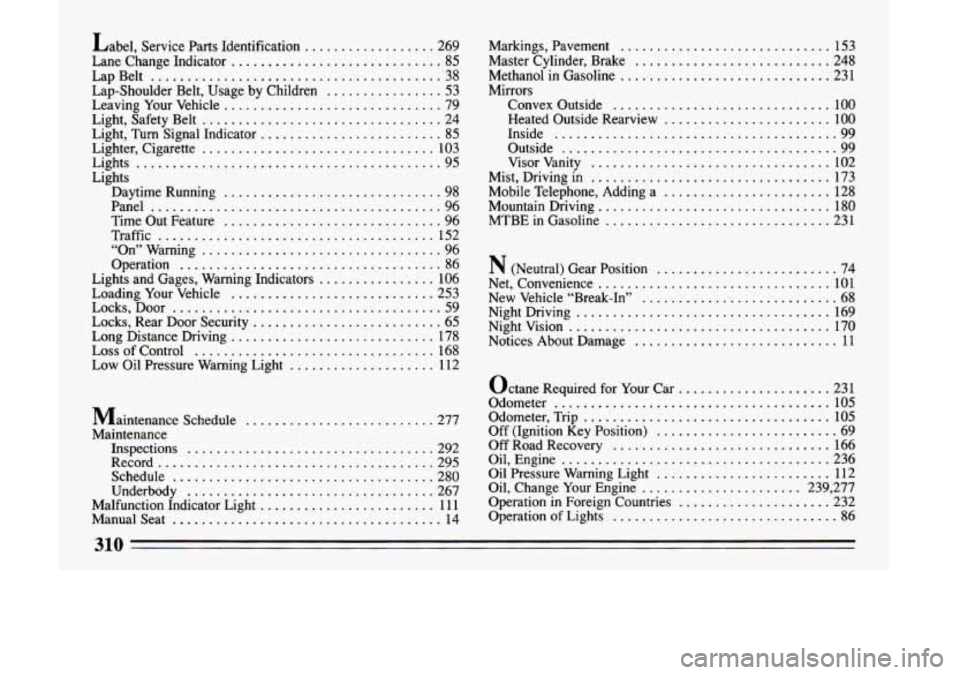
Label. Service Parts Identification .................. 269
Lane Change Indicator
............................. 85
LapBelt
........................................ 38
Lap-Shoulder Belt. Usage by Children
................ 53
Leaving Your Vehicle .............................. 79
Light. Safety Belt
................................. 24
Light.
Turn Signal Indicator ......................... 85
Lighter. Cigarette ................................ 103
Lights
.......................................... 95
Lights
Daytime Running
.............................. 98
Panel
........................................ 96
Time Out Feature
.............................. 96
Traffic
...................................... 152
“On” Warning
................................. 96
Operation
.................................... 86
Lights and Gages. Warning Indicators ................ 106
Loading Your Vehicle
............................ 253
Locks. Door
..................................... 59
Locks. Rear Door Security
.......................... 65
Long Distance Driving ............................ 178
Loss of Control
................................. 168
Low Oil Pressure Warning Light
.................... 112
Maintenance Schedule
.......................... 277
Maintenance Inspections
.................................. 292
Record
...................................... 295
Schedule
.................................... 280
Underbody
.................................. 267
Malfunction Indicator Light
........................ 11 1
Manualseat ..................................... 14 Markings. Pavement
............................. 153
Master Cylinder. Brake ........................... 248
Methanol
in Gasoline ............................. 231
Mirrors Convex Outside
.............................. 100
Heated Outside Rearview
....................... 100
Inside
....................................... 99
Outside
...................................... 99
Visor Vanity
................................. 102
Mist. Driving
in ................................. 173
Mobile Telephone. Adding a
....................... 128
Mountain Driving
................................ 180
MTBE in Gasoline
............................... 231
N (Neutral) Gear Position ......................... 74
Net. Convenience
................................ 101
New Vehicle “Break-In”
........................... 68
NightDriving
................................... 169
Night Vision .................................... 170
Notices About Damage
............................ 11
Octane Required for Your Car
..................... 231
Odometer
...................................... 105
Odometer. Trip
.................................. 105
Off (Ignition Key Position)
......................... 69
Off Road Recovery
.............................. 166
Oil. Engine
..................................... 236
Oil Pressure Warning Light
........................ 112
Operation
in Foreign Countries ..................... 232
Operation of Lights
............................... 86
Oil. Change Your Engine
...................... 239. 277
310 __ .. ~