tire pressure BUICK LESABRE 1993 Owners Manual
[x] Cancel search | Manufacturer: BUICK, Model Year: 1993, Model line: LESABRE, Model: BUICK LESABRE 1993Pages: 324, PDF Size: 17.02 MB
Page 162 of 324
0 If your engine ever stops while you’re driving, brake
normally but don’t pump your brakes.
If you do, the
pedal may get harder to push down.
If your engine
stops, you will still have some power brake assist.
But
you will use it when you brake. Once the power assist
is used up, it may take longer to stop and the brake
pedal will be harder to push.
Anti-Lock Brakes (ABS)
Your Buick has an advanced electronic braking system
that will help prevent skidding.
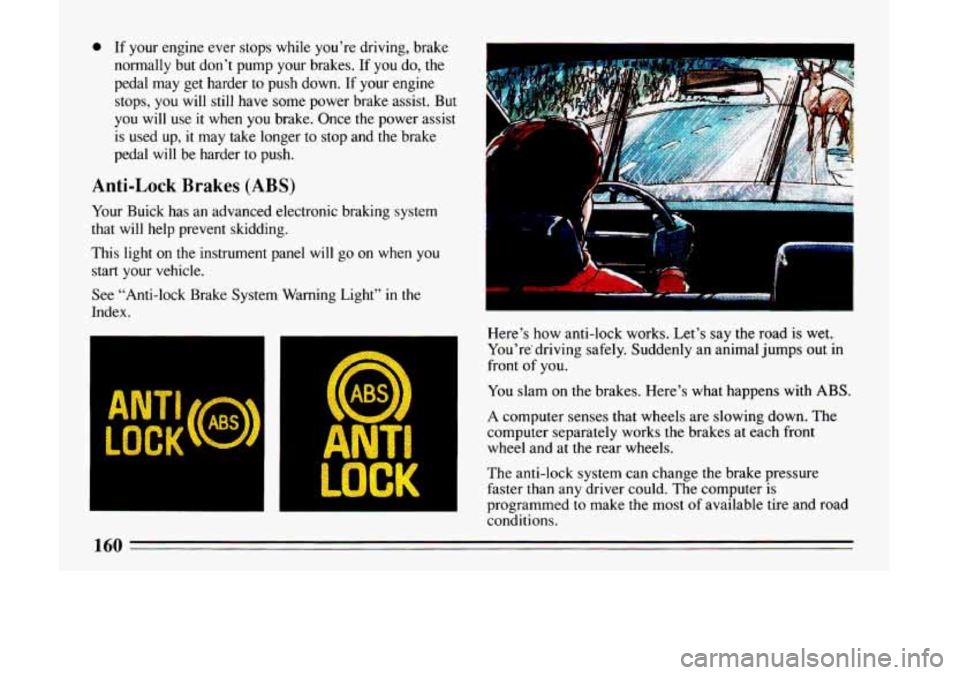
This light
on the instrument panel will go on when you
start your vehicle.
See “Anti-lock Brake System Warning Light”
in the
Index.
@
ANTI
LOCK
‘1 ”. j ’ ;I
- -’ y- ..-
a,
rn
e,
Here’s how anti-lock works. Let’s say the road is wet.
You’re. driving safely. Suddenly an animal jumps
out in
front
of you.
You slam on the brakes. Here’s what happens with ABS.
A computer senses that wheels are slowing down. The
computer separately works the brakes at each front
wheel and at the rear wheels.
The anti-lock system can change the brake pressure
faster than any driver could. The computer
is
programmed to make the most of available tire and road
conditions.
160
Page 175 of 324
to pass -- or if you get hit by a gust of wind. You could
suddenly find yourself out of control.
Hydroplaning doesn’t happen often. But it can
ir your
tires haven’t much tread or if the pressure in one or
more is low.
It can happen if a lot of water is standing
on the road. If you can see reflections from trees,
telephone poles, or other vehicles, and raindrops
“dimple” the water’s surface, there could be
hydroplaning.
Hydroplaning usually happens at higher speeds. There
just isn’t a hard and fast rule about hydroplaning. The
best advice is to slow down.when it is raining, and be
careful.
Some Other Rainy Weather Tips
0 Turn on your headlights -- not just your parking
lights
-- to help make you more visible to others.
0 Look for hard-to-see vehicles coming from behind.
You may want to use your headlights even
in
daytime if it’s raining hard.
0 Besides slowing down, allow some extra following
distance. And be especially careful when you pass
another vehicle. Allow yourself more clear room
ahead, and be prepared to have your view restricted
bv road spray. If the road spray is so heavy you are actually blinded,
drop back. Don’t pass until
conditions improve. Going more slowly is better
than having an accident.
0 Use your defogger if it helps.
0 Have good tires with proper tread depth. (See
“Tires” in the Index.)
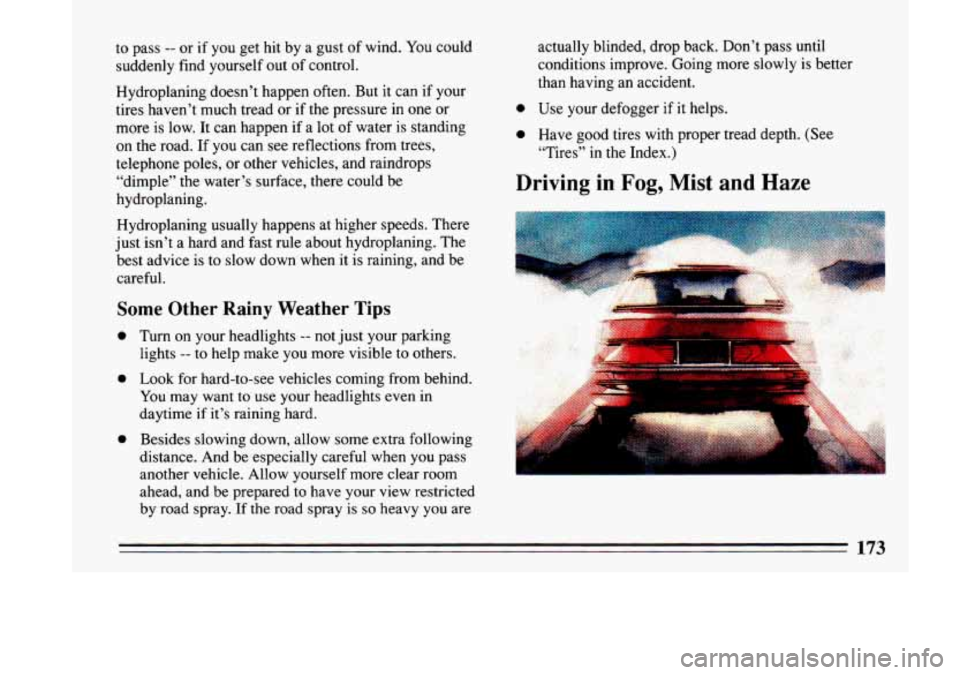
Driving in Fog, Mist and Haze
Page 180 of 324
Driving a Long Distance
Although most long trips today are made on freeways,
there are still many made on regular highways. Long-distance driving on freeways and regular
highways is the same in some ways. The trip has to be
planned and the vehicle prepared, you drive at
higher-than-city speeds, and there are longer turns
behind the wheel. You’ll enjoy your trip more if you and
your vehicle are in good shape. Here are some tips for a
successful long trip.
Before Leaving on a Long Trip
Make sure you’re ready. Try to be well rested. If you
must start when you’re not fresh
-- such as after a day’s
work
-- don’t plan to make too many miles that first part
of the journey. Wear comfortable clothing and shoes you
can easily drive
in.
Is your vehicle ready for a long trip? If you keep it
serviced and maintained,
it’s ready to go. If it needs
service, have it done before starting out. Of course,
you’!! find experienced and able service experts in
Buick dealerships all across North America. They’ll be
ready and willing to help
if you need it.
Here are some things you can check before a trip:
0
e
e
0
e
0
0
Windshield Washer Fluid: Is the reservoir full? Are
all windows clean inside and outside?
Wiper Blades: Are they in good shape?
Fuel, Engine Oil. Other Fluids: Have
you checked
all levels?
Lights: Are they all working? Are the lenses clean?
- Tires: They are vitally important to a safe,
trouble-free trip.
Is the tread good enough for
long-distance driving? Are the tires all inflated to the
recommended pressure?
Weather Forecasts: What’s the weather outlook
along your route? Should you delay your trip
a short
time to avoid a major storm system?
Maps:
Do you have up-to-date maps?
On the Road
Unless you are the only driver, it is good to share the
driving task with others. Limit turns behind the wheel to
about
100 miles (160 km) or two hours at a sitting.
Then, either change drivers or stop for some refreshment
like coffee, tea
or soft drinks and some limbering up.
But do stop and move around. Eat lightly along the way.
Heavier meals tend to make some people sleepy.
Page 229 of 324
Compact Spare Tire
Although the compact spare was fully inflated when
your vehicle was new, it can lose air after a time. Check
the inflation pressure regularly. It should be
60 psi (420
Wa). The compact spare is made to go up to 3,000 miles
(5000 km), so you can finish your trip and have your
full-size tire repaired or replaced where you want. Of
course, it’s best
to replace your spare with a full-size tire
as soon as
you can. Your spare will last longer and be in
good shape in case you need it again.
Your anti-lock brake system warning light may come
on
when you are driving with a compact spare. See
“Anti-Lock Brake System Warning Light” in the Index. Don’t
use your
compact spare on some other vehicle.
And don’t mix your compact spare or wheel with other
wheels or tires. They won’t fit. Keep your spare and its
wheel together.
Tire chains wo
them will damage
y
chains too. Do
compact spar I
A CnUTION:
Storing a jack, a tire, or other equipment in the
passenger compartment of the vehicle could
cause injury. In a sudden stop or colllsian, loose
mwipment could strike someone. Store all these
.__ the proper place.
I
227
Page 255 of 324
Loading Your Vehicle
TIRE-LOADING INFORMATION
OCCUPANTS VEHICLE CAP. WT.
FRT. CTR. RR. TOTAL LBS. KG
MAX. LOADING
& GVWR SAME AS VEHICLE
CAPACITY WEIGHT XXX COLD TIRE
TIRE SIZE SPEED PRESSURE RTG PSVKPa
FRT.
RR.
SPA.
IF TIRES ARE HOT, ADD 4PSV28KPa
SEE OWNER’S MANUAL FOR ADDITIONAL
, INFORMATION
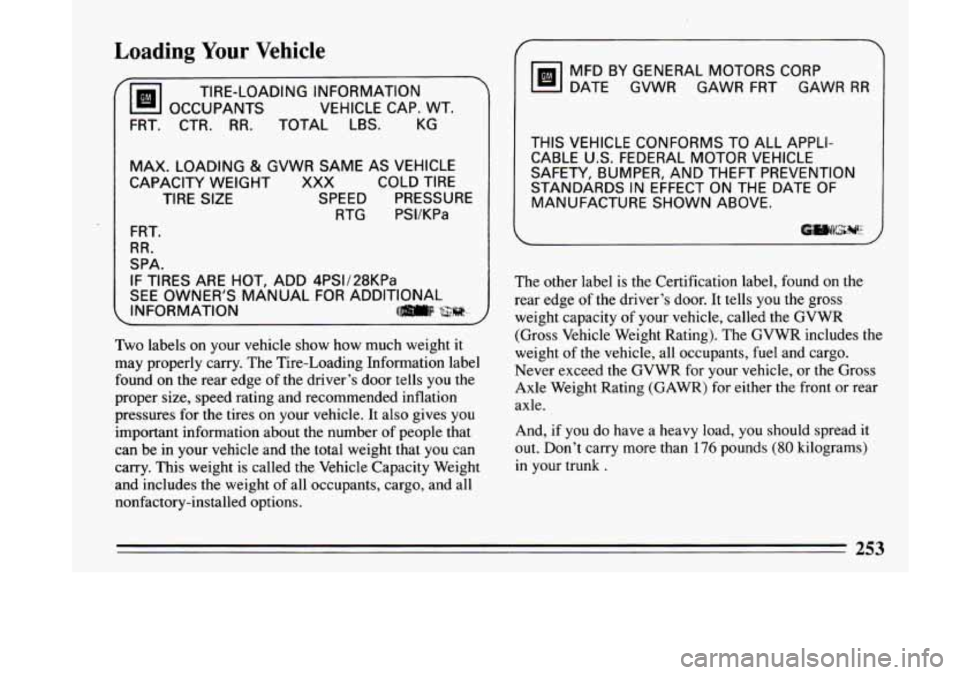
Two labels on your vehicle show how much weight it
may properly carry. The Tire-Loading Information label
found on the rear edge of the driver’s door tells you the
proper size, speed rating and recommended inflation
pressures for the tires on your vehicle. It also gives you
important information about the number of people that
can be in your vehicle and the total weight that you can
carry. This weight is called the Vehicle Capacity Weight
and includes the weight of all occupants, cargo, and all
nonfactory-installed options.
MFD BY GENERAL MOTORS CORP
DATE GVWR GAWR FRT GAWR
RR
THIS VEHICLE CONFORMS TO ALL APPLI-
CABLE U.S. FEDERAL MOTOR VEHICLE
SAFETY, BUMPER, AND THEFT PREVENTION
STANDARDS IN EFFECT ON THE DATE
OF
MANUFACTURE SHOWN ABOVE.
The other label is the Certification label, found on the
rear edge of the driver’s door. It tells you the gross
weight capacity of your vehicle, called the GVWR
(Gross Vehicle Weight Rating). The GVWR includes the
weight of the vehicle, all occupants, fuel and cargo.
Never exceed the GVWR for your vehicle, or the Gross
Axle Weight Rating (GAWR) for either the front or rear
axle.
And,
if you do have a heavy load, you should spread it
out. Don’t carry more than
176 pounds (80 kilograms)
in your trunk .
Page 257 of 324
Tires
We don’t make tires. Your new vehicle comes with high
quality tires made by
a leading tire manufacturer. These
tires are warranted by the tire manufacturers and their
warranties are delivered
with every new Buick. If your
spare tire
is a different brand than your road tires, you
will have a tire warranty folder from each of these
manufacturers.
A CAUTION:
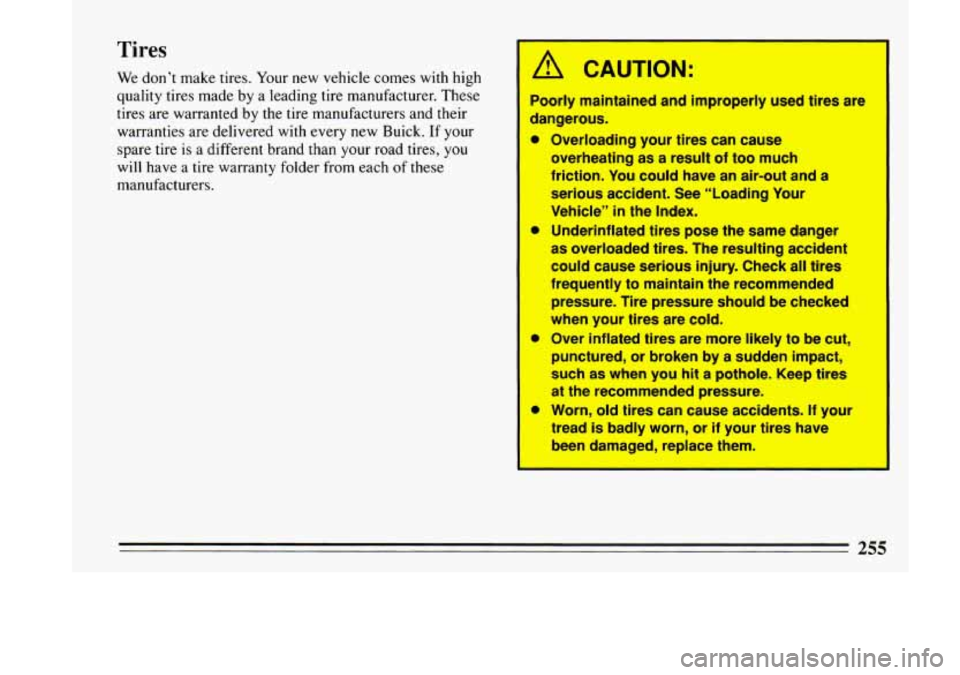
Poorly maintained and improperly used tires are
dangerous.
Overloading your tires can cause
overheating as
a result of too much
friction. You could have an air-out and a
serious accident.
See “Loading Your
Vehicle” in the Index.
Underinflated tires pose the same danger
as overloaded tires. The resulting accident
could cause serious injury. Check
all tires
frequently to maintain the recommended
pressure. Tire pressure should
be checked
when your tires are
cold.
Over inflated tires are more likely to be cut,
punctured, or broken by
a sudden impact,
such
as when you hit a pothole. Keep tires
at the recommended pressure.
Worn,
old tires can cause accidents. If your
tread
is badly worn, or if your tires have
been damaged, replace them.
255
Page 258 of 324
Inflation - Tire Pressure
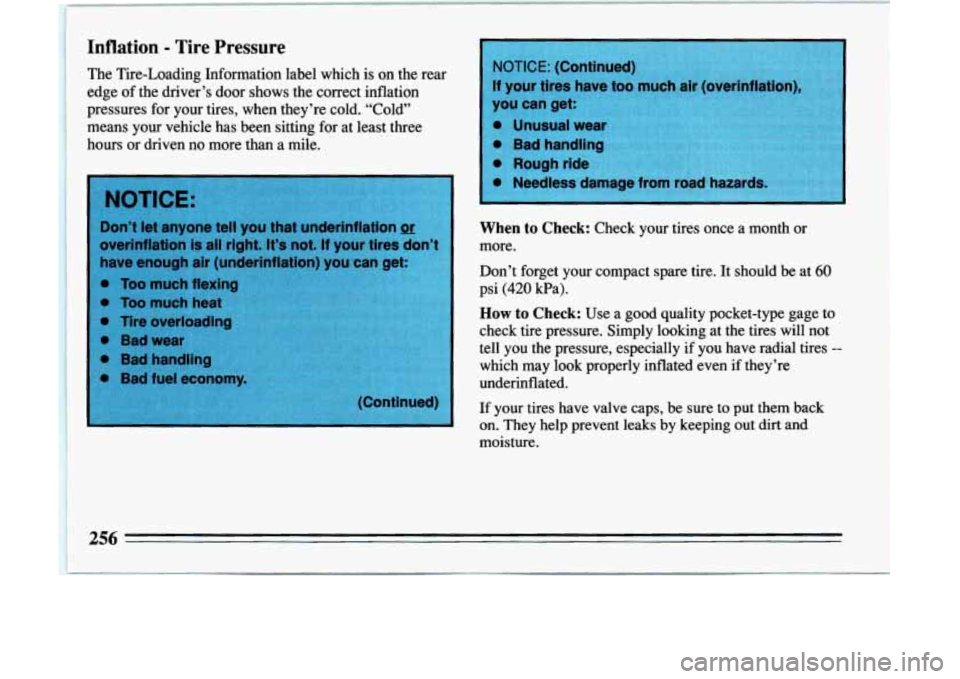
The Tire-Loading Information label which is on the rear
edge of the driver’s door shows the correct inflation
pressures for your tires, when they’re cold. “Cold”
means your vehicle has been sitting for at least
three
hours or driven no more than a mile.
When to Check: Check your tires once a month or
more.
Don’t forget your compact spare tire.
It should be at 60
psi (420 Pa).
How to Check: Use a good quality pocket-type gage to
check tire pressure. Simply looking at the tires will not
tell you the pressure, especially if you have radial tires
--
which may look properly inflated even if they’re
underinflated.
If your tires have valve caps, be sure to put them back on. They help prevent leaks by keeping out
dirt and
moisture.
256
I
Page 259 of 324
Tire Inspection and Rotation
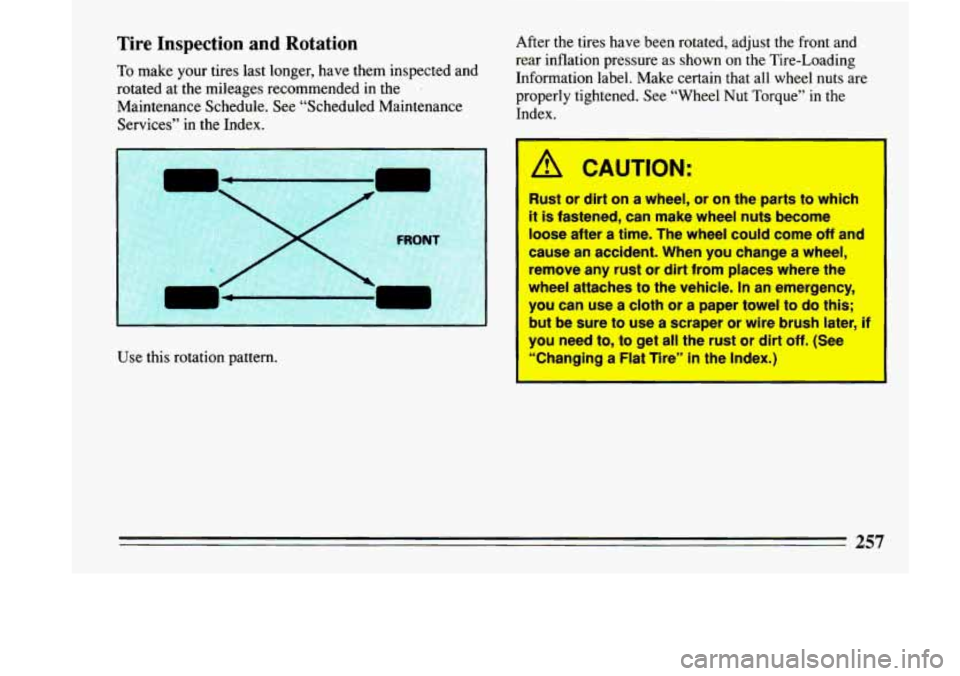
To make your tires last longer, have them inspected and
rotated at the mileages recommended in the
.
Maintenance Schedule. See “Scheduled Maintenance
Services’’ in the Index.
Use this rotation pattern. After
the tires have been rotated, adjust the front and
rear inflation pressure as shown on the Tire-Loading
Information label. Make certain that all wheel nuts are
properly tightened. See “Wheel Nut Torque” in the
Index.
I
A CAUTION:
Rust or dlrt on a wheel, or on the parts to which
it is fastetfed, can make wheel nuts become
loose after a time. The wheel could come off and
cause
an accident. When you change a wheel,
remove any rust or dirt from places where the
wheel attaches
to the vehicle. In an emergency,
you can use a cloth or a paper towel to do this;
but be
sure to use a scraper or wire brush later, if
you need to, to get all the rust or dirt off. (See
“Changing a FI; Tire’* On the Index.)
Page 265 of 324
0 Use solvent-type cleaners in a well-ventilated area
only. If you use them, don’t saturate the stained area.
0 If a ring forms after spot cleaning, clean the entire
area immediately or it will set.
Using Foam-Type Cleaner on Fabric
0
0
0
0
0
0
0
0
0
0
Vacuum and brush the area to remove any loose dirt.
Always clean a whole trim panel or section. Mask
surrounding trim along stitch or welt lines.
Mix Multi-Purpose Powdered Cleaner following the
directions on the container label.
Use suds
only and apply with a clean sponge.
Don’t saturate the material.
Don’t rub it roughly.
As soon as you’ve cleaned the section, use a sponge
to remove the suds.
Rinse the section with
a clean, wet sponge.
Wipe off what’s left with a slightly damp paper towel
or cloth.
Then dry
it immediately with an air hose, a hair
dryer
or a heat lamp.
I
Wipe with a clean cloth.
Using Solvent-Type Cleaner on
Fabric
First, see if you have to use solvent-type cleaner at all.
Some spots and stains will clean off better with just
water and mild soap.
If you need
to use it, then:
0
0
Gently scrape excess soil from the trim material with
a clean, dull knife or scraper. Use very little cleaner,
light pressure and clean cloths (preferably
cheesecloth). Cleaning should start
at the outside of
the stain, “feathering” toward the center. Keep
changing to a clean section of the cloth.
When you clean a stain from fabric, immediately dry
the area with an air hose, hair dryer, or heat lamp to
help prevent a cleaning ring. (See the previous
NOTICE.)
263
Page 268 of 324
Don’t wash your vehicle in the direct rays of the sun.
Don’t use strong soaps or chemical detergents. Use liquid
hand, dish or car washing (non-detergent) soaps. Don’t
use cleaning agents that contain acid or abrasives. All
cleaning agents should
be flushed promptly and not
allowed to dry on the surface, or they could stain. Dry the
finish with a soft, clean chamois or a 100% cotton towel
to avoid surface scratches and water spotting.
High pressure car washes may cause water to enter your
vehicle.
Finish Care
Occasional waxing or mild polishing of your Buick may
be necessary
to remove residue from the paint finish. You
can get
GM approved cleaning products from your dealer.
(See “Appearance Care and Materials”
in the Index.)
Your Buick has a “basecoat/clearcoat” paint finish. The
clearcoat gives more depth and gloss to the colored
basecoat.
finish or leave swirl marks,
Aluminum Wheels (If So Equipped)
Your aluminum wheels have a protective coating similar
to the painted surface of your car. Don’t use strong
soaps, chemicals, chrome polish, or other abrasive
cleaners on them because
you could damage this
coating. After rinsing thoroughly, a wax may be applied.
If you have aluminum wheels, don’
automatic vehicle wash that has hard silico
carbide cleaning brushes. TheFm brushes can
White Sidewall Tires
Your Buick dealer has a GM White Sidewall Tire
Cleaner. You can use a stiff brush with
it.
Weatherstrips
These are places where glass or metal meets rubber.
Silicone grease there will make them last longer, seal
better, and not squeak. Apply silicone grease with a
clean cloth at least every six months.