Coolant BUICK LESABRE 2003 User Guide
[x] Cancel search | Manufacturer: BUICK, Model Year: 2003, Model line: LESABRE, Model: BUICK LESABRE 2003Pages: 380, PDF Size: 2.75 MB
Page 257 of 380
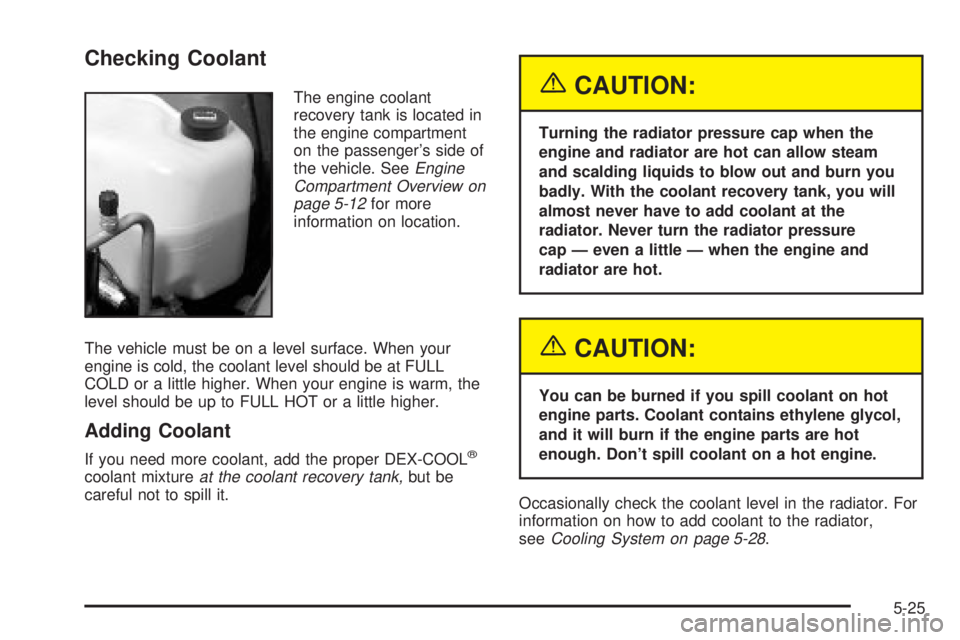
Checking Coolant
The engine coolant
recovery tank is located in
the engine compartment
on the passenger's side of
the vehicle. See
Engine
Compartment Overview on
page 5-12
for more
information on location.
The vehicle must be on a level surface. When your
engine is cold, the coolant level should be at FULL
COLD or a little higher. When your engine is warm, the
level should be up to FULL HOT or a little higher.
Adding Coolant
If you need more coolant, add the proper DEX-COOLž
coolant mixtureat the coolant recovery tank,but be
careful not to spill it.
{CAUTION:
Turning the radiator pressure cap when the
engine and radiator are hot can allow steam
and scalding liquids to blow out and burn you
badly. With the coolant recovery tank, you will
almost never have to add coolant at the
radiator. Never turn the radiator pressure
cap Ð even a little Ð when the engine and
radiator are hot.
{CAUTION:
You can be burned if you spill coolant on hot
engine parts. Coolant contains ethylene glycol,
and it will burn if the engine parts are hot
enough. Don't spill coolant on a hot engine.
Occasionally check the coolant level in the radiator. For
information on how to add coolant to the radiator,
see
Cooling System on page 5-28.
5-25
Page 258 of 380
Radiator Pressure Cap
Notice:Your radiator cap is a pressure-type cap
and must be tightly installed to prevent coolant loss
and possible engine damage from overheating.
Be sure the arrows on the cap line up with the
over¯ow tube on the radiator ®ller neck.
See
Engine Compartment Overview on page 5-12for
more information on location.
Engine Overheating
You will ®nd a warning light about a hot engine as well
as an engine coolant temperature gage on your
vehicle's instrument panel cluster.
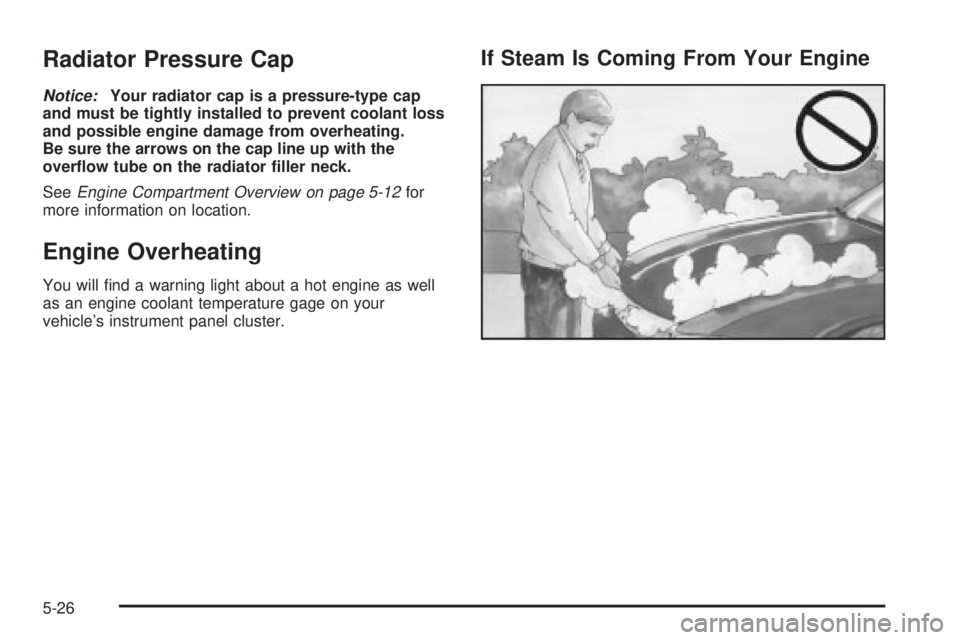
If Steam Is Coming From Your Engine
5-26
Page 259 of 380
{CAUTION:
Steam from an overheated engine can burn
you badly, even if you just open the hood. Stay
away from the engine if you see or hear steam
coming from it. Just turn it off and get
everyone away from the vehicle until it cools
down. Wait until there is no sign of steam or
coolant before you open the hood.
If you keep driving when your engine is
overheated, the liquids in it can catch ®re. You
or others could be badly burned. Stop your
engine if it overheats, and get out of the
vehicle until the engine is cool.
Notice:If your engine catches ®re because you
keep driving with no coolant, your vehicle can
be badly damaged. The costly repairs would not be
covered by your warranty.
If No Steam Is Coming From Your
Engine
If you get an engine overheat warning but see or hear
no steam, the problem may not be too serious.
Sometimes the engine can get a little too hot when you:
·Climb a long hill on a hot day.
·Stop after high-speed driving.
·Idle for long periods in traffic.
·Tow a trailer.
If you get the overheat warning with no sign of steam,
try this for a minute or so:
1. In heavy traffic, let the engine idle in NEUTRAL (N)
while stopped. If it is safe to do so, pull off the road,
shift to PARK (P) or NEUTRAL (N) and let the
engine idle.
2. Turn on your heater to full hot at the highest fan
speed and open the window as necessary.
If you no longer have the overheat warning, you can
drive. Just to be safe, drive slower for about 10 minutes.
If the warning doesn't come back on, you can drive
normally.
If the warning continues and you have not stopped, pull
over, stop, and park your vehicle right away.
5-27
Page 260 of 380
If there's still no sign of steam, you can idle the engine
for three minutes while you're parked. If you still
have the warning,
turn off the engine and get everyone
out of the vehicleuntil it cools down.
You may decide not to lift the hood but to get service
help right away.
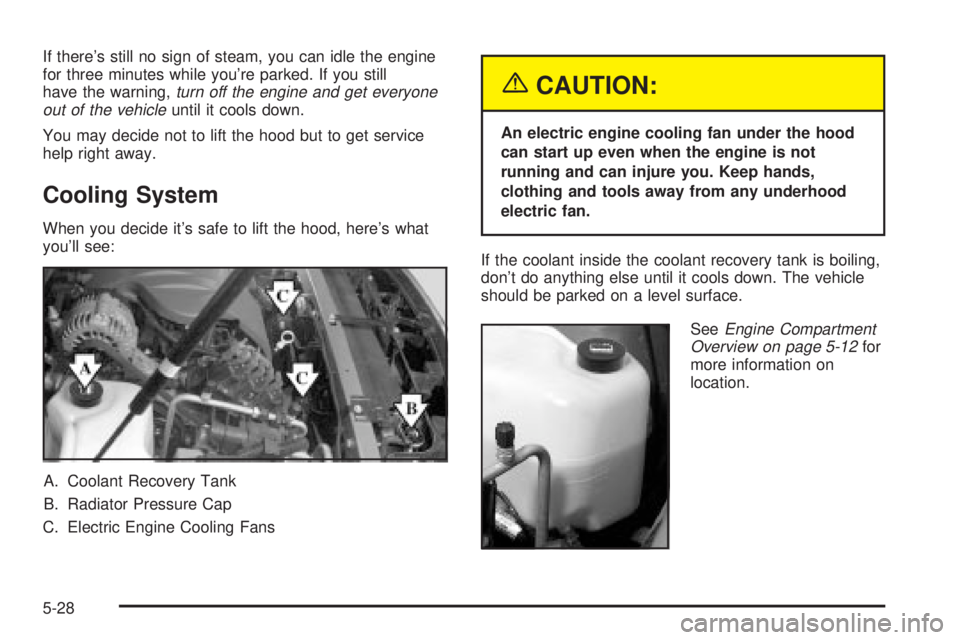
Cooling System
When you decide it's safe to lift the hood, here's what
you'll see:
A. Coolant Recovery Tank
B. Radiator Pressure Cap
C. Electric Engine Cooling Fans
{CAUTION:
An electric engine cooling fan under the hood
can start up even when the engine is not
running and can injure you. Keep hands,
clothing and tools away from any underhood
electric fan.
If the coolant inside the coolant recovery tank is boiling,
don't do anything else until it cools down. The vehicle
should be parked on a level surface.
See
Engine Compartment
Overview on page 5-12for
more information on
location.
5-28
Page 261 of 380
The coolant level should be at or above the FULL
COLD mark when the engine is cold. The coolant level
should be at the FULL HOT mark under normal
operating conditions. If it isn't, you may have a leak at
the pressure cap or in the radiator hoses, heater hoses,
radiator, water pump or somewhere else in the cooling
system.
{CAUTION:
Heater and radiator hoses, and other engine
parts, can be very hot. Don't touch them. If you
do, you can be burned.
Don't run the engine if there is a leak. If you
run the engine, it could lose all coolant. That
could cause an engine ®re, and you could be
burned. Get any leak ®xed before you drive the
vehicle.If there seems to be no leak, with the engine on, check
to see if the electric engine cooling fans are running.
If the engine is overheating, both fans should be
running. If they aren't, your vehicle needs service.
Notice:Engine damage from running your engine
without coolant isn't covered by your warranty.
Notice:When adding coolant, it is important that
you use only DEX-COOLž(silicate-free) coolant.
If coolant other than DEX-COOLžis added to
the system, premature engine, heater core or
radiator corrosion may result. In addition, the engine
coolant will require change sooner Ð at 30,000 miles
(50 000 km) or 24 months, whichever occurs ®rst.
Damage caused by the use of coolant other
than DEX-COOL
žis not covered by your new vehicle
warranty.
5-29
Page 262 of 380
How to Add Coolant to the Coolant
Recovery Tank
{CAUTION:
Adding only plain water to your cooling
system can be dangerous. Plain water, or
some other liquid such as alcohol, can boil
before the proper coolant mixture will. Your
vehicle's coolant warning system is set for the
proper coolant mixture. With plain water or the
wrong mixture, your engine could get too hot
but you wouldn't get the overheat warning.
Your engine could catch ®re and you or others
could be burned. Use a 50/50 mixture of clean,
drinkable water and DEX-COOL
žcoolant.
Notice:In cold weather, water can freeze and crack
the engine, radiator, heater core and other parts.
Use the recommended coolant and the proper
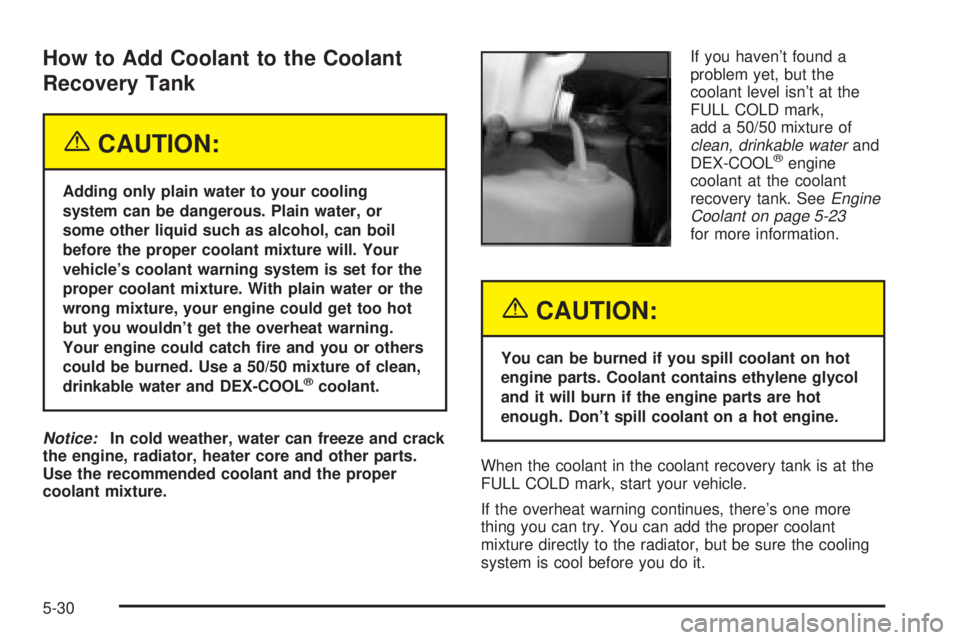
coolant mixture.If you haven't found a
problem yet, but the
coolant level isn't at the
FULL COLD mark,
add a 50/50 mixture of
clean, drinkable waterand
DEX-COOLžengine
coolant at the coolant
recovery tank. See
Engine
Coolant on page 5-23
for more information.
{CAUTION:
You can be burned if you spill coolant on hot
engine parts. Coolant contains ethylene glycol
and it will burn if the engine parts are hot
enough. Don't spill coolant on a hot engine.
When the coolant in the coolant recovery tank is at the
FULL COLD mark, start your vehicle.
If the overheat warning continues, there's one more
thing you can try. You can add the proper coolant
mixture directly to the radiator, but be sure the cooling
system is cool before you do it.
5-30
Page 263 of 380
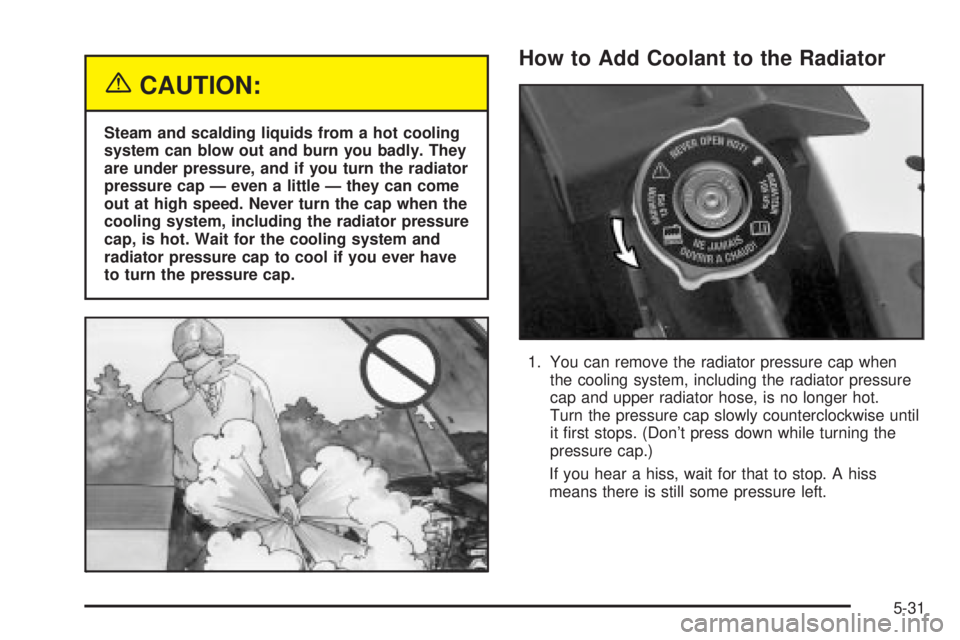
{CAUTION:
Steam and scalding liquids from a hot cooling
system can blow out and burn you badly. They
are under pressure, and if you turn the radiator
pressure cap Ð even a little Ð they can come
out at high speed. Never turn the cap when the
cooling system, including the radiator pressure
cap, is hot. Wait for the cooling system and
radiator pressure cap to cool if you ever have
to turn the pressure cap.
How to Add Coolant to the Radiator
1. You can remove the radiator pressure cap when
the cooling system, including the radiator pressure
cap and upper radiator hose, is no longer hot.
Turn the pressure cap slowly counterclockwise until
it ®rst stops. (Don't press down while turning the
pressure cap.)
If you hear a hiss, wait for that to stop. A hiss
means there is still some pressure left.
5-31
Page 265 of 380
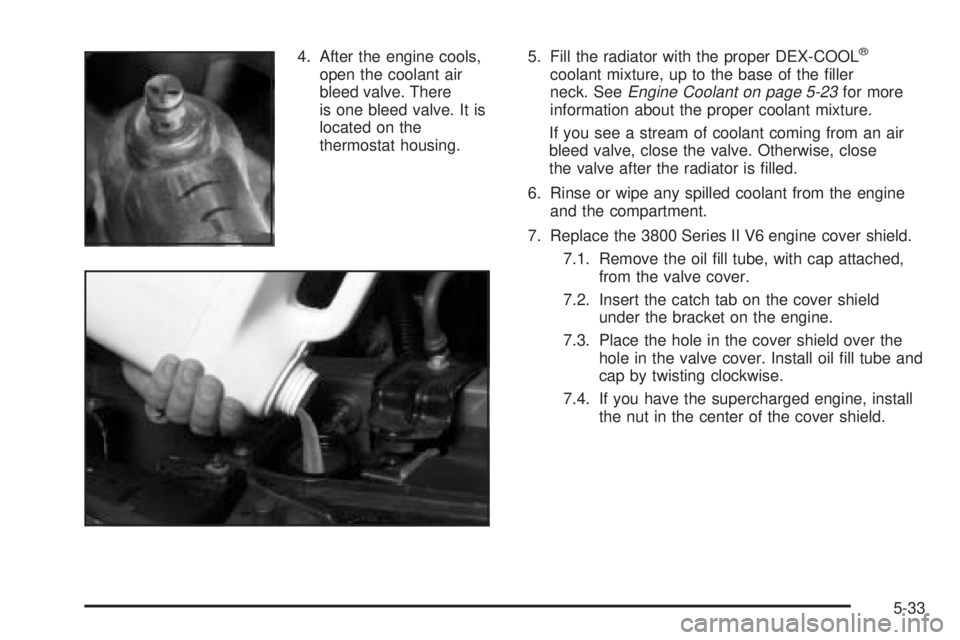
4. After the engine cools,
open the coolant air
bleed valve. There
is one bleed valve. It is
located on the
thermostat housing.5. Fill the radiator with the proper DEX-COOLž
coolant mixture, up to the base of the ®ller
neck. SeeEngine Coolant on page 5-23for more
information about the proper coolant mixture.
If you see a stream of coolant coming from an air
bleed valve, close the valve. Otherwise, close
the valve after the radiator is ®lled.
6. Rinse or wipe any spilled coolant from the engine
and the compartment.
7. Replace the 3800 Series II V6 engine cover shield.
7.1. Remove the oil ®ll tube, with cap attached,
from the valve cover.
7.2. Insert the catch tab on the cover shield
under the bracket on the engine.
7.3. Place the hole in the cover shield over the
hole in the valve cover. Install oil ®ll tube and
cap by twisting clockwise.
7.4. If you have the supercharged engine, install
the nut in the center of the cover shield.
5-33
Page 266 of 380
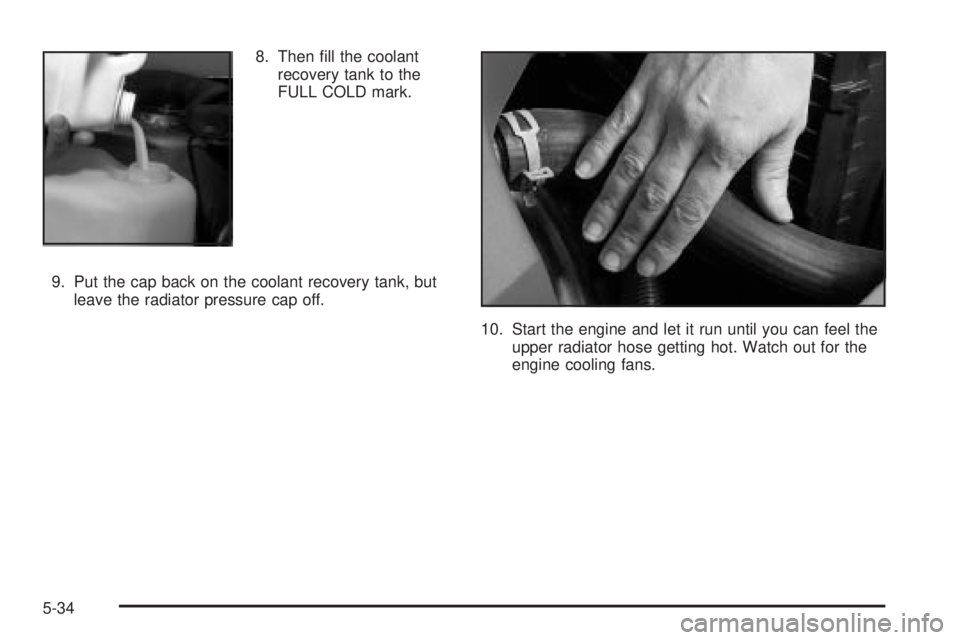
8. Then ®ll the coolant
recovery tank to the
FULL COLD mark.
9. Put the cap back on the coolant recovery tank, but
leave the radiator pressure cap off.
10. Start the engine and let it run until you can feel the
upper radiator hose getting hot. Watch out for the
engine cooling fans.
5-34
Page 267 of 380
11. By this time, the coolant level inside the radiator
®ller neck may be lower. If the level is lower, add
more of the proper DEX-COOL
žcoolant mixture
through the ®ller neck until the level reaches
the base of the ®ller neck.
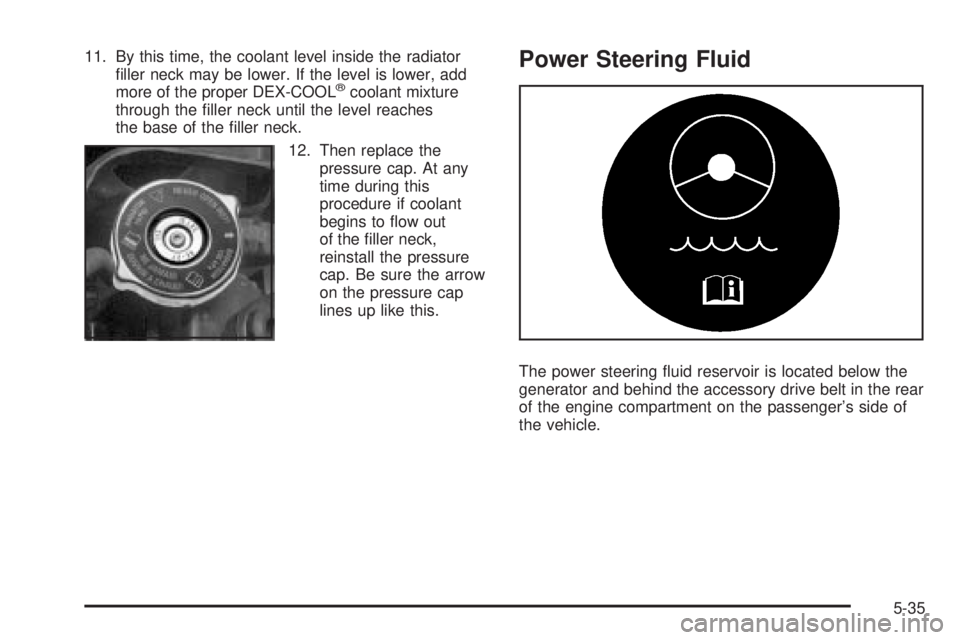
12. Then replace the
pressure cap. At any
time during this
procedure if coolant
begins to ¯ow out
of the ®ller neck,
reinstall the pressure
cap. Be sure the arrow
on the pressure cap
lines up like this.
Power Steering Fluid
The power steering ¯uid reservoir is located below the
generator and behind the accessory drive belt in the rear
of the engine compartment on the passenger's side of
the vehicle.
5-35