traction control BUICK LESABRE 2004 User Guide
[x] Cancel search | Manufacturer: BUICK, Model Year: 2004, Model line: LESABRE, Model: BUICK LESABRE 2004Pages: 392, PDF Size: 4.3 MB
Page 207 of 392
Loss of Control
Let us review what driving experts say about what
happens when the three control systems (brakes, steering
and acceleration) do not have enough friction where
the tires meet the road to do what the driver has asked.
In any emergency, do not give up. Keep trying to
steer and constantly seek an escape route or area of
less danger.
Skidding
In a skid, a driver can lose control of the vehicle.
Defensive drivers avoid most skids by taking reasonable
care suited to existing conditions, and by not “overdriving”
those conditions. But skids are always possible.
The three types of skids correspond to your vehicle’s
three control systems. In the braking skid, your wheels
are not rolling. In the steering or cornering skid, too much
speed or steering in a curve causes tires to slip and lose
cornering force. And in the acceleration skid, too much
throttle causes the driving wheels to spin.
A cornering skid is best handled by easing your foot off
the accelerator pedal.
If you have the traction control system, remember: It
helps avoid only the acceleration skid. If you do not have
traction control, or if the system is off, then an
acceleration skid is also best handled by easing your
foot off the accelerator pedal.If your vehicle starts to slide, ease your foot off the
accelerator pedal and quickly steer the way you want
the vehicle to go. If you start steering quickly enough,
your vehicle may straighten out. Always be ready
for a second skid if it occurs.
If you have Stabilitrak
®, you may see the STABILITY
SYSTEM ACTIVE message on the Driver Information
Center. See “Stability System Active Message”
underDIC Warnings and Messages on page 3-49.
Of course, traction is reduced when water, snow, ice,
gravel or other material is on the road. For safety,
you will want to slow down and adjust your driving to
these conditions. It is important to slow down on slippery
surfaces because stopping distance will be longer and
vehicle control more limited.
While driving on a surface with reduced traction, try
your best to avoid sudden steering, acceleration
or braking (including engine braking by shifting to a
lower gear). Any sudden changes could cause the tires
to slide. You may not realize the surface is slippery
until your vehicle is skidding. Learn to recognize warning
clues — such as enough water, ice or packed snow
on the road to make a “mirrored surface” — and slow
down when you have any doubt.
Remember: Any anti-lock brake system (ABS) helps
avoid only the braking skid.
4-15
Page 219 of 392
the least traction of all. You can get wet ice when it’s
about freezing (32°F; 0°C) and freezing rain begins
to fall. Try to avoid driving on wet ice until salt and sand
crews can get there.
Whatever the condition – smooth ice, packed, blowing
or loose snow – drive with caution.
If you have traction control, keep the system on. It will
improve your ability to accelerate when driving on a
slippery road. Even though your vehicle has a traction
control system you’ll want to slow down and adjust your
driving to the road conditions. SeeTraction Control
System (TCS) on page 4-9.
If you don’t have a traction control system, accelerate
gently. Try not to break the fragile traction. If you
accelerate too fast, the drive wheels will spin and polish
the surface under the tires even more.Your anti-lock brakes improve your vehicle’s stability
when you make a hard stop on a slippery road.
Even though you have the anti-lock braking system,
you’ll want to begin stopping sooner than you would on
dry pavement. SeeBraking on page 4-6.
Allow greater following distance on any
slippery road.
Watch for slippery spots. The road might be ne
until you hit a spot that’s covered with ice. On
an otherwise clear road, ice patches may appear in
shaded areas where the sun can’t reach: around
clumps of trees, behind buildings or under bridges.
Sometimes the surface of a curve or an overpass
may remain icy when the surrounding roads
are clear. If you see a patch of ice ahead of you,
brake before you are on it. Try not to brake
while you’re actually on the ice, and avoid sudden
steering maneuvers.
4-27
Page 223 of 392
Notice:Spinning your wheels can destroy parts of
your vehicle as well as the tires. If you spin the
wheels too fast while shifting your transaxle back
and forth, you can destroy your transaxle. See
“Rocking Your Vehicle To Get It Out.”
For information about using tire chains on your vehicle,
seeTire Chains on page 5-72.
Rocking Your Vehicle To Get It Out
First, turn your steering wheel left and right. That will
clear the area around your front wheels. If your vehicle
has traction control, you should turn the system off.
SeeTraction Control System (TCS) on page 4-9. Then
shift back and forth between REVERSE (R) and a
forward gear, spinning the wheels as little as possible.
Release the accelerator pedal while you shift, and press
lightly on the accelerator pedal when the transaxle is
in gear. By slowly spinning your wheels in the forward
and reverse directions, you will cause a rocking
motion that may free your vehicle. If that doesn’t get
you out after a few tries, you may need to be towed out.
If you do need to be towed out, see “Towing Your
Vehicle” following.
Towing
Towing Your Vehicle
Consult your dealer or a professional towing service if
you need to have your disabled vehicle towed. See
Roadside Assistance Program on page 7-6.
If you want to tow your vehicle behind another vehicle
for recreational purposes (such as behind a motorhome),
see “Recreational Vehicle Towing” following.
4-31
Page 307 of 392
Buying New Tires
To nd out what kind and size of tires you need, look at
the tire and loading information label. For an example
of this label and its location, seeLoading Your Vehicle
on page 4-33.
The tires installed on your vehicle when it was new had
a Tire Performance Criteria Specication (TPC Spec)
number on each tire’s sidewall. When you get new tires,
get ones with that same TPC Spec number. That way
your vehicle will continue to have tires that are designed
to give proper endurance, handling, speed rating,
load range, traction, ride and other things during normal
service on your vehicle. If your tires have an all-season
tread design, the TPC number will be followed by
an “MS” (for mud and snow).
If you ever replace your tires with those not having a
TPC Spec number, make sure they are the same size,
load range, speed rating and construction type (bias,
bias-belted or radial) as your original tires.{CAUTION:
Mixing tires could cause you to lose control
while driving. If you mix tires of different sizes
or types (radial and bias-belted tires), the
vehicle may not handle properly, and you
could have a crash. Using tires of different
sizes may also cause damage to your vehicle.
Be sure to use the same size and type tires on
all wheels. It’s all right to drive with your
compact spare temporarily, it was developed
for use on your vehicle. See “Compact Spare
Tire” in the index.
{CAUTION:
If you use bias-ply tires on your vehicle, the
wheel rim anges could develop cracks after
many miles of driving. A tire and/or wheel
could fail suddenly, causing a crash. Use only
radial-ply tires with the wheels on your vehicle.
5-69
Page 308 of 392
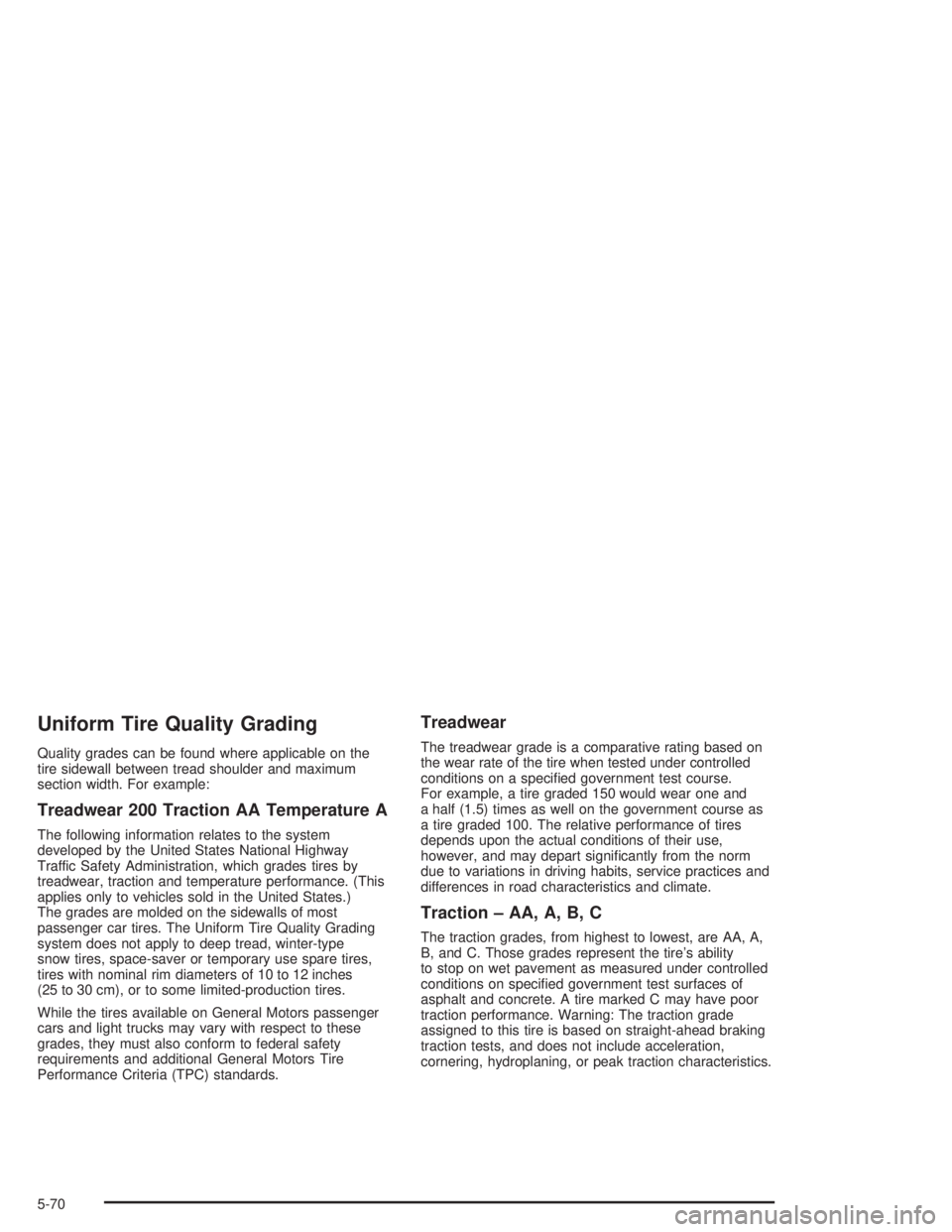
Uniform Tire Quality Grading
Quality grades can be found where applicable on the
tire sidewall between tread shoulder and maximum
section width. For example:
Treadwear 200 Traction AA Temperature A
The following information relates to the system
developed by the United States National Highway
Traffic Safety Administration, which grades tires by
treadwear, traction and temperature performance. (This
applies only to vehicles sold in the United States.)
The grades are molded on the sidewalls of most
passenger car tires. The Uniform Tire Quality Grading
system does not apply to deep tread, winter-type
snow tires, space-saver or temporary use spare tires,
tires with nominal rim diameters of 10 to 12 inches
(25 to 30 cm), or to some limited-production tires.
While the tires available on General Motors passenger
cars and light trucks may vary with respect to these
grades, they must also conform to federal safety
requirements and additional General Motors Tire
Performance Criteria (TPC) standards.
Treadwear
The treadwear grade is a comparative rating based on
the wear rate of the tire when tested under controlled
conditions on a specied government test course.
For example, a tire graded 150 would wear one and
a half (1.5) times as well on the government course as
a tire graded 100. The relative performance of tires
depends upon the actual conditions of their use,
however, and may depart signicantly from the norm
due to variations in driving habits, service practices and
differences in road characteristics and climate.
Traction – AA, A, B, C
The traction grades, from highest to lowest, are AA, A,
B, and C. Those grades represent the tire’s ability
to stop on wet pavement as measured under controlled
conditions on specied government test surfaces of
asphalt and concrete. A tire marked C may have poor
traction performance. Warning: The traction grade
assigned to this tire is based on straight-ahead braking
traction tests, and does not include acceleration,
cornering, hydroplaning, or peak traction characteristics.
5-70
Page 384 of 392
L
Lamps
Exterior......................................................3-14
Interior.......................................................3-17
Language Selection.........................................3-54
Lap Belt........................................................1-19
Lap-Shoulder Belt...................................1-12, 1-21
LATCH System
Child Restraints...........................................1-39
Securing a Child Restraint Designed for
the LATCH System...................................1-41
Leaving Your Vehicle.......................................2-13
Leaving Your Vehicle With the
Engine Running..........................................2-29
Light
Air Bag Readiness.......................................3-36
Anti-Lock Brake System Warning...................3-38
Battery Warning..........................................3-37
Brake System Warning.................................3-37
Cruise Control.............................................3-44
Malfunction Indicator....................................3-40
Oil Pressure...............................................3-43
Safety Belt Reminder...................................3-36
Security.....................................................3-44
Service Vehicle Soon...................................3-44
TCS Warning Light......................................3-39
Traction Control System (TCS) Warning..........3-39
Lighted Visor Vanity Mirror...............................2-17
Loading Your Vehicle.......................................4-33Lockout Protection..........................................2-13
Locks
Central Door Unlocking System.....................2-10
Delayed Locking..........................................2-11
Door........................................................... 2-9
Leaving Your Vehicle....................................2-13
Lockout Protection.......................................2-13
Power Door................................................2-10
Programmable Automatic Door Locks.............2-12
Rear Door Security Locks.............................2-13
Long Trip/Highway Denition.............................. 6-6
Long Trip/Highway Intervals............................... 6-6
Long Trip/Highway Scheduled Maintenance........6-13
Loss of Control...............................................4-15
Lumbar
Manual Controls............................................ 1-3
Power Controls............................................. 1-3
M
Maintenance Schedule
At Each Fuel Fill.........................................6-17
At Least Once a Month................................6-17
At Least Once a Year..................................6-18
At Least Twice a Year..................................6-18
Brake System Inspection..............................6-22
Engine Cooling System Inspection.................6-22
Exhaust System Inspection...........................6-21
Fuel System Inspection................................6-22
8
Page 390 of 392
Tire Ination Check.........................................6-17
Tire Sidewall Labeling......................................5-58
Tire Size.......................................................5-62
Tire Terminology and Denitions........................5-62
Tires.............................................................5-58
Buying New Tires........................................5-69
Chains.......................................................5-72
Changing a Flat Tire....................................5-74
Check Tire Pressure System.........................5-66
Compact Spare Tire.....................................5-83
If a Tire Goes Flat.......................................5-73
Ination - Tire Pressure................................5-65
Inspection and Rotation................................5-67
Uniform Tire Quality Grading.........................5-70
Wheel Alignment and Tire Balance.................5-71
Wheel Replacement.....................................5-71
When It Is Time for New Tires......................5-68
To Use the Engine Coolant Heater....................2-24
Top Strap......................................................1-37
Top Strap Anchor Location...............................1-38
Torque Lock...................................................2-30
Total Weight on Your Vehicle’s Tires..................4-42
Towing
Recreational Vehicle.....................................4-32
Towing a Trailer..........................................4-39
Your Vehicle...............................................4-31
Traction
Control System (TCS).................................... 4-9
Control System Warning Light.......................3-39Trailer Brakes.................................................4-43
Trailer Wiring Harness.....................................4-43
Transaxle
Fluid, Automatic...........................................5-21
Transaxle Operation, Automatic.........................2-25
Transmission, Transaxle, Transfer Case Unit
Repair Manual............................................7-11
Transportation Options...................................... 7-8
Trip Odometer................................................3-35
Trunk............................................................2-14
Trunk Lock Release........................................2-14
Trunk Security Override...................................2-15
Trunk-Mounted CD Changer.............................3-73
Turn and Lane-Change Signals.......................... 3-8
Turn Signal/Multifunction Lever........................... 3-7
Turn Signals When Towing a Trailer..................4-44
Twilight Sentinel
®............................................3-16
U
Underbody Flushing Service.............................6-20
Understanding Radio Reception........................3-79
Uniform Tire Quality Grading............................5-70
United States – Customer Assistance.................. 7-4
Used Replacement Wheels..............................5-72
Using Cleaner on Fabric..................................5-85
Using HomeLink
®...........................................2-41
Using RDS....................................................3-58
14