key BUICK LESABRE 2004 Workshop Manual
[x] Cancel search | Manufacturer: BUICK, Model Year: 2004, Model line: LESABRE, Model: BUICK LESABRE 2004Pages: 392, PDF Size: 4.3 MB
Page 356 of 392
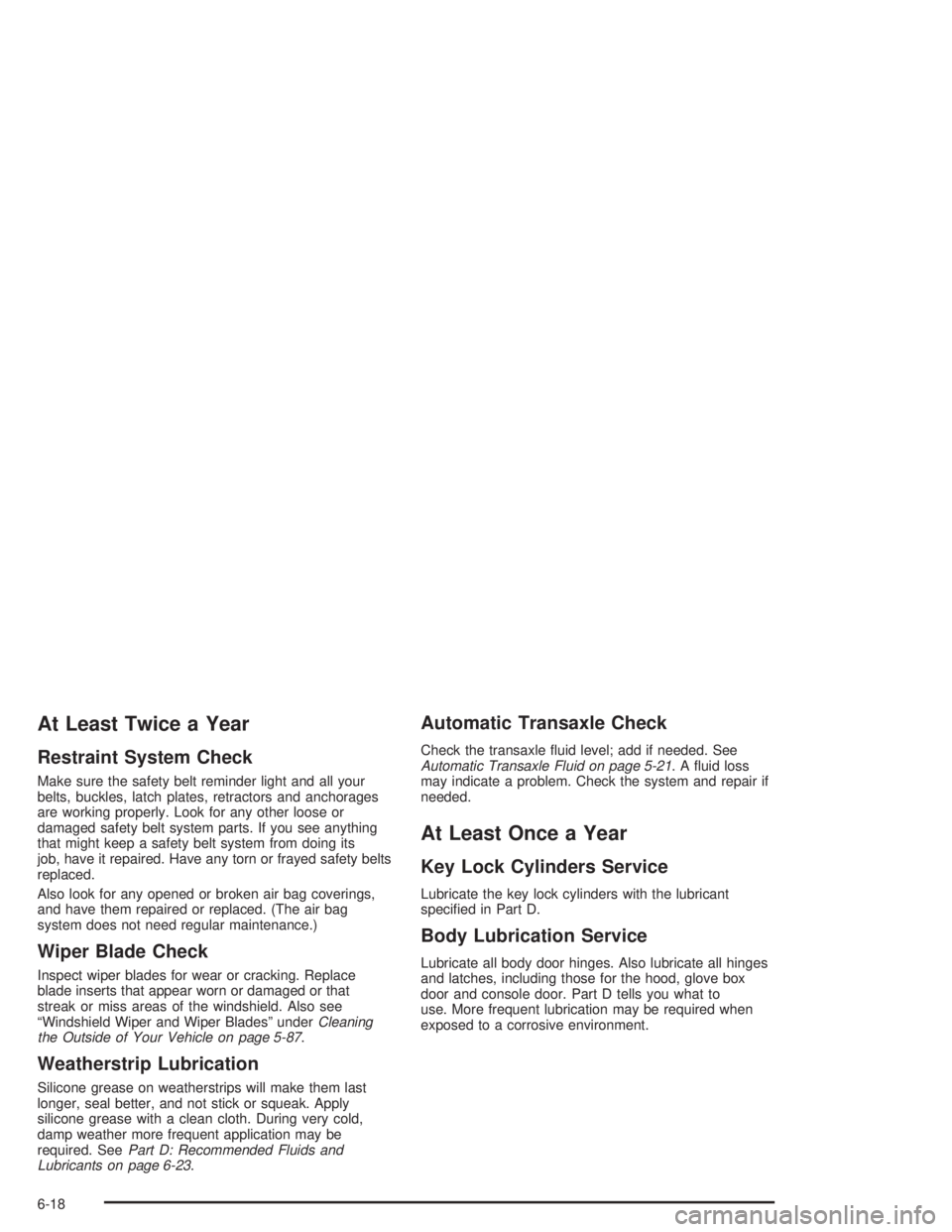
At Least Twice a Year
Restraint System Check
Make sure the safety belt reminder light and all your
belts, buckles, latch plates, retractors and anchorages
are working properly. Look for any other loose or
damaged safety belt system parts. If you see anything
that might keep a safety belt system from doing its
job, have it repaired. Have any torn or frayed safety belts
replaced.
Also look for any opened or broken air bag coverings,
and have them repaired or replaced. (The air bag
system does not need regular maintenance.)
Wiper Blade Check
Inspect wiper blades for wear or cracking. Replace
blade inserts that appear worn or damaged or that
streak or miss areas of the windshield. Also see
“Windshield Wiper and Wiper Blades” underCleaning
the Outside of Your Vehicle on page 5-87.
Weatherstrip Lubrication
Silicone grease on weatherstrips will make them last
longer, seal better, and not stick or squeak. Apply
silicone grease with a clean cloth. During very cold,
damp weather more frequent application may be
required. SeePart D: Recommended Fluids and
Lubricants on page 6-23.
Automatic Transaxle Check
Check the transaxle uid level; add if needed. See
Automatic Transaxle Fluid on page 5-21. A uid loss
may indicate a problem. Check the system and repair if
needed.
At Least Once a Year
Key Lock Cylinders Service
Lubricate the key lock cylinders with the lubricant
specied in Part D.
Body Lubrication Service
Lubricate all body door hinges. Also lubricate all hinges
and latches, including those for the hood, glove box
door and console door. Part D tells you what to
use. More frequent lubrication may be required when
exposed to a corrosive environment.
6-18
Page 357 of 392
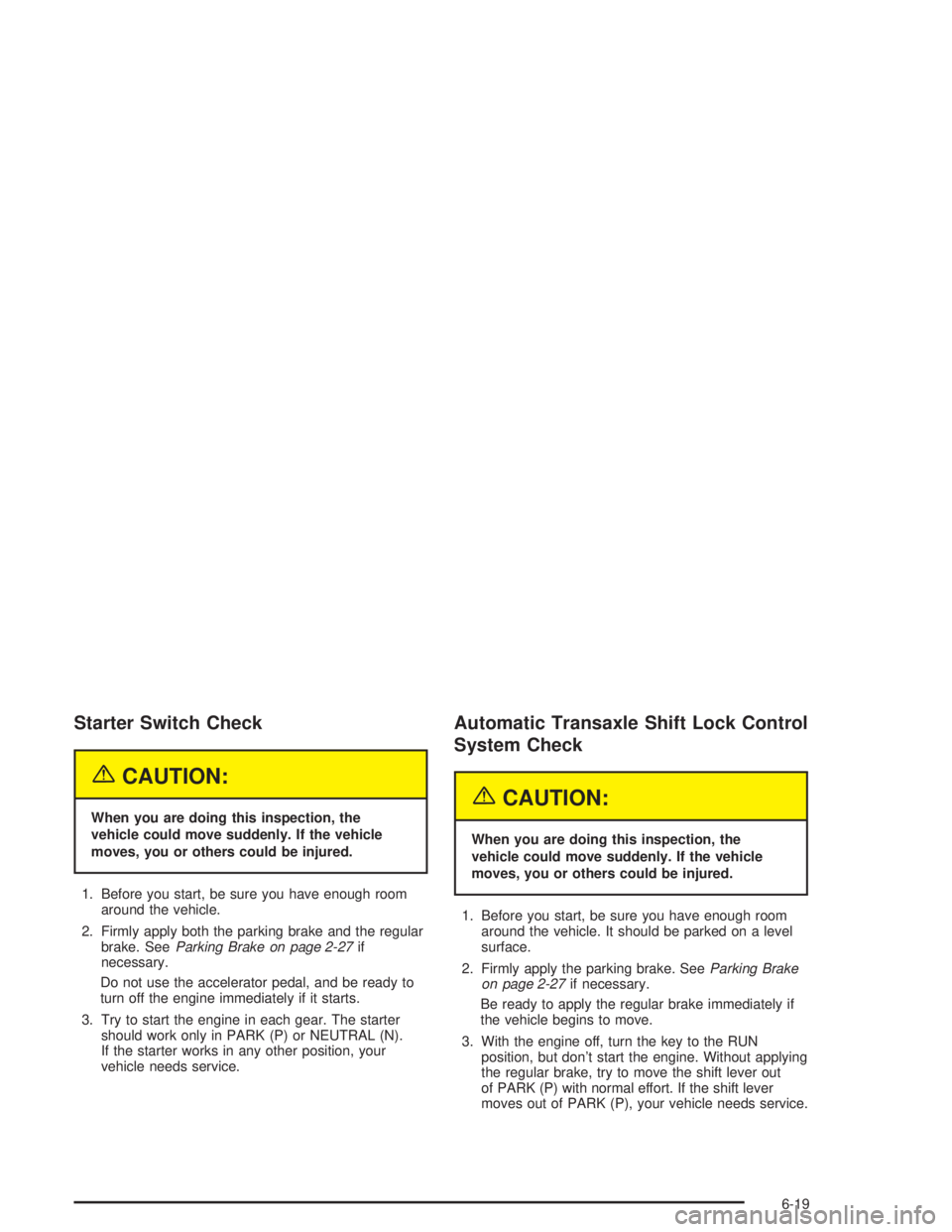
Starter Switch Check
{CAUTION:
When you are doing this inspection, the
vehicle could move suddenly. If the vehicle
moves, you or others could be injured.
1. Before you start, be sure you have enough room
around the vehicle.
2. Firmly apply both the parking brake and the regular
brake. SeeParking Brake on page 2-27if
necessary.
Do not use the accelerator pedal, and be ready to
turn off the engine immediately if it starts.
3. Try to start the engine in each gear. The starter
should work only in PARK (P) or NEUTRAL (N).
If the starter works in any other position, your
vehicle needs service.
Automatic Transaxle Shift Lock Control
System Check
{CAUTION:
When you are doing this inspection, the
vehicle could move suddenly. If the vehicle
moves, you or others could be injured.
1. Before you start, be sure you have enough room
around the vehicle. It should be parked on a level
surface.
2. Firmly apply the parking brake. SeeParking Brake
on page 2-27if necessary.
Be ready to apply the regular brake immediately if
the vehicle begins to move.
3. With the engine off, turn the key to the RUN
position, but don’t start the engine. Without applying
the regular brake, try to move the shift lever out
of PARK (P) with normal effort. If the shift lever
moves out of PARK (P), your vehicle needs service.
6-19
Page 358 of 392
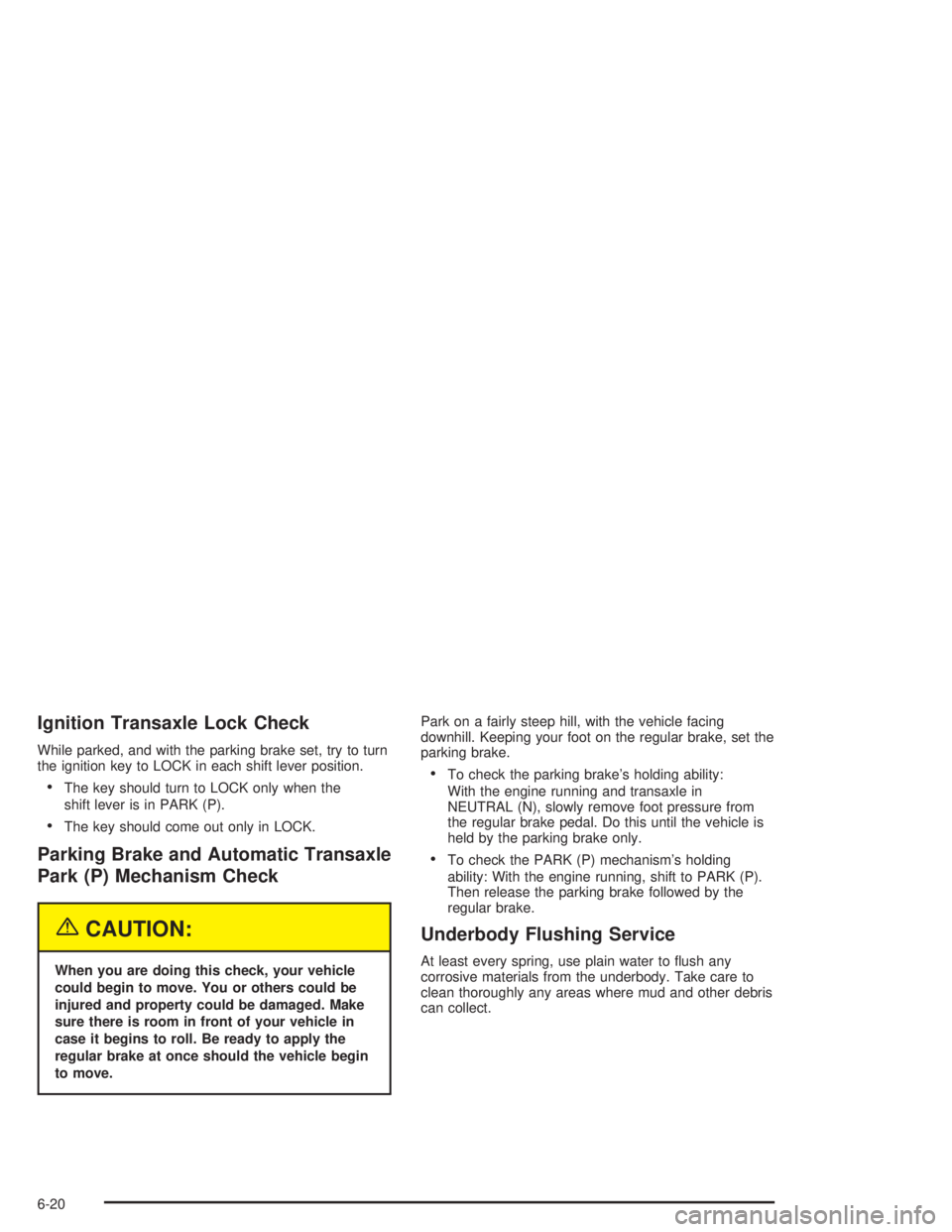
Ignition Transaxle Lock Check
While parked, and with the parking brake set, try to turn
the ignition key to LOCK in each shift lever position.
The key should turn to LOCK only when the
shift lever is in PARK (P).
The key should come out only in LOCK.
Parking Brake and Automatic Transaxle
Park (P) Mechanism Check
{CAUTION:
When you are doing this check, your vehicle
could begin to move. You or others could be
injured and property could be damaged. Make
sure there is room in front of your vehicle in
case it begins to roll. Be ready to apply the
regular brake at once should the vehicle begin
to move.Park on a fairly steep hill, with the vehicle facing
downhill. Keeping your foot on the regular brake, set the
parking brake.
To check the parking brake’s holding ability:
With the engine running and transaxle in
NEUTRAL (N), slowly remove foot pressure from
the regular brake pedal. Do this until the vehicle is
held by the parking brake only.
To check the PARK (P) mechanism’s holding
ability: With the engine running, shift to PARK (P).
Then release the parking brake followed by the
regular brake.
Underbody Flushing Service
At least every spring, use plain water to ush any
corrosive materials from the underbody. Take care to
clean thoroughly any areas where mud and other debris
can collect.
6-20
Page 361 of 392
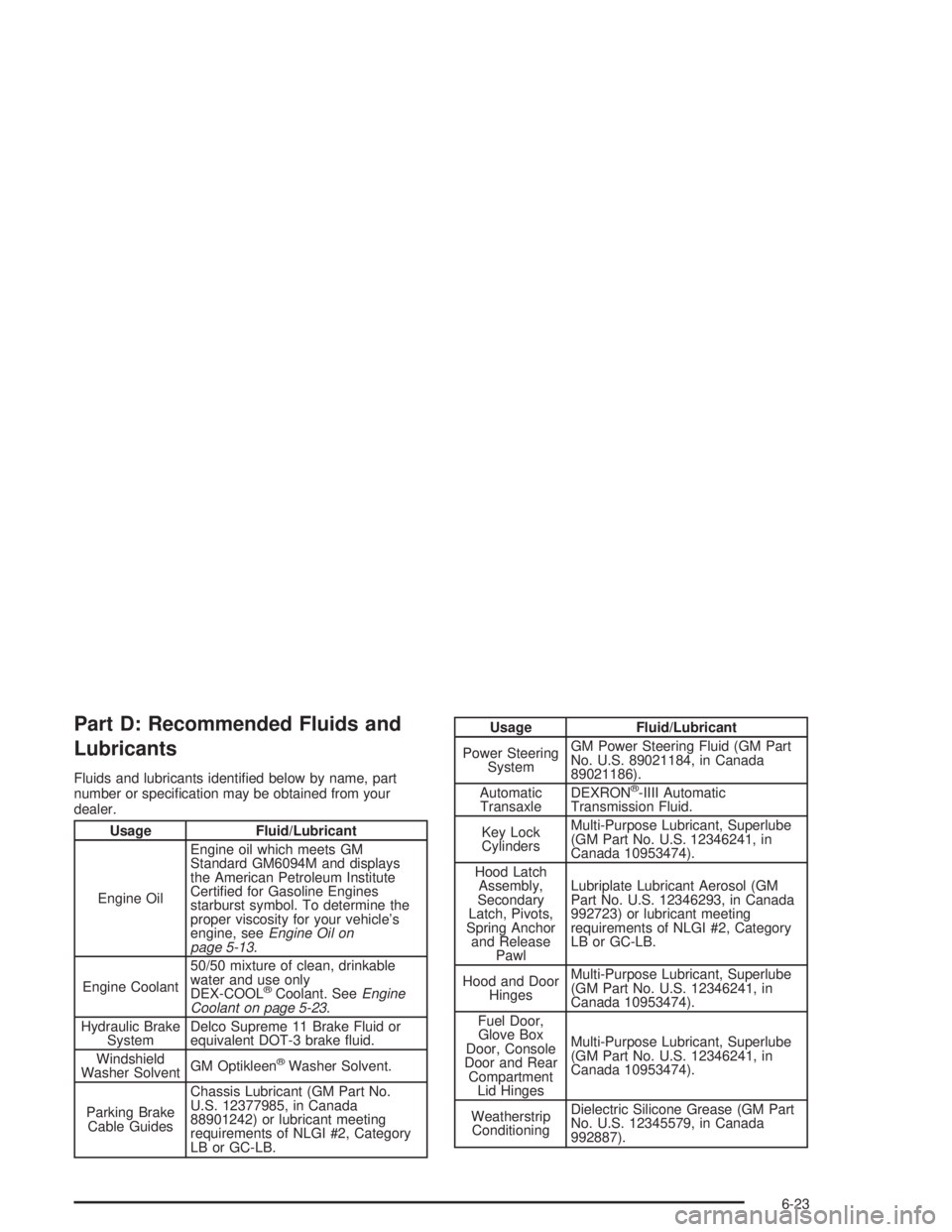
Part D: Recommended Fluids and
Lubricants
Fluids and lubricants identied below by name, part
number or specication may be obtained from your
dealer.
Usage Fluid/Lubricant
Engine OilEngine oil which meets GM
Standard GM6094M and displays
the American Petroleum Institute
Certied for Gasoline Engines
starburst symbol. To determine the
proper viscosity for your vehicle’s
engine, seeEngine Oil on
page 5-13.
Engine Coolant50/50 mixture of clean, drinkable
water and use only
DEX-COOL
®Coolant. SeeEngine
Coolant on page 5-23.
Hydraulic Brake
SystemDelco Supreme 11 Brake Fluid or
equivalent DOT-3 brake uid.
Windshield
Washer SolventGM Optikleen
®Washer Solvent.
Parking Brake
Cable GuidesChassis Lubricant (GM Part No.
U.S. 12377985, in Canada
88901242) or lubricant meeting
requirements of NLGI #2, Category
LB or GC-LB.
Usage Fluid/Lubricant
Power Steering
SystemGM Power Steering Fluid (GM Part
No. U.S. 89021184, in Canada
89021186).
Automatic
TransaxleDEXRON
®-IIII Automatic
Transmission Fluid.
Key Lock
CylindersMulti-Purpose Lubricant, Superlube
(GM Part No. U.S. 12346241, in
Canada 10953474).
Hood Latch
Assembly,
Secondary
Latch, Pivots,
Spring Anchor
and Release
PawlLubriplate Lubricant Aerosol (GM
Part No. U.S. 12346293, in Canada
992723) or lubricant meeting
requirements of NLGI #2, Category
LB or GC-LB.
Hood and Door
HingesMulti-Purpose Lubricant, Superlube
(GM Part No. U.S. 12346241, in
Canada 10953474).
Fuel Door,
Glove Box
Door, Console
Door and Rear
Compartment
Lid HingesMulti-Purpose Lubricant, Superlube
(GM Part No. U.S. 12346241, in
Canada 10953474).
Weatherstrip
ConditioningDielectric Silicone Grease (GM Part
No. U.S. 12345579, in Canada
992887).
6-23
Page 383 of 392
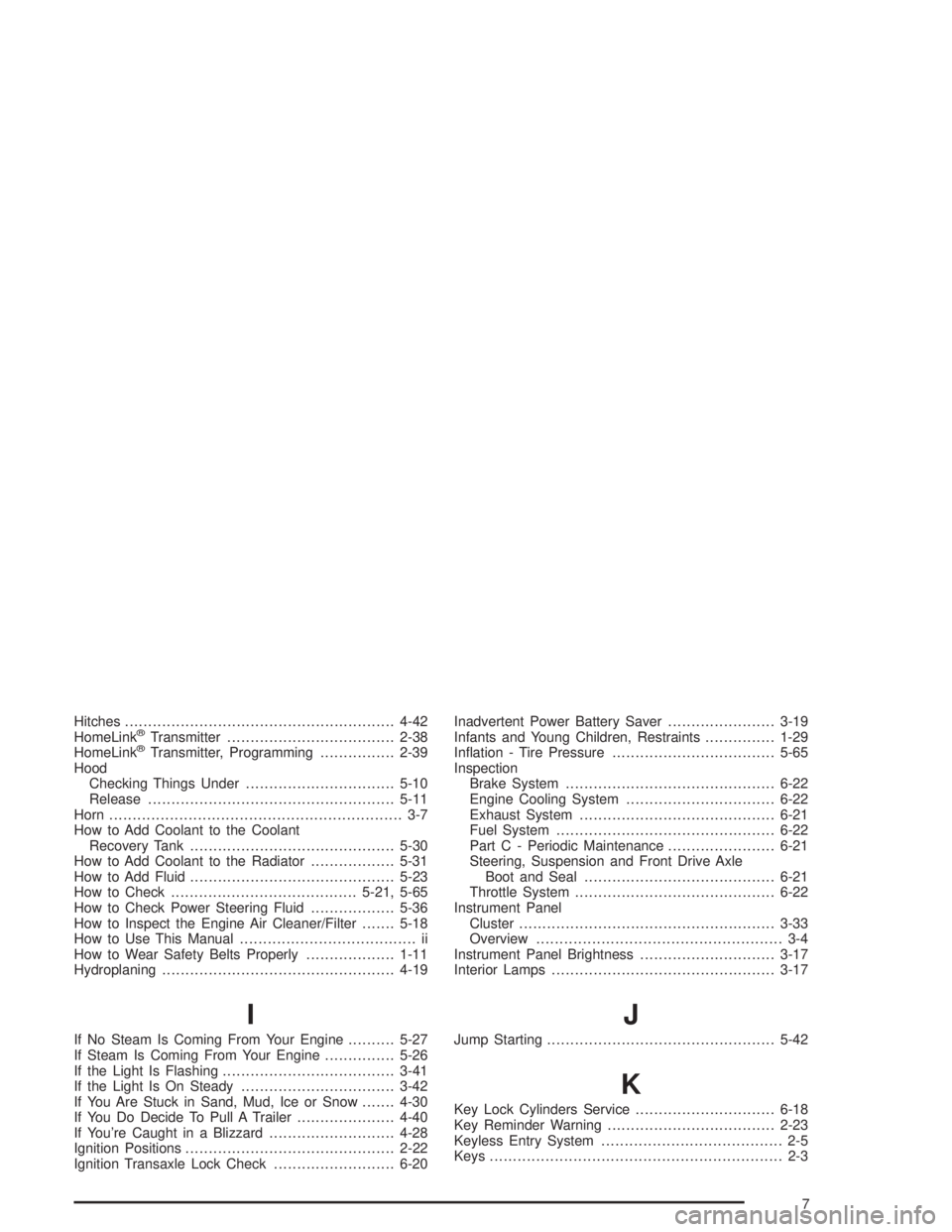
Hitches..........................................................4-42
HomeLink®Transmitter....................................2-38
HomeLink®Transmitter, Programming................2-39
Hood
Checking Things Under................................5-10
Release.....................................................5-11
Horn............................................................... 3-7
How to Add Coolant to the Coolant
Recovery Tank............................................5-30
How to Add Coolant to the Radiator..................5-31
How to Add Fluid............................................5-23
How to Check........................................5-21, 5-65
How to Check Power Steering Fluid..................5-36
How to Inspect the Engine Air Cleaner/Filter.......5-18
How to Use This Manual...................................... ii
How to Wear Safety Belts Properly...................1-11
Hydroplaning..................................................4-19
I
If No Steam Is Coming From Your Engine..........5-27
If Steam Is Coming From Your Engine...............5-26
If the Light Is Flashing.....................................3-41
If the Light Is On Steady.................................3-42
If You Are Stuck in Sand, Mud, Ice or Snow.......4-30
If You Do Decide To Pull A Trailer.....................4-40
If You’re Caught in a Blizzard...........................4-28
Ignition Positions.............................................2-22
Ignition Transaxle Lock Check..........................6-20Inadvertent Power Battery Saver.......................3-19
Infants and Young Children, Restraints...............1-29
Ination - Tire Pressure...................................5-65
Inspection
Brake System.............................................6-22
Engine Cooling System................................6-22
Exhaust System..........................................6-21
Fuel System...............................................6-22
Part C - Periodic Maintenance.......................6-21
Steering, Suspension and Front Drive Axle
Boot and Seal.........................................6-21
Throttle System...........................................6-22
Instrument Panel
Cluster.......................................................3-33
Overview..................................................... 3-4
Instrument Panel Brightness.............................3-17
Interior Lamps................................................3-17
J
Jump Starting.................................................5-42
K
Key Lock Cylinders Service..............................6-18
Key Reminder Warning....................................2-23
Keyless Entry System....................................... 2-5
Keys............................................................... 2-3
7
Page 386 of 392
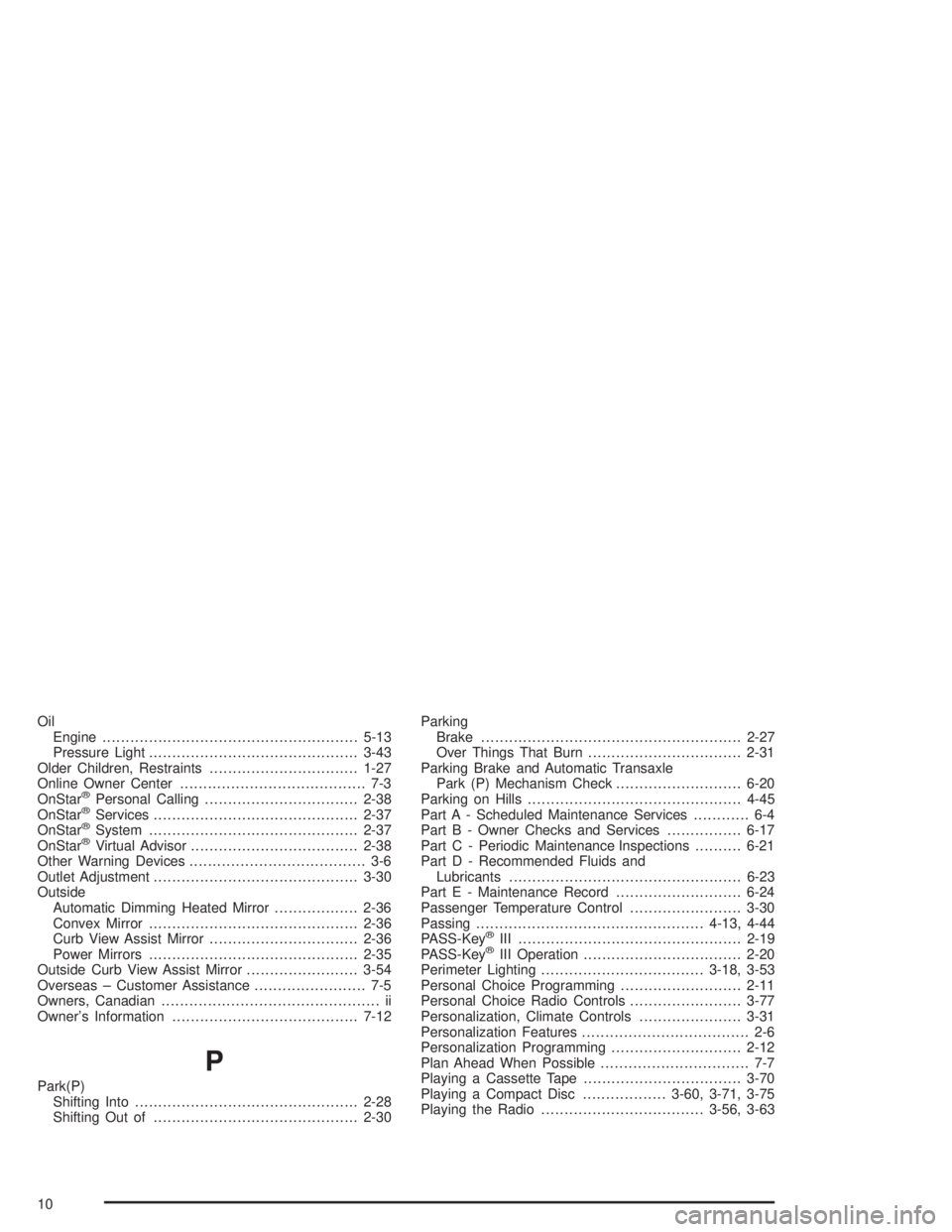
Oil
Engine.......................................................5-13
Pressure Light.............................................3-43
Older Children, Restraints................................1-27
Online Owner Center........................................ 7-3
OnStar
®Personal Calling.................................2-38
OnStar®Services............................................2-37
OnStar®System.............................................2-37
OnStar®Virtual Advisor....................................2-38
Other Warning Devices...................................... 3-6
Outlet Adjustment............................................3-30
Outside
Automatic Dimming Heated Mirror..................2-36
Convex Mirror.............................................2-36
Curb View Assist Mirror................................2-36
Power Mirrors.............................................2-35
Outside Curb View Assist Mirror........................3-54
Overseas – Customer Assistance........................ 7-5
Owners, Canadian............................................... ii
Owner’s Information........................................7-12
P
Park(P)
Shifting Into................................................2-28
Shifting Out of............................................2-30Parking
Brake........................................................2-27
Over Things That Burn.................................2-31
Parking Brake and Automatic Transaxle
Park (P) Mechanism Check...........................6-20
Parking on Hills..............................................4-45
Part A - Scheduled Maintenance Services............ 6-4
Part B - Owner Checks and Services................6-17
Part C - Periodic Maintenance Inspections..........6-21
Part D - Recommended Fluids and
Lubricants..................................................6-23
Part E - Maintenance Record...........................6-24
Passenger Temperature Control........................3-30
Passing.................................................4-13, 4-44
PASS-Key
®III ................................................2-19
PASS-Key®III Operation..................................2-20
Perimeter Lighting...................................3-18, 3-53
Personal Choice Programming..........................2-11
Personal Choice Radio Controls........................3-77
Personalization, Climate Controls......................3-31
Personalization Features.................................... 2-6
Personalization Programming............................2-12
Plan Ahead When Possible................................ 7-7
Playing a Cassette Tape..................................3-70
Playing a Compact Disc..................3-60, 3-71, 3-75
Playing the Radio...................................3-56, 3-63
10
Page 387 of 392
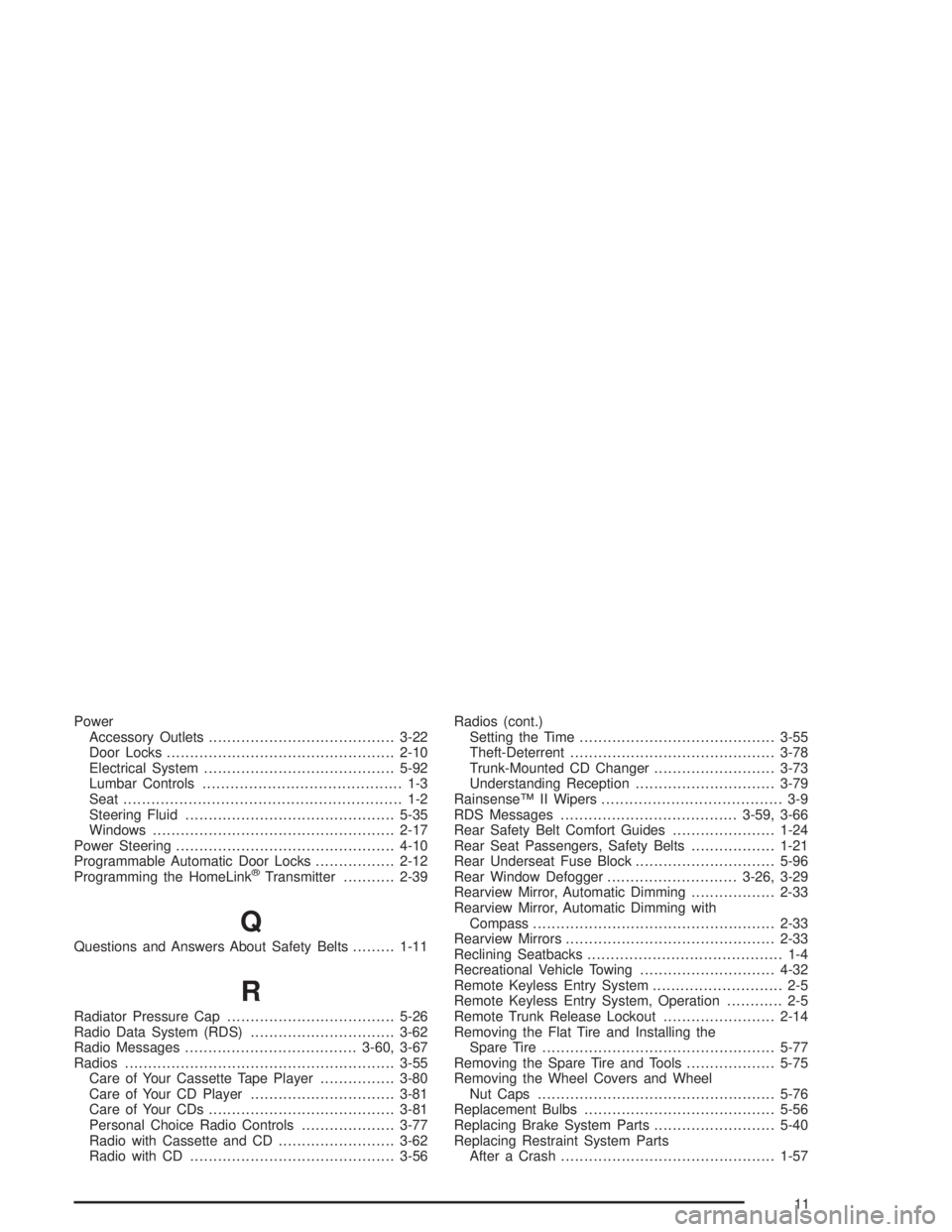
Power
Accessory Outlets........................................3-22
Door Locks.................................................2-10
Electrical System.........................................5-92
Lumbar Controls........................................... 1-3
Seat............................................................ 1-2
Steering Fluid.............................................5-35
Windows....................................................2-17
Power Steering...............................................4-10
Programmable Automatic Door Locks.................2-12
Programming the HomeLink
®Transmitter...........2-39
Q
Questions and Answers About Safety Belts.........1-11
R
Radiator Pressure Cap....................................5-26
Radio Data System (RDS)...............................3-62
Radio Messages.....................................3-60, 3-67
Radios..........................................................3-55
Care of Your Cassette Tape Player................3-80
Care of Your CD Player...............................3-81
Care of Your CDs........................................3-81
Personal Choice Radio Controls....................3-77
Radio with Cassette and CD.........................3-62
Radio with CD............................................3-56Radios (cont.)
Setting the Time..........................................3-55
Theft-Deterrent............................................3-78
Trunk-Mounted CD Changer..........................3-73
Understanding Reception..............................3-79
Rainsense™ II Wipers....................................... 3-9
RDS Messages......................................3-59, 3-66
Rear Safety Belt Comfort Guides......................1-24
Rear Seat Passengers, Safety Belts..................1-21
Rear Underseat Fuse Block..............................5-96
Rear Window Defogger............................3-26, 3-29
Rearview Mirror, Automatic Dimming..................2-33
Rearview Mirror, Automatic Dimming with
Compass....................................................2-33
Rearview Mirrors.............................................2-33
Reclining Seatbacks.......................................... 1-4
Recreational Vehicle Towing.............................4-32
Remote Keyless Entry System............................ 2-5
Remote Keyless Entry System, Operation............ 2-5
Remote Trunk Release Lockout........................2-14
Removing the Flat Tire and Installing the
Spare Tire..................................................5-77
Removing the Spare Tire and Tools...................5-75
Removing the Wheel Covers and Wheel
Nut Caps...................................................5-76
Replacement Bulbs.........................................5-56
Replacing Brake System Parts..........................5-40
Replacing Restraint System Parts
After a Crash..............................................1-57
11
Page 389 of 392
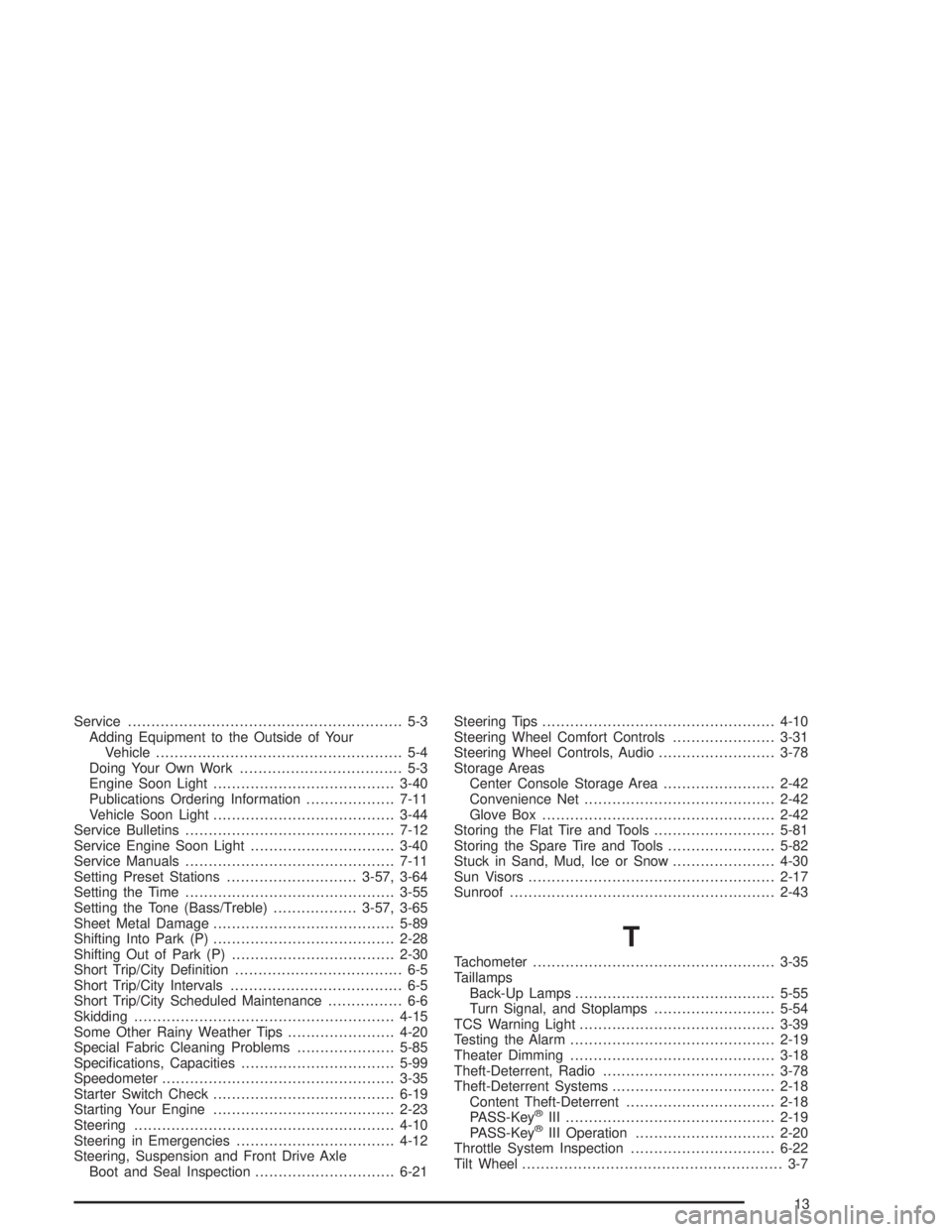
Service........................................................... 5-3
Adding Equipment to the Outside of Your
Vehicle..................................................... 5-4
Doing Your Own Work................................... 5-3
Engine Soon Light.......................................3-40
Publications Ordering Information...................7-11
Vehicle Soon Light.......................................3-44
Service Bulletins.............................................7-12
Service Engine Soon Light...............................3-40
Service Manuals.............................................7-11
Setting Preset Stations............................3-57, 3-64
Setting the Time.............................................3-55
Setting the Tone (Bass/Treble)..................3-57, 3-65
Sheet Metal Damage.......................................5-89
Shifting Into Park (P).......................................2-28
Shifting Out of Park (P)...................................2-30
Short Trip/City Denition.................................... 6-5
Short Trip/City Intervals..................................... 6-5
Short Trip/City Scheduled Maintenance................ 6-6
Skidding........................................................4-15
Some Other Rainy Weather Tips.......................4-20
Special Fabric Cleaning Problems.....................5-85
Specications, Capacities.................................5-99
Speedometer..................................................3-35
Starter Switch Check.......................................6-19
Starting Your Engine.......................................2-23
Steering........................................................4-10
Steering in Emergencies..................................4-12
Steering, Suspension and Front Drive Axle
Boot and Seal Inspection..............................6-21Steering Tips..................................................4-10
Steering Wheel Comfort Controls......................3-31
Steering Wheel Controls, Audio.........................3-78
Storage Areas
Center Console Storage Area........................2-42
Convenience Net.........................................2-42
Glove Box..................................................2-42
Storing the Flat Tire and Tools..........................5-81
Storing the Spare Tire and Tools.......................5-82
Stuck in Sand, Mud, Ice or Snow......................4-30
Sun Visors.....................................................2-17
Sunroof.........................................................2-43
T
Tachometer....................................................3-35
Taillamps
Back-Up Lamps...........................................5-55
Turn Signal, and Stoplamps..........................5-54
TCS Warning Light..........................................3-39
Testing the Alarm............................................2-19
Theater Dimming............................................3-18
Theft-Deterrent, Radio.....................................3-78
Theft-Deterrent Systems...................................2-18
Content Theft-Deterrent................................2-18
PASS-Key
®III .............................................2-19
PASS-Key®III Operation..............................2-20
Throttle System Inspection...............................6-22
Tilt Wheel........................................................ 3-7
13