change wheel BUICK LESABRE 2005 User Guide
[x] Cancel search | Manufacturer: BUICK, Model Year: 2005, Model line: LESABRE, Model: BUICK LESABRE 2005Pages: 392, PDF Size: 2.45 MB
Page 234 of 392
Towing a Trailer
{CAUTION:
If you do not use the correct equipment and
drive properly, you can lose control when you
pull a trailer. For example, if the trailer is too
heavy, the brakes may not work well — or even
at all. You and your passengers could be
seriously injured. You may also damage your
vehicle; the resulting repairs would not be
covered by your warranty. Pull a trailer only if
you have followed all the steps in this section.
Ask your dealer for advice and information
about towing a trailer with your vehicle.Your vehicle can tow a trailer if it is equipped with the
proper trailer towing equipment. To identify what
the vehicle trailering capacity is for your vehicle, you
should read the information in “Weight of the Trailer” that
appears later in this section. But trailering is different
than just driving your vehicle by itself. Trailering means
changes in handling, acceleration, braking, durability
and fuel economy. Successful, safe trailering takes
correct equipment, and it has to be used properly.
That is the reason for this part. In it are many
time-tested, important trailering tips and safety rules.
Many of these are important for your safety and that of
your passengers. So please read this section carefully
before you pull a trailer.
Load-pulling components such as the engine, transaxle,
wheel assemblies and tires are forced to work harder
against the drag of the added weight. The engine
is required to operate at relatively higher speeds and
under greater loads, generating extra heat. Also,
the trailer adds considerably to wind resistance,
increasing the pulling requirements.
4-38
Page 238 of 392
Passing
You will need more passing distance up ahead when
you are towing a trailer. And, because the vehicle
is a good deal longer, you will need to go much farther
beyond the passed vehicle before you can return to
your lane.
Backing Up
Hold the bottom of the steering wheel with one hand.
Then, to move the trailer to the left, just move that hand
to the left. To move the trailer to the right, move your
hand to the right. Always back up slowly and, if possible,
have someone guide you.
Making Turns
Notice:Making very sharp turns while trailering
could cause the trailer to come in contact with the
vehicle. Your vehicle could be damaged. Avoid
making very sharp turns while trailering.
When you are turning with a trailer, make wider turns
than normal. Do this so your trailer will not strike
soft shoulders, curbs, road signs, trees or other
objects. Avoid jerky or sudden maneuvers. Signal well
in advance.
Turn Signals When Towing a Trailer
When you tow a trailer, your vehicle may need a
different turn signal asher and/or extra wiring. Check
with your dealer. The arrows on your instrument
panel will ash whenever you signal a turn or lane
change. Properly hooked up, the trailer lamps will also
ash, telling other drivers you are about to turn,
change lanes or stop.
When towing a trailer, the arrows on your instrument
panel will ash for turns even if the bulbs on the trailer
are burned out. Thus, you may think drivers behind
you are seeing your signal when they are not. It
is important to check occasionally to be sure the trailer
bulbs are still working.
Your vehicle has bulb warning lights. When you plug a
trailer lighting system into your vehicle’s lighting
system, its bulb warning lights may not let you know if
one of your lamps goes out. So, when you have a trailer
lighting system plugged in, be sure to check your
vehicle and trailer lamps from time to time to be sure
they are all working. Once you disconnect the trailer
lamps, the bulb warning lights again can tell you if one
of your vehicle lamps is out.
4-42
Page 304 of 392
Reset the check tire pressure system, if equipped. See
Check Tire Pressure System on page 5-62.
Make certain that all wheel nuts are properly tightened.
See “Wheel Nut Torque” underCapacities and
Specications on page 5-96.
{CAUTION:
Rust or dirt on a wheel, or on the parts to
which it is fastened, can make wheel nuts
become loose after a time. The wheel could
come off and cause an accident. When you
change a wheel, remove any rust or dirt from
places where the wheel attaches to the vehicle.
In an emergency, you can use a cloth or a
paper towel to do this; but be sure to use a
scraper or wire brush later, if you need to, to
get all the rust or dirt off. SeeChanging a Flat
Tire on page 5-70.
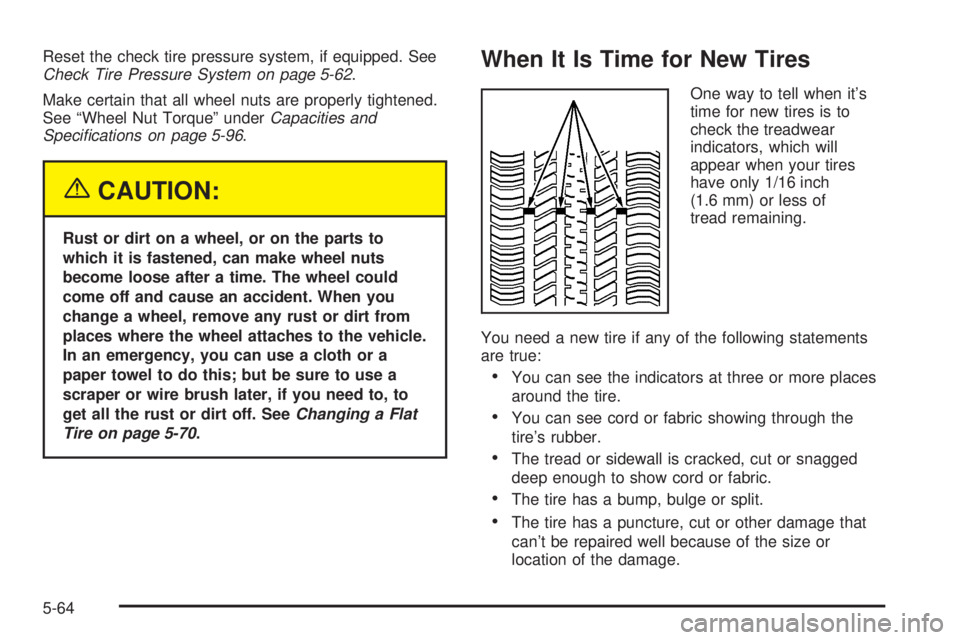
When It Is Time for New Tires
One way to tell when it’s
time for new tires is to
check the treadwear
indicators, which will
appear when your tires
have only 1/16 inch
(1.6 mm) or less of
tread remaining.
You need a new tire if any of the following statements
are true:
You can see the indicators at three or more places
around the tire.
You can see cord or fabric showing through the
tire’s rubber.
The tread or sidewall is cracked, cut or snagged
deep enough to show cord or fabric.
The tire has a bump, bulge or split.
The tire has a puncture, cut or other damage that
can’t be repaired well because of the size or
location of the damage.
5-64
Page 309 of 392

If a Tire Goes Flat
It’s unusual for a tire to “blowout” while you’re driving,
especially if you maintain your tires properly. If air goes
out of a tire, it’s much more likely to leak out slowly.
But if you should ever have a “blowout,” here are a few
tips about what to expect and what to do:
If a front tire fails, the at tire will create a drag that
pulls the vehicle toward that side. Take your foot off the
accelerator pedal and grip the steering wheel rmly.
Steer to maintain lane position, and then gently brake to
a stop well out of the traffic lane.
A rear blowout, particularly on a curve, acts much like a
skid and may require the same correction you’d use
in a skid. In any rear blowout, remove your foot from the
accelerator pedal. Get the vehicle under control by
steering the way you want the vehicle to go. It may be
very bumpy and noisy, but you can still steer. Gently
brake to a stop, well off the road if possible.{CAUTION:
Lifting a vehicle and getting under it to do
maintenance or repairs is dangerous without
the appropriate safety equipment and training.
The jack provided with your vehicle is
designed only for changing a at tire. If it is
used for anything else, you or others could be
badly injured or killed if the vehicle slips off
the jack. Use the jack provided with your
vehicle only for changing a at tire.
If a tire goes at, the next part shows how to use your
jacking equipment to change a at tire safely.
5-69
Page 310 of 392
Changing a Flat Tire
If a tire goes at, avoid further tire and wheel damage
by driving slowly to a level place. Turn on your
hazard warning ashers.
{CAUTION:
Changing a tire can be dangerous. The vehicle
can slip off the jack and roll over or fall on you
or other people. You and they could be badly
injured or even killed. Find a level place to
change your tire. To help prevent the vehicle
from moving:
1. Set the parking brake rmly.
2. Put the shift lever in PARK (P).
3. Turn off the engine and do not restart
while the vehicle is raised.
4. Do not allow passengers to remain in
the vehicle.
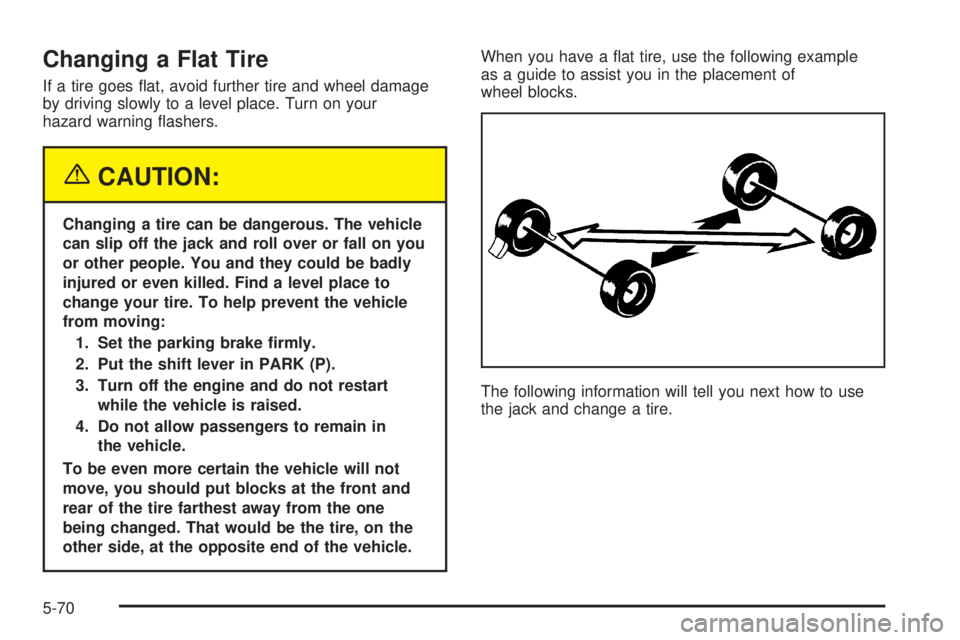
To be even more certain the vehicle will not
move, you should put blocks at the front and
rear of the tire farthest away from the one
being changed. That would be the tire, on the
other side, at the opposite end of the vehicle.When you have a at tire, use the following example
as a guide to assist you in the placement of
wheel blocks.
The following information will tell you next how to use
the jack and change a tire.
5-70
Page 315 of 392
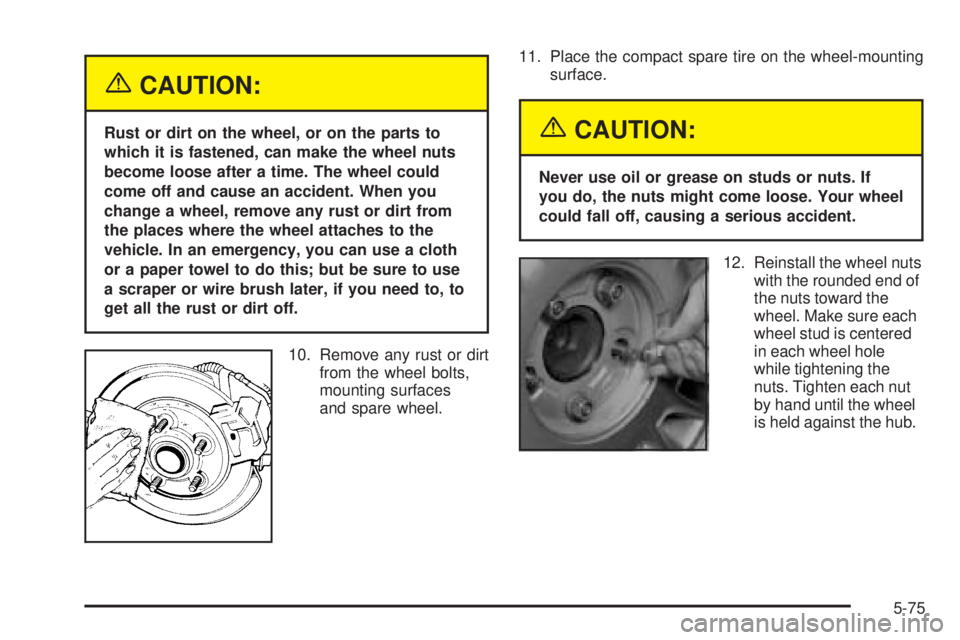
{CAUTION:
Rust or dirt on the wheel, or on the parts to
which it is fastened, can make the wheel nuts
become loose after a time. The wheel could
come off and cause an accident. When you
change a wheel, remove any rust or dirt from
the places where the wheel attaches to the
vehicle. In an emergency, you can use a cloth
or a paper towel to do this; but be sure to use
a scraper or wire brush later, if you need to, to
get all the rust or dirt off.
10. Remove any rust or dirt
from the wheel bolts,
mounting surfaces
and spare wheel.11. Place the compact spare tire on the wheel-mounting
surface.{CAUTION:
Never use oil or grease on studs or nuts. If
you do, the nuts might come loose. Your wheel
could fall off, causing a serious accident.
12. Reinstall the wheel nuts
with the rounded end of
the nuts toward the
wheel. Make sure each
wheel stud is centered
in each wheel hole
while tightening the
nuts. Tighten each nut
by hand until the wheel
is held against the hub.
5-75
Page 379 of 392
A
Accessory Power Outlets.................................3-22
Additives, Fuel................................................. 5-6
Add-On Electrical Equipment............................5-88
Air Cleaner/Filter, Engine.................................5-18
Air Conditioning......................................3-24, 3-27
Airbag
Readiness Light..........................................3-37
Airbag Sensing and Diagnostic Module (SDM)...... 7-9
Airbag System................................................1-47
How Does an Airbag Restrain?......................1-53
Servicing Your Airbag-Equipped Vehicle..........1-56
What Makes an Airbag Inate?......................1-53
What Will You See After an Airbag Inates?....1-54
When Should an Airbag Inate?....................1-52
Where Are the Airbags?...............................1-50
Antenna, Diversity Antenna System...................3-84
Antenna, XM™ Satellite Radio
Antenna System..........................................3-85
Anti-Lock Brake System (ABS)........................... 4-7
Anti-Lock Brake, System Warning Light..............3-39
Appearance Care............................................5-78
Aluminum or Chrome-Plated Wheels..............5-84
Care of Safety Belts....................................5-82
Chemical Paint Spotting...............................5-85
Cleaning Exterior Lamps/Lenses....................5-83
Fabric/Carpet..............................................5-79
Finish Care.................................................5-83
Finish Damage............................................5-85Appearance Care (cont.)
Glass Surfaces............................................5-81
Instrument Panel.........................................5-81
Interior Plastic Components...........................5-81
Leather......................................................5-81
Sheet Metal Damage...................................5-85
Tires..........................................................5-84
Underbody Maintenance...............................5-85
Vehicle Care/Appearance Materials................5-86
Vinyl..........................................................5-81
Washing Your Vehicle...................................5-82
Weatherstrips..............................................5-82
Windshield and Wiper Blades........................5-83
Ashtrays........................................................3-23
Audio System(s).............................................3-56
Audio Steering Wheel Controls......................3-81
Care of Your Cassette Tape Player................3-83
Care of Your CD Player...............................3-84
Care of Your CDs........................................3-84
Chime Level Adjustment...............................3-85
Diversity Antenna System.............................3-84
Personal Choice Radio Controls....................3-80
Radio with Cassette and CD.........................3-65
Radio with CD............................................3-57
Setting the Time..........................................3-57
Theft-Deterrent Feature................................3-81
Trunk-Mounted CD Changer..........................3-77
Understanding Radio Reception.....................3-82
XM™ Satellite Radio Antenna System............3-85
1
Page 390 of 392
Shifting Out of Park (P)...................................2-30
Short Trip/City Scheduled Maintenance................ 6-6
Signals, Turn and Lane-Change.......................... 3-7
Spare Tire
Installing....................................................5-72
Removing...................................................5-71
Storing.......................................................5-77
Specications, Capacities.................................5-96
Speedometer..................................................3-36
Starting Your Engine.......................................2-23
Steering........................................................4-10
Steering, Suspension and Front Drive Axle
Boot and Seal Inspection..............................6-22
Steering Wheel Comfort Controls......................3-31
Steering Wheel Controls, Audio.........................3-81
Steering Wheel, Tilt Wheel................................. 3-6
Storage Areas
Center Console Storage Area........................2-43
Convenience Net.........................................2-43
Glove Box..................................................2-43
Stuck in Sand, Mud, Ice or Snow......................4-30
Sun Visors.....................................................2-17
Sunroof.........................................................2-44
T
Tachometer....................................................3-36
Taillamps
Back-Up Lamps...........................................5-51Taillamps (cont.)
Turn Signal, and Stoplamps..........................5-50
TCS Warning Light..........................................3-40
Theater Dimming............................................3-18
Theft-Deterrent, Radio.....................................3-81
Theft-Deterrent Systems...................................2-18
Content Theft-Deterrent................................2-18
PASS-Key
®III .............................................2-19
PASS-Key®III Operation..............................2-20
Throttle System Inspection...............................6-23
Tilt Wheel........................................................ 3-6
Tires.............................................................5-54
Aluminum or Chrome-Plated
Wheels, Cleaning.....................................5-84
Buying New Tires........................................5-65
Chains.......................................................5-68
Changing a Flat Tire....................................5-70
Check Tire Pressure System.........................5-62
Cleaning....................................................5-84
Compact Spare Tire.....................................5-78
If a Tire Goes Flat.......................................5-69
Ination -- Tire Pressure...............................5-60
Inspection and Rotation................................5-63
Installing the Spare Tire................................5-72
Removing the Flat Tire.................................5-72
Removing the Spare Tire and Tools...............5-71
Storing a Flat or Spare Tire and Tools............5-77
Tire Sidewall Labelling..................................5-55
Tire Terminology and Denitions....................5-57
Uniform Tire Quality Grading.........................5-66
12
Page 391 of 392

Tires (cont.)
Wheel Alignment and Tire Balance.................5-67
Wheel Replacement.....................................5-67
When It Is Time for New Tires......................5-64
Top Strap......................................................1-38
Top Strap Anchor Location...............................1-39
Towing
Recreational Vehicle.....................................4-36
Towing a Trailer..........................................4-38
Your Vehicle...............................................4-36
Traction
Control System (TCS).................................... 4-9
Control System Warning Light.......................3-40
Transaxle
Fluid, Automatic...........................................5-21
Transaxle Operation, Automatic.........................2-25
Trip Odometer................................................3-36
Trunk............................................................2-14
Trunk-Mounted CD Changer.............................3-77
Turn and Lane-Change Signals.......................... 3-7
Turn Signal/Multifunction Lever........................... 3-7
Twilight Sentinel
®............................................3-16
U
Understanding Radio Reception........................3-82
Uniform Tire Quality Grading............................5-66
V
Vehicle
Control........................................................ 4-5
Damage Warnings........................................... iv
Service Soon Light......................................3-46
Symbols......................................................... iv
Vehicle Data Collection and Event Data
Recorders.................................................... 7-9
Vehicle Identication
Number (VIN).............................................5-87
Service Parts Identication Label...................5-87
Vehicle Personalization
DIC ...........................................................3-51
Memory Seat and Mirrors.............................2-45
Ventilation Adjustment......................................3-31
Visors...........................................................2-17
W
Warning Lights, Gages and Indicators................3-33
Warnings
DIC Warnings and Messages........................3-50
Hazard Warning Flashers............................... 3-6
Other Warning Devices.................................. 3-6
Safety and Symbols......................................... iii
Vehicle Damage.............................................. iv
13