trunk BUICK LESABRE 2005 User Guide
[x] Cancel search | Manufacturer: BUICK, Model Year: 2005, Model line: LESABRE, Model: BUICK LESABRE 2005Pages: 392, PDF Size: 2.45 MB
Page 187 of 392
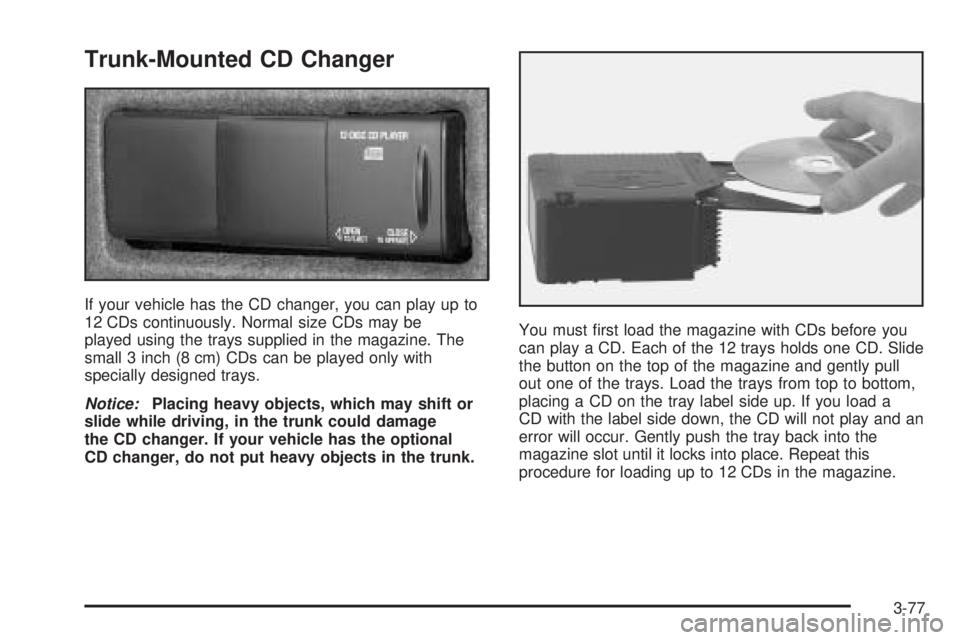
Trunk-Mounted CD Changer
If your vehicle has the CD changer, you can play up to
12 CDs continuously. Normal size CDs may be
played using the trays supplied in the magazine. The
small 3 inch (8 cm) CDs can be played only with
specially designed trays.
Notice:Placing heavy objects, which may shift or
slide while driving, in the trunk could damage
the CD changer. If your vehicle has the optional
CD changer, do not put heavy objects in the trunk.You must rst load the magazine with CDs before you
can play a CD. Each of the 12 trays holds one CD. Slide
the button on the top of the magazine and gently pull
out one of the trays. Load the trays from top to bottom,
placing a CD on the tray label side up. If you load a
CD with the label side down, the CD will not play and an
error will occur. Gently push the tray back into the
magazine slot until it locks into place. Repeat this
procedure for loading up to 12 CDs in the magazine.
3-77
Page 221 of 392
{CAUTION:
Coasting downhill in NEUTRAL (N) or with the
ignition off is dangerous. Your brakes will have
to do all the work of slowing down. They could
get so hot that they would not work well. You
would then have poor braking or even none
going down a hill. You could crash. Always
have your engine running and your vehicle in
gear when you go downhill.
Know how to go uphill. Drive in the highest
gear possible.
Stay in your own lane when driving on two-lane
roads in hills or mountains. Do not swing wide
or cut across the center of the road. Drive at speeds
that let you stay in your own lane.
As you go over the top of a hill, be alert. There
could be something in your lane, like a stalled car or
an accident.
You may see highway signs on mountains that
warn of special problems. Examples are long
grades, passing or no-passing zones, a falling rocks
area, or winding roads. Be alert to these and take
appropriate action.
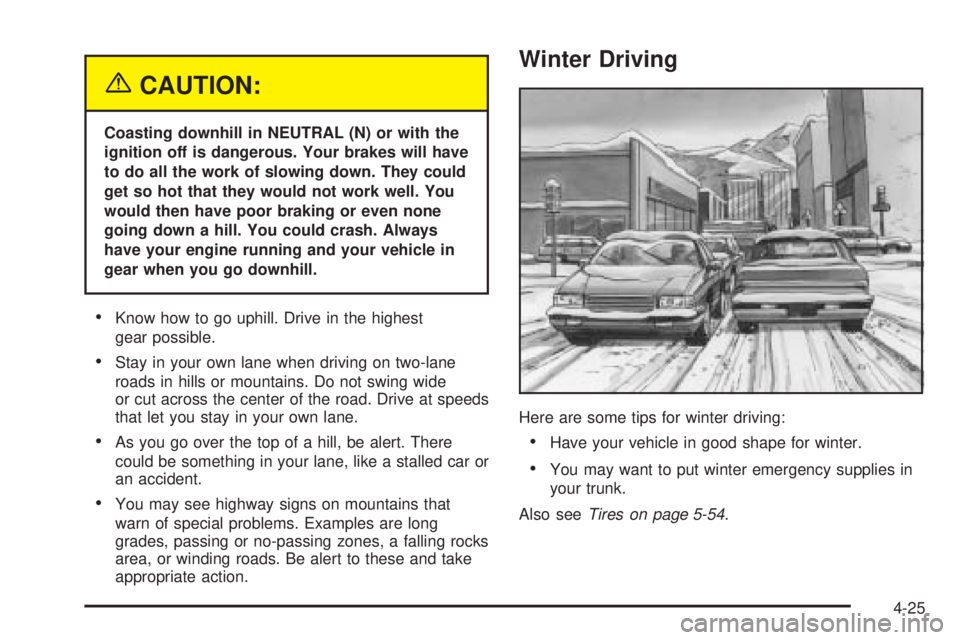
Winter Driving
Here are some tips for winter driving:
Have your vehicle in good shape for winter.
You may want to put winter emergency supplies in
your trunk.
Also seeTires on page 5-54.
4-25
Page 230 of 392
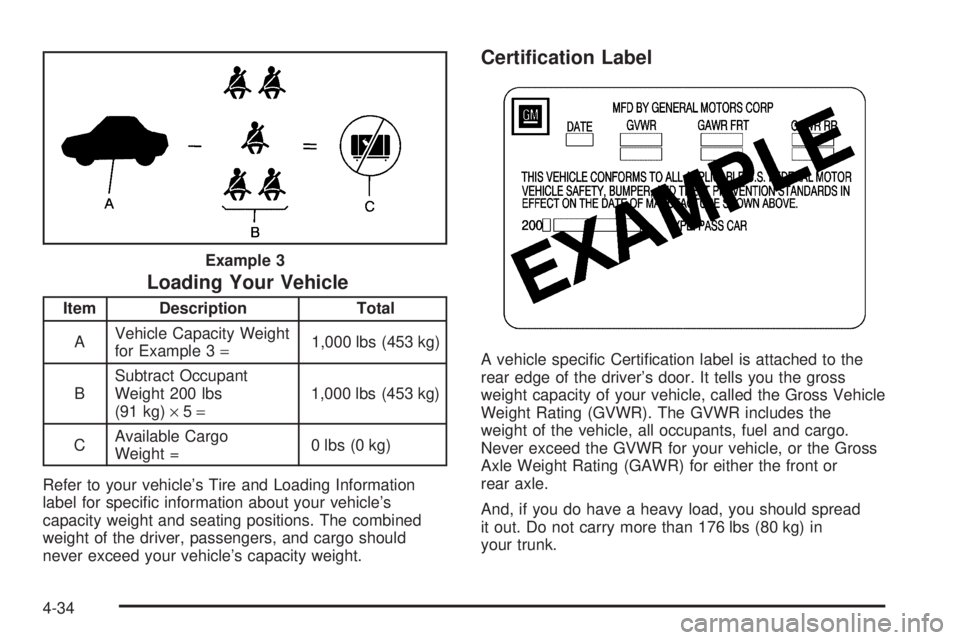
Loading Your Vehicle
Item Description Total
AVehicle Capacity Weight
for Example 3=1,000 lbs (453 kg)
BSubtract Occupant
Weight 200 lbs
(91 kg)×5=1,000 lbs (453 kg)
CAvailable Cargo
Weight =0 lbs (0 kg)
Refer to your vehicle’s Tire and Loading Information
label for specic information about your vehicle’s
capacity weight and seating positions. The combined
weight of the driver, passengers, and cargo should
never exceed your vehicle’s capacity weight.
Certication Label
A vehicle specic Certication label is attached to the
rear edge of the driver’s door. It tells you the gross
weight capacity of your vehicle, called the Gross Vehicle
Weight Rating (GVWR). The GVWR includes the
weight of the vehicle, all occupants, fuel and cargo.
Never exceed the GVWR for your vehicle, or the Gross
Axle Weight Rating (GAWR) for either the front or
rear axle.
And, if you do have a heavy load, you should spread
it out. Do not carry more than 176 lbs (80 kg) in
your trunk. Example 3
4-34
Page 231 of 392
{CAUTION:
Do not load your vehicle any heavier than the
Gross Vehicle Weight Rating (GVWR), or either
the maximum front or rear Gross Axle Weight
Rating (GAWR). If you do, parts on your
vehicle can break, and it can change the way
your vehicle handles. These could cause you
to lose control and crash. Also, overloading
can shorten the life of your vehicle.
Notice:Overloading your vehicle may cause
damage. Repairs would not be covered by your
warranty. Do not overload your vehicle.
If you put things inside your vehicle, like suitcases,
tools, packages, or anything else, they will go as fast as
the vehicle goes. If you have to stop or turn quickly,
or if there is a crash, they will keep going.
{CAUTION:
Things you put inside your vehicle can strike
and injure people in a sudden stop or turn, or
in a crash.
Put things in the trunk of your vehicle. In a
trunk, put them as far forward as you can.
Try to spread the weight evenly.
Never stack heavier things, like suitcases,
inside the vehicle so that some of them
are above the tops of the seats.
Do not leave an unsecured child restraint
in your vehicle.
When you carry something inside the
vehicle, secure it whenever you can.
4-35
Page 237 of 392
Safety Chains
You should always attach chains between your vehicle
and your trailer. Cross the safety chains under the
tongue of the trailer so that the tongue will not drop to
the road if it becomes separated from the hitch.
Instructions about safety chains may be provided by the
hitch manufacturer or by the trailer manufacturer.
Follow the manufacturer’s recommendation for attaching
safety chains and do not attach them to the bumper.
Always leave just enough slack so you can turn
with your rig. And, never allow safety chains to drag
on the ground.
Trailer Brakes
Does your trailer have its own brakes? Be sure to
read and follow the instructions for the trailer brakes
so you will be able to install, adjust and maintain
them properly.
Because you have anti-lock brakes, do not try to tap
into your vehicle’s brake system. If you do, both brake
systems will not work well, or at all.
Trailer Wiring Harness
All of the electrical circuits required for your trailer
lighting system can be accessed at the driver’s side rear
lamp connector. This connector is located under the
carpet on the rear corner of the trunk compartment.
Driving with a Trailer
Towing a trailer requires a certain amount of experience.
Before setting out for the open road, you will want to
get to know your rig. Acquaint yourself with the feel of
handling and braking with the added weight of the trailer.
And always keep in mind that the vehicle you are
driving is now a good deal longer and not nearly as
responsive as your vehicle is by itself.
Before you start, check all trailer hitch parts and
attachments, safety chains, electrical connector, lamps,
tires and mirror adjustment. If the trailer has electric
brakes, start your vehicle and trailer moving and then
apply the trailer brake controller by hand to be sure
the brakes are working. This lets you check your
electrical connection at the same time.
During your trip, check occasionally to be sure that the
load is secure, and that the lamps and any trailer
brakes are still working.
Following Distance
Stay at least twice as far behind the vehicle ahead as
you would when driving your vehicle without a trailer.
This can help you avoid situations that require
heavy braking and sudden turns.
4-41
Page 250 of 392
Filling a Portable Fuel Container
{CAUTION:
Never ll a portable fuel container while it is in
your vehicle. Static electricity discharge from
the container can ignite the gasoline vapor.
You can be badly burned and your vehicle
damaged if this occurs. To help avoid injury to
you and others:
Dispense gasoline only into approved
containers.
Do not ll a container while it is inside a
vehicle, in a vehicle’s trunk, pickup bed or
on any surface other than the ground.
Bring the ll nozzle in contact with the
inside of the ll opening before operating
the nozzle. Contact should be maintained
until the lling is complete.
Do not smoke while pumping gasoline.
Checking Things Under
the Hood
{CAUTION:
An electric fan under the hood can start up
and injure you even when the engine is not
running. Keep hands, clothing and tools away
from any underhood electric fan.
{CAUTION:
Things that burn can get on hot engine parts
and start a re. These include liquids like fuel,
oil, coolant, brake uid, windshield washer and
other uids, and plastic or rubber. You or
others could be burned. Be careful not to drop
or spill things that will burn onto a hot engine.
5-10
Page 290 of 392

Front Turn Signal Lamps
1. Follow Steps 1 through 3 underHeadlamps on
page 5-49to remove the headlamp assembly
2. Reach down into the space provided by the
removal of the headlamp assembly and, while
pushing in the tab on the bulb assembly, turn the
assembly counterclockwise and remove it.
3. Remove the old bulb by pulling it straight out of
the retainer.
4. Install the new bulb and turn the bulb assembly
back into place.
Taillamps, Turn Signal, and
Stoplamps
1. Open the trunk. SeeTrunk on page 2-14for
more information.
2. Turn the screws located just inside of the trunk
counterclockwise and remove them.
3. Remove the plastic trim piece from the trunk.
4. Pull the carpet away from the rear area to access
the turn signal bulb assembly.
5. Loosen and remove the bolts that hold the lamp
assembly in place.6. Pull out the lamp assembly.
5-50
Page 291 of 392
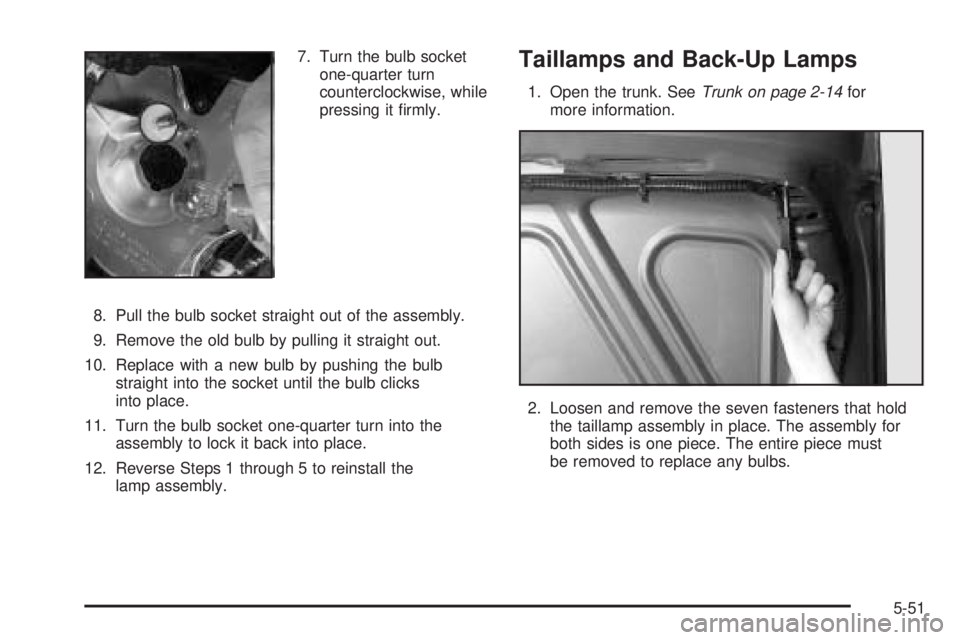
7. Turn the bulb socket
one-quarter turn
counterclockwise, while
pressing it rmly.
8. Pull the bulb socket straight out of the assembly.
9. Remove the old bulb by pulling it straight out.
10. Replace with a new bulb by pushing the bulb
straight into the socket until the bulb clicks
into place.
11. Turn the bulb socket one-quarter turn into the
assembly to lock it back into place.
12. Reverse Steps 1 through 5 to reinstall the
lamp assembly.Taillamps and Back-Up Lamps
1. Open the trunk. SeeTrunk on page 2-14for
more information.
2. Loosen and remove the seven fasteners that hold
the taillamp assembly in place. The assembly for
both sides is one piece. The entire piece must
be removed to replace any bulbs.
5-51
Page 293 of 392

Replacement Bulbs
Exterior Lamp Bulb Number
Front Turn Signals 3157
Headlamps
High-Beam 9005
Low-Beam 9006
Trunk-Mounted Back-Up Lamps 3057
Trunk-Mounted Taillamps 194
Tail/Stop/Turn Signal Lamps 3357
For replacement bulbs not listed here, contact
your dealer.
Windshield Wiper Blade
Replacement
Windshield wiper blades should be inspected at least
twice a year for wear or cracking. See “Wiper Blade
Check” underPart B: Owner Checks and Services on
page 6-18for more information.
Replacement blades come in different types and are
removed in different ways.
To replace the wiper blade assembly, do the following:
1. Lift the windshield wiper arm away from
the windshield.2. Push the tab on the wiper blade assembly and pull
the assembly down enough to release it from the
U-hooked end of the wiper arm. Slide the assembly
away from the arm.
3. Remove the blade.
4. To reinstall the wiper blade assembly, slide it over
the wiper arm to engage the U-hooked end on the
wiper blade assembly. Pull up on the assembly
to lock it into place.
For the proper windshield wiper blade replacement
length and type, seeNormal Maintenance Replacement
Parts on page 5-97.
5-53
Page 311 of 392
Removing the Spare Tire and Tools
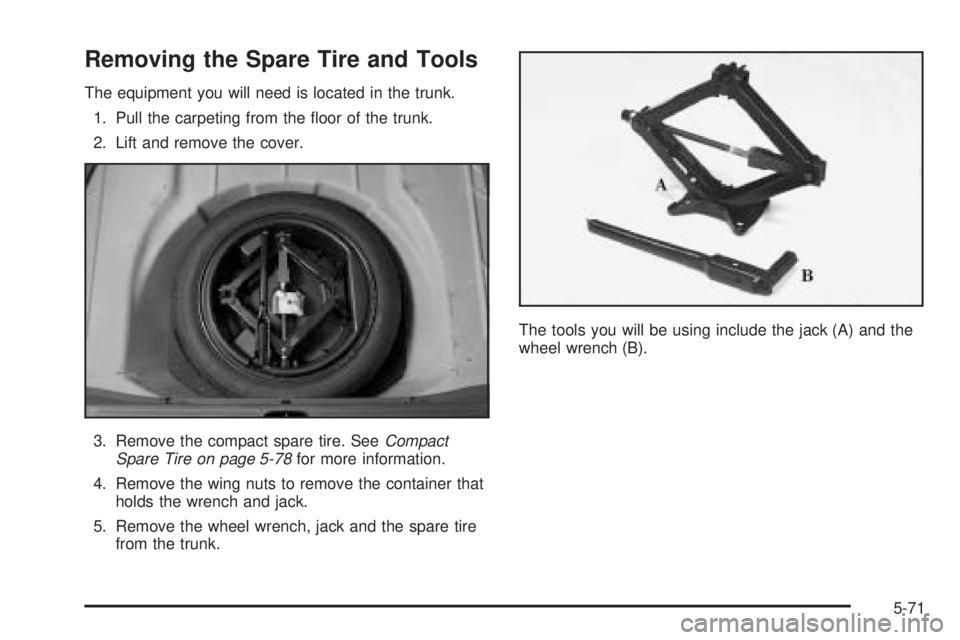
The equipment you will need is located in the trunk.
1. Pull the carpeting from the oor of the trunk.
2. Lift and remove the cover.
3. Remove the compact spare tire. SeeCompact
Spare Tire on page 5-78for more information.
4. Remove the wing nuts to remove the container that
holds the wrench and jack.
5. Remove the wheel wrench, jack and the spare tire
from the trunk.The tools you will be using include the jack (A) and the
wheel wrench (B).
5-71