lock BUICK LUCERNE 2006 Owner's Manual
[x] Cancel search | Manufacturer: BUICK, Model Year: 2006, Model line: LUCERNE, Model: BUICK LUCERNE 2006Pages: 416, PDF Size: 2.6 MB
Page 367 of 416
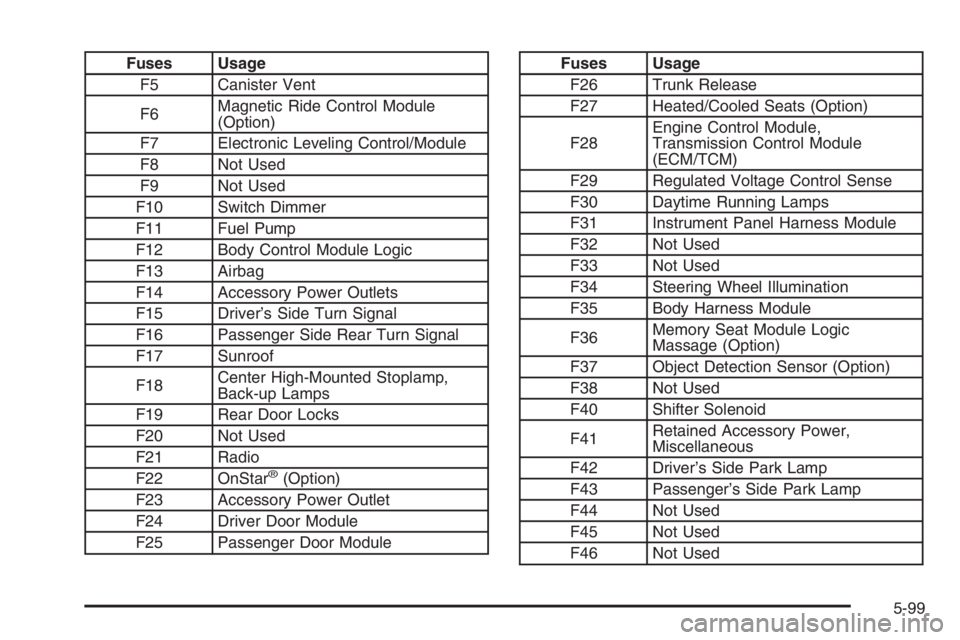
Fuses Usage
F5 Canister Vent
F6Magnetic Ride Control Module
(Option)
F7 Electronic Leveling Control/Module
F8 Not Used
F9 Not Used
F10 Switch Dimmer
F11 Fuel Pump
F12 Body Control Module Logic
F13 Airbag
F14 Accessory Power Outlets
F15 Driver’s Side Turn Signal
F16 Passenger Side Rear Turn Signal
F17 Sunroof
F18Center High-Mounted Stoplamp,
Back-up Lamps
F19 Rear Door Locks
F20 Not Used
F21 Radio
F22 OnStar
®(Option)
F23 Accessory Power Outlet
F24 Driver Door Module
F25 Passenger Door Module
Fuses Usage
F26 Trunk Release
F27 Heated/Cooled Seats (Option)
F28Engine Control Module,
Transmission Control Module
(ECM/TCM)
F29 Regulated Voltage Control Sense
F30 Daytime Running Lamps
F31 Instrument Panel Harness Module
F32 Not Used
F33 Not Used
F34 Steering Wheel Illumination
F35 Body Harness Module
F36Memory Seat Module Logic
Massage (Option)
F37 Object Detection Sensor (Option)
F38 Not Used
F40 Shifter Solenoid
F41Retained Accessory Power,
Miscellaneous
F42 Driver’s Side Park Lamp
F43 Passenger’s Side Park Lamp
F44 Not Used
F45 Not Used
F46 Not Used
5-99
Page 368 of 416
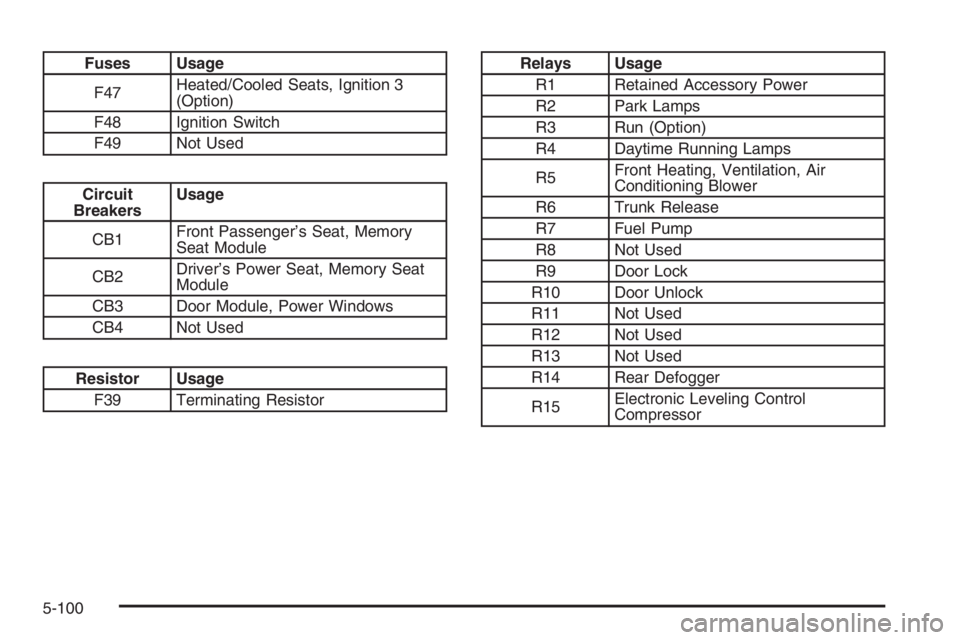
Fuses Usage
F47Heated/Cooled Seats, Ignition 3
(Option)
F48 Ignition Switch
F49 Not Used
Circuit
BreakersUsage
CB1Front Passenger’s Seat, Memory
Seat Module
CB2Driver’s Power Seat, Memory Seat
Module
CB3 Door Module, Power Windows
CB4 Not Used
Resistor Usage
F39 Terminating Resistor
Relays Usage
R1 Retained Accessory Power
R2 Park Lamps
R3 Run (Option)
R4 Daytime Running Lamps
R5Front Heating, Ventilation, Air
Conditioning Blower
R6 Trunk Release
R7 Fuel Pump
R8 Not Used
R9 Door Lock
R10 Door Unlock
R11 Not Used
R12 Not Used
R13 Not Used
R14 Rear Defogger
R15Electronic Leveling Control
Compressor
5-100
Page 378 of 416
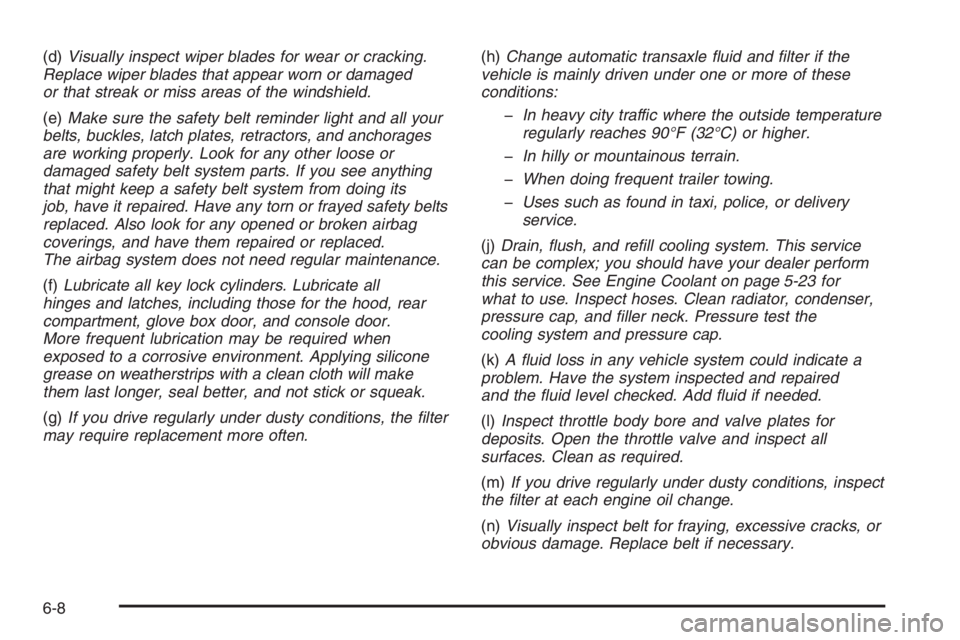
(d)Visually inspect wiper blades for wear or cracking.
Replace wiper blades that appear worn or damaged
or that streak or miss areas of the windshield.
(e)Make sure the safety belt reminder light and all your
belts, buckles, latch plates, retractors, and anchorages
are working properly. Look for any other loose or
damaged safety belt system parts. If you see anything
that might keep a safety belt system from doing its
job, have it repaired. Have any torn or frayed safety belts
replaced. Also look for any opened or broken airbag
coverings, and have them repaired or replaced.
The airbag system does not need regular maintenance.
(f)Lubricate all key lock cylinders. Lubricate all
hinges and latches, including those for the hood, rear
compartment, glove box door, and console door.
More frequent lubrication may be required when
exposed to a corrosive environment. Applying silicone
grease on weatherstrips with a clean cloth will make
them last longer, seal better, and not stick or squeak.
(g)If you drive regularly under dusty conditions, the lter
may require replacement more often.(h)Change automatic transaxle uid and lter if the
vehicle is mainly driven under one or more of these
conditions:
In heavy city traffic where the outside temperature
regularly reaches 90°F (32°C) or higher.
In hilly or mountainous terrain.
When doing frequent trailer towing.
Uses such as found in taxi, police, or delivery
service.
(j)Drain, ush, and rell cooling system. This service
can be complex; you should have your dealer perform
this service. See Engine Coolant on page 5-23 for
what to use. Inspect hoses. Clean radiator, condenser,
pressure cap, and ller neck. Pressure test the
cooling system and pressure cap.
(k)A uid loss in any vehicle system could indicate a
problem. Have the system inspected and repaired
and the uid level checked. Add uid if needed.
(l)Inspect throttle body bore and valve plates for
deposits. Open the throttle valve and inspect all
surfaces. Clean as required.
(m)If you drive regularly under dusty conditions, inspect
the lter at each engine oil change.
(n)Visually inspect belt for fraying, excessive cracks, or
obvious damage. Replace belt if necessary.
6-8
Page 380 of 416

At Least Once a Year
Starter Switch Check
{CAUTION:
When you are doing this inspection, the
vehicle could move suddenly. If the vehicle
moves, you or others could be injured.
1. Before you start, be sure you have enough room
around the vehicle.
2. Firmly apply both the parking brake and the regular
brake. SeeParking Brake on page 2-28.
Do not use the accelerator pedal, and be ready to
turn off the engine immediately if it starts.
3. Try to start the engine in each gear. The vehicle
should start only in PARK (P) or NEUTRAL (N). If
the vehicle starts in any other position, contact your
GM Goodwrench
®dealer for service.
Automatic Transaxle Shift Lock Control
System Check
{CAUTION:
When you are doing this inspection, the
vehicle could move suddenly. If the vehicle
moves, you or others could be injured.
1. Before you start, be sure you have enough room
around the vehicle. It should be parked on a level
surface.
2. Firmly apply the parking brake. SeeParking Brake
on page 2-28.
Be ready to apply the regular brake immediately if
the vehicle begins to move.
3. With the engine off, turn the ignition to RUN, but do
not start the engine. Without applying the regular
brake, try to move the shift lever out of PARK (P)
with normal effort. If the shift lever moves out
of PARK (P), contact your GM Goodwrench
®dealer
for service.
6-10
Page 381 of 416

Ignition Transaxle Lock Check
While parked, and with the parking brake set, try to turn
the ignition to OFF in each shift lever position.
The ignition should turn to OFF only when the shift
lever is in PARK (P).
The key should come out only in OFF.
Contact your GM Goodwrench
®dealer if service is
required.
Parking Brake and Automatic Transaxle
Park (P) Mechanism Check
{CAUTION:
When you are doing this check, your vehicle
could begin to move. You or others could be
injured and property could be damaged. Make
sure there is room in front of your vehicle in
case it begins to roll. Be ready to apply the
regular brake at once should the vehicle begin
to move.Park on a fairly steep hill, with the vehicle facing
downhill. Keeping your foot on the regular brake, set the
parking brake.
To check the parking brake’s holding ability: With
the engine running and transaxle in NEUTRAL (N),
slowly remove foot pressure from the regular
brake pedal. Do this until the vehicle is held by the
parking brake only.
To check the PARK (P) mechanism’s holding ability:
With the engine running, shift to PARK (P). Then
release the parking brake followed by the regular
brake.
Contact your GM Goodwrench
®dealer if service is
required.
Underbody Flushing Service
At least every spring, use plain water to ush any
corrosive materials from the underbody. Take care to
clean thoroughly any areas where mud and other debris
can collect.
6-11
Page 382 of 416
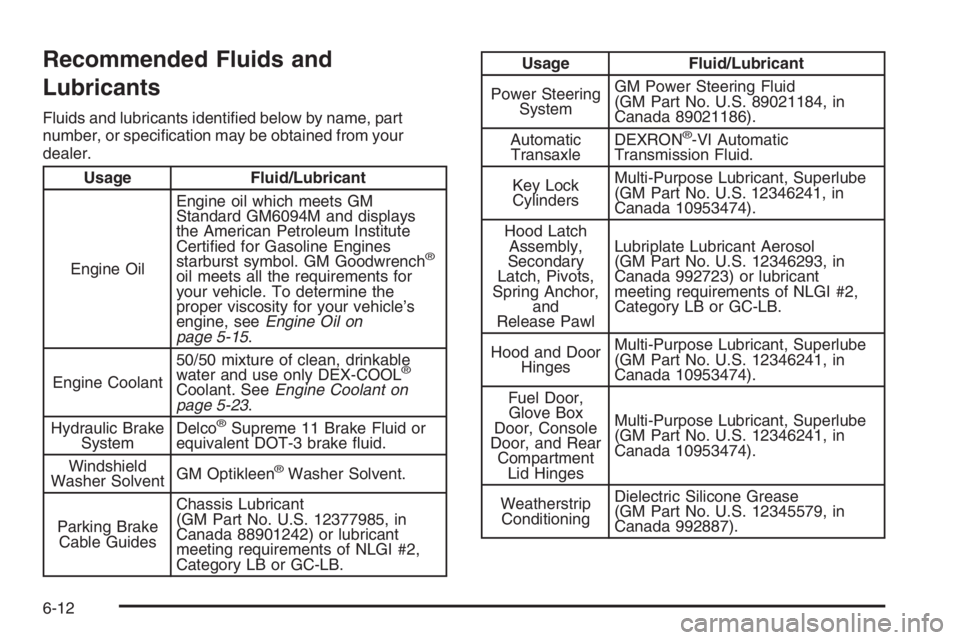
Recommended Fluids and
Lubricants
Fluids and lubricants identied below by name, part
number, or specication may be obtained from your
dealer.
Usage Fluid/Lubricant
Engine OilEngine oil which meets GM
Standard GM6094M and displays
the American Petroleum Institute
Certied for Gasoline Engines
starburst symbol. GM Goodwrench
®
oil meets all the requirements for
your vehicle. To determine the
proper viscosity for your vehicle’s
engine, seeEngine Oil on
page 5-15.
Engine Coolant50/50 mixture of clean, drinkable
water and use only DEX-COOL
®
Coolant. SeeEngine Coolant on
page 5-23.
Hydraulic Brake
SystemDelco
®Supreme 11 Brake Fluid or
equivalent DOT-3 brake uid.
Windshield
Washer SolventGM Optikleen
®Washer Solvent.
Parking Brake
Cable GuidesChassis Lubricant
(GM Part No. U.S. 12377985, in
Canada 88901242) or lubricant
meeting requirements of NLGI #2,
Category LB or GC-LB.
Usage Fluid/Lubricant
Power Steering
SystemGM Power Steering Fluid
(GM Part No. U.S. 89021184, in
Canada 89021186).
Automatic
TransaxleDEXRON
®-VI Automatic
Transmission Fluid.
Key Lock
CylindersMulti-Purpose Lubricant, Superlube
(GM Part No. U.S. 12346241, in
Canada 10953474).
Hood Latch
Assembly,
Secondary
Latch, Pivots,
Spring Anchor,
and
Release PawlLubriplate Lubricant Aerosol
(GM Part No. U.S. 12346293, in
Canada 992723) or lubricant
meeting requirements of NLGI #2,
Category LB or GC-LB.
Hood and Door
HingesMulti-Purpose Lubricant, Superlube
(GM Part No. U.S. 12346241, in
Canada 10953474).
Fuel Door,
Glove Box
Door, Console
Door, and Rear
Compartment
Lid HingesMulti-Purpose Lubricant, Superlube
(GM Part No. U.S. 12346241, in
Canada 10953474).
Weatherstrip
ConditioningDielectric Silicone Grease
(GM Part No. U.S. 12345579, in
Canada 992887).
6-12
Page 392 of 416
Roadside Assistance Program
Call1-800-252-1112for Buick Roadside Assistance.
As the proud owner of a new Buick vehicle, you
are automatically enrolled in the Buick Roadside
Assistance program. This value-added service is
intended to provide you with peace of mind as you drive
in the city or travel the open road. Call Buick’s
Roadside Assistance toll-free number at1-800-252-1112
to speak with a Buick Roadside Assistance
representative 24 hours a day, 365 days a year.
We will provide the following services during the
Bumper-to-Bumper warranty period, at no expense
to you:
Fuel Delivery:Delivery of enough fuel,
$5 maximum, for the customer to get to the
nearest service station.
Lock-out Service (identication required):
Replacement keys or locksmith service will
be covered at no charge if you are unable to gain
entry into your vehicle. Delivery of the replacement
key will be covered within 10 miles (16 km).
Emergency Tow:Tow to the nearest dealership for
warranty service or in the event of a
vehicle-disabling accident. Assistance when the
vehicle is mired in sand, mud, or snow.
Flat Tire Change:Installation of a spare tire will be
covered at no charge. The customer is responsible
for the repair or replacement of the tire if not
covered by a warrantable failure.
Jump Start:No-start occurrences which require a
battery jump start will be covered at no charge.
Dealer Locator Service
In many instances, mechanical failures are covered
under Buick’s Bumper-to-Bumper warranty. However,
when other services are utilized, our Roadside
Assistance Representatives will explain any payment
obligations you might incur.
For prompt and efficient assistance when calling, please
provide the following to the Roadside Assistance
Representative:
Your name, home address, and home
telephone number.
Telephone number of your location.
Location of the vehicle.
Model, year, color, and license plate number.
Mileage, Vehicle Identication Number, and delivery
date of the vehicle.
Description of the problem.
7-6
Page 395 of 416

Courtesy Transportation is available only at participating
dealers and all program options, such as shuttle
service, may not be available at every dealer. Please
contact your dealer for specic information about
availability. All Courtesy Transportation arrangements
will be administered by appropriate dealer personnel.
Canadian Vehicles:For warranty repairs during
the Complete Vehicle Coverage period of the General
Motors of Canada New Vehicle Limited Warranty,
alternative transportation may be available under the
Courtesy Transportation Program. Please consult
your dealer for details.
General Motors reserves the right to unilaterally modify,
change or discontinue Courtesy Transportation at
any time and to resolve all questions of claim eligibility
pursuant to the terms and conditions described
herein at its sole discretion.Vehicle Data Collection and Event
Data Recorders
Your vehicle, like other modern motor vehicles, has a
number of sophisticated computer systems that monitor
and control several aspects of the vehicle’s performance.
Your vehicle uses on-board vehicle computers to monitor
emission control components to optimize fuel economy,
to monitor conditions for airbag deployment and, if so
equipped, to provide anti-lock braking and to help the
driver control the vehicle in difficult driving situations.
Some information may be stored during regular
operations to facilitate repair of detected malfunctions;
other information is stored only in a crash event by
computer systems, such as those commonly called event
data recorders (EDR).
In a crash event, computer systems, such as the Airbag
Sensing and Diagnostic Module (SDM) in your vehicle
may record information about the condition of the vehicle
and how it was operated, such as data related to
engine speed, brake application, throttle position, vehicle
speed, safety belt usage, airbag readiness, airbag
performance, and the severity of a collision. If your
vehicle is equipped with StabiliTrak
®, steering
performance, including yaw rate, steering wheel angle,
and lateral acceleration, is also recorded. This
information has been used to improve vehicle crash
performance and may be used to improve crash
performance of future vehicles and driving safety.
7-9
Page 403 of 416

A
Accessories and Modications............................ 5-3
Accessory Power Outlet(s)...............................3-21
Adding Equipment to Your Airbag-Equipped
Vehicle.......................................................1-68
Additives, Fuel................................................. 5-6
Add-On Electrical Equipment............................5-93
Air Cleaner/Filter, Engine.................................5-19
Air Conditioning......................................3-23, 3-26
Airbag
Passenger Status Indicator...........................3-37
Readiness Light..........................................3-36
Airbag Sensing and Diagnostic Module (SDM)......... 7-9
Airbag System................................................1-52
Adding Equipment to Your Airbag-Equipped
Vehicle...................................................1-68
How Does an Airbag Restrain?......................1-61
Passenger Sensing System...........................1-63
Servicing Your Airbag-Equipped Vehicle..........1-67
What Makes an Airbag Inate?......................1-61
What Will You See After an Airbag Inates?........1-62
When Should an Airbag Inate?....................1-59
Where Are the Airbags?...............................1-55
Antenna, Backglass.......................................3-101
Antenna, XM™ Satellite Radio
Antenna System........................................3-101Anti-Lock Brake System (ABS)........................... 4-7
Anti-Lock Brake, System Warning Light..............3-41
Appearance Care
Aluminum or Chrome-Plated Wheels..............5-88
Care of Safety Belts....................................5-86
Chemical Paint Spotting...............................5-90
Cleaning Exterior Lamps/Lenses....................5-87
Cleaning the Inside of Your Vehicle................5-83
Fabric/Carpet..............................................5-84
Finish Care.................................................5-87
Finish Damage............................................5-89
Instrument Panel, Vinyl, and Other
Plastic Surfaces.......................................5-86
Leather......................................................5-85
Sheet Metal Damage...................................5-89
Tires..........................................................5-89
Underbody Maintenance...............................5-90
Vehicle Care/Appearance Materials................5-91
Washing Your Vehicle...................................5-87
Weatherstrips..............................................5-86
Windshield and Wiper Blades........................5-88
Ashtray(s)......................................................3-22
Audio System(s).............................................3-74
Audio Steering Wheel Controls......................3-99
Backglass Antenna.....................................3-101
Care of Your CD Player..............................3-101
Care of Your CDs ......................................3-100
1
Page 404 of 416
Audio System(s) (cont.)
Navigation/Radio System,
see Navigation Manual..............................3-98
Radio with CD....................................3-77, 3-82
Setting the Time..................................3-75, 3-76
Theft-Deterrent Feature................................3-98
Understanding Radio Reception...................3-100
XM™ Satellite Radio Antenna System...........3-101
Automatic Transaxle
Fluid..........................................................5-21
Operation...................................................2-25
B
Backglass Antenna........................................3-101
Battery..........................................................5-42
Exterior Lighting Battery Saver......................3-16
Inadvertent Power Saver..............................3-18
Load Management.......................................3-18
Before Leaving on a Long Trip.........................4-21
Brake
Anti-Lock Brake System (ABS)........................ 4-7
Emergencies................................................ 4-8
Panic Assist................................................4-10
Parking......................................................2-28
System Warning Light..................................3-40
Brakes..........................................................5-40Braking........................................................... 4-6
Braking in Emergencies..................................... 4-8
Break-In, New Vehicle.....................................2-21
Bulb Replacement...........................................5-52
Halogen Bulbs............................................5-52
Headlamp Aiming........................................5-49
Replacement Bulbs......................................5-55
Taillamps and Back-Up Lamps.......................5-54
Taillamps, Turn Signal, Stoplamps and
Sidemarker Lamps...................................5-52
Buying New Tires...........................................5-66
C
California Fuel.................................................. 5-6
California Proposition 65 Warning....................... 5-3
Canadian Owners................................................ ii
Capacities and Specications..........................5-101
Carbon Monoxide...................2-14, 2-31, 4-24, 4-36
Care of
Safety Belts................................................5-86
Your CD Player.........................................3-101
Your CDs .................................................3-100
Center Console Storage Area...........................2-45
Center Flex Storage Unit.................................2-45
Center Front Passenger Position, Safety Belts....1-24
Center Seat...................................................1-10
2