battery light BUICK LUCERNE 2007 User Guide
[x] Cancel search | Manufacturer: BUICK, Model Year: 2007, Model line: LUCERNE, Model: BUICK LUCERNE 2007Pages: 496, PDF Size: 2.77 MB
Page 226 of 496
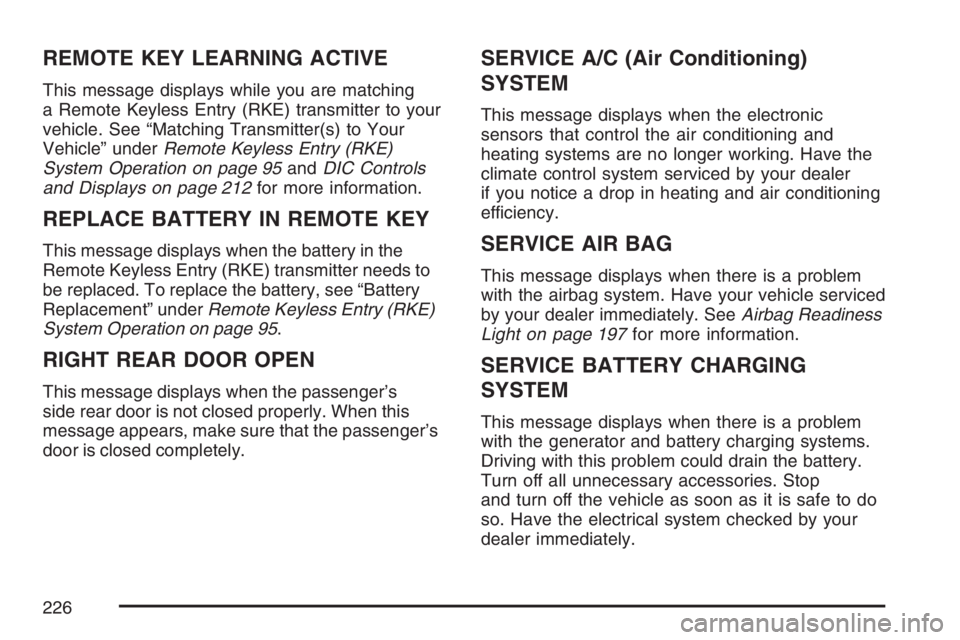
REMOTE KEY LEARNING ACTIVE
This message displays while you are matching
a Remote Keyless Entry (RKE) transmitter to your
vehicle. See “Matching Transmitter(s) to Your
Vehicle” underRemote Keyless Entry (RKE)
System Operation on page 95andDIC Controls
and Displays on page 212for more information.
REPLACE BATTERY IN REMOTE KEY
This message displays when the battery in the
Remote Keyless Entry (RKE) transmitter needs to
be replaced. To replace the battery, see “Battery
Replacement” underRemote Keyless Entry (RKE)
System Operation on page 95.
RIGHT REAR DOOR OPEN
This message displays when the passenger’s
side rear door is not closed properly. When this
message appears, make sure that the passenger’s
door is closed completely.
SERVICE A/C (Air Conditioning)
SYSTEM
This message displays when the electronic
sensors that control the air conditioning and
heating systems are no longer working. Have the
climate control system serviced by your dealer
if you notice a drop in heating and air conditioning
efficiency.
SERVICE AIR BAG
This message displays when there is a problem
with the airbag system. Have your vehicle serviced
by your dealer immediately. SeeAirbag Readiness
Light on page 197for more information.
SERVICE BATTERY CHARGING
SYSTEM
This message displays when there is a problem
with the generator and battery charging systems.
Driving with this problem could drain the battery.
Turn off all unnecessary accessories. Stop
and turn off the vehicle as soon as it is safe to do
so. Have the electrical system checked by your
dealer immediately.
226
Page 305 of 496

You can run the engine to keep warm, but be
careful.
{CAUTION:
Snow can trap exhaust gases under
your vehicle. This can cause deadly CO
(carbon monoxide) gas to get inside.
CO could overcome you and kill you.
You cannot see it or smell it, so you might
not know it is in your vehicle. Clear away
snow from around the base of your
vehicle, especially any that is blocking
your exhaust pipe. And check around
again from time to time to be sure snow
does not collect there.
Open a window just a little on the side of
the vehicle that is away from the wind.
This will help keep CO out.
Run your engine only as long as you must. This
saves fuel. When you run the engine, make it go
a little faster than just idle. That is, push the
accelerator slightly. This uses less fuel for the heat
that you get and it keeps the battery charged.
305
Page 373 of 496

Notice:Ignoring these steps could result in
costly damage to your vehicle that would
not be covered by your warranty.
Trying to start your vehicle by pushing or
pulling it will not work, and it could damage
your vehicle.
1. Check the other vehicle. It must have a
12-volt battery with a negative ground system.
Notice:If the other vehicle’s system is not a
12-volt system with a negative ground,
both vehicles can be damaged. Only use
vehicles with 12-volt systems with negative
grounds to jump start your vehicle.
2. Get the vehicles close enough so the jumper
cables can reach, but be sure the vehicles are
not touching each other. If they are, it could
cause a ground connection you do not
want. You would not be able to start your
vehicle, and the bad grounding could damage
the electrical systems.To avoid the possibility of the vehicles rolling,
set the parking brake rmly on both vehicles
involved in the jump start procedure. Put
an automatic transaxle in PARK (P) or
a manual transaxle in NEUTRAL before
setting the parking brake.
Notice:If you leave your radio or other
accessories on during the jump starting
procedure, they could be damaged. The repairs
would not be covered by your warranty.
Always turn off your radio and other
accessories when jump starting your vehicle.
3. Turn off the ignition on both vehicles.
Unplug unnecessary accessories plugged into
the cigarette lighter or the accessory power
outlet(s). Turn off the radio and all lamps that
are not needed. This will avoid sparks and
help save both batteries. And it could save
the radio!
373
Page 374 of 496

4. Open the hood on the other vehicle and
locate the positive (+) and negative (−)
terminal locations on that vehicle.
You will not see the battery of your vehicle
under the hood. It is located under the
rear passenger’s seat. You will not need to
access the battery for jump starting. The
remote positive (+) terminal is for that purpose.
SeeEngine Compartment Overview on
page 334for location.
Access the remote positive (+) terminal by
removing the cover.
{CAUTION:
An electric fan can start up even when the
engine is not running and can injure you.
Keep hands, clothing and tools away from
any underhood electric fan.
{CAUTION:
Using a match near a battery can cause
battery gas to explode. People have been
hurt doing this, and some have been
blinded. Use a ashlight if you need
more light.
Be sure the battery has enough water.
You do not need to add water to the
battery installed in your new vehicle.
CAUTION: (Continued)
374
Page 377 of 496
To disconnect the jumper cables from both
vehicles, do the following:
1. Disconnect the black negative (−) cable from
the vehicle that had the dead battery.
2. Disconnect the black negative (−) cable from
the vehicle with the good battery.
3. Disconnect the red positive (+) cable from the
vehicle with the good battery.
4. Disconnect the red positive (+) cable from the
other vehicle.
5. Return the positive (+) remote terminal cover
to its original position.
Headlamp Aiming
The vehicle has a visual optical headlamp aiming
system. The aim of the headlamps have been
preset at the factory and should need no further
adjustment.
However, if the vehicle is damaged in an accident,
the aim of the headlamps may be affected and
adjustment may be necessary.
If oncoming vehicles ash their high beams at
you, this may mean the vertical aim of your
headlamps needs to be adjusted.It is recommended that the vehicle is taken to your
dealer for service if the headlamps need to be
adjusted. It is possible however, to re-aim the
headlamps as described in the following procedure.
The vehicle should be properly prepared as
follows:
The vehicle should be placed so the
headlamps are 25 ft. (7.6 m) from a light
colored wall.
The vehicle must have all four tires on a level
surface which is level all the way to the wall.
The vehicle should be placed so it is
perpendicular to the wall.
The vehicle should not have any snow, ice or
mud on it.
The vehicle should be fully assembled and all
other work stopped while headlamp aiming is
being performed.
The vehicle should be normally loaded with a
full tank of fuel and one person or 160 lbs
(75 kg) sitting on the driver’s seat.
Tires should be properly inated.
The spare tire is in its proper location in the
vehicle.
377
Page 467 of 496

Emergency Tow From a Public Roadway or
Highway:Tow to the nearest dealership for
warranty service or in the event of a
vehicle-disabling accident. Winch-out
assistance when the vehicle is mired in sand,
mud, or snow.
Flat Tire Change:Installation of your spare tire
in good condition will be covered at no charge.
The customer is responsible for the repair or
replacement of the tire if not covered by a
warrantable failure.
Jump Start:No-start occurrences which
require a battery jump start will be covered at
no charge.
Additional Services for Canadian
Customers
Trip Routing Service:Upon Request,
Roadside Assistance will send you detailed,
computer-personalized maps, highlighting your
choice of either the most direct route or the
most scenic route to your destination,
anywhere in North America, along with any
helpful travel information we may have
pertaining to your trip. To request this service,
please call us toll-free at 1-800-268-6800.We will make every attempt to send your
personalized trip routing as quickly as possible,
but it is best to allow three weeks before your
planned departure date. Trip routing requests
will be limited to six per calendar year.
Trip Interruption Benets and Assistance:
In the event of a warranty related vehicle
disablement, while en route and over
250 kilometres from original point of departure,
you may qualify for trip interruption expense
assistance. This assistance covers reasonable
reimbursement of up to a maximum of
$500 (Canadian) for (A) meals (maximum of
$50/day), (B) lodging (maximum of $100/night)
and (C) alternate ground transportation
(maximum of $40/day). This benet is to assist
you with some of the unplanned expense you
may incur while waiting for your vehicle to be
repaired.
Pre-authorization, original detailed receipts and
a copy of the repair order are required.
Once authorization has been given, your
advisor will help you make any necessary
arrangements and explain how to claim for trip
interruption expense assistance.
467
Page 482 of 496

Audio System(s) (cont.)
Navigation/Radio System,
see Navigation Manual......................... 271
Radio with CD................................245, 251
Setting the Time..............................242, 243
Theft-Deterrent Feature............................ 271
Understanding Radio Reception............... 272
XM™ Satellite Radio Antenna System...... 274
Automatic Transaxle
Fluid........................................................ 343
Operation................................................. 119
B
Backglass Antenna...................................... 274
Battery........................................................ 370
Electric Power Management..................... 176
Exterior Lighting Battery Saver................. 173
Inadvertent Power Saver.......................... 177
Run-Down Protection............................... 177Before Leaving on a Long Trip.................... 298
Brake
Anti-Lock Brake System (ABS)................. 281
Emergencies............................................ 283
Panic Assist............................................. 285
Parking.................................................... 122
System Warning Light.............................. 201
Brakes........................................................ 367
Braking....................................................... 280
Braking in Emergencies............................... 283
Break-In, New Vehicle................................. 113
Bulb Replacement....................................... 380
Halogen Bulbs......................................... 380
Headlamp Aiming..................................... 377
License Plate Lamps................................ 383
Replacement Bulbs.................................. 383
Taillamps and Back-Up Lamps................. 382
Taillamps, Turn Signal, Stoplamps and
Sidemarker Lamps................................ 380
Buying New Tires........................................ 400
482
Page 485 of 496
Door
Delayed Locking...................................... 103
Locks....................................................... 102
Power Door Locks................................... 103
Programmable Automatic Door Locks....... 104
Rear Door Security Locks........................ 104
Driver
Position, Safety Belt................................... 25
Driver Information Center (DIC)................... 212
DIC Controls and Displays....................... 212
DIC Vehicle Customization....................... 231
DIC Warnings and Messages................... 221
Driving
At Night................................................... 291
City.......................................................... 296
Defensive................................................. 276
Drunken................................................... 277
Freeway................................................... 297
Hill and Mountain Roads.......................... 300
In Rain and on Wet Roads...................... 293
Rocking Your Vehicle to Get it Out.......... 307
Winter...................................................... 302
Dual Automatic Climate Control System....... 186E
Electric Power Management........................ 176
Electrical System
Add-On Equipment................................... 428
Fuses and Circuit Breakers...................... 428
Power Windows and
Other Power Options............................ 428
Rear Underseat Fuse Block..................... 431
Underhood Fuse Block............................. 428
Engine
Air Cleaner/Filter...................................... 342
Battery..................................................... 370
Check and Service Engine Soon Light..... 206
Coolant.................................................... 347
Coolant Heater......................................... 117
Coolant Temperature Gage...................... 204
Coolant Temperature Warning Light.......... 204
Drive Belt Routing.................................... 454
Engine Compartment Overview ................ 334
Exhaust................................................... 127
Oil ........................................................... 337
Oil Life System........................................ 340
485
Page 486 of 496
Engine (cont.)
Overheated Protection Operating Mode...... 353
Overheating............................................. 351
Starting.................................................... 116
Entry Lighting.............................................. 174
Event Data Recorders (EDR)...................... 471
Extender, Safety Belt..................................... 42
Exterior Lamps............................................ 170
Exterior Lighting Battery Saver.................... 173
F
Filter
Engine Air Cleaner................................... 342
Finish Damage............................................ 425
Flashers, Hazard Warning........................... 160
Flash-to-Pass.............................................. 164
Flat Tire...................................................... 407
Flat Tire, Changing...................................... 408
Flat Tire, Storing......................................... 416Fluid
Automatic Transaxle................................. 343
Power Steering........................................ 364
Windshield Washer.................................. 365
Fog Lamp Light........................................... 210
Fog Lamps.................................................. 173
Front Reading Lamps.................................. 175
Front Storage Area...................................... 151
Fuel............................................................ 327
Additives.................................................. 328
California Fuel.......................................... 328
Filling a Portable Fuel Container.............. 332
Filling Your Tank...................................... 330
Fuels in Foreign Countries....................... 329
Gage....................................................... 211
Gasoline Octane...................................... 327
Gasoline Specications............................ 328
Fuses
Fuses and Circuit Breakers...................... 428
Rear Underseat Fuse Block..................... 431
Underhood Fuse Block............................. 428
486
Page 488 of 496
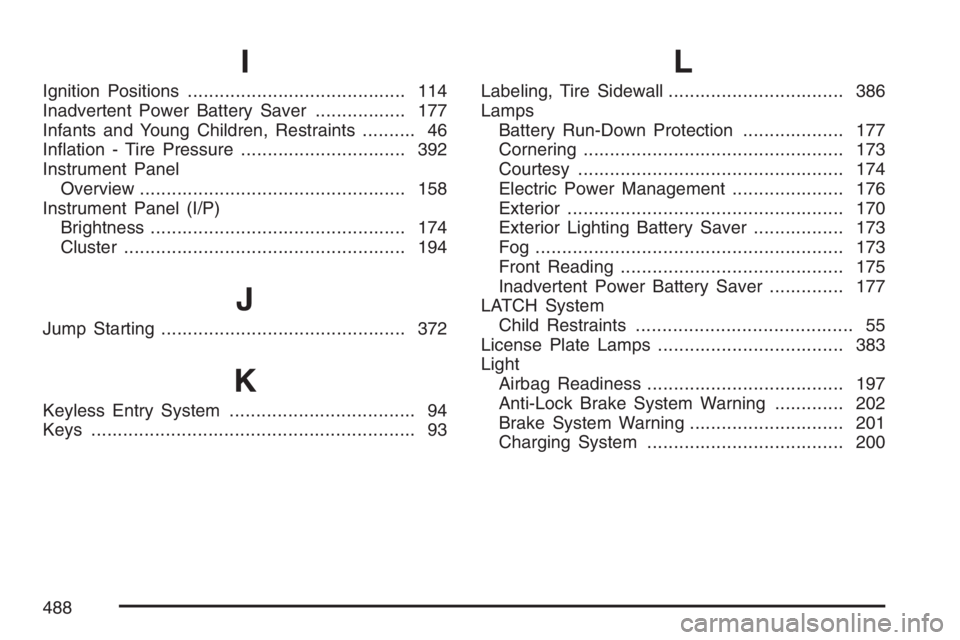
I
Ignition Positions......................................... 114
Inadvertent Power Battery Saver................. 177
Infants and Young Children, Restraints.......... 46
Ination - Tire Pressure............................... 392
Instrument Panel
Overview.................................................. 158
Instrument Panel (I/P)
Brightness................................................ 174
Cluster..................................................... 194
J
Jump Starting.............................................. 372
K
Keyless Entry System................................... 94
Keys............................................................. 93
L
Labeling, Tire Sidewall................................. 386
Lamps
Battery Run-Down Protection................... 177
Cornering................................................. 173
Courtesy.................................................. 174
Electric Power Management..................... 176
Exterior.................................................... 170
Exterior Lighting Battery Saver................. 173
Fog .......................................................... 173
Front Reading.......................................... 175
Inadvertent Power Battery Saver.............. 177
LATCH System
Child Restraints......................................... 55
License Plate Lamps................................... 383
Light
Airbag Readiness..................................... 197
Anti-Lock Brake System Warning............. 202
Brake System Warning............................. 201
Charging System..................................... 200
488