coolant level BUICK LUCERNE 2007 User Guide
[x] Cancel search | Manufacturer: BUICK, Model Year: 2007, Model line: LUCERNE, Model: BUICK LUCERNE 2007Pages: 496, PDF Size: 2.77 MB
Page 364 of 496
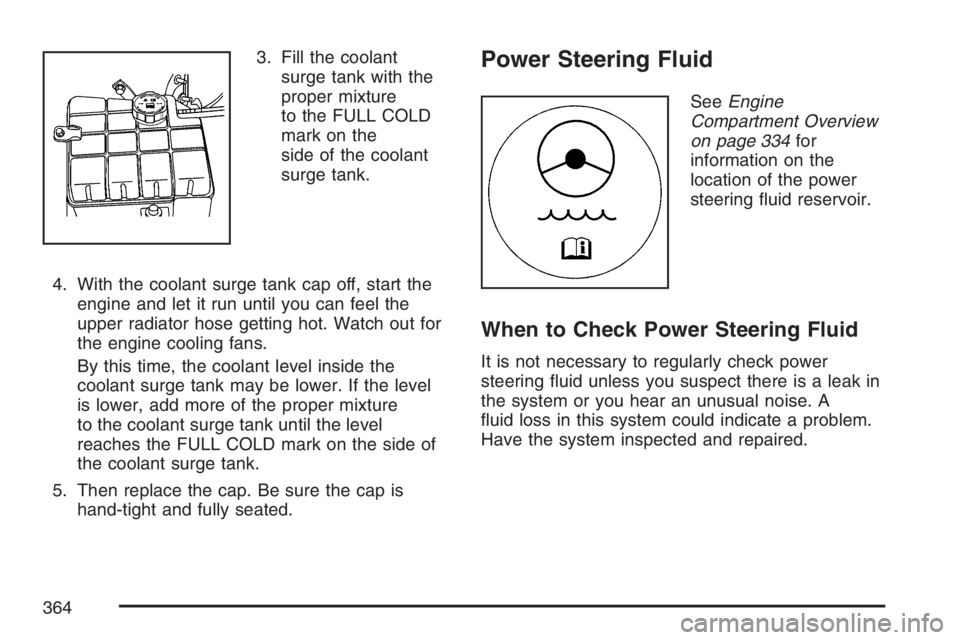
3. Fill the coolant
surge tank with the
proper mixture
to the FULL COLD
mark on the
side of the coolant
surge tank.
4. With the coolant surge tank cap off, start the
engine and let it run until you can feel the
upper radiator hose getting hot. Watch out for
the engine cooling fans.
By this time, the coolant level inside the
coolant surge tank may be lower. If the level
is lower, add more of the proper mixture
to the coolant surge tank until the level
reaches the FULL COLD mark on the side of
the coolant surge tank.
5. Then replace the cap. Be sure the cap is
hand-tight and fully seated.Power Steering Fluid
SeeEngine
Compartment Overview
on page 334for
information on the
location of the power
steering uid reservoir.
When to Check Power Steering Fluid
It is not necessary to regularly check power
steering uid unless you suspect there is a leak in
the system or you hear an unusual noise. A
uid loss in this system could indicate a problem.
Have the system inspected and repaired.
364
Page 443 of 496
When the CHANGE ENGINE OIL SOON message
appears, certain services, checks, and inspections
are required. Required services are described
in the following for “MaintenanceI” and
“MaintenanceII.” Generally, it is recommended
that your rst service be MaintenanceI, your
second service be MaintenanceII, and that you
alternate MaintenanceIand MaintenanceII
thereafter. However, in some cases,
MaintenanceIImay be required more often.MaintenanceI— Use MaintenanceIif the
CHANGE ENGINE OIL SOON message comes on
within 10 months since the vehicle was purchased
or MaintenanceIIwas performed.
MaintenanceII— Use MaintenanceIIif the
previous service performed was MaintenanceI.
Always use MaintenanceIIwhenever the message
comes on 10 months or more since the last
service or if the message has not come on at all
for one year.
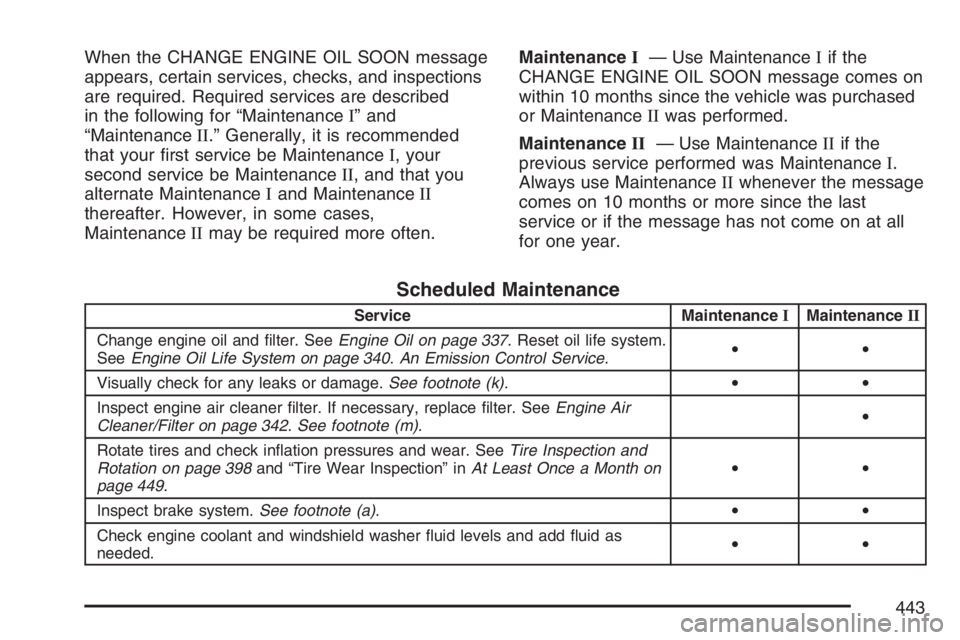
Scheduled Maintenance
Service MaintenanceIMaintenanceII
Change engine oil and lter. SeeEngine Oil on page 337. Reset oil life system.
SeeEngine Oil Life System on page 340.An Emission Control Service.••
Visually check for any leaks or damage.See footnote (k).••
Inspect engine air cleaner lter. If necessary, replace lter. SeeEngine Air
Cleaner/Filter on page 342.See footnote (m).•
Rotate tires and check ination pressures and wear. SeeTire Inspection and
Rotation on page 398and “Tire Wear Inspection” inAt Least Once a Month on
page 449.••
Inspect brake system.See footnote (a).••
Check engine coolant and windshield washer uid levels and add uid as
needed.••
443
Page 447 of 496

(f)Lubricate all key lock cylinders. Lubricate all
hinges and latches, including those for the hood,
rear compartment, glove box door, and console
door. More frequent lubrication may be required
when exposed to a corrosive environment.
Applying silicone grease on weatherstrips with a
clean cloth will make them last longer, seal better,
and not stick or squeak.
(g)If you drive regularly under dusty conditions,
the lter may require replacement more often.
(h)Change automatic transaxle uid and lter if the
vehicle is mainly driven under one or more of
these conditions:
In heavy city traffic where the outside
temperature regularly reaches 90°F (32°C) or
higher.
In hilly or mountainous terrain.
When doing frequent trailer towing.
Uses such as found in taxi, police, or delivery
service.(j)Drain, ush, and rell cooling system. This
service can be complex; you should have
your dealer perform this service. See Engine
Coolant on page 347 for what to use. Inspect
hoses. Clean radiator, condenser, pressure cap,
and ller neck. Pressure test the cooling
system and pressure cap.
(k)A uid loss in any vehicle system could
indicate a problem. Have the system inspected
and repaired and the uid level checked. Add uid
if needed.
(l)Inspect throttle body bore and valve plates for
deposits. Open the throttle valve and inspect
all surfaces. Clean as required.
(m)If you drive regularly under dusty conditions,
inspect the lter at each engine oil change.
(n)Visually inspect belt for fraying, excessive
cracks, or obvious damage. Replace belt if
necessary.
447
Page 448 of 496
Owner Checks and Services
These owner checks and services should be
performed at the intervals specied to help ensure
the safety, dependability, and emission control
performance of your vehicle. Your GM
Goodwrench
®dealer can assist you with these
checks and services.
Be sure any necessary repairs are completed at
once. Whenever any uids or lubricants are added
to your vehicle, make sure they are the proper
ones, as shown inRecommended Fluids and
Lubricants on page 452.
At Each Fuel Fill
It is important to perform these underhood checks
at each fuel ll.
Engine Oil Level Check
Check the engine oil level and add the proper oil if
necessary. SeeEngine Oil on page 337for
further details.Notice:It is important to check your oil
regularly and keep it at the proper level. Failure
to keep your engine oil at the proper level can
cause damage to your engine not covered by
your warranty.
Engine Coolant Level Check
Check the engine coolant level and add
DEX-COOL®coolant mixture if necessary. See
Engine Coolant on page 347for further details.
Windshield Washer Fluid Level Check
Check the windshield washer uid level in
the windshield washer uid reservoir and add the
proper uid if necessary.
448