maintenance BUICK LUCERNE 2007 User Guide
[x] Cancel search | Manufacturer: BUICK, Model Year: 2007, Model line: LUCERNE, Model: BUICK LUCERNE 2007Pages: 496, PDF Size: 2.77 MB
Page 222 of 496
CHANGE ENGINE OIL SOON
This message displays when service is required for
the vehicle. See your dealer. SeeEngine Oil on
page 337andScheduled Maintenance on
page 442for more information.
Acknowledging the CHANGE ENGINE OIL SOON
message will not reset the OIL LIFE REMAINING.
That must be done at the OIL LIFE screen
under the vehicle information menu. See “Oil Life”
underDIC Controls and Displays on page 212
andEngine Oil Life System on page 340.
CHECK TIRE PRESSURE
This message displays when the tire pressure in
one of the tires needs to be checked. This message
also displays LEFT FRONT, RIGHT FRONT, LEFT
REAR, or RIGHT REAR to indicate which tire needs
to be checked. You can receive more than one tire
pressure message at a time. To read the other
messages that may have been sent at the same
time, press the set/reset button. If a tire pressure
message appears on the DIC, stop as soon as you
can. Have the tire pressures checked and set to
those shown on the Tire Loading Information Label.SeeTires on page 385,Loading Your Vehicle
on page 307, andInation - Tire Pressure on
page 392. The DIC display also shows the tire
pressure values for the front and rear tires by
pressing the vehicle information button. SeeDIC
Controls and Displays on page 212. If the tire
pressure is low, the low tire pressure warning light
comes on. SeeTire Pressure Light on page 205.
DRIVER DOOR OPEN
This message displays when the driver’s door is
not closed properly. When this message appears,
make sure that the driver’s door is closed
completely.
ENGINE HOT A/C
(Air Conditioning) OFF
This message displays when the engine coolant
becomes hotter than the normal operating
temperature. To avoid added strain on a hot engine,
the air conditioning compressor is automatically
turned off. When the coolant temperature returns to
normal, the A/C operation automatically resumes.
You can continue to drive your vehicle. If this
message continues to appear, have the system
repaired by your dealer as soon as possible to
avoid compressor damage.
222
Page 322 of 496
When You Are Ready to Leave After
Parking on a Hill
1. Apply your regular brakes and hold the pedal
down while you:
Start your engine.
Shift into a gear.
Release the parking brake.
2. Let up on the brake pedal.
3. Drive slowly until the trailer is clear of
the chocks.
4. Stop and have someone pick up and store
the chocks.
Maintenance When Trailer Towing
Your vehicle will need service more often when
you’re pulling a trailer. See the Maintenance
Schedule for more on this. Things that are
especially important in trailer operation are
automatic transaxle uid (don’t overll), engine oil,
drive belt, cooling system and brake system.
Each of these is covered in this manual, and the
Index will help you nd them quickly. If you’re
trailering, it’s a good idea to review this information
before you start your trip.
Check periodically to see that all hitch nuts and
bolts are tight.
Engine Cooling When Trailer Towing
Your cooling system may temporarily overheat
during severe operating conditions. SeeEngine
Overheating on page 351.
322
Page 324 of 496
Tire Inspection and Rotation...................... 398
When It Is Time for New Tires.................. 400
Buying New Tires...................................... 400
Different Size Tires and Wheels................ 402
Uniform Tire Quality Grading..................... 402
Wheel Alignment and Tire Balance............ 404
Wheel Replacement.................................. 404
Tire Chains............................................... 406
If a Tire Goes Flat.................................... 407
Changing a Flat Tire................................. 408
Removing the Spare Tire and Tools.......... 409
Removing the Flat Tire and
Installing the Spare Tire......................... 410
Storing a Flat or Spare Tire and Tools...... 416
Compact Spare Tire.................................. 418
Appearance Care........................................ 418
Cleaning the Inside of Your Vehicle.......... 418
Fabric/Carpet............................................. 420
Leather...................................................... 421
Instrument Panel, Vinyl, and
Other Plastic Surfaces........................... 421
Care of Safety Belts.................................. 422
Weatherstrips............................................ 422Washing Your Vehicle............................... 422
Cleaning Exterior Lamps/Lenses................ 422
Finish Care............................................... 423
Windshield and Wiper Blades.................... 423
Aluminum or Chrome-Plated Wheels......... 424
Tires......................................................... 424
Sheet Metal Damage................................. 425
Finish Damage.......................................... 425
Underbody Maintenance............................ 425
Chemical Paint Spotting............................ 425
Vehicle Care/Appearance Materials............ 426
Vehicle Identication.................................. 427
Vehicle Identication Number (VIN)........... 427
Service Parts Identication Label............... 427
Electrical System........................................ 428
Add-On Electrical Equipment..................... 428
Power Windows and Other Power
Options.................................................. 428
Fuses and Circuit Breakers....................... 428
Underhood Fuse Block.............................. 428
Rear Underseat Fuse Block....................... 431
Capacities and Specications.................... 436
Section 5 Service and Appearance Care
324
Page 326 of 496
California Proposition 65 Warning
Most motor vehicles, including this one, contain
and/or emit chemicals known to the State of
California to cause cancer and birth defects or other
reproductive harm. Engine exhaust, many parts and
systems (including some inside the vehicle), many
uids, and some component wear by-products
contain and/or emit these chemicals.
Doing Your Own Service Work
{CAUTION:
You can be injured and your vehicle could
be damaged if you try to do service work
on a vehicle without knowing enough
about it.
Be sure you have sufficient knowledge,
experience, the proper replacement
parts, and tools before you attempt any
vehicle maintenance task.
CAUTION: (Continued)
CAUTION: (Continued)
Be sure to use the proper nuts, bolts,
and other fasteners. English and
metric fasteners can be easily
confused. If you use the wrong
fasteners, parts can later break or fall
off. You could be hurt.
If you want to do some of your own service work,
you will want to use the proper service manual.
It tells you much more about how to service your
vehicle than this manual can. To order the
proper service manual, seeService Publications
Ordering Information on page 478.
Your vehicle has an airbag system. Before
attempting to do your own service work, see
Servicing Your Airbag-Equipped Vehicle on
page 86.
You should keep a record with all parts receipts
and list the mileage and the date of any service
work you perform. SeeMaintenance Record
on page 455.
326
Page 327 of 496
Adding Equipment to the Outside of
Your Vehicle
Things you might add to the outside of your
vehicle can affect the airow around it. This may
cause wind noise and affect windshield washer
performance. Check with your dealer before
adding equipment to the outside of your vehicle.
Fuel
Use of the recommended fuel is an important part
of the proper maintenance of your vehicle. To
help keep your engine clean and maintain optimum
vehicle performance, GM recommends the use
of gasoline advertised as TOP TIER Detergent
Gasoline.
The 8th digit of your Vehicle Identication Number
(VIN) shows the code letter or number that
identies your engine. You will nd the VIN at the
top left of the instrument panel. SeeVehicle
Identication Number (VIN) on page 427.
Gasoline Octane
If your vehicle has the 3.8L V6 engine (VIN
Code 2), use regular unleaded gasoline with a
posted octane rating of 87 or higher. If the octane
rating is less than 87, you may notice an audible
knocking noise when you drive, commonly referred
to as spark knock. If this occurs, use a gasoline
rated at 87 octane or higher as soon as possible.
If you are using gasoline rated at 87 octane or
higher and you hear heavy knocking, your engine
needs service.
If your vehicle has the 4.6L V8 engine (VIN
Code Y), use premium unleaded gasoline with a
posted octane rating of 91 or higher. You may also
use regular unleaded gasoline rated at 87 octane
or higher, but your vehicle’s acceleration may
be slightly reduced, and you may notice a slight
audible knocking noise, commonly referred to
as spark knock. If the octane is less than 87, you
may notice a heavy knocking noise when you
drive. If this occurs, use a gasoline rated at
87 octane or higher as soon as possible.
Otherwise, you might damage your engine. If you
are using gasoline rated at 87 octane or higher
and you hear heavy knocking, your engine needs
service.
327
Page 342 of 496
Engine Air Cleaner/Filter
SeeEngine Compartment Overview on page 334
for the location of the engine air cleaner/lter.
When to Inspect the Engine Air
Cleaner/Filter
Inspect the air cleaner/lter at the MaintenanceII
intervals and replace it at the rst oil change
after each 50,000 mile (83 000 km) interval. See
Scheduled Maintenance on page 442for more
information. If you are driving in dusty/dirty
conditions, inspect the lter at each engine oil
change.
How to Inspect the Engine Air
Cleaner/Filter
To inspect the air cleaner/lter, remove the lter
from the vehicle and lightly shake the lter to
release loose dust and dirt. If the lter remains
caked with dirt, a new lter is required.To inspect or replace the lter, do the following:
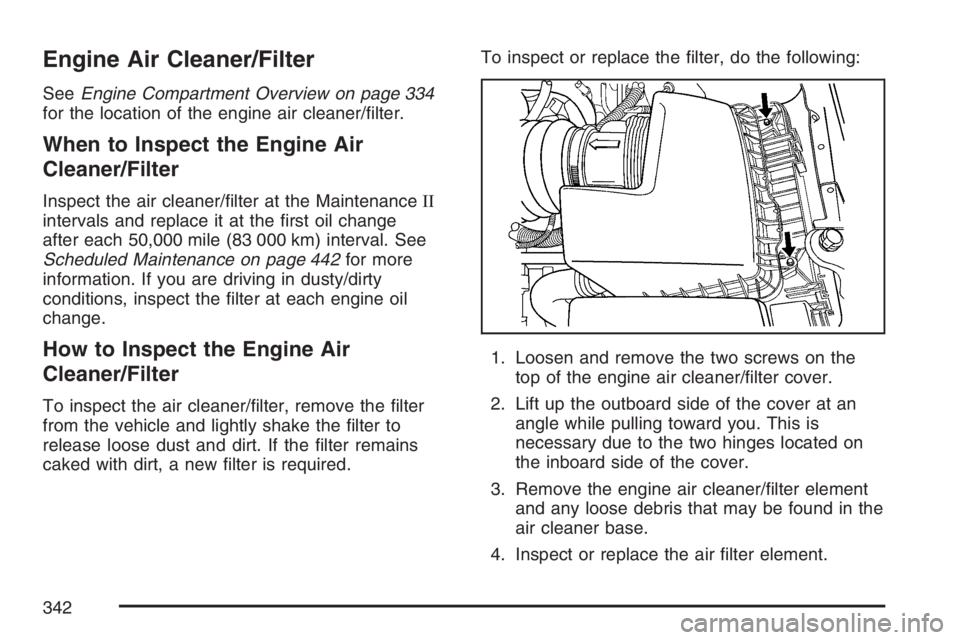
1. Loosen and remove the two screws on the
top of the engine air cleaner/lter cover.
2. Lift up the outboard side of the cover at an
angle while pulling toward you. This is
necessary due to the two hinges located on
the inboard side of the cover.
3. Remove the engine air cleaner/lter element
and any loose debris that may be found in the
air cleaner base.
4. Inspect or replace the air lter element.
342
Page 343 of 496
Follow these steps to reinstall the cover to the
engine air cleaner/lter housing:
1. Align the two hinges located on the inboard
side of the cover.
2. Push the cover slightly down and towards the
engine to engage the tabs in the hinges and
align the two screws.
3. Tighten the two screws on the top of the
engine air cleaner/lter housing cover.
{CAUTION:
Operating the engine with the air cleaner/
lter off can cause you or others to be
burned. The air cleaner not only cleans the
air; it helps to stop ames if the engine
backres. If it is not there and the engine
backres, you could be burned. Do not
drive with it off, and be careful working on
the engine with the air cleaner/lter off.Notice:If the air cleaner/lter is off, a backre
can cause a damaging engine re. And, dirt
can easily get into your engine, which will
damage it. Always have the air cleaner/lter in
place when you are driving.
Automatic Transaxle Fluid
When to Check and Change Automatic
Transaxle Fluid
A good time to check your automatic transaxle
uid level is when the engine oil is changed.
Change the uid and lter at the intervals listed in
Scheduled Maintenance on page 442, and be
sure to use the transaxle uid listed in
Recommended Fluids and Lubricants on page 452.
343
Page 346 of 496

How to Add Automatic Transaxle Fluid
Refer to the Maintenance Schedule to determine
what kind of transaxle uid to use. See
Recommended Fluids and Lubricants on page 452.
If the uid level is low, add only enough of the
proper uid to bring the level into the
cross-hatched area on the dipstick.
1. Pull out the dipstick.
2. Using a long-neck funnel, add enough uid at
the dipstick hole to bring it to the proper level.
It does not take much uid, generally less
than one pint (0.5 L). Do not overll.
Notice:Use of the incorrect automatic
transaxle uid may damage your vehicle, and
the damages may not be covered by your
warranty. Always use the automatic transaxle
uid listed inRecommended Fluids and
Lubricants on page 452.3. After adding uid, recheck the uid level as
described under “How to Check Automatic
Transaxle Fluid,” earlier in this section.
4. When the correct uid level is obtained, push
the dipstick back in all the way.
How to Check Automatic Transaxle
Fluid (4.6L Engine)
For the 4.6L V8 engine, it is not necessary to check
the transaxle uid level. A transaxle uid leak is the
only reason for uid loss. If a leak occurs, take your
vehicle to the dealership service department and
have it repaired as soon as possible.
346
Page 347 of 496
Engine Coolant
The cooling system in your vehicle is lled with
DEX-COOL®engine coolant. This coolant is
designed to remain in your vehicle for ve years or
150,000 miles (240 000 km), whichever occurs
rst, if you add only DEX-COOL
®extended
life coolant.
The following explains your cooling system and
how to add coolant when it is low. If you have
a problem with engine overheating, seeEngine
Overheating on page 351.A 50/50 mixture of clean, drinkable water and
DEX-COOL
®coolant will:
Give freezing protection down to
−34°F (−37°C).
Give boiling protection up to 265°F (129°C).
Protect against rust and corrosion.
Help keep the proper engine temperature.
Let the warning lights and gages work as
they should.
Notice:Using coolant other than DEX-COOL
®
may cause premature engine, heater core,
or radiator corrosion. In addition, the engine
coolant may require changing sooner, at
the rst maintenance service after each
30,000 miles (50 000 km) or 24 months,
whichever occurs rst. Any repairs would not
be covered by your warranty. Always use
DEX-COOL
®(silicate-free) coolant in your
vehicle.
347
Page 370 of 496

Replacing Brake System Parts
The braking system on a vehicle is complex. Its
many parts have to be of top quality and work well
together if the vehicle is to have really good
braking. Your vehicle was designed and tested
with top-quality GM brake parts. When you replace
parts of your braking system — for example,
when your brake linings wear down and you need
new ones put in — be sure you get new
approved GM replacement parts. If you do not,
your brakes may no longer work properly.
For example, if someone puts in brake linings that
are wrong for your vehicle, the balance between
your front and rear brakes can change — for
the worse. The braking performance you have
come to expect can change in many other ways
if someone puts in the wrong replacement
brake parts.
Battery
Your vehicle has a maintenance free battery.
When it is time for a new battery, get one that has
the replacement number shown on the original
battery’s label. We recommend an ACDelco
®
replacement battery.
Warning:Battery posts, terminals, and related
accessories contain lead and lead compounds,
chemicals known to the State of California
to cause cancer and reproductive harm. Wash
hands after handling.
The battery is located under the rear seat cushion.
To access the battery, see “Removing the Rear
Seat Cushion” underRear Underseat Fuse
Block on page 431. You do not need to access
the battery to jump start your vehicle. See
Jump Starting on page 372.
370