service BUICK LUCERNE 2007 User Guide
[x] Cancel search | Manufacturer: BUICK, Model Year: 2007, Model line: LUCERNE, Model: BUICK LUCERNE 2007Pages: 496, PDF Size: 2.77 MB
Page 113 of 496
To program the new key do the following:
1. Verify that the new key has a
1stamped on it.
2. Insert the already programmed key in the
ignition and start the engine. If the engine
will not start, see your dealer for service.
3. After the engine has started, turn the key to
OFF, and remove the key.
4. Insert the key to be programmed and turn it to
the RUN position within ve seconds of the
original key being turned to the OFF position.
5. The security light will turn off once the key has
been programmed.
6. Repeat Steps 1 through 5 if additional keys
are to be programmed.
If you are ever driving and the security light comes
on and stays on, you may be able to restart your
engine if you turn it off. Your PASS-Key
®III+
system, however, is not working properly and must
be serviced by your dealer. Your vehicle is not
protected by the PASS-Key
®III+ system at
this time.
If you lose or damage your PASS-Key
®III+ key,
see your dealer or a locksmith who can service
PASS-Key
®III+ to have a new key made.
Starting and Operating Your
Vehicle
New Vehicle Break-In
Notice:Your vehicle does not need an
elaborate break-in. But it will perform better in
the long run if you follow these guidelines:
Do not drive at any one constant speed, fast
or slow, for the rst 500 miles (805 km).
Do not make full-throttle starts. Avoid
downshifting to brake, or slow, the vehicle.
Avoid making hard stops for the rst
200 miles (322 km) or so. During this time
your new brake linings are not yet broken
in. Hard stops with new linings can mean
premature wear and earlier replacement.
Follow this breaking-in guideline every
time you get new brake linings.
Do not tow a trailer during break-in. See
Towing a Trailer on page 315for the trailer
towing capabilities of your vehicle and more
information.
Following break-in, engine speed and load can
be gradually increased.
113
Page 114 of 496
Ignition Positions
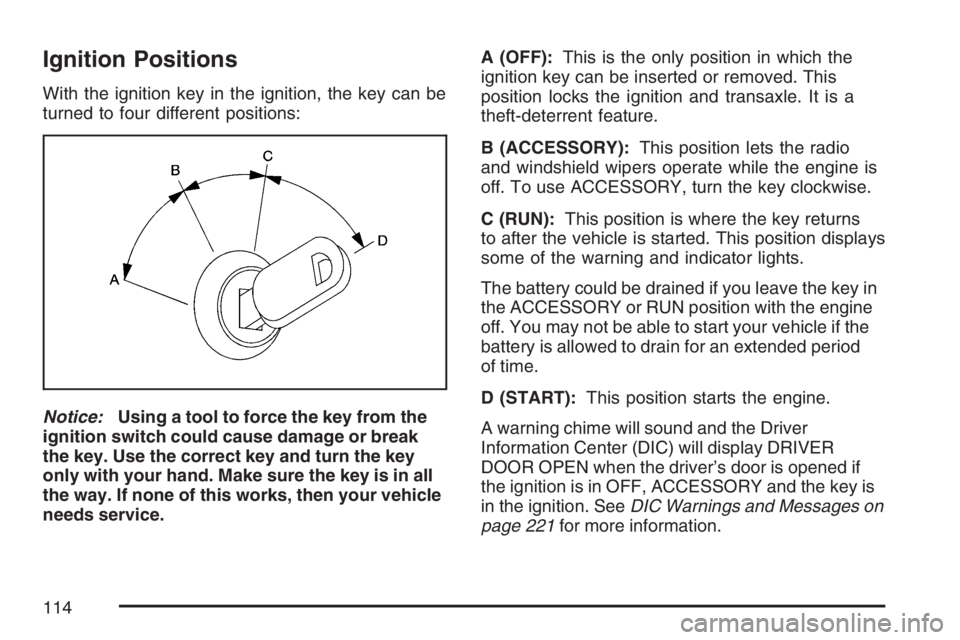
With the ignition key in the ignition, the key can be
turned to four different positions:
Notice:Using a tool to force the key from the
ignition switch could cause damage or break
the key. Use the correct key and turn the key
only with your hand. Make sure the key is in all
the way. If none of this works, then your vehicle
needs service.A (OFF):This is the only position in which the
ignition key can be inserted or removed. This
position locks the ignition and transaxle. It is a
theft-deterrent feature.
B (ACCESSORY):This position lets the radio
and windshield wipers operate while the engine is
off. To use ACCESSORY, turn the key clockwise.
C (RUN):This position is where the key returns
to after the vehicle is started. This position displays
some of the warning and indicator lights.
The battery could be drained if you leave the key in
the ACCESSORY or RUN position with the engine
off. You may not be able to start your vehicle if the
battery is allowed to drain for an extended period
of time.
D (START):This position starts the engine.
A warning chime will sound and the Driver
Information Center (DIC) will display DRIVER
DOOR OPEN when the driver’s door is opened if
the ignition is in OFF, ACCESSORY and the key is
in the ignition. SeeDIC Warnings and Messages on
page 221for more information.
114
Page 122 of 496
Parking Brake
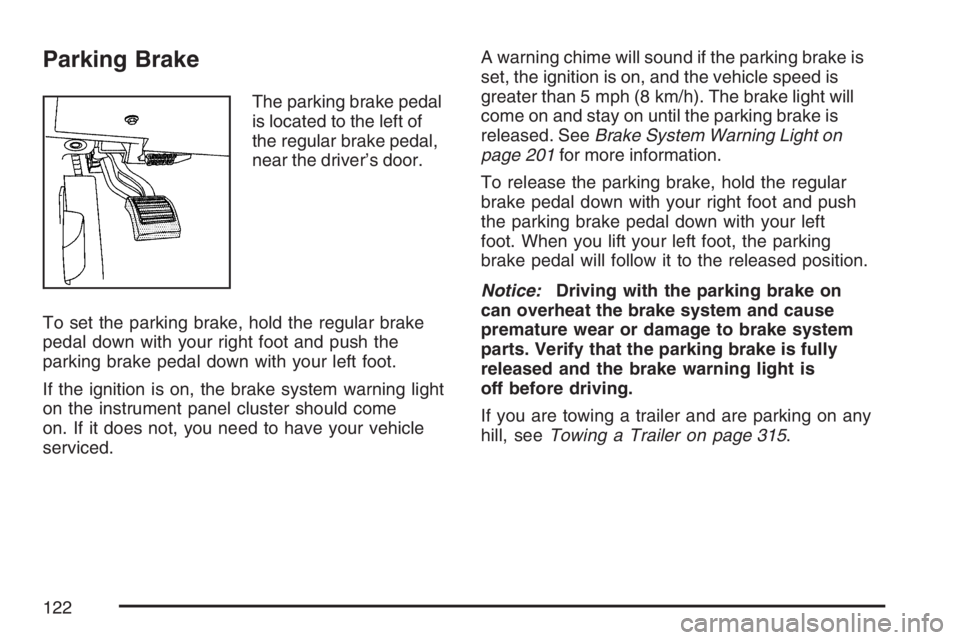
The parking brake pedal
is located to the left of
the regular brake pedal,
near the driver’s door.
To set the parking brake, hold the regular brake
pedal down with your right foot and push the
parking brake pedal down with your left foot.
If the ignition is on, the brake system warning light
on the instrument panel cluster should come
on. If it does not, you need to have your vehicle
serviced.A warning chime will sound if the parking brake is
set, the ignition is on, and the vehicle speed is
greater than 5 mph (8 km/h). The brake light will
come on and stay on until the parking brake is
released. SeeBrake System Warning Light on
page 201for more information.
To release the parking brake, hold the regular
brake pedal down with your right foot and push
the parking brake pedal down with your left
foot. When you lift your left foot, the parking
brake pedal will follow it to the released position.
Notice:Driving with the parking brake on
can overheat the brake system and cause
premature wear or damage to brake system
parts. Verify that the parking brake is fully
released and the brake warning light is
off before driving.
If you are towing a trailer and are parking on any
hill, seeTowing a Trailer on page 315.
122
Page 125 of 496
Torque Lock
If you are parking on a hill and you do not shift your
transaxle into PARK (P) properly, the weight of the
vehicle may put too much force on the parking pawl
in the transaxle. You may nd it difficult to pull the
shift lever out of PARK (P). This is called torque
lock. To prevent torque lock, set the parking brake
and then shift into PARK (P) properly before you
leave the driver’s seat. To nd out how, seeShifting
Into Park (P) on page 123.
If torque lock does occur, you may need to
have another vehicle push yours a little uphill to
take some of the pressure from the parking pawl in
the transaxle, so you can pull the shift lever out
of PARK (P).
Shifting Out of Park (P)
Your vehicle has an automatic transaxle shift lock
control system. You have to fully apply your regular
brakes before you can shift from PARK (P) when
the ignition is RUN. SeeAutomatic Transaxle
Operation on page 119.
The shift lock control system is designed to do the
following:
Prevent the ignition key from being removed
unless the shift lever is in PARK (P).
Prevent movement of the console shift lever
out of PARK (P) unless the ignition is in a
position other than OFF.
The shift lock control system is always functional
except in the case of a dead battery or low
voltage (less than 9 V) battery.
If you cannot shift out of PARK (P), ease the
pressure on the shift lever. Push the shift lever
all the way into PARK (P) as you maintain
brake application. Then move the shift lever into
the gear you want.
If you are still having a problem shifting, then have
your vehicle serviced soon.
125
Page 129 of 496
Mirrors
Manual Rearview Mirror
While sitting in a comfortable driving position,
adjust the mirror so you can see clearly behind your
vehicle. Grip the mirror in the center to move it up or
down and side to side. The control at the bottom of
the mirror is the day/night feature that allows
adjustment to the mirror so that the glare of
headlamps from behind is reduced. Push the
control for daytime use; pull it for night use.
Manual Rearview Mirror with
OnStar®
Mirror Operation
Your vehicle may have a manual rearview mirror
with the OnStar®System. You can adjust the mirror
for day or night driving. Press the tab forward for
day driving. Pull the tab back for night driving.
There are also three OnStar
®buttons located at
the bottom of the mirror. See your dealer for more
information on the system and how to subscribe
to OnStar
®. SeeOnStar®System on page 135for
more information about the services OnStar®
provides.
Cleaning the Mirror
When cleaning the mirror, use a paper towel or
similar material dampened with glass cleaner.
Do not spray glass cleaner directly on the mirror
housing.
Automatic Dimming Rearview Mirror
with OnStar
®
Your vehicle may have an automatic-dimming
rearview mirror with the OnStar®system.
There are three additional buttons for the OnStar
®
system. See your dealer for more information
on the system and how to subscribe to OnStar®.
SeeOnStar®System on page 135for more
information about the services OnStar®provides.
O(On/Off):This is the on/off button.
129
Page 130 of 496
Automatic Dimming Mirror Operation
The automatic dimming mirror function is turned on
automatically each time the ignition is started. To
operate the automatic dimming mirror, do the
following:
1. Make sure the indicator light, located to the left
of the on/off button, is lit. If it’s not, press and
hold the on/off button until the light comes on,
indicating that the mirror is in automatic
dimming mode.
2. Turn off the automatic dimming mirror function
by pressing and holding the on/off button until
the indicator light turns off.
Automatic Dimming Rearview Mirror
with OnStar®and Compass
Your vehicle may have an automatic-dimming
rearview mirror with a compass and the OnStar®
system.
There are three additional buttons for the OnStar®
system. See your dealer for more information on
the system and how to subscribe to OnStar®. See
OnStar®System on page 135for more information
about the services OnStar®provides.
O(On/Off):This is the on/off button.
Automatic Dimming Mirror Operation
The automatic dimming mirror function is turned on
automatically each time the ignition is started.
To operate the automatic dimming mirror, do the
following:
1. Make sure the indicator light, located to the
left of the on/off button, is lit. If it’s not, press
and hold the on/off button until the light
comes on, indicating that the mirror is in
automatic dimming mode.
2. Turn off the automatic dimming mirror function
by pressing and holding the on/off button until
the indicator light turns off.
Compass Operation
Press the on/off button once to turn the compass
on or off.
There is a compass display in the window in the
upper right corner of the mirror face. The compass
displays a maximum of two characters. For
example, “NE” is displayed for north-east.
130
Page 135 of 496
Outside Automatic Dimming
Heated Mirror
If you have this feature, the outside driver’s mirror
will adjust for the glare of headlamps behind you.
When you operate the rear window defogger, the
heated driver’s and passenger’s outside rearview
mirrors are warmed to help clear them of ice and
snow. See “Rear Window Defogger” underClimate
Control System on page 182orDual Automatic
Climate Control System on page 186for more
information.
Your vehicle may also have a turn signal indicator
on the mirror. An arrow on the outside rearview
mirror will ash in the direction of the turn or lane
change. SeeTurn and Lane-Change Signals
on page 162for more information.
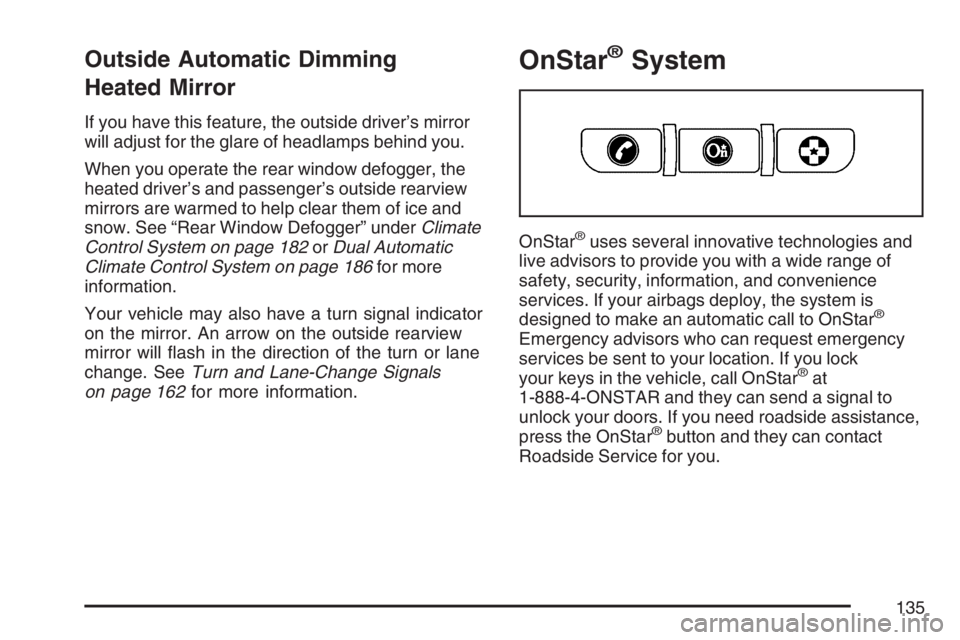
OnStar®System
OnStar®uses several innovative technologies and
live advisors to provide you with a wide range of
safety, security, information, and convenience
services. If your airbags deploy, the system is
designed to make an automatic call to OnStar
®
Emergency advisors who can request emergency
services be sent to your location. If you lock
your keys in the vehicle, call OnStar
®at
1-888-4-ONSTAR and they can send a signal to
unlock your doors. If you need roadside assistance,
press the OnStar
®button and they can contact
Roadside Service for you.
135
Page 136 of 496
OnStar®service is provided to you subject to the
OnStar®Terms and Conditions. You may cancel
your OnStar®service at any time by contacting
OnStar®as provided below. A complete OnStar®
Owners Guide and the OnStar®Terms and
Conditions are included in the vehicle’s OnStar®
Subscriber glove box literature. For more
information, visit onstar.com or onstar.ca, contact
OnStar
®at 1-888-4-ONSTAR (1-888-466-7827) or
TTY 1-877-248-2080, or press the OnStar®button
to speak with an OnStar®advisor 24 hours a day,
7 days a week.
Not all OnStar
®features are available on all
vehicles. To check if your vehicle is equipped to
provide the services described below, or for a
full description of OnStar
®services and system
limitations, see the OnStar®Owner’s Guide in your
glove box or visit onstar.com.
OnStar®Services
For new vehicles with OnStar®, the Safe & Sound
Plan, or the Directions & Connections®Plan is
included for one year from the date of purchase.
You can extend this plan beyond the rst year, or
upgrade to the Directions & Connections
®Plan.
For more information, press the OnStar®button to
speak with an advisor. Some OnStar®services
(such as Remote Door Unlock or Stolen Vehicle
Location Assistance) may not be available until you
register with OnStar
®.
136
Page 137 of 496
Available Services with Safe &
Sound®Plan
Automatic Notication of Airbag Deployment
Advanced Automatic Crash Notication
(AACN) (If equipped)
Link to Emergency Services
Roadside Assistance
Stolen Vehicle Location Assistance
AccidentAssist
Remote Door Unlock/Vehicle Alert
OnStar®Vehicle Diagnostics
GM®Goodwrench®On Demand Diagnostics
OnStar®Hands-Free Calling with
30 complimentary minutes
OnStar®Virtual Advisor
Available Services included with
Directions & Connections®Plan
All Safe and Sound Plan Services
Driving Directions - Advisor delivered or
OnStar®Turn-by-Turn Navigation (If equipped)
RideAssist
Information and Convenience Services
OnStar®Hands-Free Calling
OnStar®Hands-Free Calling allows eligible
OnStar®subscribers to make and receive calls
using voice commands. Hands-Free Calling is fully
integrated into the vehicle, and can be used with
OnStar
®Pre-Paid Minute Packages. Hands-Free
Calling may also be linked to a Verizon Wireless
service plan, depending on eligibility. To nd out
more, refer to the OnStar
®Owners Guide in the
vehicle’s glove box, visit www.onstar.com or
www.onstar.ca, or speak with an OnStar
®advisor
by pressing the OnStar®button or calling
1-888-4-ONSTAR (1-888-466-7827).
137
Page 138 of 496
OnStar®Virtual Advisor
OnStar®Virtual Advisor is a feature of OnStar®
Hands-Free Calling that uses your minutes
to access location-based weather, local traffic
reports, and stock quotes. By pressing the phone
button and giving a few simple voice commands,
you can browse through the various topics.
See the OnStar
®Owners Guide for more
information.
OnStar®Steering Wheel Controls
Your vehicle may have a Talk/Mute button that
can be used to interact with OnStar®Hands-Free
Calling. SeeAudio Steering Wheel Controls on
page 271for more information.
On some vehicles, you may have to hold the
button for a few seconds and give the command
“ONSTAR” in order to activate the OnStar
®
Hands-Free Calling feature.
On some vehicles, the mute button can be used to
dial numbers into voicemail systems, or to dial
phone extensions. See the OnStar
®Owner’s
Guide for more information.
How OnStar®Service Works
In order to provide you with OnStar®services, your
vehicle’s OnStar®system has the capability of
recording and transmitting vehicle information.
This information is automatically sent to an OnStar
®
Call Center at the time of an OnStar®button press,
Emergency button press or if your airbags or AACN
system deploys. The vehicle information usually
includes your GPS location and, in the event of a
crash, additional information regarding the accident
that your vehicle has been involved in (e.g. the
direction from which your vehicle was hit). When
you use the Virtual Advisor feature of OnStar
®
Hands-Free Calling, your vehicle also sends
OnStar®your GPS location so that we can
provide you with location-based services.
OnStar
®service cannot work unless your vehicle is
in a place where OnStar®has an agreement with a
wireless service provider for service in that area.
OnStar
®service also cannot work unless you
are in a place where the wireless service provider
OnStar
®has hired for that area has coverage,
network capacity and reception when the service is
needed, and technology that is compatible with the
OnStar
®service. Not all services are available
everywhere, particularly in remote or enclosed
areas, or at all times.
138