warning light BUICK LUCERNE 2007 Owner's Guide
[x] Cancel search | Manufacturer: BUICK, Model Year: 2007, Model line: LUCERNE, Model: BUICK LUCERNE 2007Pages: 496, PDF Size: 2.77 MB
Page 291 of 496

Of course, traction is reduced when water, snow,
ice, gravel, or other material is on the road.
For safety, you will want to slow down and adjust
your driving to these conditions. It is important
to slow down on slippery surfaces because
stopping distance will be longer and vehicle control
more limited.
While driving on a surface with reduced traction, try
your best to avoid sudden steering, acceleration, or
braking, including reducing vehicle speed by
shifting to a lower gear. Any sudden changes could
cause the tires to slide. You may not realize the
surface is slippery until your vehicle is skidding.
Learn to recognize warning clues — such as
enough water, ice, or packed snow on the road to
make a mirrored surface — and slow down when
you have any doubt.
Remember: Any Anti-Lock Brake System (ABS)
helps avoid only the braking skid.Driving at Night
Night driving is more dangerous than day driving.
One reason is that some drivers are likely to
be impaired — by alcohol or drugs, with night
vision problems, or by fatigue.
Here are some tips on night driving.
Drive defensively.
Do not drink and drive.
Adjust the inside rearview mirror to reduce the
glare from headlamps behind you.
Since you cannot see as well, you may need
to slow down and keep more space between
you and other vehicles.
Slow down, especially on higher speed roads.
Your vehicle’s headlamps can light up only so
much road ahead.
In remote areas, watch for animals.
If you are tired, pull off the road in a safe
place and rest.
291
Page 295 of 496
Driving Through Deep Standing Water
Notice:If you drive too quickly through deep
puddles or standing water, water can come in
through your engine’s air intake and badly
damage your engine. Never drive through water
that is slightly lower than the underbody of your
vehicle. If you cannot avoid deep puddles or
standing water, drive through them very slowly.
Driving Through Flowing Water
{CAUTION:
Flowing or rushing water creates strong
forces. If you try to drive through owing
water, as you might at a low water
crossing, your vehicle can be carried away.
CAUTION: (Continued)
CAUTION: (Continued)
As little as six inches of owing water
can carry away a smaller vehicle. If this
happens, you and other vehicle occupants
could drown. Do not ignore police warning
signs, and otherwise be very cautious
about trying to drive through owing water.
Some Other Rainy Weather Tips
Besides slowing down, allow some extra
following distance. And be especially careful
when you pass another vehicle. Allow yourself
more clear room ahead, and be prepared to
have your view restricted by road spray.
Have good tires with proper tread depth.
SeeTires on page 385.
295
Page 296 of 496
City Driving
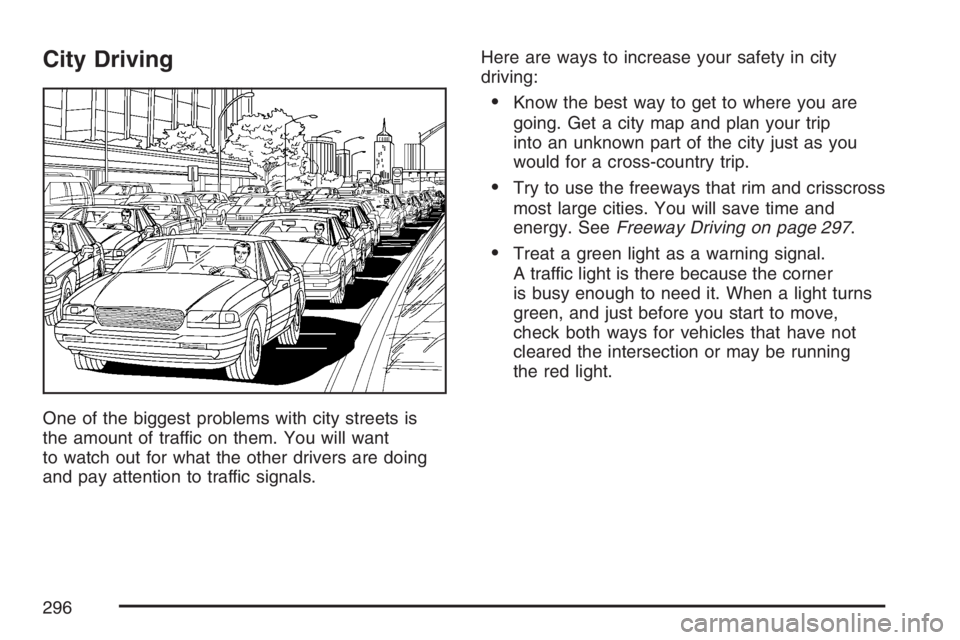
One of the biggest problems with city streets is
the amount of traffic on them. You will want
to watch out for what the other drivers are doing
and pay attention to traffic signals.Here are ways to increase your safety in city
driving:
Know the best way to get to where you are
going. Get a city map and plan your trip
into an unknown part of the city just as you
would for a cross-country trip.
Try to use the freeways that rim and crisscross
most large cities. You will save time and
energy. SeeFreeway Driving on page 297.
Treat a green light as a warning signal.
A traffic light is there because the corner
is busy enough to need it. When a light turns
green, and just before you start to move,
check both ways for vehicles that have not
cleared the intersection or may be running
the red light.
296
Page 302 of 496

Winter Driving
Here are some tips for winter driving:
Have your vehicle in good shape for winter.
You may want to put winter emergency
supplies in your trunk.
Also seeTires on page 385.Include an ice scraper, a small brush or broom, a
supply of windshield washer uid, a rag, some
winter outer clothing, a small shovel, a ashlight,
a red cloth, and a couple of reective warning
triangles. And, if you will be driving under severe
conditions, include a small bag of sand, a
piece of old carpet, or a couple of burlap bags
to help provide traction. Be sure you properly
secure these items in your vehicle.
302
Page 320 of 496
Backing Up
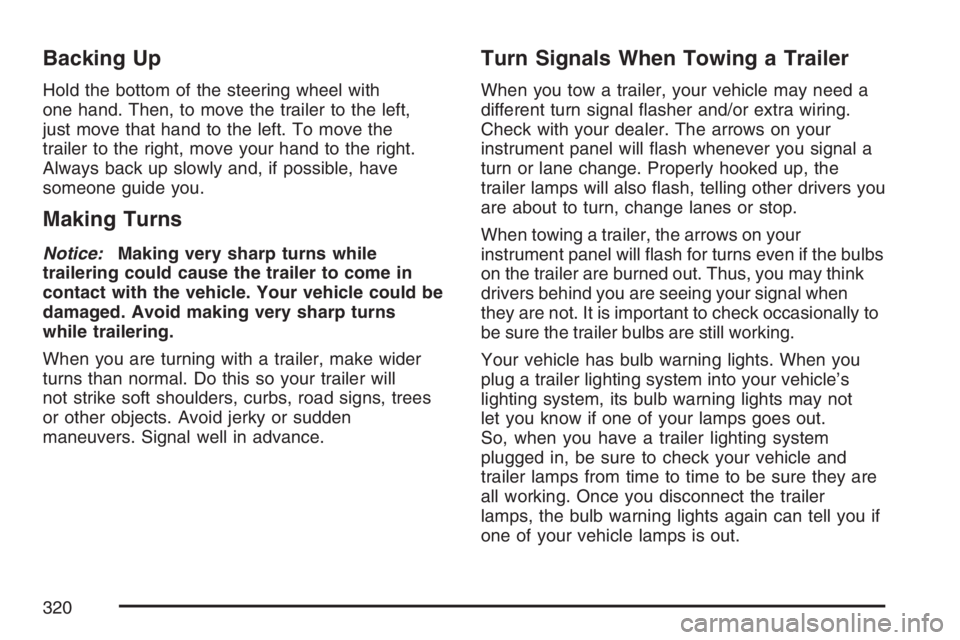
Hold the bottom of the steering wheel with
one hand. Then, to move the trailer to the left,
just move that hand to the left. To move the
trailer to the right, move your hand to the right.
Always back up slowly and, if possible, have
someone guide you.
Making Turns
Notice:Making very sharp turns while
trailering could cause the trailer to come in
contact with the vehicle. Your vehicle could be
damaged. Avoid making very sharp turns
while trailering.
When you are turning with a trailer, make wider
turns than normal. Do this so your trailer will
not strike soft shoulders, curbs, road signs, trees
or other objects. Avoid jerky or sudden
maneuvers. Signal well in advance.
Turn Signals When Towing a Trailer
When you tow a trailer, your vehicle may need a
different turn signal asher and/or extra wiring.
Check with your dealer. The arrows on your
instrument panel will ash whenever you signal a
turn or lane change. Properly hooked up, the
trailer lamps will also ash, telling other drivers you
are about to turn, change lanes or stop.
When towing a trailer, the arrows on your
instrument panel will ash for turns even if the bulbs
on the trailer are burned out. Thus, you may think
drivers behind you are seeing your signal when
they are not. It is important to check occasionally to
be sure the trailer bulbs are still working.
Your vehicle has bulb warning lights. When you
plug a trailer lighting system into your vehicle’s
lighting system, its bulb warning lights may not
let you know if one of your lamps goes out.
So, when you have a trailer lighting system
plugged in, be sure to check your vehicle and
trailer lamps from time to time to be sure they are
all working. Once you disconnect the trailer
lamps, the bulb warning lights again can tell you if
one of your vehicle lamps is out.
320
Page 347 of 496
Engine Coolant
The cooling system in your vehicle is lled with
DEX-COOL®engine coolant. This coolant is
designed to remain in your vehicle for ve years or
150,000 miles (240 000 km), whichever occurs
rst, if you add only DEX-COOL
®extended
life coolant.
The following explains your cooling system and
how to add coolant when it is low. If you have
a problem with engine overheating, seeEngine
Overheating on page 351.A 50/50 mixture of clean, drinkable water and
DEX-COOL
®coolant will:
Give freezing protection down to
−34°F (−37°C).
Give boiling protection up to 265°F (129°C).
Protect against rust and corrosion.
Help keep the proper engine temperature.
Let the warning lights and gages work as
they should.
Notice:Using coolant other than DEX-COOL
®
may cause premature engine, heater core,
or radiator corrosion. In addition, the engine
coolant may require changing sooner, at
the rst maintenance service after each
30,000 miles (50 000 km) or 24 months,
whichever occurs rst. Any repairs would not
be covered by your warranty. Always use
DEX-COOL
®(silicate-free) coolant in your
vehicle.
347
Page 351 of 496
Adding Coolant
If you need more coolant, add the proper
DEX-COOL®coolant mixture at the coolant surge
tank, but only when the engine is cool.
{CAUTION:
You can be burned if you spill coolant on
hot engine parts. Coolant contains
ethylene glycol, and it will burn if the
engine parts are hot enough. Do not spill
coolant on a hot engine.
Occasionally check the coolant level in the
radiator. For information on how to add coolant to
the radiator, see Index. When replacing the
pressure cap, make sure to turn cap until it clicks.
Radiator Pressure Cap
Notice:The radiator cap on your vehicle is a
pressure-type cap and must be tightly
installed to prevent coolant loss and possible
engine damage from overheating. Be sure
the arrows on the cap line up with the overow
tube on the radiator ller neck.
SeeEngine Compartment Overview on page 334
for more information on location.
Engine Overheating
You will nd a warning light about a hot engine as
well as an engine coolant temperature gage on
your vehicle’s instrument panel cluster.
351
Page 367 of 496
Brakes
Brake Fluid
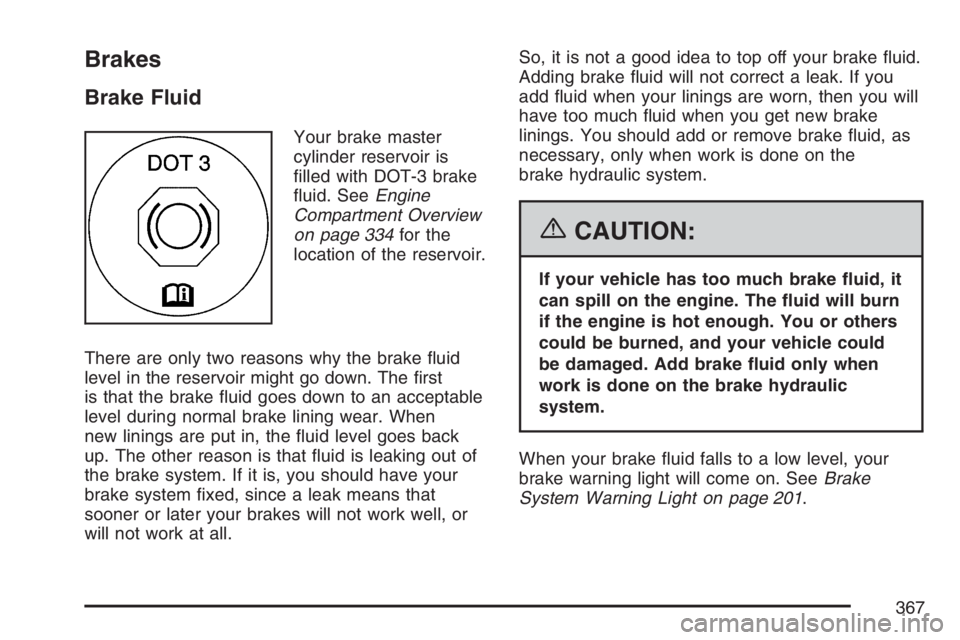
Your brake master
cylinder reservoir is
lled with DOT-3 brake
uid. SeeEngine
Compartment Overview
on page 334for the
location of the reservoir.
There are only two reasons why the brake uid
level in the reservoir might go down. The rst
is that the brake uid goes down to an acceptable
level during normal brake lining wear. When
new linings are put in, the uid level goes back
up. The other reason is that uid is leaking out of
the brake system. If it is, you should have your
brake system xed, since a leak means that
sooner or later your brakes will not work well, or
will not work at all.So, it is not a good idea to top off your brake uid.
Adding brake uid will not correct a leak. If you
add uid when your linings are worn, then you will
have too much uid when you get new brake
linings. You should add or remove brake uid, as
necessary, only when work is done on the
brake hydraulic system.
{CAUTION:
If your vehicle has too much brake uid, it
can spill on the engine. The uid will burn
if the engine is hot enough. You or others
could be burned, and your vehicle could
be damaged. Add brake uid only when
work is done on the brake hydraulic
system.
When your brake uid falls to a low level, your
brake warning light will come on. SeeBrake
System Warning Light on page 201.
367
Page 369 of 496
Brake Wear
Your vehicle has four-wheel disc brakes.
Disc brake pads have built-in wear indicators that
make a high-pitched warning sound when the
brake pads are worn and new pads are needed.
The sound may come and go or be heard all
the time your vehicle is moving, except when you
are pushing on the brake pedal rmly.
{CAUTION:
The brake wear warning sound means that
soon the brakes will not work well. That
could lead to an accident. When you hear
the brake wear warning sound, have your
vehicle serviced.Notice:Continuing to drive with worn-out
brake pads could result in costly brake repair.
Some driving conditions or climates may cause
a brake squeal when the brakes are rst applied or
lightly applied. This does not mean something is
wrong with your brakes.
Properly torqued wheel nuts are necessary to help
prevent brake pulsation. When tires are rotated,
inspect brake pads for wear and evenly tighten
wheel nuts in the proper sequence to GM torque
specications.
Brake linings should always be replaced as
complete axle sets.
Brake Pedal Travel
See your dealer if the brake pedal does not return
to normal height, or if there is a rapid increase in
pedal travel. This could be a sign of brake trouble.
Brake Adjustment
Every time you apply the brakes, with or without
the vehicle moving, your brakes adjust for wear.
369
Page 394 of 496

The TPMS is designed to alert the driver, if a low
tire pressure condition exists. If your vehicle
has the Driver Information Center (DIC), the driver
may also check tire pressure levels using the
DIC buttons located on the instrument panel.
When a low tire pressure condition is detected,
the TPMS will illuminate the low tire pressure
warning symbol, located on the instrument panel
cluster, and at the same time a message to check
the pressure in a specic tire will also appear on
the DIC display. The low tire pressure warning
symbol on the instrument panel cluster and
the CHECK TIRE PRESSURE warning message
on the DIC display will appear at each ignition
cycle until the tires are inated to the correct
ination pressure. For additional information and
details about the DIC operation and displays
seeDIC Controls and Displays on page 212and
DIC Warnings and Messages on page 221.
You may notice, during cooler weather conditions,
that the tire pressure monitor light, located on
the instrument panel cluster, and the CHECK TIRE
PRESSURE message will appear when the
vehicle is rst started and the turn off as you startto drive the vehicle. This could be an early
indicator that the tire pressures are getting low
and need to be inated to the proper pressure.
Each tire, including the spare (if provided), should
be checked monthly when cold and inated to
the ination pressure recommended by the vehicle
manufacturer on the vehicle placard or tire
ination pressure label. (If your vehicle has tires of
a different size than the size indicated on the
vehicle placard or tire ination pressure label, you
should determine the proper tire ination
pressure for those tires.)
As an added safety
feature, your vehicle
has been equipped with
a tire pressure
monitoring system
(TPMS) that illuminates
a low tire pressure
telltale when one
or more of your tires is
signicantly
under-inated.
394