service BUICK LUCERNE 2007 Manual PDF
[x] Cancel search | Manufacturer: BUICK, Model Year: 2007, Model line: LUCERNE, Model: BUICK LUCERNE 2007Pages: 496, PDF Size: 2.77 MB
Page 361 of 496
If the coolant inside the coolant surge tank is
boiling, do not do anything else until it cools down.
The vehicle should be parked on a level surface.
{CAUTION:
Heater and radiator hoses, and other
engine parts, can be very hot. Do not
touch them. If you do, you can be burned.
Do not run the engine if there is a leak. If
you run the engine, it could lose all
coolant. That could cause an engine re,
and you could be burned. Get any leak
xed before you drive the vehicle.
If there seems to be no leak, with the engine on,
check to see if the electric engine cooling fans
are running. If the engine is overheating, both fans
should be running. If they are not, your vehicle
needs service.
Notice:Engine damage from running your
engine without coolant is not covered by your
warranty. SeeOverheated Engine Protection
Operating Mode on page 353for information on
driving to a safe place in an emergency.Notice:Using coolant other than DEX-COOL
®
may cause premature engine, heater core,
or radiator corrosion. In addition, the engine
coolant could require changing sooner, at
30,000 miles (50 000 km) or 24 months,
whichever occurs rst. Any repairs would not
be covered by your warranty. Always use
DEX-COOL
®(silicate-free) coolant in your
vehicle.
How to Add Coolant to the Coolant
Surge Tank
If you have not found a problem yet, check to see
if coolant is visible in the surge tank. If coolant
is visible but the level is not at the FULL COLD
mark located on the side of the surge tank,
add enough of a 50/50 mixture of clean, drinkable
water and DEX-COOL
®coolant at the coolant
surge tank to bring the level to the FULL COLD
mark, but be sure the cooling system, including the
coolant surge tank pressure cap (if equipped), is
cool before you do it. SeeEngine Coolant on
page 347for more information.
361
Page 369 of 496
Brake Wear
Your vehicle has four-wheel disc brakes.
Disc brake pads have built-in wear indicators that
make a high-pitched warning sound when the
brake pads are worn and new pads are needed.
The sound may come and go or be heard all
the time your vehicle is moving, except when you
are pushing on the brake pedal rmly.
{CAUTION:
The brake wear warning sound means that
soon the brakes will not work well. That
could lead to an accident. When you hear
the brake wear warning sound, have your
vehicle serviced.Notice:Continuing to drive with worn-out
brake pads could result in costly brake repair.
Some driving conditions or climates may cause
a brake squeal when the brakes are rst applied or
lightly applied. This does not mean something is
wrong with your brakes.
Properly torqued wheel nuts are necessary to help
prevent brake pulsation. When tires are rotated,
inspect brake pads for wear and evenly tighten
wheel nuts in the proper sequence to GM torque
specications.
Brake linings should always be replaced as
complete axle sets.
Brake Pedal Travel
See your dealer if the brake pedal does not return
to normal height, or if there is a rapid increase in
pedal travel. This could be a sign of brake trouble.
Brake Adjustment
Every time you apply the brakes, with or without
the vehicle moving, your brakes adjust for wear.
369
Page 376 of 496

8. Now connect the black negative (−) cable to
the negative (−) terminal of the good battery.
Use a remote negative (−) terminal if the
vehicle has one.
Do not let the other end touch anything until
the next step. The other end of the
negative (−) cabledoes notgo to the dead
battery. It goes to a heavy, unpainted
metal engine part or to a remote negative (−)
terminal on the vehicle with the dead
battery.
9. Connect the other end of the negative (−) cable
at least 18 inches (45 cm) away from the dead
battery, but not near engine parts that move.
The electrical connection is just as good there,
and the chance of sparks getting back to the
battery is much less.
10. Now start the vehicle with the good battery
and run the engine for a while.
11. Try to start the vehicle that had the dead
battery. If it will not start after a few tries, it
probably needs service.Notice:If the jumper cables are connected or
removed in the wrong order, electrical shorting
may occur and damage the vehicle. The repairs
would not be covered by your warranty. Always
connect and remove the jumper cables in the
correct order, making sure that the cables do
not touch each other or other metal.
A. Dead Battery or Remote Positive (+) Terminal
B. Good Battery or Remote Positive (+) and
Remote Negative (−) Terminals
C. Heavy, Unpainted Metal Engine Part or
Remote Negative (−) Terminal
Jumper Cable Removal
376
Page 377 of 496
To disconnect the jumper cables from both
vehicles, do the following:
1. Disconnect the black negative (−) cable from
the vehicle that had the dead battery.
2. Disconnect the black negative (−) cable from
the vehicle with the good battery.
3. Disconnect the red positive (+) cable from the
vehicle with the good battery.
4. Disconnect the red positive (+) cable from the
other vehicle.
5. Return the positive (+) remote terminal cover
to its original position.
Headlamp Aiming
The vehicle has a visual optical headlamp aiming
system. The aim of the headlamps have been
preset at the factory and should need no further
adjustment.
However, if the vehicle is damaged in an accident,
the aim of the headlamps may be affected and
adjustment may be necessary.
If oncoming vehicles ash their high beams at
you, this may mean the vertical aim of your
headlamps needs to be adjusted.It is recommended that the vehicle is taken to your
dealer for service if the headlamps need to be
adjusted. It is possible however, to re-aim the
headlamps as described in the following procedure.
The vehicle should be properly prepared as
follows:
The vehicle should be placed so the
headlamps are 25 ft. (7.6 m) from a light
colored wall.
The vehicle must have all four tires on a level
surface which is level all the way to the wall.
The vehicle should be placed so it is
perpendicular to the wall.
The vehicle should not have any snow, ice or
mud on it.
The vehicle should be fully assembled and all
other work stopped while headlamp aiming is
being performed.
The vehicle should be normally loaded with a
full tank of fuel and one person or 160 lbs
(75 kg) sitting on the driver’s seat.
Tires should be properly inated.
The spare tire is in its proper location in the
vehicle.
377
Page 385 of 496

Tires
Your new vehicle comes with high-quality tires
made by a leading tire manufacturer. If you ever
have questions about your tire warranty and where
to obtain service, see your GM Warranty booklet for
details. For additional information refer to the tire
manufacturer’s booklet included with your vehicle.
{CAUTION:
Poorly maintained and improperly used
tires are dangerous.
Overloading your vehicle’s tires can
cause overheating as a result of too
much friction. You could have an
air-out and a serious accident. See
Loading Your Vehicle on page 307.
CAUTION: (Continued)
CAUTION: (Continued)
Underinated tires pose the same
danger as overloaded tires. The
resulting accident could cause serious
injury. Check all tires frequently to
maintain the recommended pressure.
Tire pressure should be checked when
your vehicle’s tires are cold. See
Inflation - Tire Pressure on page 392.
Overinated tires are more likely to be
cut, punctured, or broken by a sudden
impact — such as when you hit a
pothole. Keep tires at the
recommended pressure.
Worn, old tires can cause accidents. If
the tire’s tread is badly worn, or if
your vehicle’s tires have been
damaged, replace them.
385
Page 386 of 496
Tire Sidewall Labeling
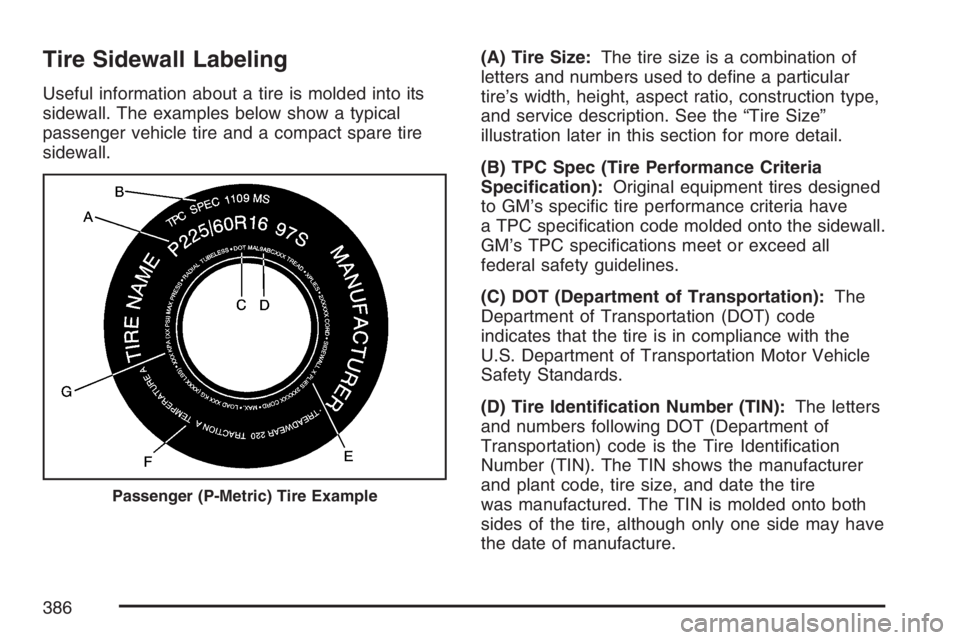
Useful information about a tire is molded into its
sidewall. The examples below show a typical
passenger vehicle tire and a compact spare tire
sidewall.(A) Tire Size:The tire size is a combination of
letters and numbers used to dene a particular
tire’s width, height, aspect ratio, construction type,
and service description. See the “Tire Size”
illustration later in this section for more detail.
(B) TPC Spec (Tire Performance Criteria
Specication):Original equipment tires designed
to GM’s specic tire performance criteria have
a TPC specication code molded onto the sidewall.
GM’s TPC specications meet or exceed all
federal safety guidelines.
(C) DOT (Department of Transportation):The
Department of Transportation (DOT) code
indicates that the tire is in compliance with the
U.S. Department of Transportation Motor Vehicle
Safety Standards.
(D) Tire Identication Number (TIN):The letters
and numbers following DOT (Department of
Transportation) code is the Tire Identication
Number (TIN). The TIN shows the manufacturer
and plant code, tire size, and date the tire
was manufactured. The TIN is molded onto both
sides of the tire, although only one side may have
the date of manufacture.
Passenger (P-Metric) Tire Example
386
Page 388 of 496
(B) Tire Ply Material:The type of cord and
number of plies in the sidewall and under the
tread.
(C) Tire Identication Number (TIN):The letters
and numbers following the DOT (Department of
Transportation) code is the Tire Identication
Number (TIN). The TIN shows the manufacturer
and plant code, tire size, and date the tire
was manufactured. The TIN is molded onto both
sides of the tire, although only one side may have
the date of manufacture.
(D) Maximum Cold Ination Load Limit:
Maximum load that can be carried and the
maximum pressure needed to support that load.
(E) Tire Ination:The temporary use tire or
compact spare tire should be inated to 60 psi
(420 kPa). For more information on tire pressure
and ination seeInation - Tire Pressure on
page 392.
(F) Tire Size:A combination of letters and
numbers dene a tire’s width, height, aspect ratio,
construction type, and service description. The
letter T as the rst character in the tire size means
the tire is for temporary use only.(G) TPC Spec (Tire Performance Criteria
Specication):Original equipment tires designed
to GM’s specic tire performance criteria have
a TPC specication code molded onto the sidewall.
GM’s TPC specications meet or exceed all
federal safety guidelines.
Tire Size
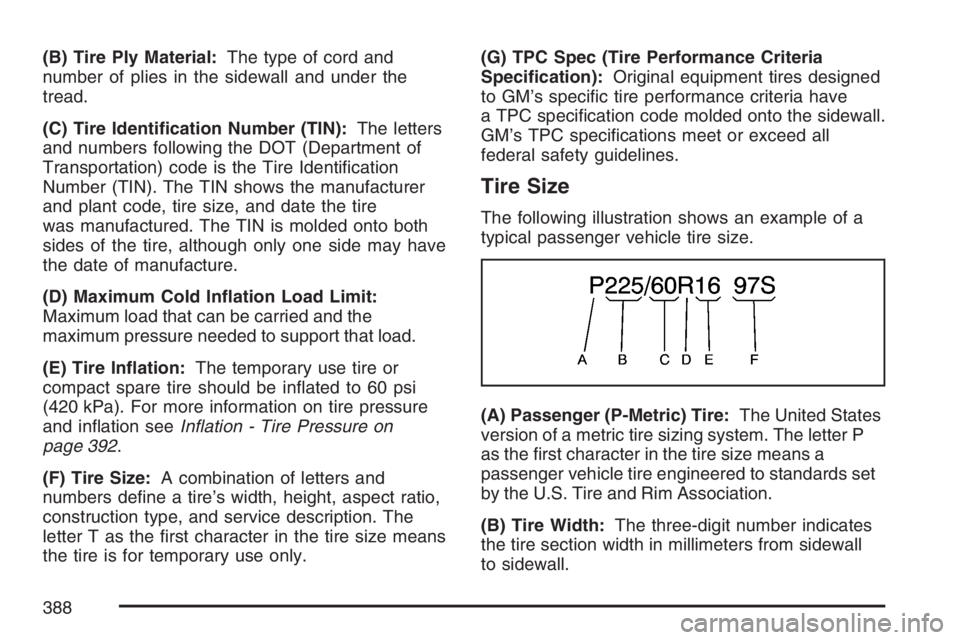
The following illustration shows an example of a
typical passenger vehicle tire size.
(A) Passenger (P-Metric) Tire:The United States
version of a metric tire sizing system. The letter P
as the rst character in the tire size means a
passenger vehicle tire engineered to standards set
by the U.S. Tire and Rim Association.
(B) Tire Width:The three-digit number indicates
the tire section width in millimeters from sidewall
to sidewall.
388
Page 389 of 496
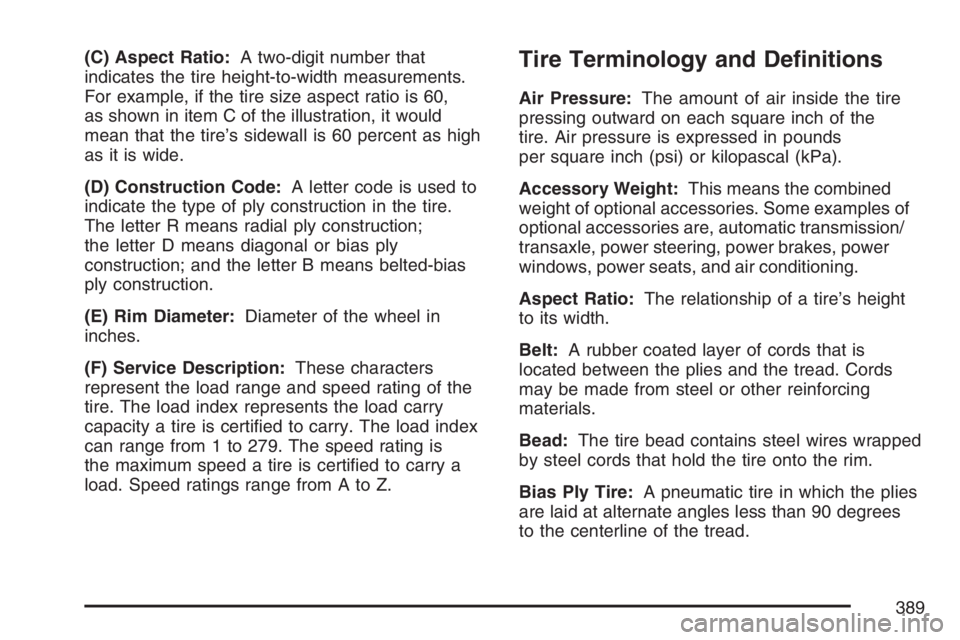
(C) Aspect Ratio:A two-digit number that
indicates the tire height-to-width measurements.
For example, if the tire size aspect ratio is 60,
as shown in item C of the illustration, it would
mean that the tire’s sidewall is 60 percent as high
as it is wide.
(D) Construction Code:A letter code is used to
indicate the type of ply construction in the tire.
The letter R means radial ply construction;
the letter D means diagonal or bias ply
construction; and the letter B means belted-bias
ply construction.
(E) Rim Diameter:Diameter of the wheel in
inches.
(F) Service Description:These characters
represent the load range and speed rating of the
tire. The load index represents the load carry
capacity a tire is certied to carry. The load index
can range from 1 to 279. The speed rating is
the maximum speed a tire is certied to carry a
load. Speed ratings range from A to Z.Tire Terminology and Denitions
Air Pressure:The amount of air inside the tire
pressing outward on each square inch of the
tire. Air pressure is expressed in pounds
per square inch (psi) or kilopascal (kPa).
Accessory Weight:This means the combined
weight of optional accessories. Some examples of
optional accessories are, automatic transmission/
transaxle, power steering, power brakes, power
windows, power seats, and air conditioning.
Aspect Ratio:The relationship of a tire’s height
to its width.
Belt:A rubber coated layer of cords that is
located between the plies and the tread. Cords
may be made from steel or other reinforcing
materials.
Bead:The tire bead contains steel wires wrapped
by steel cords that hold the tire onto the rim.
Bias Ply Tire:A pneumatic tire in which the plies
are laid at alternate angles less than 90 degrees
to the centerline of the tread.
389
Page 396 of 496

Your vehicle’s TPMS system can warn you about a
low tire pressure condition but it does not replace
normal tire maintenance. SeeTire Inspection and
Rotation on page 398andTires on page 385.
Notice:Do not use a tire sealant if your
vehicle has Tire Pressure Monitors. The liquid
sealant can damage the tire pressure monitor
sensors.
The TPMS will not function properly if one or more
of the TPMS sensors are missing or inoperable.
If the system detects a missing or inoperable
sensor, an error message SERVICE TIRE
MONITOR SYSTEM will be shown on the DIC
display. If you have replaced a tire/wheel assembly
without transferring the TPMS sensors, the error
message will be displayed. Once you re-install the
TPMS sensors, the error message should go
off. See your GM dealer for service if all TPMS
sensors are installed and the error message
comes on and stays on.Resetting the TPMS Sensor
Identication Codes
Each TPMS sensor has a unique identication
code. Any time you replace one or more of
the TPMS sensors or rotate the vehicle’s tires, the
identication codes will need to be matched to
the new tire/wheel position. The sensors are
matched, to the tire/wheel positions, in the
following order: driver’s side front tire, passenger’s
side front tire, passenger’s side rear tire, and
driver’s side rear tire using a TPMS diagnostic tool.
See your GM dealer for service.
The TPMS sensors may also be matched to each
tire/wheel position by increasing or decreasing
the tire’s air pressure. When increasing the tire’s
pressure, do not exceed the maximum ination
pressure indicated on the tire’s sidewall.
You will have two minutes to match each tire and
wheel position. If it takes longer than two minutes to
match any tire and wheel position, or more than
ve minutes to match all four tire and wheel
positions the matching process stops and you will
need to start over.
396
Page 397 of 496

The TPMS matching process is outlined below:
1. Set the parking brake.
2. Turn the ignition switch to RUN with the
engine off.
3. Using the DIC, press the vehicle information
button until the LEARN TIRE POSITIONS
message displays.
4. Press the set/reset button to allow the system
to learn the tire positions. The horn will sound
twice to indicate the receiver is ready, and
the TIRE LEARNING ACTIVE message
will display. The TPMS system is ready for
the sensor matching process to begin.
5. Start with the driver’s side front tire.
6. Remove the valve cap from the tire’s valve
stem. Activate the TPMS sensor by increasing
or decreasing the tire’s air pressure for
ve seconds, or until a horn chirp sounds.
The horn chirp, which may take up to
30 seconds to sound, conrms that the
sensor identication code has been matched
to the tire/wheel position. To decrease the
tire’s air-pressure use the pointed end of the
valve cap, a pencil-style air pressure gage,
or a key.7. Proceed to the passenger’s side front tire, and
repeat the procedure in Step 6.
8. Proceed to the passenger’s side rear tire, and
repeat the procedure in Step 6.
9. Proceed to the driver’s side rear tire, and
repeat the procedure in Step 6.
10. After hearing the conrming horn chirp for the
driver’s side rear tire, the tire learning process
ends. Turn the ignition switch to OFF.
11. Set all four tires to the recommended air
pressure level as indicated on the tire and
loading information label.
12. Put the valve caps back on the valve stems.
The compact spare tire and wheel assembly
does not have a TPMS sensor. If you replace
one of the road tires with the compact spare tire,
the SERVICE TIRE MONITOR SYSTEM
message will be displayed on the DIC display
screen. This message should go off once
you re-install the road tire containing the
TPMS sensor.
397