radiator cap BUICK LUCERNE 2008 User Guide
[x] Cancel search | Manufacturer: BUICK, Model Year: 2008, Model line: LUCERNE, Model: BUICK LUCERNE 2008Pages: 434
Page 304 of 434

Cooling System (4.6L V8 Engine)
When you decide it is safe to lift the hood, here is what
you will see:
A. Coolant Surge Tank with Pressure Cap
B. Electric Engine Cooling Fans{CAUTION:
An electric engine cooling fan under the hood
can start up even when the engine is not
running and can injure you. Keep hands,
clothing, and tools away from any underhood
electric fan.
If the coolant inside the coolant surge tank is boiling, do
not do anything else until it cools down. The vehicle
should be parked on a level surface.
{CAUTION:
Heater and radiator hoses, and other engine
parts, can be very hot. Do not touch them. If
you do, you can be burned.
Do not run the engine if there is a leak. If you
run the engine, it could lose all coolant. That
could cause an engine re, and you could be
burned. Get any leak xed before you drive the
vehicle.
5-36
Page 305 of 434

If there seems to be no leak, with the engine on, check
to see if the electric engine cooling fans are running.
If the engine is overheating, both fans should be
running. If they are not, your vehicle needs service.
Notice:Engine damage from running your engine
without coolant is not covered by your warranty. See
Overheated Engine Protection Operating Mode on
page 5-30for information on driving to a safe place
in an emergency.
Notice:Using coolant other than DEX-COOL
®may
cause premature engine, heater core, or radiator
corrosion. In addition, the engine coolant could
require changing sooner, at 30,000 miles (50 000 km)
or 24 months, whichever occurs rst. Any repairs
would not be covered by the warranty. Always
use DEX-COOL
®(silicate-free) coolant in the vehicle.
How to Add Coolant to the Coolant
Surge Tank
If you have not found a problem yet, check to see if
coolant is visible in the surge tank. If coolant is visible
but the level is not at the FULL COLD mark located
on the side of the surge tank, add enough of a 50/50
mixture of clean, drinkable water and DEX-COOL
®
coolant at the coolant surge tank to bring the level to
the FULL COLD mark, but be sure the cooling system,
including the coolant surge tank pressure cap (if
equipped), is cool before you do it. SeeEngine Coolant
on page 5-24for more information.
5-37
Page 306 of 434

If no coolant is visible in the surge tank, add coolant as
follows:
{CAUTION:
Steam and scalding liquids from a hot cooling
system can blow out and burn you badly. They
are under pressure, and if you turn the coolant
surge tank pressure cap — even a little — they
can come out at high speed. Never turn the
cap when the cooling system, including the
coolant surge tank pressure cap, is hot. Wait
for the cooling system and coolant surge tank
pressure cap to cool if you ever have to turn
the pressure cap.
{CAUTION:
Adding only plain water to the cooling system
can be dangerous. Plain water, or some other
liquid such as alcohol, can boil before the
proper coolant mixture will. The vehicle’s
coolant warning system is set for the proper
coolant mixture. With plain water or the wrong
mixture, the engine could get too hot but you
would not get the overheat warning. The
engine could catch re and you or others
could be burned. Use a 50/50 mixture of clean,
drinkable water and DEX-COOL
®coolant.
Notice:In cold weather, water can freeze and crack
the engine, radiator, heater core and other parts.
Use the recommended coolant and the proper
coolant mixture.
5-38
Page 307 of 434

{CAUTION:
You can be burned if you spill coolant on hot
engine parts. Coolant contains ethylene glycol
and it will burn if the engine parts are hot
enough. Do not spill coolant on a hot engine.
You can remove the
coolant surge tank
pressure cap when the
cooling system, including
the coolant surge tank
pressure cap and upper
radiator hose, is no
longer hot.
1. Turn the pressure cap slowly counterclockwise. If
you hear a hiss, wait for that to stop. A hiss means
there is still some pressure left.
2. Then keep turning the cap and remove it.3. Fill the coolant surge
tank with the proper
mixture to the
FULL COLD mark on
the side of the
coolant surge tank.
4. With the coolant surge tank cap off, start the engine
and let it run until you can feel the upper radiator
hose getting hot. Watch out for the engine
cooling fans.
By this time, the coolant level inside the coolant
surge tank may be lower. If the level is lower, add
more of the proper mixture to the coolant surge tank
until the level reaches the FULL COLD mark on
the side of the coolant surge tank.
5. Then replace the cap. Be sure the cap is hand-tight
and fully seated.
5-39
Page 389 of 434
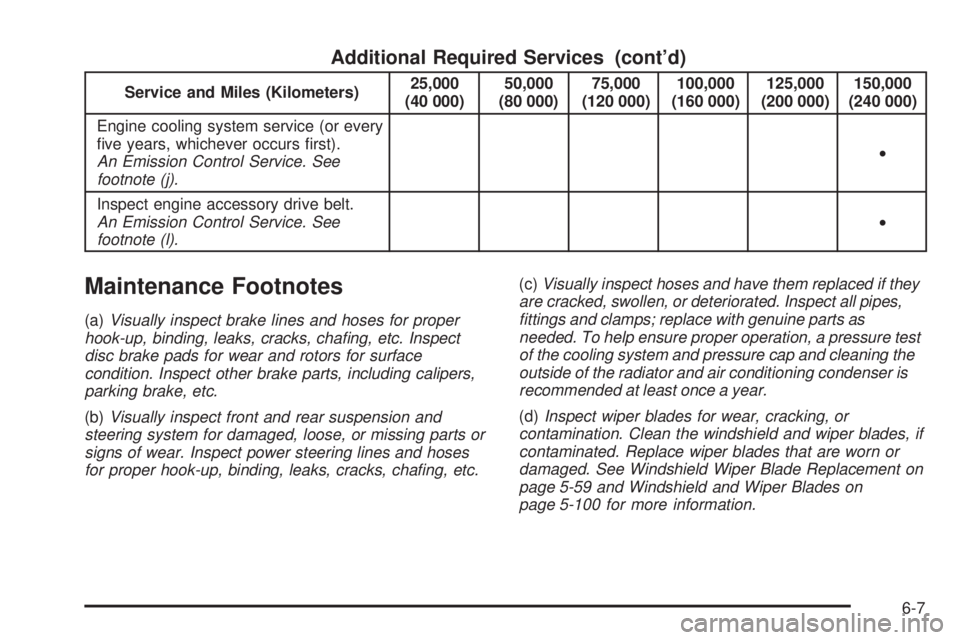
Additional Required Services (cont’d)
Service and Miles (Kilometers)25,000
(40 000)50,000
(80 000)75,000
(120 000)100,000
(160 000)125,000
(200 000)150,000
(240 000)
Engine cooling system service (or every
ve years, whichever occurs rst).
An Emission Control Service. See
footnote (j).•
Inspect engine accessory drive belt.
An Emission Control Service. See
footnote (l).•
Maintenance Footnotes
(a)Visually inspect brake lines and hoses for proper
hook-up, binding, leaks, cracks, chafing, etc. Inspect
disc brake pads for wear and rotors for surface
condition. Inspect other brake parts, including calipers,
parking brake, etc.
(b)Visually inspect front and rear suspension and
steering system for damaged, loose, or missing parts or
signs of wear. Inspect power steering lines and hoses
for proper hook-up, binding, leaks, cracks, chafing, etc.(c)Visually inspect hoses and have them replaced if they
are cracked, swollen, or deteriorated. Inspect all pipes,
fittings and clamps; replace with genuine parts as
needed. To help ensure proper operation, a pressure test
of the cooling system and pressure cap and cleaning the
outside of the radiator and air conditioning condenser is
recommended at least once a year.
(d)Inspect wiper blades for wear, cracking, or
contamination. Clean the windshield and wiper blades, if
contaminated. Replace wiper blades that are worn or
damaged. See Windshield Wiper Blade Replacement on
page 5-59 and Windshield and Wiper Blades on
page 5-100 for more information.
6-7
Page 390 of 434
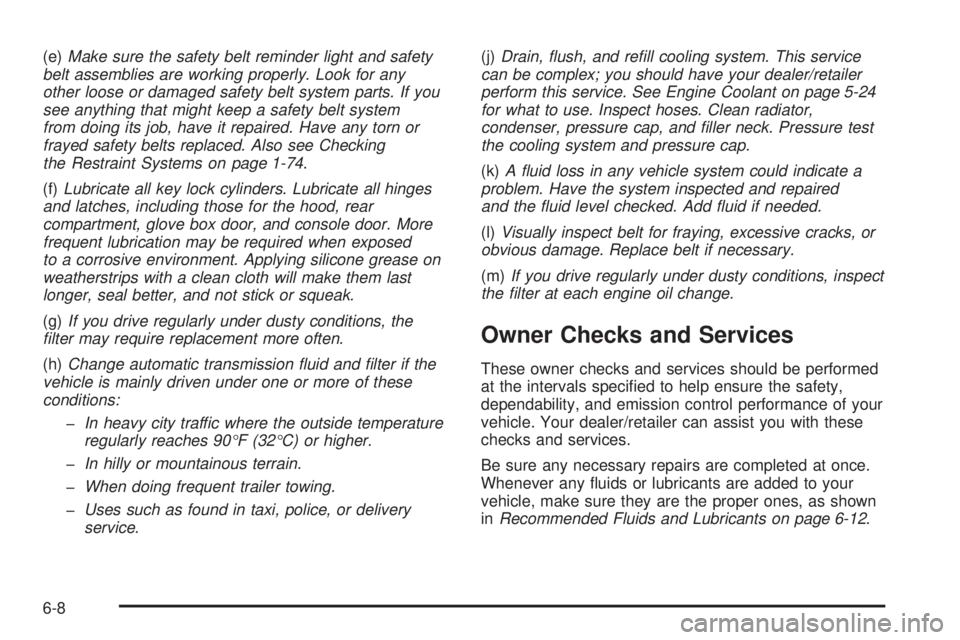
(e)Make sure the safety belt reminder light and safety
belt assemblies are working properly. Look for any
other loose or damaged safety belt system parts. If you
see anything that might keep a safety belt system
from doing its job, have it repaired. Have any torn or
frayed safety belts replaced. Also see Checking
the Restraint Systems on page 1-74.
(f)Lubricate all key lock cylinders. Lubricate all hinges
and latches, including those for the hood, rear
compartment, glove box door, and console door. More
frequent lubrication may be required when exposed
to a corrosive environment. Applying silicone grease on
weatherstrips with a clean cloth will make them last
longer, seal better, and not stick or squeak.
(g)If you drive regularly under dusty conditions, the
filter may require replacement more often.
(h)Change automatic transmission fluid and filter if the
vehicle is mainly driven under one or more of these
conditions:
In heavy city traffic where the outside temperature
regularly reaches 90°F (32°C) or higher.
In hilly or mountainous terrain.
When doing frequent trailer towing.
Uses such as found in taxi, police, or delivery
service.(j)Drain, flush, and refill cooling system. This service
can be complex; you should have your dealer/retailer
perform this service. See Engine Coolant on page 5-24
for what to use. Inspect hoses. Clean radiator,
condenser, pressure cap, and filler neck. Pressure test
the cooling system and pressure cap.
(k)A fluid loss in any vehicle system could indicate a
problem. Have the system inspected and repaired
and the fluid level checked. Add fluid if needed.
(l)Visually inspect belt for fraying, excessive cracks, or
obvious damage. Replace belt if necessary.
(m)If you drive regularly under dusty conditions, inspect
the filter at each engine oil change.
Owner Checks and Services
These owner checks and services should be performed
at the intervals specied to help ensure the safety,
dependability, and emission control performance of your
vehicle. Your dealer/retailer can assist you with these
checks and services.
Be sure any necessary repairs are completed at once.
Whenever any uids or lubricants are added to your
vehicle, make sure they are the proper ones, as shown
inRecommended Fluids and Lubricants on page 6-12.
6-8
Page 430 of 434

Power (cont.)
Seat............................................................ 1-3
Steering Fluid.............................................5-40
Tilt Wheel and Telescopic Steering Column....... 3-7
Windows....................................................2-16
Privacy..........................................................7-17
Event Data Recorders..................................7-18
Navigation System.......................................7-19
OnStar.......................................................7-19
Radio Frequency Identication.......................7-19
Programmable Automatic Door Locks.................2-11
R
Radiator Pressure Cap....................................5-28
Radio Frequency Identication (RFID), Privacy....7-19
Radios..........................................................3-75
Radio(s)........................................................3-78
Radios
Navigation/Radio System,
see Navigation Manual..............................3-94
Reception...................................................3-96
Setting the Time..........................................3-76
Theft-Deterrent............................................3-94
Rainsense™ II Wipers.....................................3-10
Rear Door Security Locks................................2-12
Rear Seat Armrest..........................................2-57
Rearview Mirror, Automatic Dimming with
Compass....................................................2-36Rearview Mirror, Automatic Dimming with
OnStar
®and Compass.................................2-34
Rearview Mirror with Compass and
Temperature...............................................1-11
Reclining Seatbacks.......................................... 1-7
Recommended Fluids and Lubricants.................6-12
Recreational Vehicle Towing.............................4-25
Remote Keyless Entry (RKE) System.................. 2-4
Remote Keyless Entry (RKE) System,
Operation..................................................... 2-5
Remote Vehicle Start........................................ 2-8
Removing the Flat Tire and Installing the
Spare Tire..................................................5-86
Removing the Spare Tire and Tools...................5-85
Replacement Bulbs.........................................5-59
Reporting Safety Defects
Canadian Government..................................7-15
General Motors...........................................7-16
United States Government............................7-15
Restraint System Check
Checking the Restraint Systems....................1-74
Replacing Restraint System Parts
After a Crash..........................................1-75
Retained Accessory Power (RAP)......................2-22
Roadside
Assistance Program....................................... 7-8
Rocking Your Vehicle to Get it Out....................4-19
Routing, Engine Drive Belt...............................6-14
Running the Engine While Parked.....................2-33
10