cooling BUICK LUCERNE 2010 User Guide
[x] Cancel search | Manufacturer: BUICK, Model Year: 2010, Model line: LUCERNE, Model: BUICK LUCERNE 2010Pages: 474
Page 330 of 474
What to Use
{WARNING:
Adding only plain water to the cooling system can
be dangerous. Plain water, or some other liquid
such as alcohol, can boil before the proper
coolant mixture will. The vehicle's coolant warning
system is set for the proper coolant mixture. With
plain water or the wrong mixture, the engine could
get too hot but you would not get the overheat
warning. The engine could catch fire and you or
others could be burned. Use a 50/50 mixture of
clean, drinkable water and DEX-COOL
®coolant.Use a 50/50 mixture of clean, drinkable water and
DEX-COOL
®coolant. If using this mixture, nothing else
needs to be added. This mixture:
.Gives freezing protection down to −34°F (−37°C),
outside temperature.
.Gives boiling protection up to 265°F (129°C),
engine temperature.
.Protects against rust and corrosion.
.Will not damage aluminum parts.
.Helps keep the proper engine temperature.
Notice: If an improper coolant mixture is used, the
engine could overheat and be badly damaged. The
repair cost would not be covered by the vehicle
warranty. Too much water in the mixture can freeze
and crack the engine, radiator, heater core, and
other parts.
Notice: If extra inhibitors and/or additives are used
in the vehicle's cooling system, the vehicle could be
damaged. Use only the proper mixture of the engine
coolant listed in this manual for the cooling system.
See Recommended Fluids and Lubricants
on
page 7‑9for more information.
6-28
Page 331 of 474
Checking Coolant
The vehicle must be on a level surface when checking
the coolant level.
Check to see if coolant is visible in the coolant recovery
tank. If the coolant inside the coolant recovery tank is
boiling, do not do anything else until it cools down.
If coolant is visible but the coolant level is not at or
above the FULL COLD mark, add a 50/50 mixture
of clean, drinkable water and DEX-COOL
®coolant at
the coolant recovery tank, but be sure the cooling
system is cool before this is done. See Engine
Coolant (4.6L Engine)
on page 6‑27or Engine
Coolant (3.9L Engine)on page 6‑31for more
information. If no coolant is visible in the surge tank, add coolant as
follows:
How to Add Coolant to the Surge Tank
{WARNING:
You can be burned if you spill coolant on hot
engine parts. Coolant contains ethylene glycol
and it will burn if the engine parts are hot enough.
Do not spill coolant on a hot engine.
Notice: This vehicle has a specific coolant fill
procedure. Failure to follow this procedure could
cause the engine to overheat and be severely
damaged.
{WARNING:
An electric engine cooling fan under the hood can
start up even when the engine is not running and
can cause injury. Keep hands, clothing, and tools
away from any underhood electric fan.
6-29
Page 332 of 474
{WARNING:
Steam and scalding liquids from a hot cooling
system can blow out and burn you badly. They are
under pressure, and if you turn the surge tank
pressure cap—even a little —they can come
out at high speed. Never turn the cap when the
cooling system, including the surge tank pressure
cap, is hot. Wait for the cooling system and surge
tank pressure cap to cool if you ever have to turn
the pressure cap.
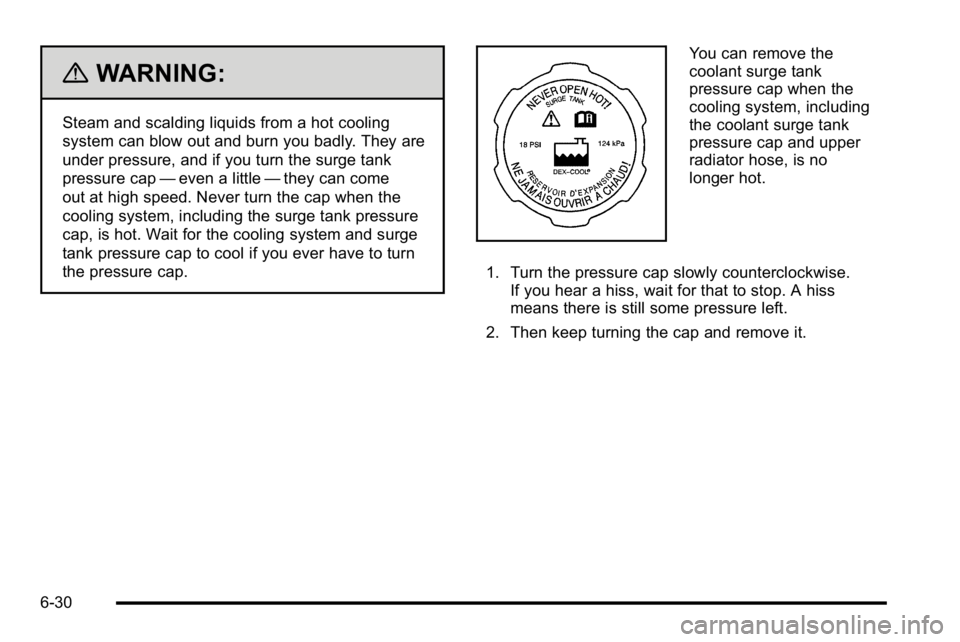
You can remove the
coolant surge tank
pressure cap when the
cooling system, including
the coolant surge tank
pressure cap and upper
radiator hose, is no
longer hot.
1. Turn the pressure cap slowly counterclockwise. If you hear a hiss, wait for that to stop. A hiss
means there is still some pressure left.
2. Then keep turning the cap and remove it.
6-30
Page 333 of 474
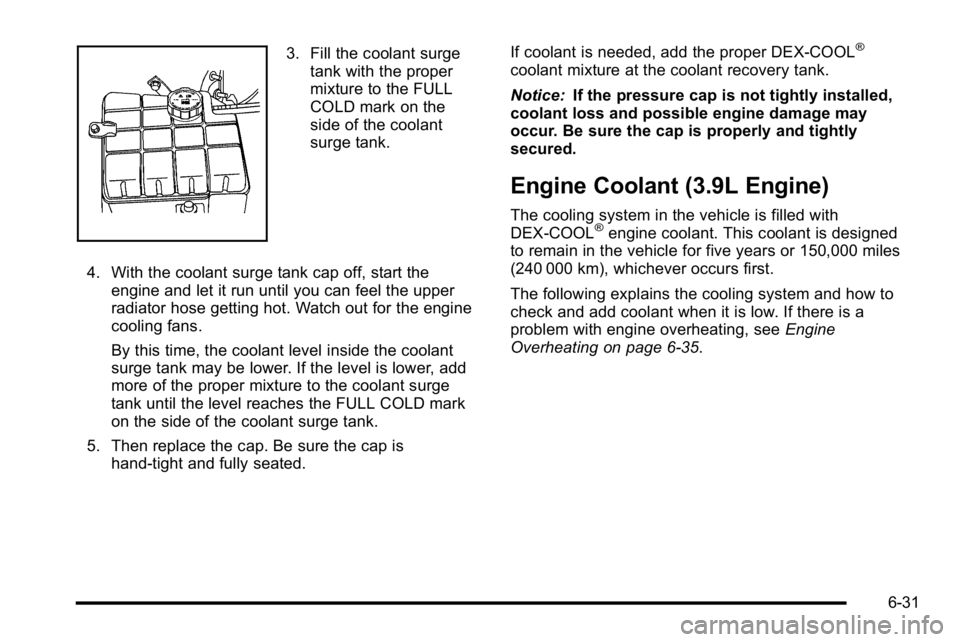
3. Fill the coolant surgetank with the proper
mixture to the FULL
COLD mark on the
side of the coolant
surge tank.
4. With the coolant surge tank cap off, start the engine and let it run until you can feel the upper
radiator hose getting hot. Watch out for the engine
cooling fans.
By this time, the coolant level inside the coolant
surge tank may be lower. If the level is lower, add
more of the proper mixture to the coolant surge
tank until the level reaches the FULL COLD mark
on the side of the coolant surge tank.
5. Then replace the cap. Be sure the cap is hand‐tight and fully seated. If coolant is needed, add the proper DEX-COOL®
coolant mixture at the coolant recovery tank.
Notice:
If the pressure cap is not tightly installed,
coolant loss and possible engine damage may
occur. Be sure the cap is properly and tightly
secured.
Engine Coolant (3.9L Engine)
The cooling system in the vehicle is filled with
DEX-COOL®engine coolant. This coolant is designed
to remain in the vehicle for five years or 150,000 miles
(240 000 km), whichever occurs first.
The following explains the cooling system and how to
check and add coolant when it is low. If there is a
problem with engine overheating, see Engine
Overheating on page 6‑35.
6-31
Page 334 of 474
What to Use
{WARNING:
Adding only plain water to the cooling system can
be dangerous. Plain water, or some other liquid
such as alcohol, can boil before the proper
coolant mixture will. The vehicle's coolant warning
system is set for the proper coolant mixture. With
plain water or the wrong mixture, the engine could
get too hot but you would not get the overheat
warning. The engine could catch fire and you or
others could be burned. Use a 50/50 mixture of
clean, drinkable water and DEX-COOL
®coolant.Use a 50/50 mixture of clean, drinkable water and
DEX-COOL coolant. If using this mixture, nothing else
needs to be added. This mixture:
.Gives freezing protection down to
−34°F (−37°C),
outside temperature.
.Gives boiling protection up to 265°F (129°C),
engine temperature.
.Protects against rust and corrosion.
.Will not damage aluminum parts.
.Helps keep the proper engine temperature.
Notice: If an improper coolant mixture is used, the
engine could overheat and be badly damaged. The
repair cost would not be covered by the vehicle
warranty. Too much water in the mixture can freeze
and crack the engine, radiator, heater core, and
other parts.
Notice: If extra inhibitors and/or additives are used
in the vehicle's cooling system, the vehicle could be
damaged. Use only the proper mixture of the engine
coolant listed in this manual for the cooling system.
See Recommended Fluids and Lubricants
on
page 7‑9for more information.
6-32
Page 335 of 474
Checking Coolant
The vehicle must be on a level surface when checking
the coolant level.
The coolant level should be at or above the FULL
COLD mark when the engine is cold. The coolant level
should be above the FULL COLD mark under normal
operating conditions. If it is not, you may have a leak in
the cooling system.
Check to see if coolant is visible in the coolant recovery
tank. If the coolant inside the coolant recovery tank is
boiling, do not do anything else until it cools down.
If coolant is visible but the coolant level is not at or
above the FULL COLD mark, add a 50/50 mixture of
clean, drinkable water and DEX-COOL coolant at the
coolant recovery tank, but be sure the cooling system is
cool before this is done. See Engine Coolant for more
information.
How to Add Coolant to the
Recovery Tank
{WARNING:
You can be burned if you spill coolant on hot
engine parts. Coolant contains ethylene glycol
and it will burn if the engine parts are hot enough.
Do not spill coolant on a hot engine.
Notice: This vehicle has a specific coolant fill
procedure. Failure to follow this procedure could
cause the engine to overheat and be severely
damaged.
If coolant is needed, add the proper DEX-COOL coolant
mixture at the coolant recovery tank.
6-33
Page 336 of 474
How to Add Coolant to the Radiator
{WARNING:
An electric engine cooling fan under the hood can
start up even when the engine is not running and
can cause injury. Keep hands, clothing, and tools
away from any underhood electric fan.
{WARNING:
Steam and scalding liquids from a hot cooling
system can blow out and burn you badly. They are
under pressure, and if you turn the surge tank
pressure cap—even a little —they can come
out at high speed. Never turn the cap when the
cooling system, including the surge tank pressure
cap, is hot. Wait for the cooling system and surge
tank pressure cap to cool if you ever have to turn
the pressure cap. If coolant is needed, add the proper mixture directly to
the radiator, but be sure the cooling system is cool
before this is done.
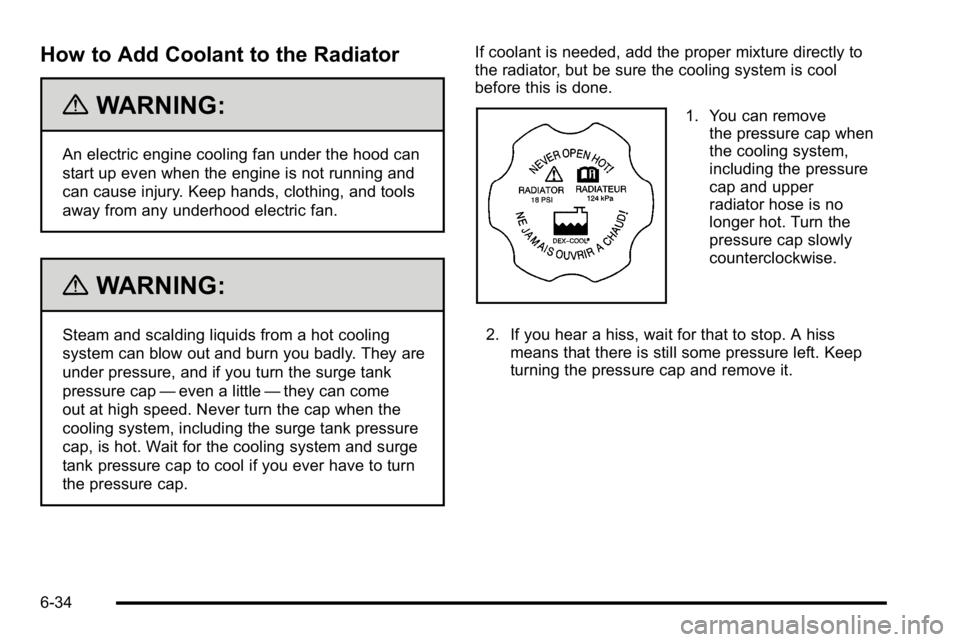
1. You can remove
the pressure cap when
the cooling system,
including the pressure
cap and upper
radiator hose is no
longer hot. Turn the
pressure cap slowly
counterclockwise.
2. If you hear a hiss, wait for that to stop. A hiss means that there is still some pressure left. Keep
turning the pressure cap and remove it.
6-34
Page 337 of 474
3. Fill the cooling system with the proper DEX-COOLcoolant mixture, up to the base of the filler neck.
See Engine Coolant (4.6L Engine)
on page 6‑27orEngine Coolant (3.9L Engine) on page 6‑31.
4. Then fill the coolant recovery tank to the COLD FILL line.
5. Install the coolant recovery tank cap and the pressure cap. After a day or two of driving, when
the engine is cold, check the coolant level in the
recovery tank. If it is low, refill it to the COLD
FILL line.
If the coolant in the recovery tank is constantly low, you
should have a dealer service department inspect the
vehicle for leaks.
Notice: If the pressure cap is not tightly installed,
coolant loss and possible engine damage may
occur. Be sure the cap is properly and tightly
secured.
Engine Overheating
The vehicle has several indicators to warn of engine
overheating.
You will find a warning light about a hot engine as
well as an engine coolant temperature gauge on the
instrument panel cluster.
You may decide not to lift the hood when this warning
appears, but instead get service help right away.
See Roadside Assistance Program on page 8‑8.
If you do decide to lift the hood , make sure the vehicle
is parked on a level surface.
Then check to see if the engine cooling fans are
running. If the engine is overheating, both fans should
be running. If they are not, do not continue to run the
engine and have the vehicle serviced.
Notice: Engine damage from running the engine
without coolant is not covered by the warranty.
Notice: If the engine catches fire while driving with
no coolant, the vehicle can be badly damaged. The
costly repairs would not be covered by the vehicle
warranty. See Overheated Engine Protection
Operating Mode
on page 6‑37for information on
driving to a safe place in an emergency.
6-35
Page 381 of 474

Your dealer will know the kind of wheel you need.
Each new wheel should have the same load-carrying
capacity, diameter, width, offset, and be mounted the
same way as the one it replaces.
If you need to replace any of your wheels, wheel bolts,
wheel nuts, or Tire Pressure Monitor System (TPMS)
sensors, replace them only with new GM original
equipment parts. This way, you will be sure to have the
right wheel, wheel bolts, wheel nuts, and TPMS sensors
for your vehicle.
{WARNING:
Using the wrong replacement wheels, wheel bolts,
or wheel nuts on your vehicle can be dangerous.
It could affect the braking and handling of your
vehicle, make your tires lose air and make you
lose control. You could have a collision in which
you or others could be injured. Always use the
correct wheel, wheel bolts, and wheel nuts for
replacement.Notice:
The wrong wheel can also cause problems
with bearing life, brake cooling, speedometer or
odometer calibration, headlamp aim, bumper height,
vehicle ground clearance, and tire or tire chain
clearance to the body and chassis.
See Changing a Flat Tire
on page 6‑90for more
information.
Used Replacement Wheels
{WARNING:
Putting a used wheel on the vehicle is dangerous.
You cannot know how it has been used or how far
it has been driven. It could fail suddenly and
cause a crash. If you have to replace a wheel, use
a new GM original equipment wheel.
6-79
Page 414 of 474
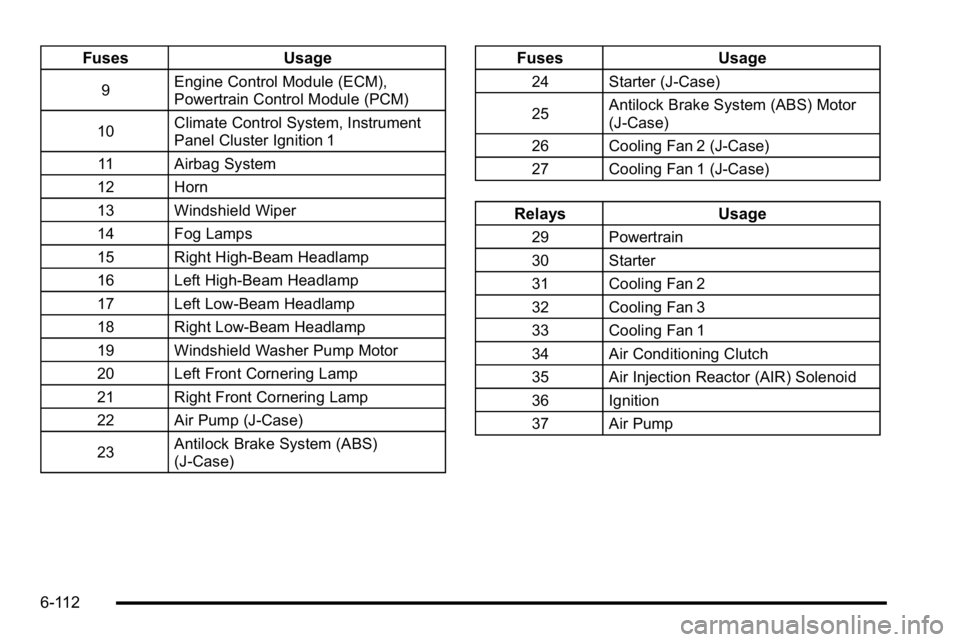
FusesUsage
9Engine Control Module (ECM),
Powertrain Control Module (PCM)
10 Climate Control System, Instrument
Panel Cluster Ignition 1
11 Airbag System
12 Horn
13 Windshield Wiper
14 Fog Lamps
15 Right High-Beam Headlamp
16 Left High-Beam Headlamp
17 Left Low-Beam Headlamp
18 Right Low-Beam Headlamp
19 Windshield Washer Pump Motor
20 Left Front Cornering Lamp
21 Right Front Cornering Lamp
22 Air Pump (J-Case)
23 Antilock Brake System (ABS)
(J-Case)
Fuses
Usage
24 Starter (J-Case)
25Antilock Brake System (ABS) Motor
(J-Case)
26 Cooling Fan 2 (J-Case)
27 Cooling Fan 1 (J-Case)
Relays Usage
29 Powertrain
30 Starter
31 Cooling Fan 2
32 Cooling Fan 3
33 Cooling Fan 1
34 Air Conditioning Clutch
35 Air Injection Reactor (AIR) Solenoid
36 Ignition
37 Air Pump
6-112