ECU BUICK LUCERNE 2010 Owner's Guide
[x] Cancel search | Manufacturer: BUICK, Model Year: 2010, Model line: LUCERNE, Model: BUICK LUCERNE 2010Pages: 474
Page 93 of 474
{WARNING:
If something is between an occupant and an
airbag, the airbag might not inflate properly or it
might force the object into that person causing
severe injury or even death. The path of an
inflating airbag must be kept clear. Do not put
anything between an occupant and an airbag, and
do not attach or put anything on the steering
wheel hub or on or near any other airbag
covering.
Do not use seat accessories that block the
inflation path of a seat-mounted side impact
airbag.
Never secure anything to the roof of a vehicle with
roof-rail airbags by routing a rope or tie down
through any door or window opening. If you do,
the path of an inflating roof-rail airbag will be
blocked.
When Should an Airbag Inflate?
Frontal airbags are designed to inflate in moderate to
severe frontal or near-frontal crashes to help reduce the
potential for severe injuries mainly to the driver's or right
front passenger's head and chest. However, they are
only designed to inflate if the impact exceeds a
predetermined deployment threshold. Deployment
thresholds are used to predict how severe a crash is
likely to be in time for the airbags to inflate and help
restrain the occupants.
Whether your frontal airbags will or should deploy is not
based on how fast your vehicle is traveling. It depends
largely on what you hit, the direction of the impact, and
how quickly your vehicle slows down.
2-61
Page 99 of 474
Passenger Sensing System
The vehicle has a passenger sensing system for the
right front passenger position. The passenger airbag
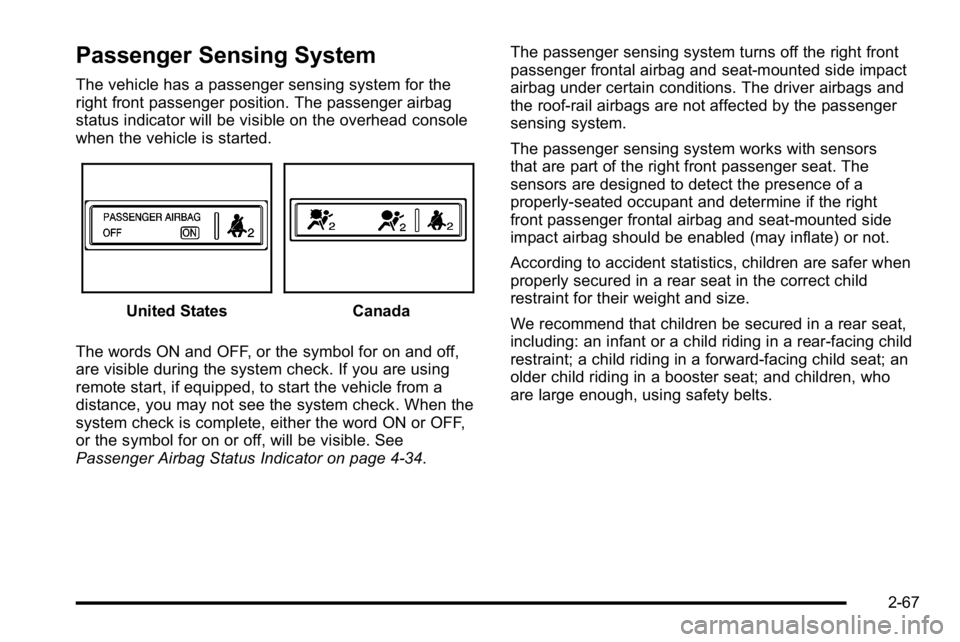
status indicator will be visible on the overhead console
when the vehicle is started.
United StatesCanada
The words ON and OFF, or the symbol for on and off,
are visible during the system check. If you are using
remote start, if equipped, to start the vehicle from a
distance, you may not see the system check. When the
system check is complete, either the word ON or OFF,
or the symbol for on or off, will be visible. See
Passenger Airbag Status Indicator on page 4‑34. The passenger sensing system turns off the right front
passenger frontal airbag and seat-mounted side impact
airbag under certain conditions. The driver airbags and
the roof-rail airbags are not affected by the passenger
sensing system.
The passenger sensing system works with sensors
that are part of the right front passenger seat. The
sensors are designed to detect the presence of a
properly-seated occupant and determine if the right
front passenger frontal airbag and seat‐mounted side
impact airbag should be enabled (may inflate) or not.
According to accident statistics, children are safer when
properly secured in a rear seat in the correct child
restraint for their weight and size.
We recommend that children be secured in a rear seat,
including: an infant or a child riding in a rear-facing child
restraint; a child riding in a forward-facing child seat; an
older child riding in a booster seat; and children, who
are large enough, using safety belts.
2-67
Page 100 of 474
A label on the sun visor says,“Never put a rear-facing
child seat in the front.” This is because the risk to the
rear-facing child is so great, if the airbag deploys.
{WARNING:
A child in a rear-facing child restraint can be
seriously injured or killed if the right front
passenger airbag inflates. This is because the
back of the rear-facing child restraint would be
very close to the inflating airbag. A child in a
forward-facing child restraint can be seriously
injured or killed if the right front passenger airbag
inflates and the passenger seat is in a forward
position.
(Continued)
WARNING: (Continued)
Even if the passenger sensing system has turned
off the right front passenger frontal airbag and
seat-mounted side impact airbag (if equipped), no
system is fail-safe. No one can guarantee that an
airbag will not deploy under some unusual
circumstance, even though the airbag(s) are off.
Secure rear-facing child restraints in a rear seat,
even if the airbag(s) are off. If you secure a
forward-facing child restraint in the right front seat,
always move the front passenger seat as far back
as it will go. It is better to secure the child restraint
in a rear seat.
2-68
Page 102 of 474
If the On Indicator is Lit for a Child
Restraint
If a child restraint has been installed and the on
indicator is lit:1. Turn the vehicle off.
2. Remove the child restraint from the vehicle.
3. Remove any additional items from the seat such as blankets, cushions, seat covers, seat heaters,
or seat massagers.
4. Reinstall the child restraint following the directions provided by the child restraint manufacturer and
refer to Securing a Child Restraint in the Right
Front Seat Position on page 2‑52. 5. If, after reinstalling the child restraint and restarting
the vehicle, the on indicator is still lit, turn the
vehicle off. Then slightly recline the vehicle
seatback and adjust the seat cushion, if adjustable,
to make sure that the vehicle seatback is not
pushing the child restraint into the seat cushion.
Also make sure the child restraint is not trapped
under the vehicle head restraint. If this happens,
adjust the head restraint. See Head Restraints
on
page 2‑2.
6. Restart the vehicle. If the on indicator is still lit, secure the child in the
child restraint in a rear seat position in the vehicle,
and check with your dealer.
2-70
Page 109 of 474
Section 3 Features and Controls
Keys. . . . . . . . . . . . . . . . . . . . . . . . . . . . . . . . . . . . . . . . . . . . . . . . 3-3
Remote Keyless Entry (RKE) System . . . . . . . . . . . 3-4
Remote Keyless Entry (RKE) System Operation . . . . . . . . . . . . . . . . . . . . . . . . . . . . . . . . . . . . . 3-4
Remote Vehicle Start . . . . . . . . . . . . . . . . . . . . . . . . . . . 3-7
Doors and Locks . . . . . . . . . . . . . . . . . . . . . . . . . . . . . . . . . . 3-9
Door Locks . . . . . . . . . . . . . . . . . . . . . . . . . . . . . . . . . . . . . 3-9
Power Door Locks . . . . . . . . . . . . . . . . . . . . . . . . . . . . . 3-10
Delayed Locking . . . . . . . . . . . . . . . . . . . . . . . . . . . . . . . 3-10
Programmable Automatic Door Locks . . . . . . . . . . 3-10
Rear Door Security Locks . . . . . . . . . . . . . . . . . . . . . . 3-11
Lockout Protection . . . . . . . . . . . . . . . . . . . . . . . . . . . . . 3-12
Trunk . . . . . . . . . . . . . . . . . . . . . . . . . . . . . . . . . . . . . . . . . . 3-12
Windows . . . . . . . . . . . . . . . . . . . . . . . . . . . . . . . . . . . . . . . . . . 3-14
Power Windows . . . . . . . . . . . . . . . . . . . . . . . . . . . . . . . 3-15
Sun Visors . . . . . . . . . . . . . . . . . . . . . . . . . . . . . . . . . . . . . 3-16
Theft-Deterrent Systems . . . . . . . . . . . . . . . . . . . . . . . . .3-16
Content Theft-Deterrent . . . . . . . . . . . . . . . . . . . . . . . . 3-16
PASS-Key
®III+ Electronic Immobilizer . . . . . . . . . 3-17
PASS-Key®III+ Electronic Immobilizer
Operation . . . . . . . . . . . . . . . . . . . . . . . . . . . . . . . . . . . . 3-17 Starting and Operating Your Vehicle
. . . . . . . . . . . .3-19
New Vehicle Break-In . . . . . . . . . . . . . . . . . . . . . . . . . . 3-19
Ignition Positions . . . . . . . . . . . . . . . . . . . . . . . . . . . . . . 3-20
Retained Accessory Power (RAP) . . . . . . . . . . . . . 3-21
Starting the Engine . . . . . . . . . . . . . . . . . . . . . . . . . . . . 3-21
Engine Coolant Heater . . . . . . . . . . . . . . . . . . . . . . . . . 3-23
Automatic Transmission Operation . . . . . . . . . . . . . 3-24
Parking Brake . . . . . . . . . . . . . . . . . . . . . . . . . . . . . . . . . 3-26
Shifting Into Park . . . . . . . . . . . . . . . . . . . . . . . . . . . . . . 3-27
Shifting Out of Park . . . . . . . . . . . . . . . . . . . . . . . . . . . . 3-30
Parking Over Things That Burn . . . . . . . . . . . . . . . . 3-30
Engine Exhaust . . . . . . . . . . . . . . . . . . . . . . . . . . . . . . . . 3-31
Running the Vehicle While Parked . . . . . . . . . . . . . 3-32
Mirrors . . . . . . . . . . . . . . . . . . . . . . . . . . . . . . . . . . . . . . . . . . . . 3-33
Automatic Dimming Rearview Mirror . . . . . . . . . . . 3-33
Compass . . . . . . . . . . . . . . . . . . . . . . . . . . . . . . . . . . . . . . 3-33
Outside Power Mirrors . . . . . . . . . . . . . . . . . . . . . . . . . 3-35
Outside Automatic Dimming Mirror . . . . . . . . . . . . . 3-35
Park Tilt Mirrors . . . . . . . . . . . . . . . . . . . . . . . . . . . . . . . . 3-36
Outside Convex Mirror . . . . . . . . . . . . . . . . . . . . . . . . . 3-36
Outside Heated Mirrors . . . . . . . . . . . . . . . . . . . . . . . . 3-36
3-1
Page 119 of 474
Rear Door Security Locks
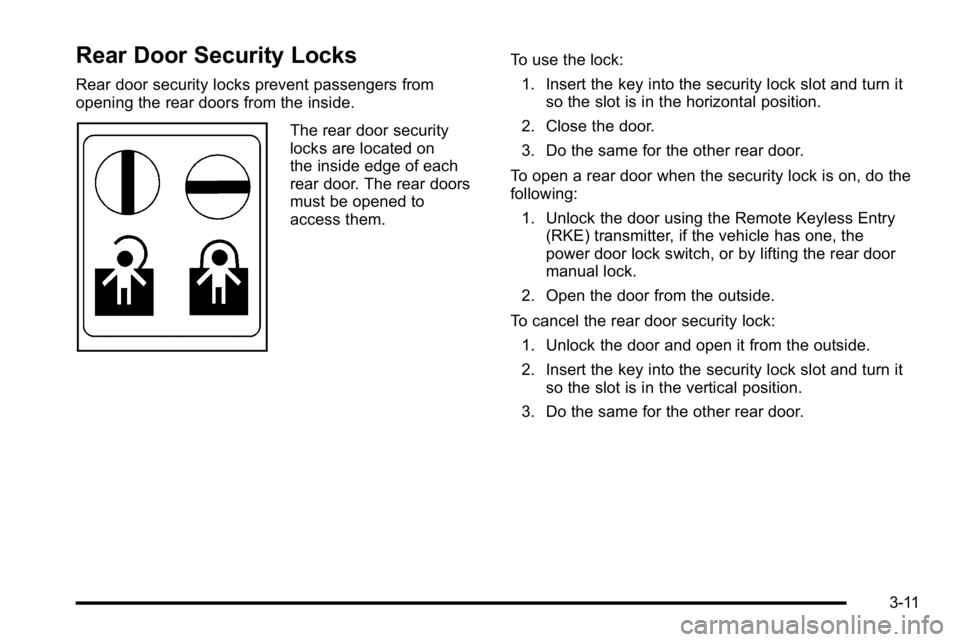
Rear door security locks prevent passengers from
opening the rear doors from the inside.
The rear door security
locks are located on
the inside edge of each
rear door. The rear doors
must be opened to
access them.To use the lock:
1. Insert the key into the security lock slot and turn it so the slot is in the horizontal position.
2. Close the door.
3. Do the same for the other rear door.
To open a rear door when the security lock is on, do the
following: 1. Unlock the door using the Remote Keyless Entry (RKE) transmitter, if the vehicle has one, the
power door lock switch, or by lifting the rear door
manual lock.
2. Open the door from the outside.
To cancel the rear door security lock: 1. Unlock the door and open it from the outside.
2. Insert the key into the security lock slot and turn it so the slot is in the vertical position.
3. Do the same for the other rear door.
3-11
Page 121 of 474
Remote Trunk Release
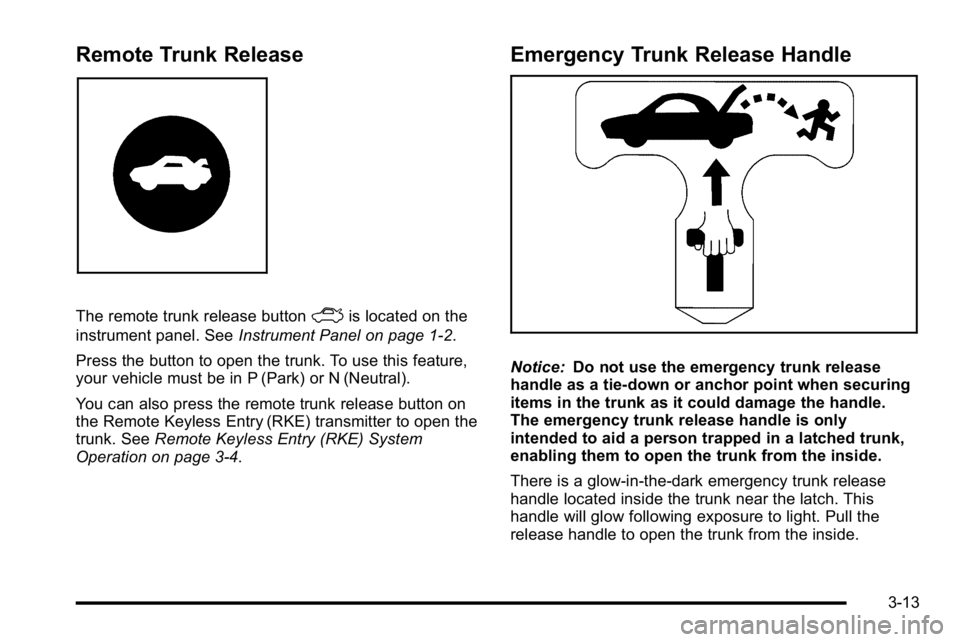
The remote trunk release buttonFis located on the
instrument panel. See Instrument Panel on page 1‑2.
Press the button to open the trunk. To use this feature,
your vehicle must be in P (Park) or N (Neutral).
You can also press the remote trunk release button on
the Remote Keyless Entry (RKE) transmitter to open the
trunk. See Remote Keyless Entry (RKE) System
Operation on page 3‑4.
Emergency Trunk Release Handle
Notice: Do not use the emergency trunk release
handle as a tie-down or anchor point when securing
items in the trunk as it could damage the handle.
The emergency trunk release handle is only
intended to aid a person trapped in a latched trunk,
enabling them to open the trunk from the inside.
There is a glow-in-the-dark emergency trunk release
handle located inside the trunk near the latch. This
handle will glow following exposure to light. Pull the
release handle to open the trunk from the inside.
3-13
Page 125 of 474
Arming with the Power Lock Switch
The alarm system will arm when you use either power
lock switch to lock the doors while any door is open and
the key is removed from the ignition. The alarm system
will not arm if the truck is open when you use either
power lock switch to lock the doors.
Arming with the RKE Transmitter
The alarm system will arm when you use your RKE
transmitter to lock the doors, if the key is not in the
ignition.
Disarming with the RKE Transmitter
The alarm system will disarm when you use your RKE
transmitter to unlock the doors.
The first time a remote unlock command is received,
three flashes will be seen and three horn chirps heard
to indicate an alarm condition has occurred since last
arming.
Disarming with Your Key
The alarm system will disarm when you use your key to
unlock the doors or insert your key in the ignition and
turn it from the LOCK/OFF position.
PASS-Key®III+ Electronic
Immobilizer
See Radio Frequency Statementon page 8‑20for
information regarding Part 15 of the Federal
Communications Commission (FCC) Rules and
RSS-210/211 of Industry Canada.
PASS-Key®III+ Electronic
Immobilizer Operation
Your vehicle is equipped with PASS-Key®III+
(Personalized Automotive Security System)
theft-deterrent system. PASS-Key
®III+ is a passive
theft-deterrent system.
The system is automatically armed when the key is
removed from the ignition.
You do not have to manually arm or disarm the system.
The security light will come on if there is a problem with
arming or disarming the theft-deterrent system.
When the PASS-Key
®III+ system senses that someone
is using the wrong key, it prevents the vehicle from
starting. Anyone using a trial-and-error method to start
the vehicle will be discouraged because of the high
number of electrical key codes.
3-17
Page 126 of 474

When trying to start the vehicle if the engine does not
start and the security light on the instrument panel
cluster comes on, there may be a problem with your
theft-deterrent system. Turn the ignition off and try
again.
If the engine still does not start, and the key appears to
be not damaged, try another ignition key. At this time,
you may also want to check the fuse, seeFuses and
Circuit Breakers
on page 6‑110. If the engine still does
not start with the other key, your vehicle needs service.
If your vehicle does start, the first key may be faulty.
See your dealer who can service the PASS-Key
®III+
to have a new key made. In an emergency, contact
Roadside Assistance. See Roadside Assistance
Program on page 8‑8.
It is possible for the PASS-Key
®III+ decoder to “learn”
the transponder value of a new or replacement key. Up
to 10 keys may be programmed for the vehicle. The
following procedure is for programming additional keys
only. If all the currently programmed keys are lost or do
not operate, you must see your dealer or a locksmith
who can service PASS-Key
®III+ to have keys made
and programmed to the system. See your dealer or a locksmith who can service
PASS-Key
®III+ to get a new key blank that is cut
exactly as the ignition key that operates the system.
To program the new key:
1. Verify that the new key has a
1stamped on it.
2. Insert the already programmed key in the ignition and start the engine. If the engine will not start, see
your dealer for service.
3. After the engine has started, turn the key to LOCK/OFF, and remove the key.
4. Insert the key to be programmed and turn it to the ON/RUN position within five seconds of the original
key being turned to the LOCK/OFF position.
The security light will turn off once the key has
been programmed.
5. Repeat Steps 1 through 4 if additional keys are to be programmed.
If you lose or damage your PASS-Key
®III+ key,
see your dealer or a locksmith who can service
PASS-Key
®III+ to have a new key made.
Do not leave the key or device that disarms or
deactivates the theft deterrent system in the vehicle.
3-18
Page 152 of 474

LDW warnings may occasionally occur due to tar
marks, shadows, cracks in the road, or other road
imperfections. This is normal system operation, the
vehicle does not need service.
LDW Error Message
SERVICE LANE DEPARTURE SYSTEM:This
message may appear in the DIC to indicate that LDW is
not working properly. If this message remains on after
continued driving, the system needs service. Take your
vehicle to your dealer.
LANE DEPARTURE SYSTEM UNAVAILABLE: This
message may appear in the DIC if LDW does not
activate due to a temporary condition.
Universal Home Remote
System
See Radio Frequency Statementon page 8‑20for
information regarding Part 15 of the Federal
Communications Commission (FCC) Rules and
RSS-210/211 of Industry Canada.
Universal Home Remote System
Operation (With Three Round LED)
This vehicle may have the Universal Home Remote
System. If there are three round Light Emitting Diode
(LED) indicator lights above the Universal Home
Remote buttons, follow the instructions below.
This system provides a way to replace up to three
remote control transmitters used to activate devices
such as garage door openers, security systems, and
home automation devices.
Do not use this system with any garage door opener
that does not have the stop and reverse feature. This
includes any garage door opener model manufactured
before April 1, 1982.
3-44