wheel BUICK LUCERNE 2010 Manual PDF
[x] Cancel search | Manufacturer: BUICK, Model Year: 2010, Model line: LUCERNE, Model: BUICK LUCERNE 2010Pages: 474
Page 385 of 474
If this vehicle has a tire sealant and compressor kit,
there may not be a spare tire, tire changing equipment,
and on some vehicles there may not be a place to store
a tire.
The tire sealant and compressor can be used to
temporarily seal punctures up to ¼ inch (6 mm) in the
tread area of the tire. It can also be used to inflate an
under inflated tire.
If the tire has been separated from the wheel, has
damaged sidewalls, or has a large puncture, the tire is
too severely damaged for the tire sealant and
compressor kit to be effective. SeeRoadside
Assistance Program on page 8‑8.
Read and follow all of the tire sealant and compressor
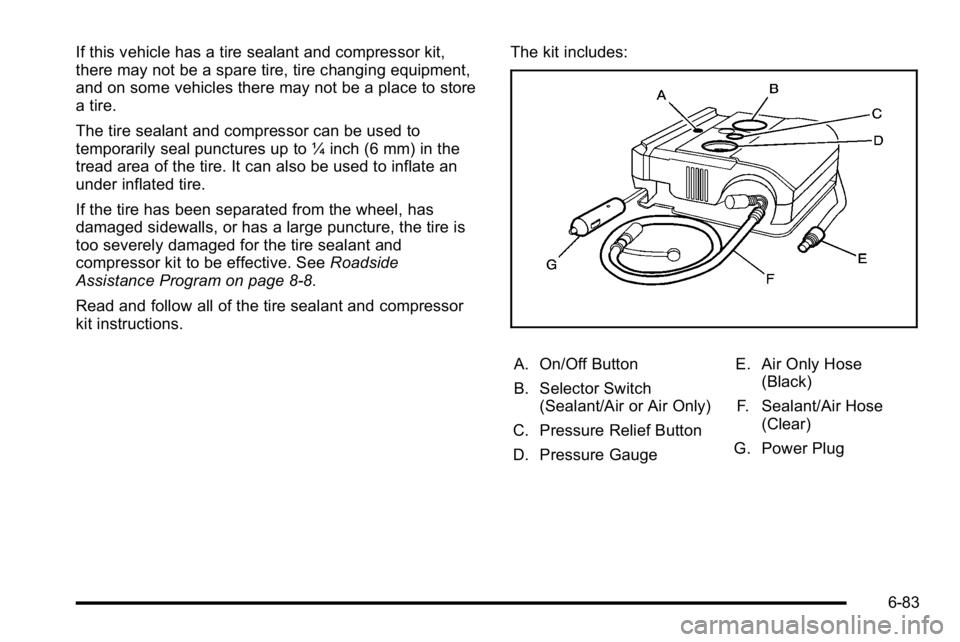
kit instructions. The kit includes:
A. On/Off Button
B. Selector Switch
(Sealant/Air or Air Only)
C. Pressure Relief Button
D. Pressure Gauge E. Air Only Hose
(Black)
F. Sealant/Air Hose (Clear)
G. Power Plug
6-83
Page 389 of 474
19. Stop at a safe location and check the tire pressure.Refer to Steps 1 through 11 under “Using the Tire
Sealant and Compressor Kit without Sealant to
Inflate a Tire (Not Punctured).”
If the tire pressure has fallen more than 10 psi
(68 kPa) below the recommended inflation
pressure, stop driving the vehicle. The tire is too
severely damaged and the tire sealant cannot seal
the tire. See Roadside Assistance Program
on
page 8‑8.
If the tire pressure has not dropped more than
10 psi (68 kPa) from the recommended inflation
pressure, inflate the tire to the recommended
inflation pressure.
20. Wipe off any sealant from the wheel, tire, and vehicle.
21. Dispose of the used sealant canister and sealant/ air hose (F) assembly at a local dealer or in
accordance with local state codes and practices.
22. Replace it with a new canister available from your dealer.
23. After temporarily sealing a tire using the tire sealant and compressor kit, take the vehicle to an
authorized dealer within a 100 miles (161 km) of
driving to have the tire repaired or replaced.
Using the Tire Sealant and Compressor
Kit without Sealant to Inflate a Tire
(Not Punctured)
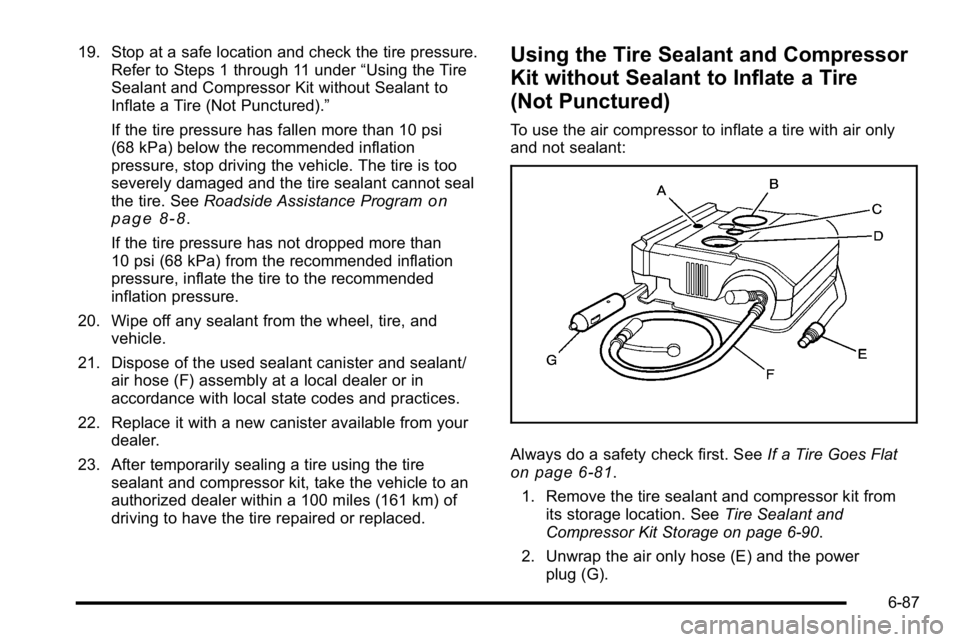
To use the air compressor to inflate a tire with air only
and not sealant:
Always do a safety check first. See If a Tire Goes Flaton page 6‑81.
1. Remove the tire sealant and compressor kit from its storage location. See Tire Sealant and
Compressor Kit Storage on page 6‑90.
2. Unwrap the air only hose (E) and the power plug (G).
6-87
Page 392 of 474

Tire Sealant and Compressor Kit
Storage
The tire sealant and compressor kit is located in the
trunk.1. Open the trunk. See Trunk on page 3‑12
2. Lift the cover.
3. Turn the retainer clockwise and remove the tire sealant and compressor kit.
To store the tire sealant and compressor kit, reverse the
steps.
Changing a Flat Tire
If a tire goes flat, avoid further tire and wheel damage
by driving slowly to a level place. Turn on the hazard
warning flashers. See Hazard Warning Flashers
on
page 4‑3.
{WARNING:
Changing a tire can be dangerous. The vehicle
can slip off the jack and roll over or fall on you or
other people. You and they could be badly injured
or even killed. Find a level place to change your
tire. To help prevent the vehicle from moving:
1. Set the parking brake firmly.
2. Put the shift lever in P (Park). (Continued)
6-90
Page 393 of 474
WARNING: (Continued)
3. Turn off the engine and do not restart whilethe vehicle is raised.
4. Do not allow passengers to remain in the vehicle.
To be even more certain the vehicle will not move,
you should put blocks at the front and rear of the
tire farthest away from the one being changed.
That would be the tire, on the other side, at the
opposite end of the vehicle.
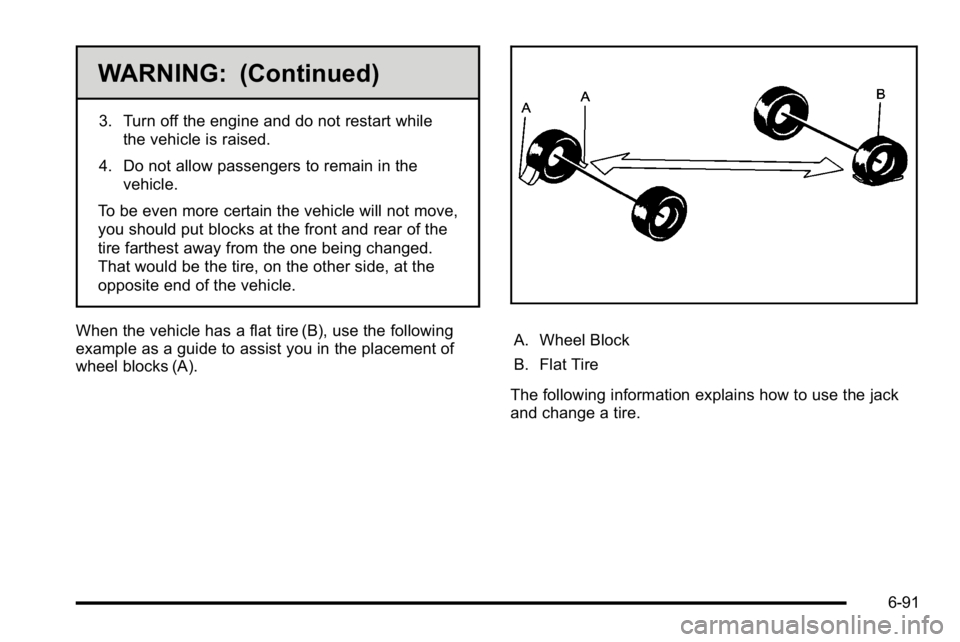
When the vehicle has a flat tire (B), use the following
example as a guide to assist you in the placement of
wheel blocks (A).
A. Wheel Block
B. Flat Tire
The following information explains how to use the jack
and change a tire.
6-91
Page 394 of 474
Removing the Spare Tire and Tools
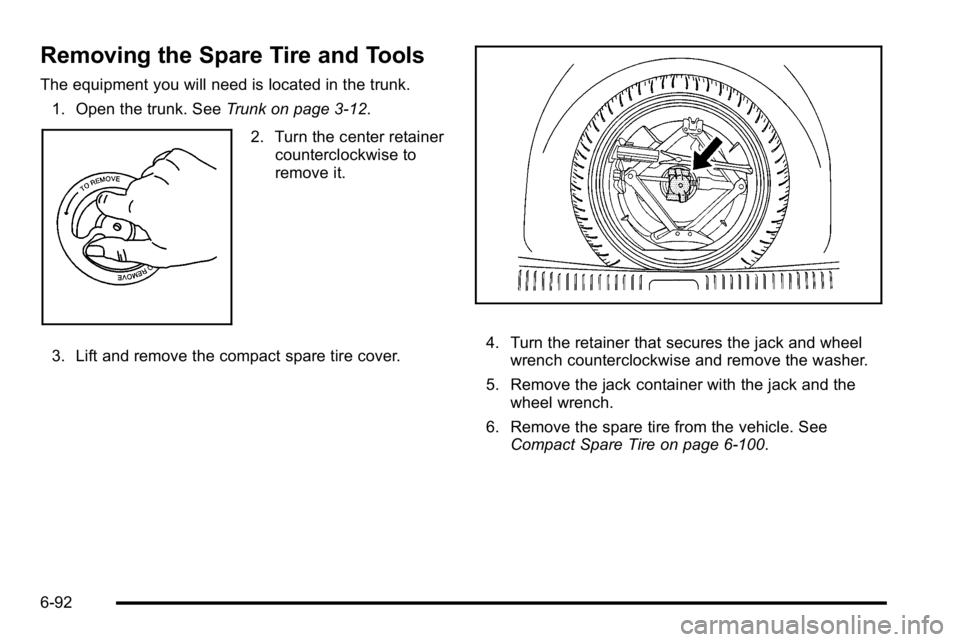
The equipment you will need is located in the trunk.1. Open the trunk. See Trunk on page 3‑12.
2. Turn the center retainer
counterclockwise to
remove it.
3. Lift and remove the compact spare tire cover.
4. Turn the retainer that secures the jack and wheel wrench counterclockwise and remove the washer.
5. Remove the jack container with the jack and the wheel wrench.
6. Remove the spare tire from the vehicle. See Compact Spare Tire on page 6‑100.
6-92
Page 395 of 474
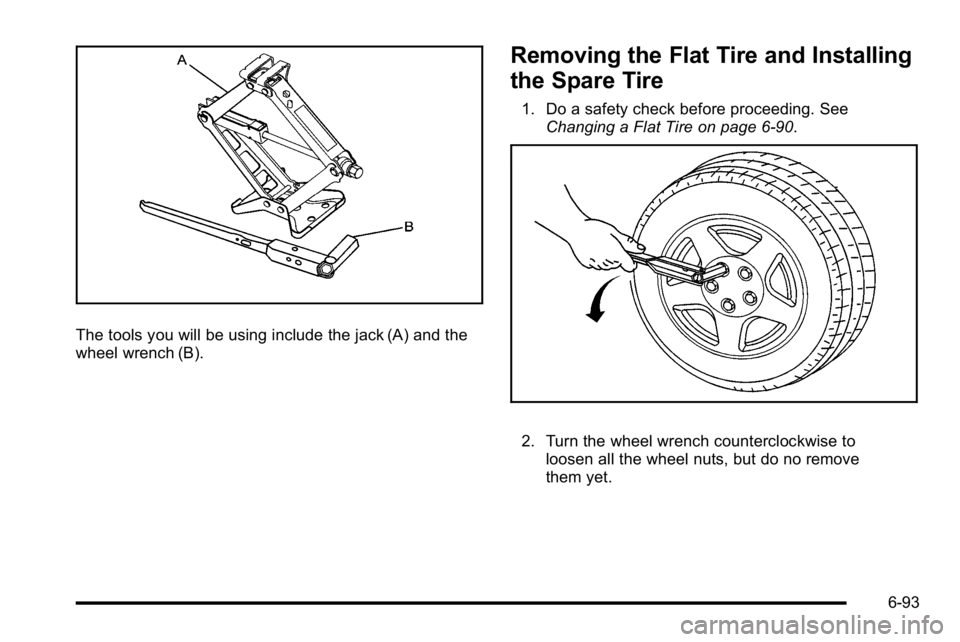
The tools you will be using include the jack (A) and the
wheel wrench (B).
Removing the Flat Tire and Installing
the Spare Tire
1. Do a safety check before proceeding. SeeChanging a Flat Tire on page 6‑90.
2. Turn the wheel wrench counterclockwise toloosen all the wheel nuts, but do no remove
them yet.
6-93
Page 396 of 474
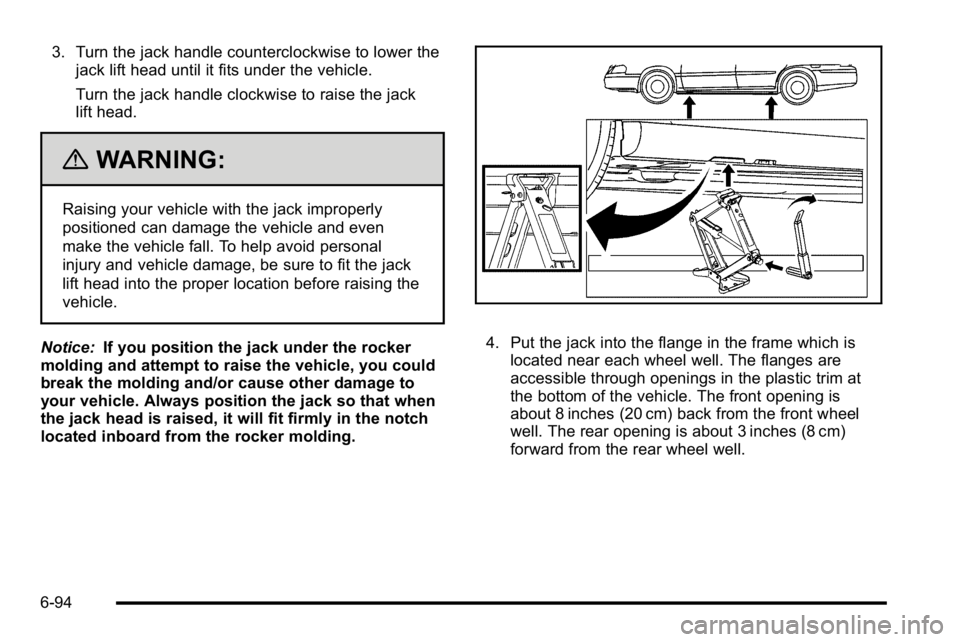
3. Turn the jack handle counterclockwise to lower thejack lift head until it fits under the vehicle.
Turn the jack handle clockwise to raise the jack
lift head.
{WARNING:
Raising your vehicle with the jack improperly
positioned can damage the vehicle and even
make the vehicle fall. To help avoid personal
injury and vehicle damage, be sure to fit the jack
lift head into the proper location before raising the
vehicle.
Notice: If you position the jack under the rocker
molding and attempt to raise the vehicle, you could
break the molding and/or cause other damage to
your vehicle. Always position the jack so that when
the jack head is raised, it will fit firmly in the notch
located inboard from the rocker molding.
4. Put the jack into the flange in the frame which is located near each wheel well. The flanges are
accessible through openings in the plastic trim at
the bottom of the vehicle. The front opening is
about 8 inches (20 cm) back from the front wheel
well. The rear opening is about 3 inches (8 cm)
forward from the rear wheel well.
6-94
Page 398 of 474
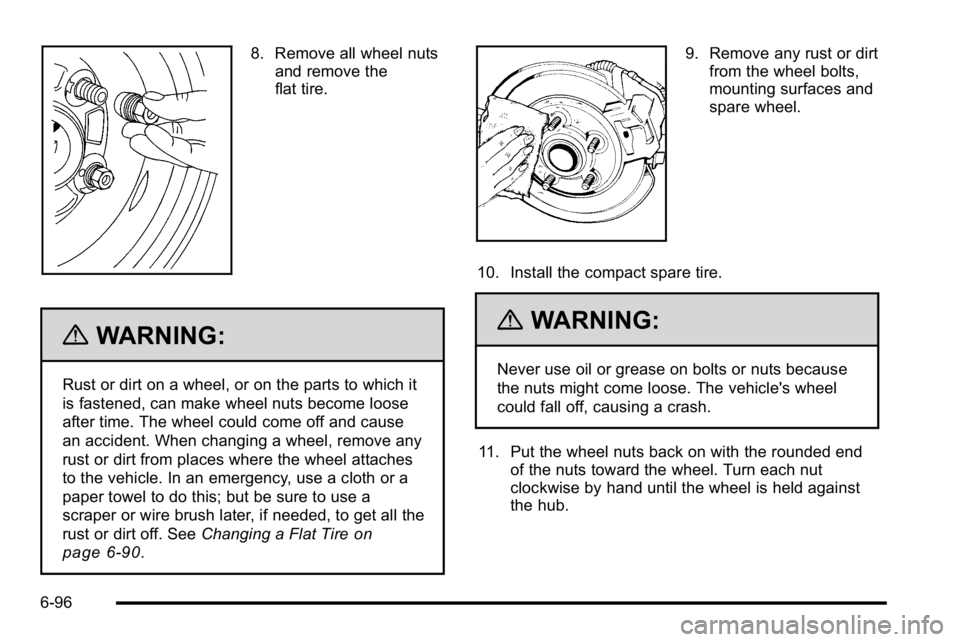
8. Remove all wheel nutsand remove the
flat tire.
{WARNING:
Rust or dirt on a wheel, or on the parts to which it
is fastened, can make wheel nuts become loose
after time. The wheel could come off and cause
an accident. When changing a wheel, remove any
rust or dirt from places where the wheel attaches
to the vehicle. In an emergency, use a cloth or a
paper towel to do this; but be sure to use a
scraper or wire brush later, if needed, to get all the
rust or dirt off. See Changing a Flat Tire
on
page 6‑90
.
9. Remove any rust or dirt from the wheel bolts,
mounting surfaces and
spare wheel.
10. Install the compact spare tire.
{WARNING:
Never use oil or grease on bolts or nuts because
the nuts might come loose. The vehicle's wheel
could fall off, causing a crash.
11. Put the wheel nuts back on with the rounded end of the nuts toward the wheel. Turn each nut
clockwise by hand until the wheel is held against
the hub.
6-96
Page 399 of 474
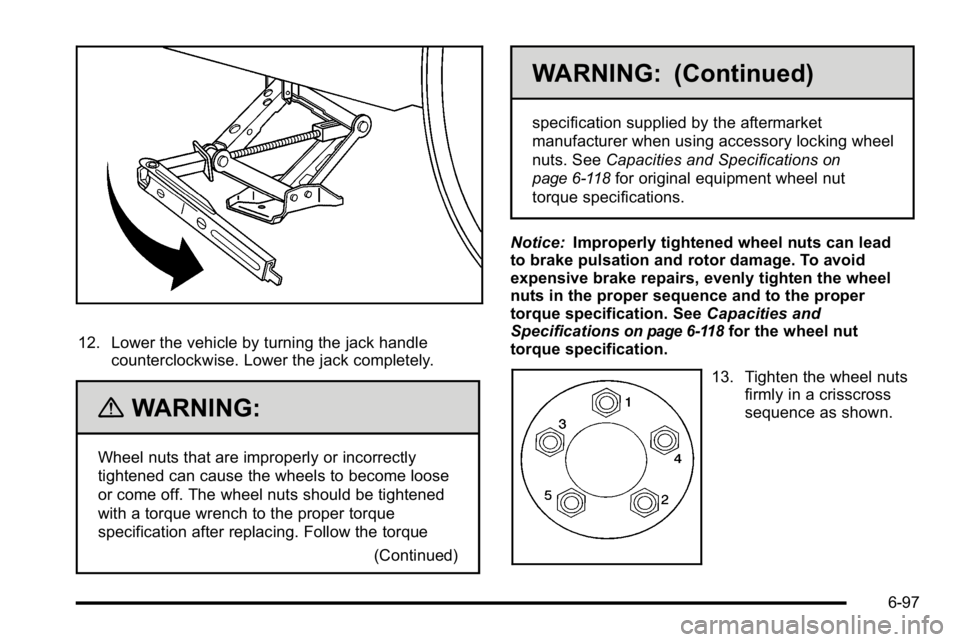
12. Lower the vehicle by turning the jack handlecounterclockwise. Lower the jack completely.
{WARNING:
Wheel nuts that are improperly or incorrectly
tightened can cause the wheels to become loose
or come off. The wheel nuts should be tightened
with a torque wrench to the proper torque
specification after replacing. Follow the torque
(Continued)
WARNING: (Continued)
specification supplied by the aftermarket
manufacturer when using accessory locking wheel
nuts. SeeCapacities and Specifications
on
page 6‑118
for original equipment wheel nut
torque specifications.
Notice: Improperly tightened wheel nuts can lead
to brake pulsation and rotor damage. To avoid
expensive brake repairs, evenly tighten the wheel
nuts in the proper sequence and to the proper
torque specification. See Capacities and
Specifications
on page 6‑118for the wheel nut
torque specification.
13. Tighten the wheel nuts firmly in a crisscross
sequence as shown.
6-97
Page 400 of 474
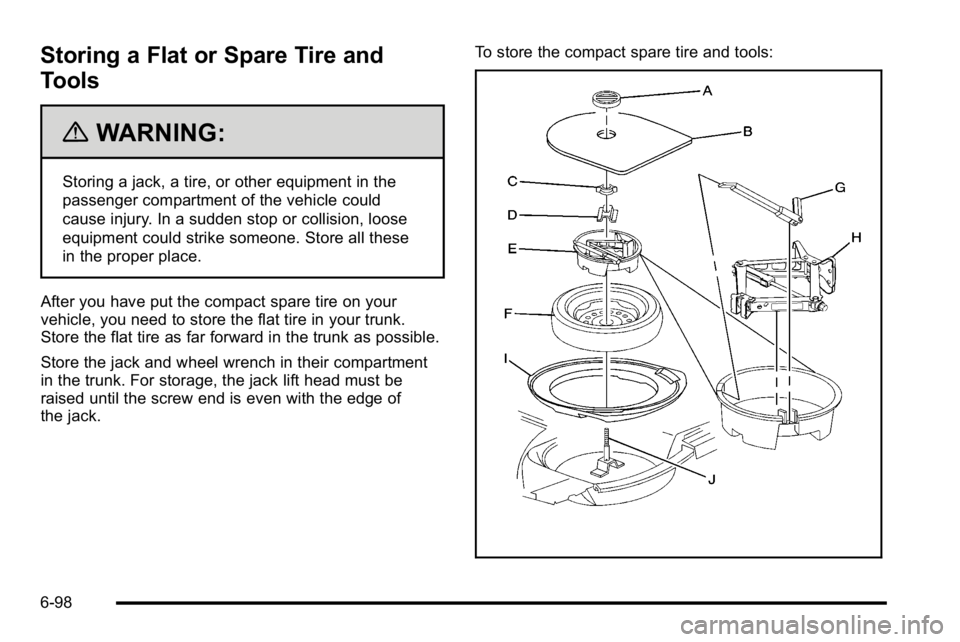
Storing a Flat or Spare Tire and
Tools
{WARNING:
Storing a jack, a tire, or other equipment in the
passenger compartment of the vehicle could
cause injury. In a sudden stop or collision, loose
equipment could strike someone. Store all these
in the proper place.
After you have put the compact spare tire on your
vehicle, you need to store the flat tire in your trunk.
Store the flat tire as far forward in the trunk as possible.
Store the jack and wheel wrench in their compartment
in the trunk. For storage, the jack lift head must be
raised until the screw end is even with the edge of
the jack. To store the compact spare tire and tools:
6-98