air condition BUICK LUCERNE 2011 Owner's Guide
[x] Cancel search | Manufacturer: BUICK, Model Year: 2011, Model line: LUCERNE, Model: BUICK LUCERNE 2011Pages: 450, PDF Size: 3.63 MB
Page 353 of 450
Black plate (67,1)Buick Lucerne Owner Manual - 2011
If the warning light comes on, stop as soon as possible
and inflate the tires to the recommended pressure
shown on the tire loading information label. See
Loading the Vehicle on page 5‑18.
A message to check the pressure in a specific tire
displays in the Driver Information Center (DIC). The
low tire pressure warning light and the DIC warning
message come on at each ignition cycle until the tires
are inflated to the correct inflation pressure. Using the
DIC, tire pressure levels can be viewed by the driver.
For additional information and details about the DIC
operation and displays seeDIC Operation and Displays
on page 4‑42andDIC Warnings and Messageson
page 4‑49.
The low tire pressure warning light may come on in
cool weather when the vehicle is first started, and then
turn off as the vehicle is driven. This could be an early
indicator that the air pressure is getting low and needs
to be inflated to the proper pressure. A Tire and Loading Information label shows the size
of the original equipment tires and the correct inflation
pressure for the tires when they are cold. See
Loading
the Vehicle
on page 5‑18, for an example of the Tire
and Loading Information label and its location on your
vehicle. Also see Inflation - Tire Pressure on page 6‑64.
Your vehicle's TPMS can warn you about a low tire
pressure condition but it does not replace normal tire
maintenance. See Tire Inspection and Rotation
on
page 6‑70and Tires on page 6‑57.
Notice: Tire sealant materials are not all the same.
A non-approved tire sealant could damage the
TPMS sensors. TPMS sensor damage caused by
using an incorrect tire sealant is not covered by the
vehicle warranty. Always use only the GM-approved
tire sealant available through your dealer or
included in the vehicle.
Factory-installed Tire Inflator Kits use a GM approved
liquid tire sealant. Using non-approved tire sealants
could damage the TPMS sensors. See Tire Sealant and
Compressor Kit
on page 6‑80for information regarding
the inflator kit materials and instructions.
6-67
Page 362 of 450
Black plate (76,1)Buick Lucerne Owner Manual - 2011
Traction–AA, A, B, C
The traction grades, from highest to lowest,
are AA, A, B, and C. Those grades represent
the tire's ability to stop on wet pavement as
measured under controlled conditions on
specified government test surfaces of asphalt
and concrete. A tire marked C may have poor
traction performance. Warning: The traction grade
assigned to this tire is based on straight-ahead
braking traction tests, and does not include
acceleration, cornering, hydroplaning, or peak
traction characteristics.
Temperature –A, B, C
The temperature grades are A (the highest), B,
and C, representing the tire's resistance to the
generation of heat and its ability to dissipate heat
when tested under controlled conditions on a
specified indoor laboratory test wheel. Sustained
high temperature can cause the material of the
tire to degenerate and reduce tire life, and
excessive temperature can lead to sudden tire
failure. The grade C corresponds to a level of
performance which all passenger car tires must
meet under the Federal Motor Safety Standard
No. 109. Grades B and A represent higher levels
of performance on the laboratory test wheel than the minimum required by law. Warning: The
temperature grade for this tire is established for a
tire that is properly inflated and not overloaded.
Excessive speed, underinflation, or excessive
loading, either separately or in combination, can
cause heat buildup and possible tire failure.
Wheel Alignment and Tire Balance
The tires and wheels on your vehicle were aligned
and balanced carefully at the factory to give you
the longest tire life and best overall performance.
Adjustments to wheel alignment and tire balancing will
not be necessary on a regular basis. However, if you
notice unusual tire wear or your vehicle pulling to
one side or the other, the alignment might need to be
checked. If you notice your vehicle vibrating when
driving on a smooth road, the tires and wheels might
need to be rebalanced. See your dealer for proper
diagnosis.
Wheel Replacement
Replace any wheel that is bent, cracked, or badly
rusted or corroded. If wheel nuts keep coming loose,
the wheel, wheel bolts, and wheel nuts should be
replaced. If the wheel leaks air, replace it (except some
aluminum wheels, which can sometimes be repaired).
See your dealer if any of these conditions exist.
6-76
Page 364 of 450
Black plate (78,1)Buick Lucerne Owner Manual - 2011
Tire Chains
{WARNING:
If your vehicle has P235/55R17, or P245/50R18
size tires, do not use tire chains. There is not
enough clearance.
Tire chains used on a vehicle without the proper
amount of clearance can cause damage to the
brakes, suspension, or other vehicle parts. The
area damaged by the tire chains could cause you
to lose control of your vehicle and you or others
may be injured in a crash.
Use another type of traction device only if its
manufacturer recommends it for use on your
vehicle and tire size combination and road
conditions. Follow that manufacturer's
instructions. To help avoid damage to your
vehicle, drive slowly, readjust or remove the
device if it is contacting your vehicle, and do
not spin your vehicle's wheels.
If you do find traction devices that will fit, install
them on the front tires.Notice:
If your vehicle has P225/60R16 size tires,
use tire chains only where legal and only when you
must. Use only SAE Class S‐type chains that are the
proper size for your tires. Install them on the front
tires and tighten them as tightly as possible with the
ends securely fastened. Drive slowly and follow the
chain manufacturer's instructions. If you can hear
the chains contacting your vehicle, stop and
retighten them. If the contact continues, slow down
until it stops. Driving too fast or spinning the wheels
with chains on will damage your vehicle.
If a Tire Goes Flat
It is unusual for a tire to blowout while you are driving,
especially if you maintain your vehicle's tires properly.
If air goes out of a tire, it is much more likely to leak out
slowly. But if you should ever have a blowout, here are
a few tips about what to expect and what to do:
If a front tire fails, the flat tire creates a drag that pulls
the vehicle toward that side. Take your foot off the
accelerator pedal and grip the steering wheel firmly.
Steer to maintain lane position, and then gently brake to
a stop, well off the road, if possible.
6-78
Page 387 of 450
Black plate (101,1)Buick Lucerne Owner Manual - 2011
Instrument Panel, Vinyl, and Other
Plastic Surfaces
A soft cloth dampened with water may be used to
remove dust. If a more thorough cleaning is necessary,
a clean soft cloth dampened with a mild soap solution
can be used to gently remove dust and dirt. Never use
spot lifters or removers on plastic surfaces. Many
commercial cleaners and coatings that are sold to
preserve and protect soft plastic surfaces may
permanently change the appearance and feel of the
interior and are not recommended. Do not use silicone
or wax-based products, or those containing organic
solvents to clean the vehicle's interior because they
can alter the appearance by increasing the gloss in a
non-uniform manner.
Some commercial products may increase gloss on the
instrument panel. The increase in gloss may cause
annoying reflections in the windshield and even make it
difficult to see through the windshield under certain
conditions.
Notice:Air fresheners contain solvents that may
cause damage to plastics and painted surfaces.
Follow the manufacturer ’s instructions when using
air fresheners in the vehicle. If air freshener comes
in contact with paint or a plastic surface, blot
immediately with a soft cloth. Damage caused by
using air fresheners would not be covered by the
vehicle warranty.
Care of Safety Belts
Keep belts clean and dry.
{WARNING:
Do not bleach or dye safety belts. It may severely
weaken them. In a crash, they might not be able
to provide adequate protection. Clean safety belts
only with mild soap and lukewarm water.
Weatherstrips
Silicone grease on weatherstrips will make them last
longer, seal better, and not stick or squeak. Apply
silicone grease with a clean cloth. During very cold,
damp weather frequent application may be required.
See Recommended Fluids and Lubricants
on
page 7‑8.
6-101
Page 390 of 450
Black plate (104,1)Buick Lucerne Owner Manual - 2011
Aluminum or Chrome-Plated Wheels
and Trim
The vehicle may have either aluminum or
chrome-plated wheels.
Keep the wheels clean using a soft clean cloth with mild
soap and water. Rinse with clean water. After rinsing
thoroughly, dry with a soft clean towel. A wax may then
be applied.
Notice:Chrome wheels and other chrome trim
may be damaged if the vehicle is not washed after
driving on roads that have been sprayed with
magnesium, calcium or sodium chloride. These
chlorides are used on roads for conditions such as
ice and dust. Always wash the vehicle's chrome
with soap and water after exposure.
Notice: Using strong soaps, chemicals, abrasive
polishes, cleaners, brushes, or cleaners that contain
acid on aluminum or chrome-plated wheels, could
damage the surface of the wheel(s). The repairs
would not be covered by the vehicle warranty.
Use only approved cleaners on aluminum or
chrome-plated wheels. The surface of these wheels is similar to the painted
surface of the vehicle. Do not use strong soaps,
chemicals, abrasive polishes, abrasive cleaners,
cleaners with acid, or abrasive cleaning brushes on
them because they could damage the surface. Do not
use chrome polish on aluminum wheels.
Notice:
Using chrome polish on aluminum wheels
could damage the wheels. The repairs would not be
covered by the vehicle warranty. Use chrome polish
on chrome wheels only.
Use chrome polish only on chrome-plated wheels, but
avoid any painted surface of the wheel, and buff off
immediately after application.
Notice: Driving the vehicle through an automatic
car wash that has silicone carbide tire cleaning
brushes, could damage the aluminum or
chrome-plated wheels. The repairs would not be
covered by the vehicle warranty. Never drive a
vehicle that has aluminum or chrome-plated wheels
through an automatic car wash that uses silicone
carbide tire cleaning brushes.
6-104
Page 392 of 450
Black plate (106,1)Buick Lucerne Owner Manual - 2011
Chemical Paint Spotting
Some weather and atmospheric conditions can create a
chemical fallout. Airborne pollutants can fall upon and
attack painted surfaces on the vehicle. This damage
can take two forms: blotchy, ring-shaped discolorations,
and small, irregular dark spots etched into the paint
surface.
Although no defect in the paint job causes this, we will
repair, at no charge to the owner, the surfaces of new
vehicles damaged by this fallout condition within
12 months or 20 000 km (12,000 mi) of purchase,
whichever occurs first.
Vehicle Identification
Vehicle Identification Number (VIN)
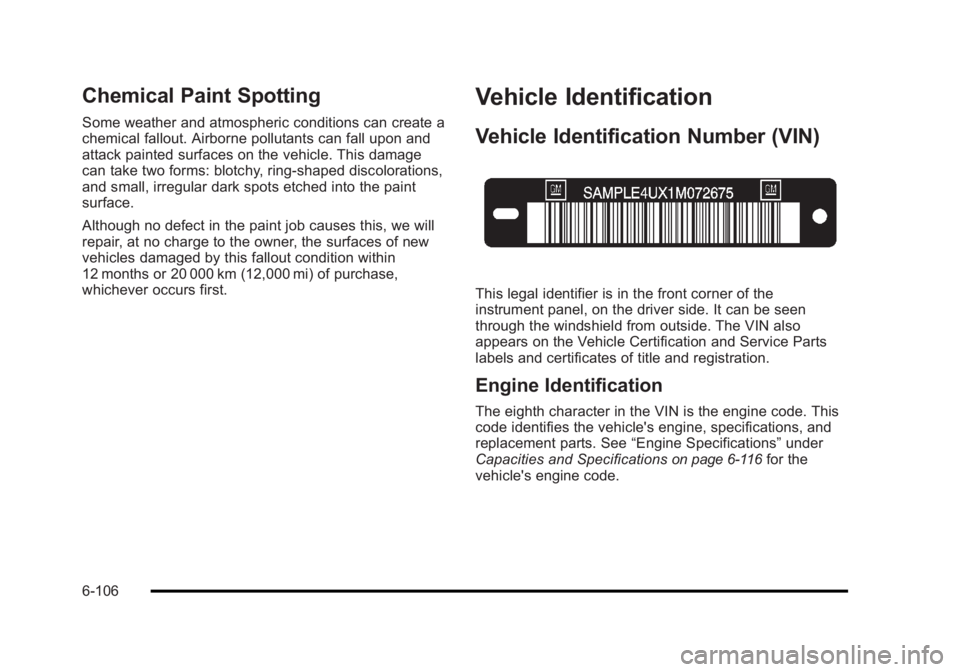
This legal identifier is in the front corner of the
instrument panel, on the driver side. It can be seen
through the windshield from outside. The VIN also
appears on the Vehicle Certification and Service Parts
labels and certificates of title and registration.
Engine Identification
The eighth character in the VIN is the engine code. This
code identifies the vehicle's engine, specifications, and
replacement parts. See“Engine Specifications”under
Capacities and Specifications
on page 6‑116for the
vehicle's engine code.
6-106
Page 395 of 450
Black plate (109,1)Buick Lucerne Owner Manual - 2011
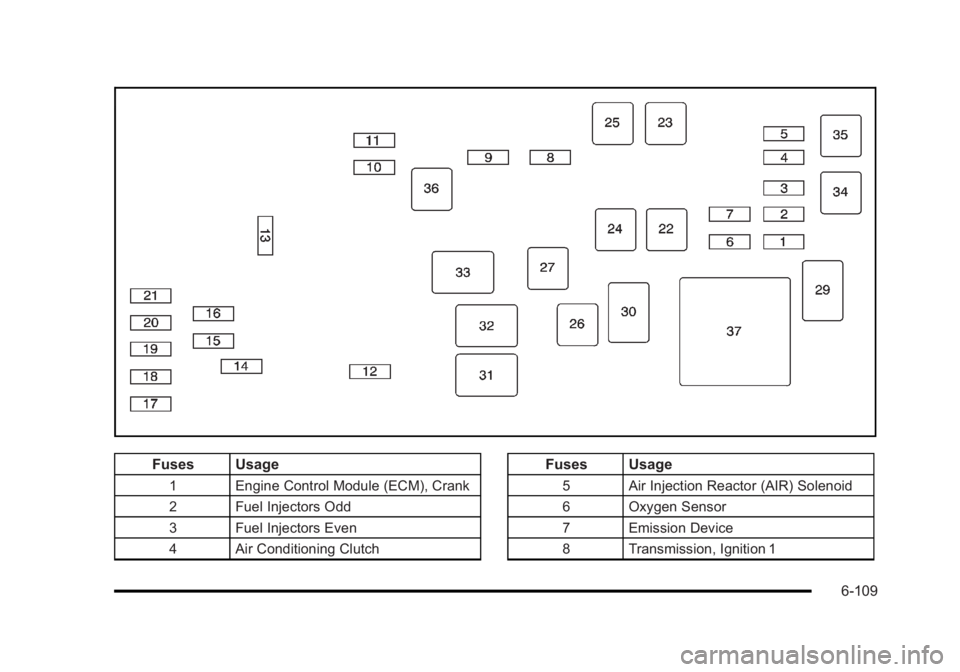
Fuses Usage
1 Engine Control Module (ECM), Crank
2 Fuel Injectors Odd
3 Fuel Injectors Even
4 Air Conditioning Clutch
Fuses Usage
5 Air Injection Reactor (AIR) Solenoid
6 Oxygen Sensor
7 Emission Device
8 Transmission, Ignition 1
6-109
Page 396 of 450
Black plate (110,1)Buick Lucerne Owner Manual - 2011
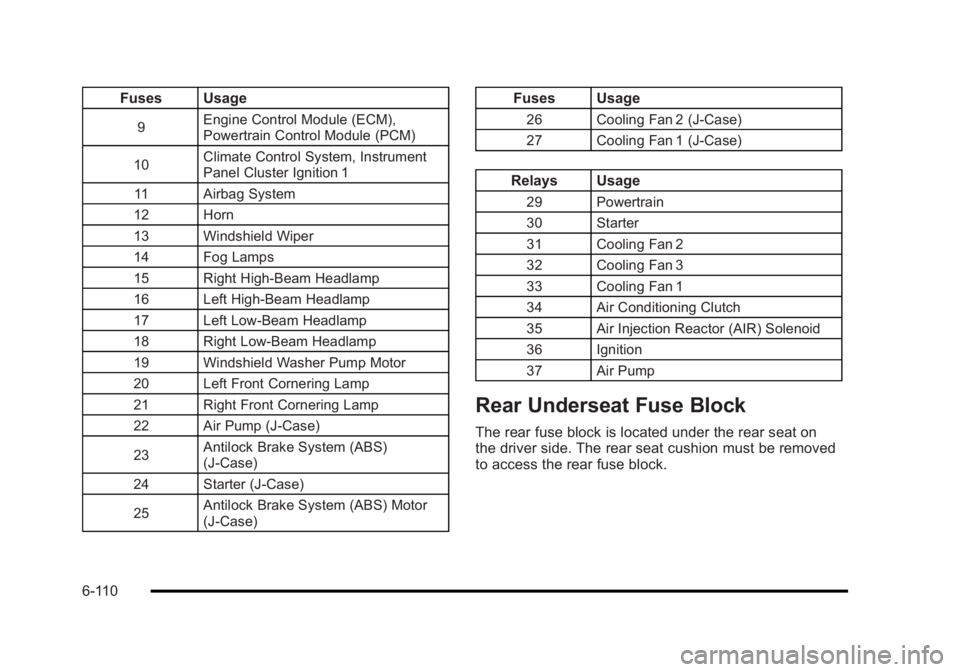
Fuses Usage
9Engine Control Module (ECM),
Powertrain Control Module (PCM)
10 Climate Control System, Instrument
Panel Cluster Ignition 1
11 Airbag System
12 Horn
13 Windshield Wiper
14 Fog Lamps
15 Right High-Beam Headlamp
16 Left High-Beam Headlamp
17 Left Low-Beam Headlamp
18 Right Low-Beam Headlamp
19 Windshield Washer Pump Motor
20 Left Front Cornering Lamp
21 Right Front Cornering Lamp
22 Air Pump (J-Case)
23 Antilock Brake System (ABS)
(J-Case)
24 Starter (J-Case)
25 Antilock Brake System (ABS) Motor
(J-Case)
Fuses Usage
26 Cooling Fan 2 (J-Case)
27 Cooling Fan 1 (J-Case)
Relays Usage
29 Powertrain
30 Starter
31 Cooling Fan 2
32 Cooling Fan 3
33 Cooling Fan 1
34 Air Conditioning Clutch
35 Air Injection Reactor (AIR) Solenoid
36 Ignition
37 Air Pump
Rear Underseat Fuse Block
The rear fuse block is located under the rear seat on
the driver side. The rear seat cushion must be removed
to access the rear fuse block.
6-110
Page 402 of 450
Black plate (116,1)Buick Lucerne Owner Manual - 2011
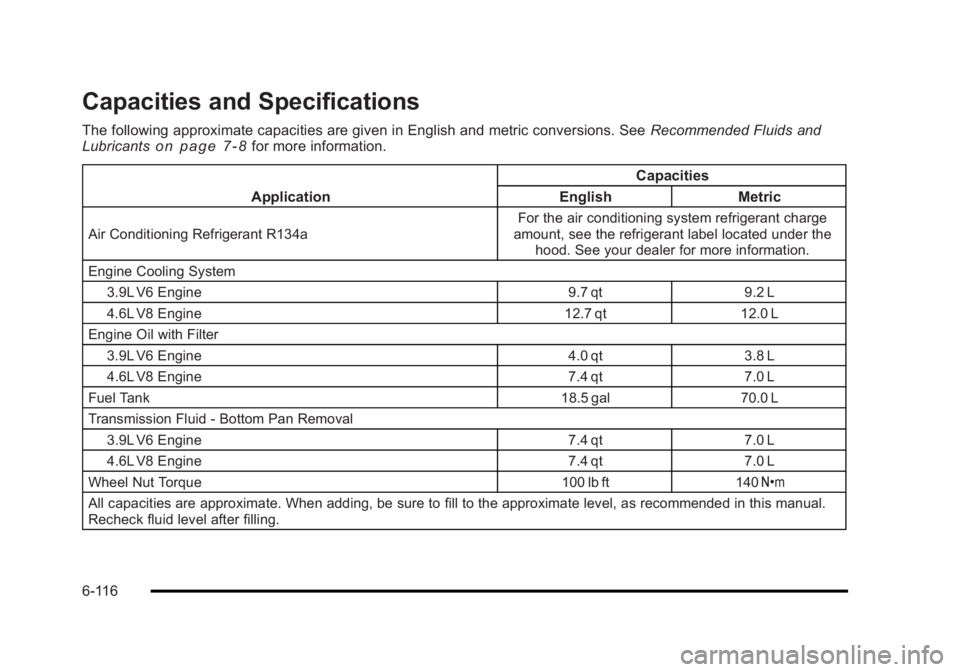
Capacities and Specifications
The following approximate capacities are given in English and metric conversions. SeeRecommended Fluids and
Lubricantson page 7‑8for more information.
Application Capacities
English Metric
Air Conditioning Refrigerant R134a For the air conditioning system refrigerant charge
amount, see the refrigerant label located under the hood. See your dealer for more information.
Engine Cooling System 3.9L V6 Engine 9.7 qt9.2 L
4.6L V8 Engine 12.7 qt12.0 L
Engine Oil with Filter
3.9L V6 Engine 4.0 qt3.8 L
4.6L V8 Engine 7.4 qt7.0 L
Fuel Tank 18.5 gal70.0 L
Transmission Fluid - Bottom Pan Removal 3.9L V6 Engine 7.4 qt7.0 L
4.6L V8 Engine 7.4 qt7.0 L
Wheel Nut Torque 100 lb ft140Y
All capacities are approximate. When adding, be sure to fill to the approximate level, as recommended in this manual.
Recheck fluid level after filling.
6-116
Page 406 of 450
Black plate (2,1)Buick Lucerne Owner Manual - 2011
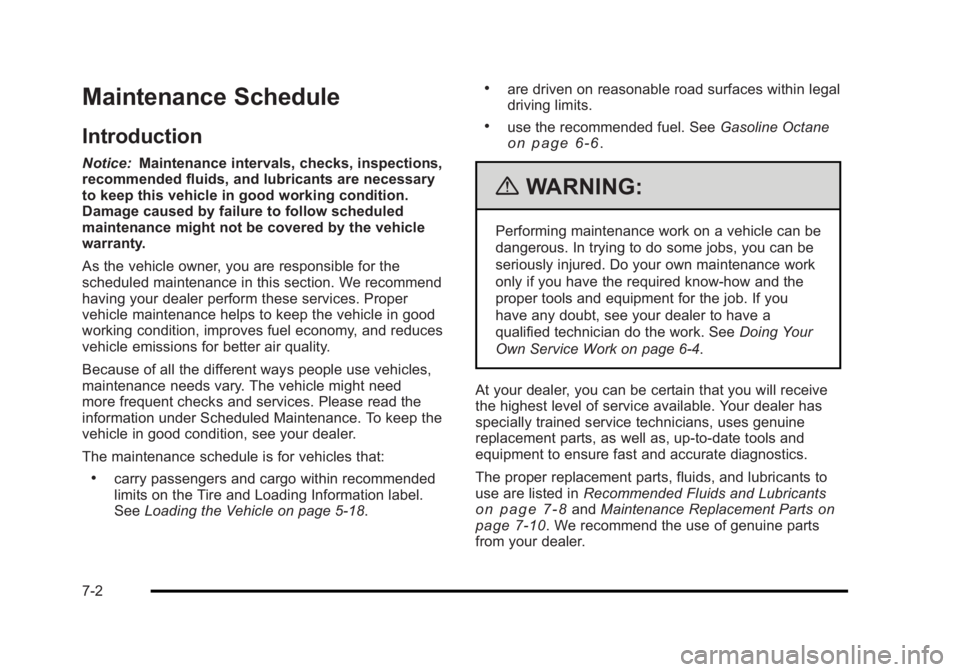
Maintenance Schedule
Introduction
Notice:Maintenance intervals, checks, inspections,
recommended fluids, and lubricants are necessary
to keep this vehicle in good working condition.
Damage caused by failure to follow scheduled
maintenance might not be covered by the vehicle
warranty.
As the vehicle owner, you are responsible for the
scheduled maintenance in this section. We recommend
having your dealer perform these services. Proper
vehicle maintenance helps to keep the vehicle in good
working condition, improves fuel economy, and reduces
vehicle emissions for better air quality.
Because of all the different ways people use vehicles,
maintenance needs vary. The vehicle might need
more frequent checks and services. Please read the
information under Scheduled Maintenance. To keep the
vehicle in good condition, see your dealer.
The maintenance schedule is for vehicles that:
.carry passengers and cargo within recommended
limits on the Tire and Loading Information label.
See Loading the Vehicle on page 5‑18.
.are driven on reasonable road surfaces within legal
driving limits.
.use the recommended fuel. See Gasoline Octaneon page 6‑6.
{WARNING:
Performing maintenance work on a vehicle can be
dangerous. In trying to do some jobs, you can be
seriously injured. Do your own maintenance work
only if you have the required know-how and the
proper tools and equipment for the job. If you
have any doubt, see your dealer to have a
qualified technician do the work. See Doing Your
Own Service Work on page 6‑4.
At your dealer, you can be certain that you will receive
the highest level of service available. Your dealer has
specially trained service technicians, uses genuine
replacement parts, as well as, up‐to‐date tools and
equipment to ensure fast and accurate diagnostics.
The proper replacement parts, fluids, and lubricants to
use are listed in Recommended Fluids and Lubricants
on page 7‑8andMaintenance Replacement Partson
page 7‑10. We recommend the use of genuine parts
from your dealer.
7-2